August 5, 2026
The Invisible Hand Over Global Nickel Markets: How One Quota Decision Can Reshape an Entire Supply Chain
Every few years, a single regulatory decision in a single country reminds commodity markets just how concentrated the world's critical mineral supply really is. The global nickel industry is experiencing one of those moments in 2026, as Eramet halts Weda Bay Nickel production in Indonesia, exposing the structural fragility embedded in battery metal supply chains. Understanding why this matters requires looking beyond the headline suspension and examining the mechanics of how Indonesia governs its nickel sector, and why those mechanics carry consequences far beyond the archipelago's borders.
When big ASX news breaks, our subscribers know first
Indonesia's RKAB System: The Regulatory Engine Driving Nickel Supply
Indonesia's nickel production is governed through an annual work plan and budget approval mechanism known as the RKAB, an acronym drawn from the Indonesian term Rencana Kerja dan Anggaran Biaya. This system functions as a production licensing framework administered by Indonesia's Ministry of Energy and Mineral Resources, requiring all nickel miners to obtain approved annual extraction quotas before they can legally produce ore.
Unlike export quotas or tariff mechanisms, the RKAB system operates upstream, at the point of extraction. This means the Indonesian government can control how much ore enters the domestic processing chain before any refined product ever reaches international markets. The practical effect is significant:
- Quota decisions are made annually, creating a recurring window of uncertainty for all operators.
- Revisions to approved quotas can be requested mid-year, with decisions typically concluded before the end of July.
- The system applies regardless of a mining company's ownership structure, joint venture arrangements, or long-term capital commitments.
Indonesia controls an estimated 40 to 50 percent of global nickel mine supply. This means that ministerial quota decisions made in Jakarta carry the same weight for international nickel pricing as production policy shifts at any major central bank carry for currency markets.
The Indonesian nickel price trends reflect how policy intent behind tightening quotas in recent years has been shaped by Indonesia's recognition that the production surge between 2020 and 2025 contributed to a prolonged depression in global nickel prices. By constraining upstream ore volumes, the government aims to support downstream processing margins and stabilise export revenues across the value chain.
Eramet Halts Weda Bay Nickel Production: The Scale of the Disruption
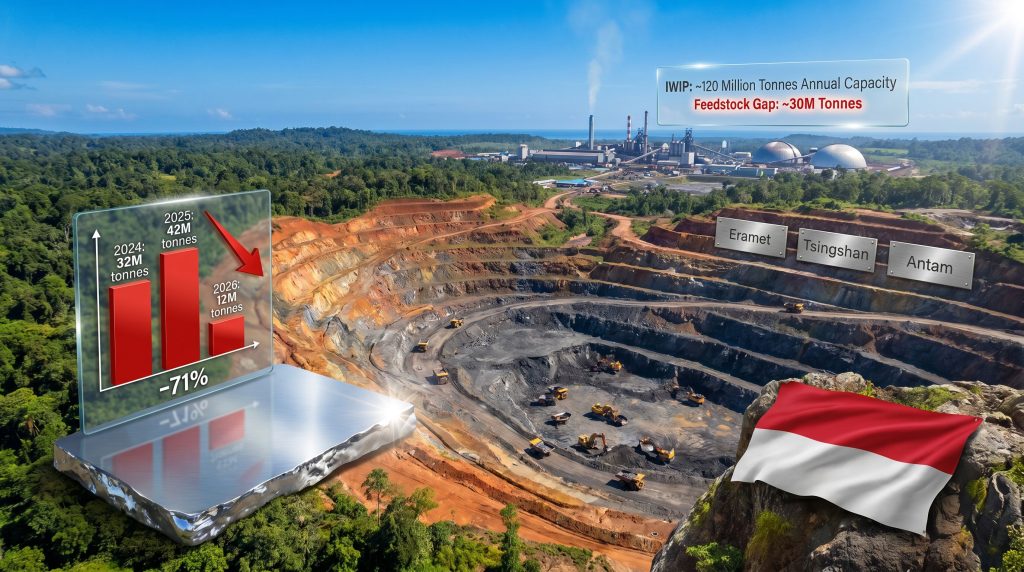
The immediate trigger for the current market disruption is the decision to allocate PT Weda Bay Nickel an initial 2026 mining quota of just 12 million wet metric tonnes, compared to the 42 million wet metric tonnes the operation produced across 2025. That figure itself represented an upward revision from an initial 2025 allocation of 32 million wet metric tonnes, meaning the operation had already demonstrated the ability to scale rapidly when quota headroom was available.
The numbers tell a stark story:
| Year | Production or Quota (wet metric tonnes) | Year-on-Year Change |
|---|---|---|
| 2024 | 32 million (actual) | Baseline |
| 2025 | 42 million (revised quota and output) | +31% |
| 2026 | 12 million (initial quota) | -71% |
With its 2026 quota exhausted by late May, Eramet halts Weda Bay Nickel production in Indonesia and the operation transitioned into a maintenance phase. Workforce numbers were reduced, active extraction ceased, and the company's Indonesian leadership began formal discussions with the Ministry of Energy and Mineral Resources to seek a quota extension. You can find further detail on Eramet's reaction to the quota allocation directly from the company's official communications.
What a Maintenance Phase Actually Means
A quota-triggered maintenance phase is fundamentally different from a mine closure. Key distinctions include:
- Infrastructure preservation: Physical assets, processing equipment, and site infrastructure remain intact and are actively maintained.
- Workforce reduction, not elimination: A core team continues operating on-site to manage maintenance activities and ensure the operation can restart when quota conditions change.
- Regulatory engagement continues: The company remains in active dialogue with authorities, filing formal applications for quota upward revision.
- Reversibility: Unlike a mine closure driven by resource depletion or financial insolvency, a quota suspension can be resolved through a single administrative decision.
The company has indicated it is seeking a quota revision sufficient to sustain ongoing operations, noting that the ultimate decision rests with the Indonesian government. Its approach also includes adjusting its mining configuration to limit economic disruption to North Maluku's regional economy during the suspension period.
The Three-Party Joint Venture: Competing Interests in a Single Operation
Weda Bay Nickel's ownership structure introduces a layer of complexity that is easy to overlook. The operation is a joint venture involving three parties with distinctly different strategic priorities:
- Eramet (France): A publicly listed Western mining company with operational expertise and significant revenue exposure to Weda Bay's output. For Eramet, the quota reduction represents a direct hit to production volumes and earnings, making quota restoration a financial imperative.
- Tsingshan Group (China): The world's largest stainless steel and nickel processing conglomerate. Tsingshan's interest in Weda Bay is fundamentally about securing upstream ore feedstock for its downstream processing empire, much of which is located within the Indonesia Weda Bay Industrial Park itself.
- PT Antam (Indonesia): A state-owned mining enterprise that serves as the sovereign interface between the JV and the Indonesian government. Antam's participation provides regulatory legitimacy and a negotiating channel that purely foreign-owned ventures would lack.
Furthermore, China's investment in Indonesia nickel has created an inherent tension when quota decisions are made. The Indonesian government's interests in price stabilisation and downstream value capture do not always align with the interests of foreign capital partners seeking maximum production throughput. Tsingshan's dual position as both a JV partner and a major downstream processor at IWIP adds further complexity, as lower ore supply from Weda Bay ultimately raises Tsingshan's own input costs.
IWIP's Feedstock Problem: When One-Third of Supply Disappears
The Indonesia Weda Bay Industrial Park processes approximately 120 million tonnes of nickel ore annually, making it one of the country's most significant nickel processing hubs. Weda Bay Nickel's 2025 contribution of 42 million tonnes represented roughly one-third of IWIP's total ore input, a dependency ratio that leaves the industrial park highly exposed to any disruption at the mine.
The downstream facilities reliant on IWIP ore supply include:
- Nickel Pig Iron (NPI) smelters requiring consistent, high-volume ore feedstock.
- High Pressure Acid Leach (HPAL) processing plants targeting battery-grade nickel intermediate products.
- Ferronickel processing operations serving stainless steel manufacturers.
If the 2026 quota is not revised upward and no extension is granted, IWIP processors face a structural feedstock deficit of approximately 30 million wet metric tonnes. Operating smelters and HPAL plants at meaningfully below-design capacity generates significant fixed cost inefficiencies, as capital-intensive processing infrastructure cannot simply be idled and restarted without substantial penalty.
The Philippines Fallback: A High-Cost Alternative
When Indonesian ore supply tightens, global processors have historically turned to the Philippines, the world's second-largest nickel ore producer. Philippine ore is predominantly lateritic, similar in mineralogy to Indonesian deposits, however sourcing it as a replacement for IWIP's domestic supply carries meaningful cost penalties:
- Seaborne freight costs add a per-tonne premium that domestic Indonesian supply does not incur.
- Ore quality variability across Philippine mines can complicate processing yields at facilities calibrated to Indonesian feedstock specifications.
- Export seasonality in the Philippines, where weather-related shipping interruptions are common during the wet season, creates supply reliability risks.
- Geopolitical complexity, as increasing reliance on Philippine imports exposes Indonesian processors to external supply chain dependencies the domestic policy framework was specifically designed to avoid.
If IWIP operators are forced to source 30 million tonnes of replacement ore from Philippine exporters, the landed cost premium over domestic supply would likely be substantial enough to compress processing margins significantly across the park's facilities. In addition, the Indonesia nickel industry challenges arising from this dynamic extend well beyond a single operational disruption.
The next major ASX story will hit our subscribers first
What Indonesia's Quota Tightening Reveals About Its Industrial Strategy
The 71% quota reduction at Weda Bay Nickel is not an isolated administrative error. It reflects a deliberate strategic posture that Indonesia has been developing since its 2020 prohibition on raw nickel ore exports. The logic follows a coherent sequence:
- Ban raw ore exports to force foreign capital to build processing facilities inside Indonesia.
- Attract investment in NPI, HPAL, and battery material refining through the promise of captive ore supply.
- Once sufficient processing capacity exists, manage ore supply volumes to prevent oversupply from depressing the prices of downstream products.
- Use quota management as a tool to ensure domestic processors operate profitably, increasing tax revenues and employment in higher-value activities.
This strategy has been effective in attracting industrial investment, particularly from Chinese processing groups. The tension it creates is that the same quota system used to manage prices can also periodically starve the processing facilities it was designed to support, if calibration is imperfect or if quota review timelines create gaps between exhaustion and renewal. Consequently, the role of nickel in the energy transition makes these supply disruptions all the more consequential for battery manufacturers globally.
Three Scenarios for the Quota Revision Outcome
The trajectory of global nickel supply through the second half of 2026 will be substantially influenced by how Indonesia resolves Weda Bay Nickel's quota application. Three distinct scenarios are plausible:
| Scenario | Quota Outcome | Operational Impact | Market Implication |
|---|---|---|---|
| Full Restoration | ~42 million tonnes | 2025-level operations resume | Neutral to bearish for nickel prices |
| Partial Extension | 25 to 35 million tonnes | Partial ramp-up; reduced workforce returns | Modest supply tightening |
| No Extension Granted | 12 million tonnes unchanged | Extended suspension; IWIP feedstock deficit persists | Upward price pressure; Philippine imports surge |
A partial extension is arguably the most politically coherent outcome for the Indonesian government, as it allows some relief for IWIP processors while maintaining a supply management posture consistent with its price stabilisation objectives. For further context on how these dynamics are unfolding, Mining Weekly's coverage of Eramet's capital plans offers useful perspective on the company's broader strategic response.
Structural Regulatory Risk: A Feature, Not a Bug
For Western mining companies operating in Indonesia, the Weda Bay Nickel situation crystallises a risk that is structural rather than exceptional. The RKAB system was never designed to provide long-term production certainty. It is explicitly an annual instrument, meaning every operator in the Indonesian nickel sector faces a recurring renewal risk regardless of how much capital has been invested or how many long-term supply agreements are in place.
This creates a fundamental mismatch between the investment horizons of mining companies, which typically span decades, and the regulatory horizon of the quota system, which resets annually. Joint venture structures that include state-owned entities like Antam can provide a degree of negotiating access, but they cannot override sovereign policy decisions when the government's supply management objectives diverge from the JV's production interests.
For investors assessing exposure to Indonesian nickel assets, the prospects for nickel market recovery must be weighed against this regulatory structure, which warrants particular attention. Production guidance from Indonesian nickel operations should be understood as subject to annual revision risk that operates entirely outside the control of the mining company, regardless of its operational performance or financial standing.
FAQ: Eramet, Weda Bay Nickel, and Indonesia's Quota System
What caused Weda Bay Nickel to halt production in 2026?
PT Weda Bay Nickel exhausted its government-issued 2026 mining quota of 12 million wet metric tonnes, a 71% reduction from its 2025 output of 42 million tonnes, and transitioned to a maintenance phase while seeking a quota extension from Indonesia's Ministry of Energy and Mineral Resources.
Is the Weda Bay Nickel operation permanently closed?
No. The suspension is quota-driven and operational, not a permanent closure. The company is actively negotiating with Indonesian authorities for an upward quota revision, with decisions typically processed before the end of July each year.
Who are the joint venture partners in Weda Bay Nickel?
The operation involves France's Eramet, China's Tsingshan Group, and Indonesian state miner PT Antam.
How significant is Weda Bay Nickel to Indonesia's nickel processing sector?
In 2025, Weda Bay Nickel supplied approximately 42 million tonnes of ore, representing roughly one-third of the total ore processed at the Indonesia Weda Bay Industrial Park, one of the country's largest nickel processing hubs.
What happens to IWIP if the quota is not extended?
IWIP processors could face a feedstock deficit of approximately 30 million tonnes, potentially requiring expensive replacement ore imports from the Philippines and placing upward pressure on production costs and global nickel prices.
When will a quota decision be made?
RKAB quota revisions are typically concluded before the end of July. A decision is expected within weeks of the suspension being reported in early June 2026.
Disclaimer: This article contains forward-looking statements and scenario analysis that are subject to significant uncertainty. Nothing in this article constitutes financial or investment advice. Readers should conduct their own independent research before making any investment decisions related to companies or commodities mentioned herein.
Want to Stay Ahead of the Next Major Nickel Discovery Before the Market Moves?
Discovery Alert's proprietary Discovery IQ model scans ASX announcements in real time, instantly identifying significant mineral discoveries across nickel and 30+ other commodities — turning complex data into actionable opportunities the moment they emerge. Start your 14-day free trial today and explore historic discovery returns on Discovery Alert's dedicated discoveries page to understand just how transformative early positioning in major mineral finds can be.