May 12, 2026
The global commodity landscape is experiencing unprecedented transformation as iron ore pricing trends evolve beyond traditional benchmark models. These changes reflect fundamental shifts in market structure, where iron ore trends & China demand patterns are reshaping how the world's largest dry bulk commodity adapts to new economic realities and operational constraints.
The emergence of new pricing indices specifically designed for mid-grade materials demonstrates how market infrastructure adapts to changing physical realities. These developments reflect broader economic forces reshaping commodity valuation models, from monetary policy transmission mechanisms to regional trade flow optimization strategies.
Understanding the New Iron Ore Pricing Ecosystem
The global iron ore market has reached an inflection point where traditional pricing mechanisms are proving inadequate for current trading patterns. Mid-grade iron ore fines with iron content between 60-63% now dominate both China's seaborne and portside markets, fundamentally altering the relevance of historical benchmark specifications.
Market participants are witnessing a systematic evolution in quality acceptance standards as steelmakers optimise their raw material strategies around economic efficiency rather than premium specifications. This shift reflects deeper changes in blast furnace technology, beneficiation capabilities, and cost management pressures affecting steel production economics.
Table: Iron Ore Market Scale and Transformation
| Metric | 2024-2026 Data | Market Impact |
|---|---|---|
| Global Seaborne Trade Volume | 1.4 billion tonnes | Largest dry bulk commodity |
| Annual Market Value | $180-200 billion USD | Significant price sensitivity |
| Mid-Grade Market Share | 60-63% Fe dominance | Benchmark obsolescence pressure |
| Chinese Import Dependence | >1 billion tonnes annually | Price formation centralisation |
The introduction of specialised pricing indices for 61% Fe iron ore fines represents market recognition that quality-adjusted pricing must replace simplified benchmark systems. This methodological advancement reflects economic principles where price discovery mechanisms evolve to capture underlying utility differences more accurately.
Traditional pricing relied on 62% Fe benchmarks that increasingly failed to represent actual trading patterns. Changes in iron content of mainstream Australian direct shipping ore have narrowed price differences between major mid-grade brands, forcing market participants to seek more representative pricing tools.
Value-in-Use Calculation Revolution
Advanced Value-in-Use (VIU) calculation refinements now provide more accurate valuation of specific impurity elements including silica, alumina, and phosphorus content. This methodological enhancement recognises that different contaminants have distinct economic impacts on blast furnace operations and steel production costs.
Furthermore, market participants report increased trading of ores with elevated contaminant levels, including:
- Brazilian ores with silica content reaching 15%
- Indian ores with alumina content up to 7%
- African concentrates with varying phosphorus specifications
These products attract buyers through significant discounts compared to traditional 62% Fe benchmarks, reflecting persistent pressure on steelmaking margins from weak downstream demand conditions.
When big ASX news breaks, our subscribers know first
What Economic Factors Drive Modern Iron Ore Price Discovery?
Monetary Policy and Commodity Demand Cycles
Central bank policies across major economies significantly influence iron ore pricing trends through complex transmission mechanisms affecting construction activity and infrastructure spending. Before 2021, China's iron ore imports and crude steel output experienced strong growth, prompting major miners in Australia and Brazil to increase production significantly.
However, current market dynamics reveal the limitations of monetary policy effectiveness in sustaining commodity demand. Recent short-term stimulus measures in China have provided intermittent market support despite declining underlying demand fundamentals, while construction activity and real estate remain weak, limiting sustained recovery prospects.
The relationship between interest rates and iron ore demand operates through multiple channels, though effectiveness varies significantly based on regional economic conditions. Lower borrowing costs typically stimulate construction projects, but a projected 46.6 million tonne decline in crude steel output in H2 2025 reflects weakened economic fundamentals that monetary policy alone cannot address.
Key Economic Correlation Analysis
| Economic Indicator | Correlation with Iron Ore Prices | Lead Time | Reliability Score |
|---|---|---|---|
| Chinese Construction PMI | 0.72 | 2-3 months | High |
| Global Manufacturing Output | 0.68 | 1-2 months | High |
| Infrastructure Investment | 0.65 | 3-6 months | Medium |
| Real Estate Development | 0.58 | 4-8 months | Medium |
Currency Fluctuations and Regional Price Differentials
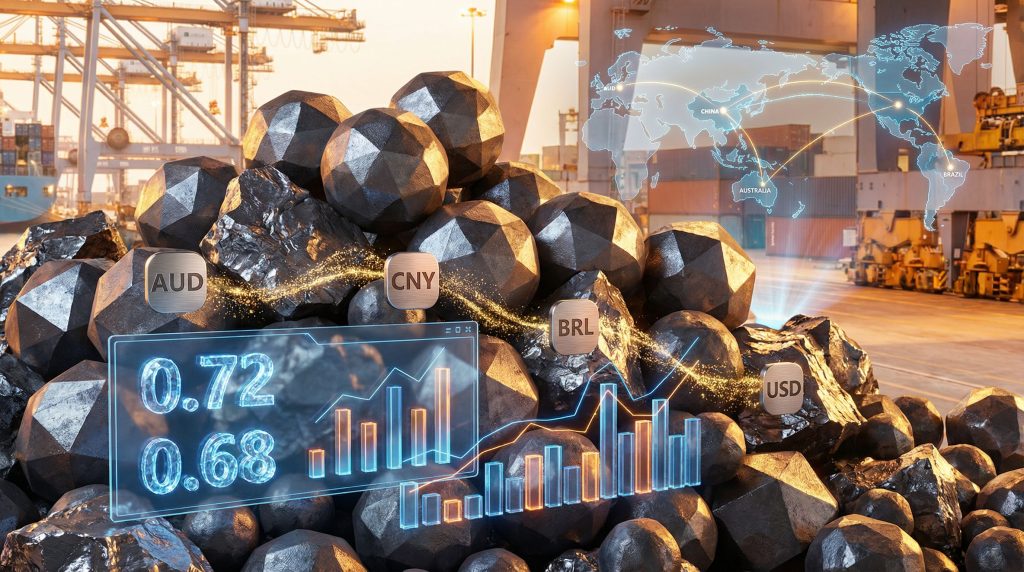
Exchange rate movements create substantial pricing pressures across different markets, often overriding short-term supply-demand fundamentals. A strengthening Chinese yuan relative to the Australian dollar makes Australian iron ore more attractive to Chinese buyers, while simultaneously affecting the competitiveness of Brazilian exports.
Currency Impact Assessment (2024-2026)
| Currency Pair | 2024 Average | Current Level | Price Impact |
|---|---|---|---|
| AUD/CNY | 4.85 | 4.92 | +1.4% support |
| BRL/CNY | 1.42 | 1.38 | -2.8% pressure |
| USD/CNY | 7.15 | 7.28 | Mixed effects |
Market analysts characterise the broader price outlook for iron ore as firmly bearish, despite temporary support from stimulus measures and easing US-China trade tensions. These developments reflect the price decline amid surplus conditions affecting global markets.
How Are Supply Chain Economics Influencing Quality Premiums?
The Economics of Grade Differentiation
Quality premium structures are undergoing fundamental recalibration as steelmakers prioritise total delivered cost over individual raw material specifications. Most steel mills indicate they can adapt to changes in the quality of major Australian mid-grade fines, provided that price differentials adjust accordingly to reflect processing cost implications.
This adaptive capacity reflects technological improvements in beneficiation and blending capabilities. Market participants observe that steelmakers have developed operational capabilities to optimise blends for cost savings rather than relying on specific brand specifications.
In addition, iron ore pricing trends are being shaped by trading patterns that include:
- High-contaminant Brazilian ores (silica up to 15%)
- Indian concentrates (alumina up to 7%)
- African materials with varying phosphorus content
- Blended Australian products targeting cost optimisation
Regional Economic Integration Effects
Economic integration between major producing and consuming regions reshapes pricing dynamics through vertical integration effects. Chinese investments in African mining projects create relationships extending beyond simple buyer-seller dynamics to encompass financing and technology transfer.
The Simandou project, backed by Chinese investment, is expected to bring large quantities of high-grade ore to regional markets. This development relates to the Australian industry advantages in maintaining competitive positioning against new supply sources.
Supply economics demonstrate that total supply of mid-grade iron ore fines from Australia is expected to remain stable or increase slightly in 2026 following quality adjustments. Meanwhile, some high-grade suppliers are blending their products to slightly lower specifications to align with market demand.
What Role Does Chinese Economic Policy Play in Global Pricing?
Domestic Production Incentives and Import Substitution
China's strategic resource security policies are driving significant investments in domestic iron ore production capabilities. Chinese government guidance aims to raise domestic concentrate output to 370 million tonnes in 2026, representing substantial import substitution potential.
China's domestic supply has already replaced a significant portion of imported high-grade pellet feed and pellets, particularly for mills in northern China. These policies extend beyond simple cost considerations to include supply security and employment creation in resource-rich regions.
The economic rationale behind domestic production expansion creates natural price floors that support international suppliers despite higher production costs. While domestic Chinese iron ore involves higher production expenses, these operations effectively establish price support levels for global markets.
Infrastructure Investment Cycles and Demand Patterns
Chinese infrastructure investment patterns operate on multi-year cycles that significantly influence global iron ore demand through their effects on steel consumption patterns. Understanding these cycles requires analysing fiscal policy announcements and local government debt capacity.
However, recent policy shifts toward "new infrastructure" focusing on technology and green energy projects may reduce the steel intensity of Chinese economic growth. This creates structural headwinds for surging iron ore demand that extend beyond typical economic cycles.
Steelmaking margins remain under persistent pressure due to a difficult macroeconomic climate, changing steel demand patterns, and the availability of competitively-priced metallurgical coke. Consequently, these factors collectively influence steelmaker raw material selection strategies.
How Do Global Trade Dynamics Affect Price Formation?
Shipping Costs and Logistical Economics
Transportation costs represent a significant component of delivered iron ore prices, particularly affecting long-distance trade routes where fluctuations in shipping rates substantially impact regional price differentials. Brazil posted a record 186 million tonnes of iron ore exports in H1 2025, with shipments continuing strong into Q3 2025.
The concentration of iron ore trade in specific shipping routes creates vulnerability to disruptions that can cause temporary price spikes. Furthermore, vessel availability and fuel cost fluctuations affect the economics of different supply sources reaching end markets.
For instance, recent operational improvements have been highlighted in the Onslow iron haulage update, demonstrating how logistics efficiency can impact competitive positioning.
Trade Policy and Tariff Implications
International trade policies increasingly influence iron ore pricing trends through their effects on steel trade flows. Lower iron ore prices in China have reduced shipments from higher-cost producers in India, Ukraine, Chile and Sweden, while major miners from Australia and Brazil maintain their market position due to low production costs.
Anti-dumping measures and trade disputes create uncertainty affecting long-term contracting and investment decisions. However, the easing of US-China trade tensions has buoyed market sentiment, though market participants note that the effect has been largely priced in to current valuation levels.
What Economic Indicators Predict Iron Ore Price Movements?
Leading Economic Indicators for Demand Forecasting
Several macroeconomic indicators provide early signals of iron ore demand changes, though their effectiveness varies based on broader economic conditions:
Primary Demand Indicators:
- Construction permit issuance in major consuming regions
- Manufacturing PMI readings across steel-intensive industries
- Infrastructure spending announcements and budget allocations
- Real estate investment and sales data from key markets
- Crude steel production capacity utilisation rates
Secondary Economic Metrics:
- Local government debt capacity in China
- Central bank policy stance across major economies
- Currency stability in key trading relationships
- Energy cost trends affecting steel production economics
According to Trading Economics, these indicators collectively help market participants understand the complex interplay of factors affecting iron ore pricing trends.
Supply-Side Economic Factors
Production economics at major mining operations provide insights into supply responsiveness to price changes. Understanding cost curves of different producers reveals natural price support levels where marginal operations become uneconomical.
Capital investment cycles in the mining sector typically operate on 5-10 year timeframes, creating periodic supply adjustments that significantly impact long-term price trends. Market participants can track these developments through resources like MacroTrends for historical perspective.
The next major ASX story will hit our subscribers first
How Will Economic Structural Changes Affect Future Pricing?
Decarbonisation Economics and Steel Demand
The global transition toward lower-carbon economies creates both challenges and opportunities for iron ore demand through changing steel consumption patterns. While traditional steel-intensive industries may experience reduced growth, new applications in renewable energy infrastructure generate alternative demand sources.
The economics of green steel production using hydrogen-based processes could eventually alter iron ore quality requirements and pricing structures. However, these changes will likely occur gradually as technology costs decline and environmental regulations tighten.
Property sector activity remains muted, continuing to cap upside potential for iron ore demand recovery, while premiums narrowed further in Q3 amid weak steel margins and cautious procurement strategies across the steel industry.
Emerging Market Industrialisation Patterns
Economic development in emerging markets outside China represents potential future iron ore demand growth, though these markets may follow different industrialisation patterns than historical precedents. Understanding economic factors driving development in Southeast Asia, Africa, and Latin America proves crucial for forecasting.
These regions may require less steel-intensive development models compared to historical industrialisation patterns, potentially affecting global demand growth assumptions and iron ore pricing trends over the medium to long term.
What Investment Implications Emerge from These Trends?
Portfolio Allocation Considerations
Iron ore price volatility creates both risks and opportunities for investment portfolios through its sensitivity to macroeconomic factors. This makes it useful as an inflation hedge and economic cycle indicator while creating correlation risks during global economic downturns.
Understanding economic drivers behind iron ore pricing trends helps investors time exposure to mining equities more effectively. However, basis risk and liquidity constraints remain significant considerations for risk management strategies.
Risk Management in Volatile Markets
Economic uncertainty surrounding iron ore pricing creates challenges for both producers and consumers in managing price risk exposure. Financial instruments for hedging continue to evolve, but market participants must navigate significant uncertainty about future price formation methods.
First rail shipment from Simandou in October, combined with stronger-than-expected Brazilian exports, will add incremental high-grade supply and potentially affect premium structures across different quality categories.
The development of more sophisticated pricing mechanisms may eventually provide better risk management tools. However, current market participants face substantial uncertainty about future pricing methodologies and their practical implementation.
Long-Term Strategic Considerations
Investment strategies must account for structural changes in iron ore pricing trends, including the shift toward mid-grade ore dominance and evolving quality acceptance standards. The broader outlook remains cautious despite temporary support from Chinese stimulus and seasonal restocking, with risks skewed to the downside if stimulus measures fail to broaden.
Market participants should consider how technological improvements in steel production, environmental regulations, and changing industrialisation patterns across emerging markets may affect long-term demand projections. These factors will correspondingly influence investment opportunities throughout the iron ore value chain.
Looking to Capitalise on Iron Ore Market Volatility?
As iron ore pricing trends navigate unprecedented transformation, savvy investors recognise that market disruptions create exceptional opportunities for those positioned ahead of the curve. Discovery Alert's proprietary Discovery IQ model delivers instant notifications on significant ASX mineral discoveries, empowering subscribers to identify actionable opportunities in volatile commodity markets before broader market awareness develops. Begin your 30-day free trial today and secure your market-leading advantage in this rapidly evolving sector.