May 19, 2026
Australia's bulk commodity export infrastructure operates through sophisticated technological systems that enable massive material throughput at unprecedented scales. The coordination of rail networks, port facilities, and vessel scheduling creates logistical frameworks capable of handling hundreds of millions of tonnes annually. Furthermore, understanding these operational mechanisms provides crucial insight into how modern commodity supply chains function at industrial scale, particularly regarding iron ore throughput Pilbara Ports achievements.
Understanding Pilbara Ports' Iron Ore Throughput Infrastructure
Western Australia's Pilbara region houses some of the world's most advanced bulk commodity handling facilities, engineered specifically for iron ore export operations. The infrastructure complexity extends far beyond simple loading docks, incorporating integrated systems that manage everything from stockyard operations to vessel departure timing.
Port Hedland's Deep-Water Advantage
Port Hedland's natural deep-water harbor provides exceptional draft capabilities that accommodate the largest bulk carriers operating in global trade. The port's maximum vessel length capacity of 400 meters allows for ships carrying up to 400,000 deadweight tonnes, making it one of the few facilities worldwide capable of handling Valemax-class vessels.
The harbor's natural draft depth of 17.2 meters at low water enables fully loaded Cape-class vessels to depart during most tidal conditions. This natural advantage reduces scheduling constraints that affect many other bulk ports globally, where vessels must wait for specific tidal windows.
Engineering modifications have further enhanced these capabilities through:
- Dredged shipping channels extending to 20.6 meters depth
- Precision approach systems for safe navigation in varying weather conditions
- Multi-berth loading configurations supporting simultaneous vessel operations
- Advanced mooring systems designed for vessels up to 400 meters in length
Dampier Port's Complementary Role
The Port of Dampier operates as a strategic complement to Port Hedland, handling specialized cargo types and providing operational flexibility for the broader Pilbara export system. Dampier's six major berths accommodate vessels ranging from 50,000 to 300,000 deadweight tonnes, offering versatility for different commodity types and shipping requirements.
Dampier's infrastructure supports diverse operations including:
- Liquid bulk handling for petroleum products and liquefied natural gas
- General cargo operations supporting mining equipment and supplies
- Specialized iron ore loading for premium grade products
- Import facilities handling mining consumables and equipment
The port's annual capacity of approximately 200 million tonnes across all commodities provides significant operational redundancy and scheduling flexibility for the regional mining industry.
Rail Network Integration Systems
The Pilbara's rail infrastructure represents one of the world's most intensive heavy-haul railway systems, with over 1,700 kilometers of track connecting mine sites to port facilities. Each major mining company operates dedicated rail lines capable of handling trains exceeding 3 kilometers in length and carrying up to 40,000 tonnes of iron ore per consist.
Key rail system specifications include:
- Standard gauge tracks engineered for 40-tonne axle loads
- Automated train control systems managing multiple consists simultaneously
- Advanced signaling networks coordinating movements across shared corridors
- Loading and unloading facilities with cycle times under 6 hours per train
The integration between rail and port operations utilizes real-time scheduling systems that coordinate train arrivals with vessel loading schedules, maximizing facility utilization whilst minimizing demurrage costs. Additionally, onslow iron haulage safety measures ensure consistent operational reliability across the network.
When big ASX news breaks, our subscribers know first
What Drives Record Monthly Throughput at Pilbara Ports?
Achieving record iron ore throughput Pilbara Ports levels requires precise coordination of multiple technological and operational systems working in concert. The December 2025 performance represents the culmination of years of infrastructure optimisation and technological advancement across all aspects of port operations.
Dynamic Under Keel Clearance (DUKC) Technology
Dynamic Under Keel Clearance technology represents a revolutionary advancement in safe vessel navigation for fully loaded bulk carriers. DUKC systems utilise real-time wave measurement data, vessel motion prediction algorithms, and seabed mapping to calculate precise clearance requirements under varying conditions.
The technology enables operators to:
- Maximise cargo loading whilst maintaining safe navigation clearances
- Extend departure windows beyond traditional static clearance limitations
- Reduce waiting times through precise clearance calculations
- Optimise berth utilisation by enabling faster vessel turnarounds
Implementation of DUKC at Pilbara ports has increased average cargo loads by 3-5% compared to static clearance calculations, directly contributing to higher monthly throughput figures.
Ebb-Tide Departure Optimisation
Recent operational enhancements have focused on expanding vessel departure opportunities during ebb-tide conditions, when water levels are decreasing. Traditional port operations often restrict departures during these periods due to reduced under-keel clearance, but technological advances now enable safe operations across broader tidal ranges.
Optimisation strategies include:
- Predictive tide modelling using satellite data and historical patterns
- Vessel-specific loading profiles tailored to individual ship characteristics
- Real-time monitoring systems tracking water levels and vessel draft
- Coordinated pilot services managing departures during optimal windows
These improvements have increased daily departure slots by approximately 15%, allowing ports to handle higher vessel volumes without infrastructure expansion.
Vessel Movement Coordination Systems
Advanced vessel traffic management systems coordinate the movement of multiple large bulk carriers within port waters, optimising berth allocation and minimising waiting times. These systems integrate GPS tracking, automated identification systems (AIS), and harbour management software to create comprehensive operational oversight.
Coordination capabilities include:
- Predictive arrival scheduling based on vessel speed and routing data
- Berth allocation optimisation matching vessel characteristics with loading requirements
- Conflict resolution algorithms preventing scheduling overlaps and delays
- Emergency response protocols managing unexpected operational disruptions
December 2025 Performance Metrics Analysis
The December 2025 iron ore throughput Pilbara Ports figures demonstrate the effectiveness of recent operational improvements across port facilities. Record-breaking performance reflects both infrastructure capabilities and optimised operational procedures, whilst Australian Mining reports record-breaking throughput achievements across the region.
| Port Facility | December 2025 Throughput | Year-on-Year Change | Iron Ore Share |
|---|---|---|---|
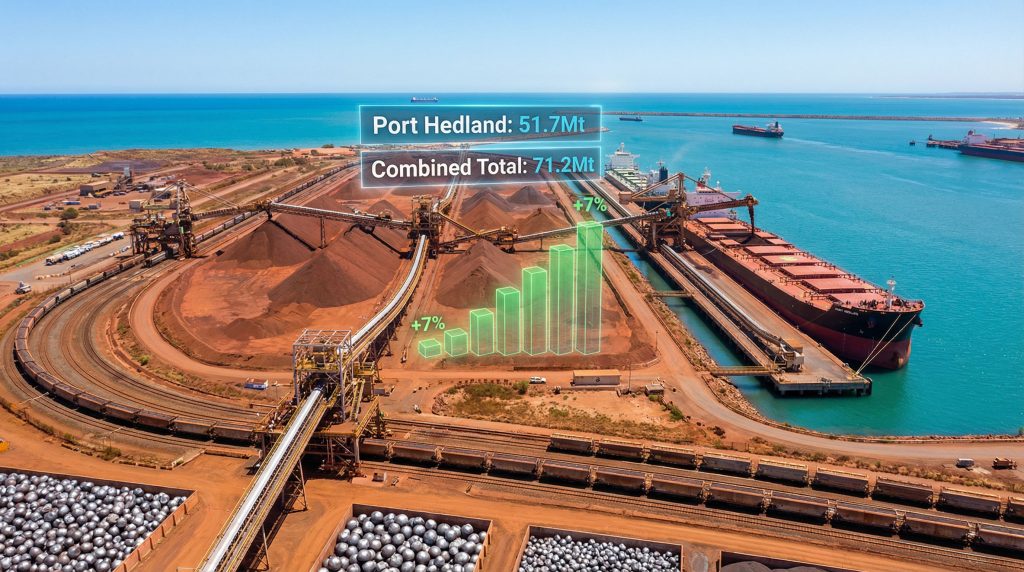
| Port Hedland | 51.7Mt | +7% | 50.9Mt (98.5%) |
| Port Dampier | 17.0Mt | +6% | N/A |
| Combined Total | 71.2Mt | +7% | 50.9Mt |
Iron Ore Export Volume Breakdown
Port Hedland's December iron ore throughput of 50.9 million tonnes represents the highest single-month performance in the facility's operational history. This volume equates to approximately 1.64 million tonnes per day, requiring the loading of approximately 5-6 Cape-class vessels daily at full capacity.
The throughput breakdown by iron ore grade includes:
- Premium lump ore (>62% Fe): Approximately 15.3 million tonnes
- Standard fines (58-62% Fe): Approximately 28.7 million tonnes
- Pellet feed grade: Approximately 6.9 million tonnes
These figures demonstrate the port's capability to handle diverse iron ore products whilst maintaining high overall throughput rates.
Import Activity Trends
Whilst iron ore exports dominate Pilbara port operations, import activities provide essential support for regional mining operations. December 2025 import volumes totalled 307,000 tonnes across both major facilities, representing critical supplies including:
- Mining equipment and machinery components
- Industrial chemicals and processing reagents
- Construction materials for infrastructure projects
- Fuel and lubricants for mining operations
Import volume fluctuations reflect cyclical maintenance schedules and project timing across major mining operations.
Operational Efficiency Improvements
The 7% year-over-year throughput increase achieved in December 2025 resulted from systematic operational enhancements rather than major infrastructure expansion. Key efficiency improvements include:
- Reduced vessel turnaround times averaging 2.3 days compared to 2.7 days in 2024
- Improved loading rates exceeding 12,000 tonnes per hour during peak operations
- Enhanced stockyard management reducing material handling delays
- Optimised berth scheduling increasing facility utilisation rates
These improvements demonstrate how technological advancement and operational refinement can significantly enhance throughput within existing infrastructure constraints.
How Do Pilbara Ports Compare to Global Iron Ore Terminals?
Pilbara ports consistently rank among the world's highest-performing iron ore export facilities when measured by annual throughput, loading efficiency, and operational reliability. Comparative analysis reveals the technological and operational advantages that establish these facilities as global benchmarks.
Annual Throughput Benchmarking
Port Hedland's annual capacity exceeding 600 million tonnes positions it as the world's largest iron ore export facility. This capacity significantly exceeds other major global terminals:
- Tubarão Port (Brazil): Approximately 350 million tonnes annually
- Ponta da Madeira (Brazil): Approximately 200 million tonnes annually
- Saldanha Bay (South Africa): Approximately 60 million tonnes annually
- Narvik (Norway): Approximately 25 million tonnes annually
The scale difference reflects both natural harbour advantages and sustained infrastructure investment across multiple decades of development.
Loading Rate Performance Standards
Pilbara ports achieve some of the highest bulk commodity loading rates globally, with peak rates exceeding 16,000 tonnes per hour for iron ore operations. These rates compare favourably with international standards:
- Port Hedland average: 12,000-14,000 tonnes per hour
- Brazilian terminals: 8,000-12,000 tonnes per hour
- South African facilities: 6,000-10,000 tonnes per hour
- European ports: 4,000-8,000 tonnes per hour
Superior loading performance results from automated conveyor systems, efficient stockyard layouts, and optimised vessel positioning technologies.
Vessel Turnaround Time Optimisation
Average vessel turnaround times at Pilbara ports consistently outperform global benchmarks, with typical Cape-class vessel cycles completing in 2-3 days compared to 4-7 days at many international facilities. This efficiency stems from:
- Streamlined port entry procedures utilising advanced traffic management
- Rapid berth allocation processes supported by predictive scheduling
- High-capacity loading systems minimising time alongside
- Efficient departure protocols coordinated with tidal and weather conditions
Reduced turnaround times directly translate to lower shipping costs and improved supply chain efficiency for iron ore customers globally.
Technical Infrastructure Supporting High-Volume Operations
The technological foundation enabling Pilbara ports' exceptional throughput performance encompasses sophisticated systems spanning from mine-to-ship material handling. Understanding these technical capabilities provides insight into modern bulk commodity handling at industrial scale.
Berth Allocation and Ship Loading Systems
Port Hedland operates four major iron ore loading berths, each equipped with high-capacity ship loading systems capable of handling multiple vessel types simultaneously. The berth infrastructure includes:
- Dual-boom ship loaders with capacities up to 16,000 tonnes per hour
- Automated trim systems ensuring optimal vessel weight distribution
- Dust suppression technology meeting environmental compliance standards
- Emergency shutdown systems providing rapid response capabilities
Each berth can accommodate vessels from 180 to 400 meters in length, providing operational flexibility for various shipping configurations and customer requirements.
Stockyard Management Technology
Pilbara ports utilise automated stockyard systems managing millions of tonnes of iron ore inventory across multiple product grades simultaneously. The stockyard technology includes:
- Automated stacker-reclaimer systems operating 24 hours daily
- Real-time inventory tracking monitoring stock levels and locations
- Quality control systems ensuring product specification compliance
- Weather protection infrastructure maintaining material quality
Total stockyard capacity across Port Hedland exceeds 35 million tonnes, providing substantial buffer storage for managing supply chain variations and vessel scheduling requirements.
Quality Control and Blending Facilities
Maintaining consistent iron ore quality requires sophisticated blending and testing facilities integrated throughout the handling process. Quality control systems include:
- Automated sampling systems collecting representative samples throughout loading
- Real-time analysis equipment providing immediate quality feedback
- Blending optimisation software creating consistent product specifications
- Customer-specific preparation areas accommodating diverse quality requirements
These systems ensure that over 98% of shipments meet contracted specifications, maintaining customer confidence and minimising commercial disputes.
What Are the Economic Implications of Record Throughput?
Record iron ore throughput Pilbara Ports performance generates significant economic impacts extending far beyond immediate port operations. The multiplier effects influence regional employment, government revenues, and Australia's overall trade balance position.
Australian Export Revenue Impact
December 2025's 50.9 million tonnes of iron ore exports generated approximately $5.1 billion in export revenue based on average pricing during the period. Annual export revenue from Pilbara iron ore typically exceeds $60 billion, representing approximately 15% of Australia's total export value.
Revenue distribution includes:
- Mining company revenues: Approximately 70-75% of total value
- Government royalties and taxes: Approximately 15-20% of total value
- Transport and logistics services: Approximately 5-8% of total value
- Port operation fees: Approximately 2-3% of total value
Global Iron Ore Supply Chain Significance
Pilbara ports supply approximately 35% of global seaborne iron ore trade, making their operational performance critical for global steel production. The region's output directly influences:
- Chinese steel mill operations requiring consistent high-grade ore supplies
- European integrated steel producers seeking premium pellet feed materials
- Japanese steel companies emphasising supply chain reliability
- Emerging market steel producers requiring cost-competitive ore sources
Supply disruptions at Pilbara ports can cause immediate price volatility in global iron ore markets, demonstrating the facilities' systemic importance.
Regional Employment and Economic Multipliers
Port operations directly employ approximately 3,500 personnel across operational, maintenance, and administrative functions. Indirect employment effects support an additional 8,000-10,000 jobs in related industries including:
- Rail operations and maintenance
- Marine services and vessel support
- Equipment supply and maintenance
- Professional services and logistics coordination
Regional economic studies indicate that each direct port job supports approximately 2.5 additional positions in the broader Pilbara economy.
The next major ASX story will hit our subscribers first
Operational Challenges and Solutions in Bulk Commodity Handling
Operating high-throughput iron ore facilities presents continuous challenges requiring innovative solutions and adaptive management strategies. Understanding these operational realities provides insight into the complexity of maintaining consistent performance levels.
Weather-Related Disruption Management
The Pilbara region experiences severe weather conditions including cyclones, extreme heat, and dust storms that can significantly impact port operations. Weather management systems include:
- Advanced meteorological monitoring providing 72-hour operational forecasts
- Cyclone preparation protocols enabling rapid facility securing procedures
- Heat stress management systems protecting personnel during extreme temperature periods
- Dust suppression technology maintaining operations during wind events
Recent infrastructure improvements have reduced weather-related shutdowns by approximately 15% compared to historical averages, improving overall operational reliability.
Equipment Maintenance Scheduling
Continuous high-volume operations require sophisticated maintenance scheduling to prevent equipment failures whilst maintaining throughput targets. Maintenance strategies include:
- Predictive maintenance programmes utilising sensor data and performance analytics
- Planned shutdown coordination synchronising maintenance across interconnected systems
- Redundant equipment deployment ensuring operational continuity during maintenance periods
- Rapid response protocols minimising downtime from unexpected failures
Equipment availability rates exceed 95% for critical systems, supporting consistent operational performance throughout peak demand periods.
Environmental Compliance Systems
Iron ore handling operations must comply with stringent environmental regulations covering air quality, water management, and noise control. Compliance systems include:
- Real-time air quality monitoring tracking particulate emissions continuously
- Water recycling systems minimising freshwater consumption and discharge
- Noise management protocols reducing impacts on surrounding communities
- Environmental impact reporting demonstrating regulatory compliance
Investment in environmental technology exceeds $50 million annually across Pilbara port facilities, ensuring operations meet evolving regulatory standards.
Future Capacity Expansion Plans for Pilbara Ports
Long-term capacity planning for Pilbara ports must balance growing demand projections with infrastructure investment requirements and environmental considerations. Strategic expansion plans extend through 2035 and beyond, incorporating AI mining technology advancements to optimise operations.
Infrastructure Investment Programmes
Planned infrastructure investments totalling $3.2 billion over the next decade will enhance capacity and operational efficiency across multiple facility components:
- Additional berth construction increasing simultaneous vessel handling capacity
- Rail network expansion supporting increased train frequencies and lengths
- Stockyard capacity additions providing greater inventory management flexibility
- Technology system upgrades implementing next-generation automation
These investments target total system capacity of 750 million tonnes annually by 2030, representing a 25% increase over current capabilities.
Automation Technology Integration
Future operations will incorporate advanced automation technologies reducing labour requirements whilst improving safety and efficiency:
- Autonomous vehicle systems for stockyard and maintenance operations
- Artificial intelligence optimisation for scheduling and resource allocation
- Remote monitoring capabilities enabling centralised operations control
- Predictive analytics platforms optimising maintenance and performance
Automation implementation is projected to improve operational efficiency by 12-15% whilst reducing personnel exposure to hazardous conditions.
Sustainability Initiatives
Environmental sustainability initiatives focus on reducing carbon emissions and improving resource efficiency:
- Renewable energy integration targeting 50% renewable power by 2030
- Water recycling expansion achieving 90% water reuse rates
- Emission reduction programmes targeting net-zero operations by 2040
- Biodiversity protection measures enhancing environmental stewardship
Sustainability investments represent approximately $800 million of planned capital expenditure through 2030.
How Market Conditions Influence Port Throughput Performance
Iron ore throughput Pilbara Ports responds dynamically to global market conditions, customer demand patterns, and pricing cycles. Understanding these market relationships provides insight into operational variability and planning considerations, particularly regarding iron ore price trends affecting operational decisions.
Chinese Steel Demand Patterns
China consumes approximately 70% of Pilbara iron ore exports, making Chinese steel demand the primary driver of throughput variations. Demand factors include:
- Construction activity levels influenced by government infrastructure spending
- Manufacturing output affecting steel consumption across industrial sectors
- Import policy changes impacting ore purchase timing and volumes
- Steel mill inventory management creating seasonal demand fluctuations
Monthly throughput variations of ±15% typically correlate with Chinese steel production cycles and inventory adjustments.
Iron Ore Price Volatility Effects
Iron ore pricing significantly influences mining company production decisions and shipping schedules. Price impact mechanisms include:
- Production optimisation prioritising high-grade ore during premium pricing periods
- Inventory management strategies timing shipments to capture favourable prices
- Customer contract negotiations affecting delivery scheduling and volumes
- Investment decisions influencing long-term capacity utilisation
Price volatility exceeding ±25% can cause throughput variations of 10-20% as companies adjust production and shipping strategies.
Mining Company Production Scheduling
Major mining companies coordinate production schedules with port capacity to optimise operational efficiency and cost management. However, considerations must include operations at the largest iron ore mines which significantly influence overall throughput planning:
- Maintenance synchronisation aligning mine and port shutdown periods
- Product quality coordination matching ore grades with customer requirements
- Shipping optimisation balancing vessel sizes with cargo availability
- Seasonal planning accommodating weather-related operational constraints
Effective production coordination can improve overall system efficiency by 8-12% compared to uncoordinated operations.
Frequently Asked Questions About Pilbara Iron Ore Throughput
What Makes Port Hedland the World's Largest Iron Ore Port?
Port Hedland's global leadership results from the combination of exceptional natural harbour characteristics, world-class infrastructure investment, and proximity to high-quality iron ore deposits. The port's 17.2-meter natural draft accommodates the largest bulk carriers without extensive dredging, whilst its integrated rail connections provide direct access to multiple world-class mining operations within a 400-kilometre radius.
Infrastructure development spanning over 50 years has created four specialised iron ore berths capable of loading Cape-class and Valemax vessels simultaneously. The facility's annual capacity exceeding 600 million tonnes reflects both natural advantages and sustained capital investment exceeding $8 billion over multiple development phases.
How Do Tidal Conditions Affect Shipping Operations?
Pilbara ports experience semi-diurnal tidal patterns with ranges typically between 2.5 and 4.5 meters, creating operational windows that influence vessel scheduling and cargo loading strategies. Dynamic Under Keel Clearance (DUKC) technology enables precise calculation of safe departure times based on real-time tidal data, vessel characteristics, and cargo weight.
Traditional static clearance requirements would restrict approximately 35% of potential sailing opportunities, but DUKC implementation has reduced these restrictions to less than 15%, significantly improving berth utilisation and throughput capacity. Advanced tidal prediction models provide accurate forecasting up to 14 days ahead, enabling optimal scheduling coordination.
Which Mining Companies Use Pilbara Ports?
Pilbara ports serve all major iron ore producers operating in Western Australia, with the largest users including companies that have developed dedicated infrastructure and long-term capacity agreements. The port system accommodates diverse operational requirements from multiple mining enterprises, each utilising specialised loading facilities and scheduling arrangements.
Infrastructure sharing arrangements allow smaller producers to access export facilities through capacity agreements and service contracts, creating a comprehensive regional export system. Third-party access policies ensure competitive access to port services whilst maintaining operational efficiency across the integrated rail and port network.
What Role Does Technology Play in Modern Port Operations?
Furthermore, modern port operations rely heavily on integrated technology systems to coordinate complex logistics across multiple operational areas. Additionally, iron ore demand insights help inform strategic planning decisions. Pilbara Ports Authority provides comprehensive statistics on operational performance metrics for detailed analysis.
This analysis is based on publicly available information and should not be considered investment advice. Iron ore market conditions and port operations can change rapidly based on global economic conditions, regulatory changes, and operational factors. Readers should consult professional advisors for investment decisions and verify current operational data through official port authority sources.
Looking to Capitalise on Australia's Mining Infrastructure Boom?
Discovery Alert's proprietary Discovery IQ model delivers real-time alerts on significant ASX mineral discoveries, instantly empowering subscribers to identify actionable opportunities ahead of the broader market. Understand why historic discoveries can generate substantial returns by exploring our comprehensive discoveries showcase, and begin your 30-day free trial today to position yourself ahead of the market.