The global mining industry faces mounting pressure to transform environmental liabilities into valuable resources. Water contamination from mining operations represents one of the sector's most persistent challenges, with acidic runoff affecting ecosystems across multiple continents. This technical transformation involves sophisticated chemical processes that can extract commercially viable materials from what was previously considered industrial waste, representing significant industry innovation trends shaping the sector's future.
Modern extraction technologies are revolutionising how the industry approaches contaminated water management. Advanced precipitation methods now enable the selective recovery of dissolved metals, creating opportunities for circular economy applications within mining operations. These innovations address both environmental remediation needs and resource scarcity challenges simultaneously.
Understanding Acid Mine Drainage as a Resource Stream
Chemical Composition and Metal Concentrations
Acid mine drainage forms when sulfide-bearing minerals undergo oxidation after exposure to air and water, producing sulfuric acid that dissolves surrounding metals. This process creates highly acidic water with pH levels typically ranging from 2.0 to 4.5, optimal conditions for maintaining elevated dissolved metal concentrations.
Iron represents the most abundant metal in AMD systems, with concentrations frequently exceeding 200 milligrams per liter in active mining environments. These levels far surpass natural background concentrations, creating both environmental challenges and potential resource opportunities for iron recycling acid mine drainage applications.
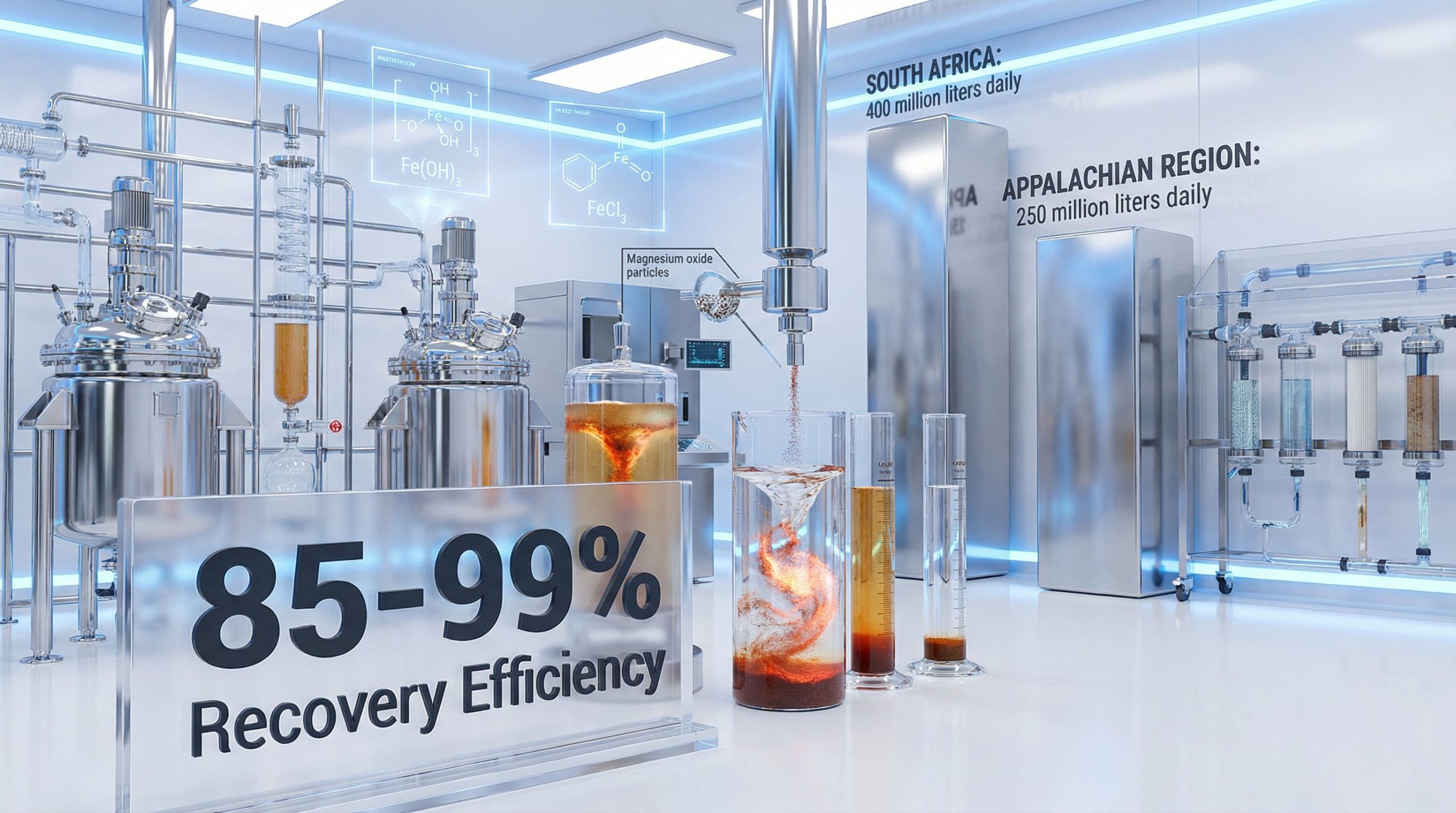
Research conducted at active coal operations in South Africa's Mpumalanga Province demonstrates the scale of available resources. The country generates approximately 400 million litres of acid mine drainage daily from active and derelict mining sites, representing substantial volumes of metal-rich water requiring treatment.
Secondary Mineral Formation Dynamics
The acidic environment in AMD systems prevents natural precipitation of dissolved metals, keeping iron, aluminium, and other elements in solution for extended periods. This chemical stability creates opportunities for selective metal recovery through controlled precipitation processes.
Understanding these formation dynamics enables engineers to design recovery systems that work with natural chemical processes rather than against them. The high solubility of metals in acidic conditions becomes an advantage when implementing targeted extraction technologies.
Environmental Impact Assessment
Untreated acid mine drainage causes severe ecological damage through multiple pathways:
• Stream acidification reducing biodiversity in aquatic ecosystems
• Metal bioaccumulation affecting food chain integrity
• Infrastructure corrosion damaging bridges, pipelines, and treatment facilities
• Groundwater contamination threatening drinking water supplies
South African researchers have documented extensive infrastructure damage from AMD exposure, with bridges and pipeline systems requiring frequent maintenance or replacement due to acidic corrosion. This economic burden adds to the environmental justification for implementing recovery technologies.
Advanced Precipitation Technologies for Metal Extraction
Magnesium Oxide Nanoparticle Applications
Revolutionary research from Heriot-Watt University and the University of South Africa has demonstrated the effectiveness of magnesium oxide nanoparticles for selective iron recovery. The process utilises cryptocrystalline magnesite calcination to produce highly reactive MgO nanoparticles with optimised surface areas for metal binding.
Laboratory evaluations using real AMD from Mpumalanga coal operations achieved greater than 99% removal efficiency for aluminium, iron, and chromium. This performance level represents a significant advancement over conventional precipitation methods, which typically achieve 85-95% removal rates.
The nanoparticle approach offers several technical advantages:
• Rapid reaction kinetics enabling continuous processing
• Selective metal binding reducing chemical consumption
• Low energy requirements compared to electrochemical alternatives
• Local material sourcing utilising available magnesite deposits
Process Optimisation Strategies
The precipitation process requires careful control of multiple variables to maximise iron recovery while maintaining product quality. pH management represents the most critical parameter, with optimal iron precipitation occurring between 3.5 and 4.0.
Temperature control affects both reaction rates and product crystallinity. Maintaining temperatures between 20-25°C ensures consistent product formation while minimising energy consumption. Higher temperatures can accelerate reactions but may compromise product quality through unwanted side reactions.
Furthermore, mixing intensity influences contact between nanoparticles and dissolved metals. Gentle agitation prevents particle aggregation while ensuring adequate mass transfer for complete metal removal through AI process optimization techniques.
Chemical Conversion to Marketable Products
The recovered iron solids undergo chemical conversion to produce ferric chloride, a widely used water treatment chemical. The conversion process involves combining recovered iron hydroxides with hydrochloric acid:
Fe(OH)₃ + 3HCl → FeCl₃ + 3H₂O
This reaction produces ferric chloride meeting industrial quality specifications for municipal water treatment applications. Laboratory testing demonstrates that AMD-derived ferric chloride removes over 99% of aluminium, iron, and chromium from contaminated water sources.
Commercial Applications for Recovered Iron Products
Municipal Water Treatment Markets
Ferric chloride serves as a primary coagulant in drinking water treatment facilities worldwide. The chemical facilitates removal of suspended particles, organic matter, and dissolved contaminants through flocculation and precipitation mechanisms.
AMD-derived ferric chloride demonstrates performance characteristics equivalent to or exceeding virgin material. Treated water samples consistently meet South Africa's national drinking water standards, indicating commercial viability for municipal applications.
The global ferric chloride market represents substantial commercial opportunity, with municipal utilities requiring consistent supplies for daily operations. Recovery from AMD sources can provide cost-effective alternatives to traditional production methods.
Industrial Process Applications
Beyond water treatment, recovered iron products find applications across multiple industrial sectors:
| Application | Product Form | Market Demand |
|---|---|---|
| Water treatment | Ferric chloride | High, consistent |
| Pigment manufacturing | Iron oxides | Moderate, seasonal |
| Steel production | Iron concentrates | High, price sensitive |
| Chemical processing | Iron salts | Moderate, specialised |
Each application requires specific product specifications regarding purity, particle size, and chemical composition. AMD recovery processes can be tailored to meet these varying requirements through adjusted operating parameters.
Quality Assurance Protocols
Commercial acceptance of recovered iron products depends on consistent quality control throughout the production process. Key specifications include:
• Metal purity levels meeting industry standards
• Trace contaminant limits within acceptable ranges
• Particle size distribution optimised for specific applications
• Chemical stability ensuring product shelf life
Regular analytical testing throughout production ensures products meet customer specifications. Third-party certification may be required for certain applications, particularly in municipal water treatment.
Economic Viability Assessment
Capital Investment Requirements
Iron recycling acid mine drainage systems require significant upfront investment in specialised equipment and infrastructure. Primary cost components include:
- Nanoparticle production facilities for MgO synthesis
- Precipitation and separation equipment for metal recovery
- Chemical conversion systems for product finishing
- Quality control laboratories for product testing
- Storage and handling infrastructure for raw materials and products
Scale represents the most critical factor affecting economic viability. Larger operations benefit from economy of scale effects, reducing per-unit processing costs and improving return on investment timelines.
Operating Cost Analysis
Ongoing operational expenses include raw material procurement, energy consumption, labour requirements, and maintenance costs. The largest variable cost typically involves hydrochloric acid for chemical conversion processes.
Energy requirements remain relatively modest compared to alternative metal recovery technologies. The low-temperature, atmospheric pressure conditions minimise utility costs while maintaining high recovery efficiency.
However, labour requirements depend on automation levels and production scale. Automated systems can operate with minimal staffing but require higher initial capital investment.
Revenue Generation Potential
Revenue streams from AMD iron recovery include:
• Primary product sales (ferric chloride, iron oxides)
• Co-product recovery (aluminium, other metals)
• Environmental services (AMD treatment contracts)
• Carbon credit generation from waste reduction
Market pricing for recovered products typically aligns with virgin material prices, though some applications may require modest discounts during initial market penetration phases.
Regional Implementation Case Studies
South African Coal Mining Operations
The Mpumalanga Province case study represents the most advanced demonstration of AMD iron recovery technology. Real-world testing using actual mine drainage has validated both technical feasibility and product quality for commercial applications.
Key success factors in the South African context include:
• Abundant raw material availability from extensive mining operations
• Local magnesite resources for nanoparticle production
• Established water treatment infrastructure providing market access
• Supportive regulatory environment encouraging circular economy initiatives
The research team's approach demonstrates how academic institutions can partner with industry to develop practical solutions for environmental challenges while creating economic opportunities.
Global Expansion Opportunities
Similar geological and mining conditions exist in numerous regions worldwide, suggesting broad applicability for AMD iron recovery technologies. Potential markets include:
• Appalachian coal mining regions in the United States
• Australian coal and metal mining operations
• Canadian mineral extraction zones
• European legacy mining areas
Each region presents unique challenges related to climate, regulations, and market access, requiring customised implementation approaches.
Technical Challenges and Solutions
Process Optimisation Hurdles
Scaling laboratory results to commercial operations presents several technical challenges. Seasonal variations in AMD composition can affect recovery efficiency, requiring adaptive process control systems.
"This could be a low-energy and low-carbon practical solution to a problem that blights communities around the world and has lasting health, ecological and economic impact."
Continuous operation introduces equipment fouling and scaling issues not present in batch laboratory testing. Regular maintenance protocols and anti-fouling strategies become essential for sustained commercial operation.
Product consistency represents another significant challenge, as end users require predictable chemical and physical properties. Advanced monitoring systems using real-time analytical techniques can optimise process parameters to maintain product specifications.
Quality Control Implementation
Commercial acceptance requires robust quality assurance programmes throughout the production process. Automated monitoring systems can track key parameters continuously, enabling rapid response to process deviations.
Statistical process control methods help identify trends and prevent quality issues before they affect final products. Regular calibration of analytical equipment ensures accurate measurements supporting quality decisions.
Regulatory Compliance Framework
Transforming waste materials into commercial products requires navigation of complex regulatory frameworks. Environmental permits may need modification when AMD transitions from waste disposal to feedstock utilisation.
Product registration requirements vary by jurisdiction and end-use application. Municipal water treatment chemicals typically require extensive testing and certification before regulatory approval for commercial use.
Future Technology Developments
Advanced Separation Technologies
Emerging membrane separation techniques offer potential improvements in selectivity and energy efficiency for metal recovery from AMD. Research demonstrates that reverse osmosis and nanofiltration systems can concentrate dissolved metals while reducing water volumes requiring treatment.
Electrochemical separation methods using renewable energy sources could eliminate chemical consumption while enabling selective metal recovery. Solar-powered electrowinning systems represent promising approaches for remote mining locations.
Biotechnology Integration
Biological systems utilising specialised bacteria can enhance metal recovery while reducing chemical inputs. Iron-oxidising bacteria can convert dissolved metals to more easily separated forms, potentially improving overall recovery efficiency.
Constructed wetland systems incorporating metal recovery capabilities offer dual benefits of environmental remediation and resource extraction. These hybrid biological-chemical systems could provide cost-effective solutions for smaller mining operations.
Artificial Intelligence Applications
Machine learning algorithms can optimise recovery processes by analysing complex relationships between operating parameters and product quality. Predictive maintenance systems reduce equipment downtime while improving operational reliability.
Real-time process optimisation using AI-driven control systems can maximise recovery efficiency while minimising chemical consumption and energy usage. These technologies become increasingly important as operations scale to commercial levels.
Market Trends and Investment Opportunities
Circular Economy Policy Drivers
Government policies increasingly favour circular economy approaches that transform waste into valuable resources. Carbon pricing mechanisms may provide additional economic incentives for technologies that reduce environmental impacts while generating useful products.
"This approach supports the circular economy by turning waste into a product with real value. It also helps reduce the environmental footprint of mining operations."
International development funding organisations recognise water treatment and resource recovery technologies as priority investment areas, particularly in regions facing water scarcity challenges. Consequently, this creates opportunities for sustainability transformation initiatives.
Private Sector Partnerships
Mining companies face growing pressure to address environmental legacies while maintaining operational profitability. Iron recycling acid mine drainage technologies offer solutions that address both objectives simultaneously.
Water utility partnerships provide natural market channels for recovered treatment chemicals. Long-term supply agreements can provide stable revenue streams supporting project financing.
Technology licensing opportunities enable rapid deployment across multiple geographic markets without requiring large capital investments from individual developers.
Investment Risk Assessment
Primary risks include commodity price volatility affecting product revenues, regulatory changes impacting waste-to-product classifications, and technology scale-up challenges affecting commercial viability.
Market acceptance risk decreases as demonstration projects prove product quality and reliability. Early adopter utilities and industrial users can provide validation supporting broader market penetration.
Technical risk mitigation involves staged development approaches, moving from laboratory to pilot to commercial scale with validation at each phase before proceeding to larger investments.
Implementation Strategies for Mining Operations
Site Assessment Protocols
Successful implementation begins with comprehensive site characterisation including AMD volume, composition, and seasonal variability assessment. Minimum economically viable flow rates typically exceed 10 million litres daily for standalone operations.
Proximity to end-use markets affects transportation costs and overall project economics. Co-location with existing water treatment facilities or industrial users provides significant competitive advantages.
Infrastructure requirements include reliable electrical power, transportation access, and skilled labour availability. Remote mining locations may require additional infrastructure investment affecting project economics.
Financing and Development Models
Public-private partnerships leverage government environmental remediation funding with private sector operational expertise. These arrangements can reduce capital requirements while ensuring long-term operational sustainability.
Build-operate-transfer models enable mining companies to implement recovery technologies without large capital investments while maintaining long-term environmental benefits. In addition, these approaches incorporate data-driven operations principles for enhanced efficiency.
Revenue sharing agreements between technology providers and site operators align incentives for successful commercial operation while reducing development risks for all parties.
Integration with Existing Operations
"Climate change is exacerbating water scarcity pressures and creates new challenges that the water sector needs to address sustainably. This technology can be part of a portfolio approach."
Modular system designs enable phased implementation starting with smaller demonstration units before scaling to full commercial operations. This approach reduces technical risk while proving commercial viability.
Integration with existing mine water management systems can reduce infrastructure costs while improving overall environmental performance. Synergies with other metal recovery processes may create additional revenue opportunities alongside mine reclamation innovation efforts.
Training programmes for operating personnel ensure safe and efficient operation while maintaining product quality standards. Knowledge transfer from research institutions supports successful commercial implementation.
The transformation of acid mine drainage from environmental liability to valuable resource represents a fundamental shift in mining industry thinking. Advanced technologies now enable economically viable metal recovery while addressing environmental remediation needs. Iron recycling acid mine drainage applications demonstrate how innovative approaches can create win-win scenarios for industry and environment alike.
Successful implementation requires careful attention to technical, economic, and regulatory factors while maintaining focus on product quality and market acceptance. The growing emphasis on circular economy principles and environmental sustainability provides favourable conditions for widespread adoption of these transformative technologies.
Want to Discover the Next Major Mineral Innovation Before the Market?
Discovery Alert provides instant notifications on significant ASX mineral discoveries using its proprietary Discovery IQ model, turning complex mining developments into actionable trading opportunities. See how major discoveries like the breakthroughs in sustainable mining technologies can generate exceptional returns by exploring Discovery Alert's discoveries page and begin your 30-day free trial today.