May 20, 2026
Ironveld Lapon plant magnetite production: what really matters in the ramp-up
In mineral processing, the hardest step is often not building a plant. It is proving that the circuit can produce the same saleable product repeatedly, at the right quality, in the right volumes, and on a timetable customers can trust. That is the key lens for understanding Ironveld Lapon plant magnetite production in Limpopo, South Africa.
The current story is not simply about restart activity or mechanical upgrades. Rather, it is about whether plant reconfiguration, a detailed metallurgical audit, and final civil works can turn commissioning progress into reliable DMS-grade magnetite supply.
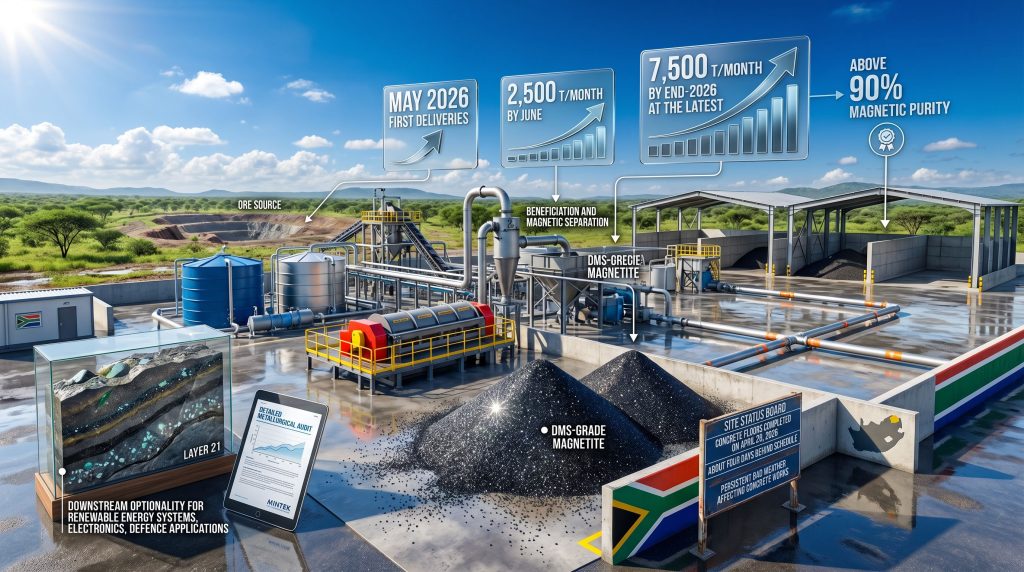
As of 29 April 2026, the Lapon plant was reported to be about four days behind schedule after persistent poor weather disrupted concrete work. Even so, the concrete floors for product storage were completed on 28 April 2026, and management contractor Daemaneng Minerals remained confident of first deliveries in May 2026.
The published production pathway is specific:
- Mid-May 2026: first shipments targeted
- By end-May 2026: sustained production expected by management commentary
- June 2026: 2,500 tonnes per month targeted
- By end-2026 at the latest: 7,500 tonnes per month nameplate target
Those milestones matter because investors, customers, and industry observers will judge this South African magnetite project less by intent and more by evidence of repeatable product quality, throughput stability, and delivery execution.
When big ASX news breaks, our subscribers know first
Why the Lapon plant matters in the magnetite value chain
The Lapon operation sits in a useful position within the magnetite supply chain. Upstream, it draws on magnetite-bearing ore within Ironveld’s mining rights. For readers wanting broader context on magnetite ore types, that upstream geology can shape both processing performance and product consistency.
Midstream, the value is created through beneficiation and magnetic separation. Downstream, the immediate commercial goal is dense media separation magnetite for industrial buyers.
That positioning is important because DMS magnetite is not a generic bulk product. Buyers care about whether material performs consistently inside a dense medium circuit, where even moderate variability can affect separation efficiency, media recovery, and operating cost.
A simple way to frame the project is to compare three different risk types:
| Comparison area | Early-stage plant risk | Mature producer advantage |
|---|---|---|
| Volume | Ramp-up may miss monthly targets | Stable feed and demonstrated throughput |
| Specification | Product purity and size consistency still being proven | Established specs and buyer confidence |
| Revenue mix | Initially concentrated on one product | Possible diversification or long-term customer base |
For the Lapon plant, the central challenge is moving from plant commissioning risk to commercial repeatability.
The most useful proof point is not the first truckload. It is whether the plant can repeatedly produce saleable DMS-grade magnetite at target purity and rising monthly tonnage.
The plant upgrades that could influence throughput and consistency
The plant modifications disclosed are not cosmetic. Instead, each one targets a known pressure point in magnetite processing plants.
Water systems and why flow stability matters
The upgraded water supply and storage systems are intended to support continuous operations. In many beneficiation circuits, unstable water availability can cause fluctuating feed density, unpredictable cyclone performance, and intermittent downtime.
In practical terms, stronger water infrastructure can help with:
- steadier slurry handling
- fewer stoppages
- more repeatable separation conditions
- more consistent concentrate quality
In magnetite processing, this matters because water is not just a utility. It is part of the separation environment itself.
Cyclone relocation and optimisation
The disclosed relocation and optimisation of the sizing cyclone is one of the more technically significant changes. Cyclones classify particles by size and density under pressure. If classification is poor, downstream separation efficiency can suffer because the plant is effectively feeding a less controlled particle mix into the next stage.
| Cyclone function | Why it matters | Expected production impact |
|---|---|---|
| Particle classification | Controls feed size range | Better separation stability |
| Cut-point management | Reduces coarse and fine contamination | Improved product consistency |
| Circuit balancing | Helps regulate downstream load | Potentially higher throughput |
This is relevant to both specification risk and volume risk. In addition, anyone interpreting drill results from magnetite projects will appreciate how feed variability can later appear as a plant performance issue.
Axial-aligned magnetic separator and the purity target
The installation of an axial-aligned magnetic separator is central to the plant’s stated target of more than 90% magnetic purity for DMS-grade magnetite.
In plain language, magnetic separators recover particles that respond strongly to a magnetic field. However, there is usually a trade-off between recovery and product purity. Pushing hard for maximum tonnes can sometimes drag more impurities into concentrate. Tightening purity can sometimes reduce yield.
That is why the audit focus on product variability is so important. A separator upgrade can improve results, but the real test is whether the circuit can maintain those results over sustained runs rather than short commissioning windows.
Pipelines and storage are more important than they sound
The product pipeline replacement and completion of product storage facilities may sound like minor balance-of-plant items. Yet these often determine whether a plant is actually shipment-ready.
They affect:
- contamination control
- moisture handling
- stockpile management
- dispatch timing
- customer readiness for first deliveries
The completion of concrete floors on 28 April 2026 is therefore more than a construction milestone. It is part of the physical chain needed to move product from plant to buyer.
What DMS-grade magnetite means and why 90% magnetic purity matters
DMS-grade magnetite is a dense, magnetic material used in dense media separation, a common mineral processing method that separates particles based on density differences.
A simple step-by-step explanation looks like this:
- Magnetite is mixed with water to create a dense slurry.
- Crushed ore is introduced into that medium.
- Particles separate depending on density.
- The magnetite is then recovered magnetically and recycled through the circuit.
Because the medium itself must behave predictably, buyers usually focus on several quality parameters rather than just one headline number. Furthermore, mineralogy and ore economics often determine whether a technically recoverable product is commercially attractive.
| Quality parameter | Why buyers care |
|---|---|
| Magnetic purity | Supports media recovery and process reliability |
| Particle size distribution | Affects suspension behaviour and separation performance |
| Moisture | Influences transport, storage, and handling |
| Contaminants | Can reduce circuit efficiency or create operational issues |
| Batch consistency | Critical for customer acceptance |
The target of above 90% magnetic purity matters because denser, cleaner, and more magnetically recoverable material generally improves separation efficiency and reduces performance variability in customer circuits.
This does not automatically guarantee customer acceptance, but it is an important threshold for a plant seeking to supply dense media separation magnetite into industrial markets.
How credible is the current magnetite production ramp-up?
The current ramp-up plan has some credibility markers, but it still carries normal commissioning risk. Recent reporting on technical improvements at Lapon also supports the view that the upgrade programme is focused on practical bottlenecks rather than promotional headlines.
Positive indicators include:
- a detailed metallurgical audit was completed to address product variability
- specific process upgrades were disclosed rather than generic progress language
- a modest schedule slip of about four days was acknowledged openly
- clear monthly targets were published
- the operator Daemaneng Minerals remains on record with near-term delivery expectations
Here is a practical risk map for the next milestones:
| Milestone | Target timing | Required technical condition | Main risk factor | Validation signal to watch |
|---|---|---|---|---|
| First saleable product | Mid-May 2026 | Final works complete, stable circuit startup | Commissioning instability | Actual shipment confirmation |
| First deliveries under offtake | May 2026 | Product accepted by buyer | Spec mismatch or logistics delays | Delivery volumes disclosed |
| Stable production at 2,500 t/month | June 2026 | Reliable feed, water, separation, storage | Variability in ore or plant performance | Repeat monthly production data |
| Expansion toward 7,500 t/month | By end-2026 | Debottlenecking and sustained reliability | Throughput bottlenecks | Multi-month operating consistency |
| Additional offtake activation | After capacity proof | Confidence in supply capability | Over-contracting too early | New agreements aligned with proven output |
A balanced reading would separate three scenarios:
- Bull case: the plant quickly stabilises, product meets spec, and higher output supports additional offtake discussions.
- Base case: the project reaches milestones in stages, with ordinary commissioning friction and incremental improvement.
- Cautious case: throughput or purity takes longer to stabilise than targeted, delaying commercial scale-up.
Ramp-up guidance is forward-looking and not guaranteed. Production targets should be read as company objectives, not as independently verified output levels.
Offtake strategy: disciplined or unproven?
The commercial stance appears more measured than many small-plant narratives. There is an existing offtake contract linked to first DMS-grade magnetite deliveries, while several additional offtake options are said to be at an advanced negotiation stage.
The important detail is that the company is not committing to new offtake agreements until capacity is firmly established. From a market credibility perspective, that restraint may be constructive.
| Contracting approach | Potential benefit | Main risk |
|---|---|---|
| Sign more contracts before stable production | Can demonstrate market interest early | Delivery failures can damage credibility |
| Phase in contracts after output is proven | Better alignment of supply and demand | Revenue visibility may build more slowly |
For investors, this becomes a market psychology issue as much as an operations issue. Early contracting can generate excitement, but underdelivering against signed commitments can damage pricing leverage, counterpart confidence, and reputation.
A phased approach may reduce those risks, even if it looks less dramatic in the short term. Likewise, project analysts often compare these decisions with findings from definitive feasibility studies when assessing execution discipline.
The next major ASX story will hit our subscribers first
What Layer 21 adds beyond magnetite
A second strategic angle opens up through the newly commissioned Mintek study on two boreholes from Layer 21. This part of the story broadens the project beyond a single-product magnetite narrative.
Layer 21 is described as a magnetite-bearing horizon across the mining rights area that outcrops west of the main magnetite layer. The disclosed mineralogical interest includes:
- ilmenite, a titanium-bearing mineral
- apatite, which may point to phosphate potential
- possible rare earth elements associated with apatite mineralisation
Mintek’s work is intended to assess:
- whether a discrete ilmenite-rich layer exists
- whether an apatite-rich layer can be identified
- whether REE potential linked to apatite may be present
This matters because mineralogical variability can influence mine planning long before any by-product economics are proven. In turn, that links closely to cut-off grade economics, especially if different mineral zones require selective mining or blending.
Important caution is needed here. Presence of minerals does not equal economic recovery. By-product stories often fail when mineral continuity, grade distribution, liberation characteristics, or processing cost do not support commercial extraction.
What readers should watch next
Several technical validation steps will matter more than promotional language over the next few months:
- independent or third-party lab specification results
- repeatable product quality across multiple batches
- actual shipment tonnages
- buyer acceptance signals
- recovery and yield disclosure, if later published
- evidence that the move from 2,500 t/month toward 7,500 t/month is supported by sustained operating data
A metallurgical audit usually examines process stability, bottlenecks, equipment performance, sources of variability, and sampling discipline. Meanwhile, mineralogical studies of the kind assigned to Mintek often use industry-standard tools such as microscopy, assay comparison, and mineral association analysis.
For further operational context, the company’s own Ironveld mining operations page helps frame how the plant fits into the wider project footprint. That broader picture matters when assessing Ironveld Lapon plant magnetite production beyond a single commissioning milestone.
FAQ on Ironveld Lapon plant magnetite production
When will the Lapon plant start magnetite deliveries?
Based on the disclosed schedule, first deliveries were being targeted for May 2026, with management commentary pointing to mid-May for first shipments, subject to final works and stable start-up.
What production level is the plant targeting?
The stated target is 2,500 tonnes per month by June 2026, rising toward 7,500 tonnes per month by the end of 2026 at the latest.
What magnetite specification is being targeted?
The plant is targeting DMS-grade magnetite above 90% magnetic purity.
Why was the project delayed?
The reported delay was about four days, mainly because persistent bad weather affected concrete-related works.
What is Layer 21?
Layer 21 is a magnetite-bearing horizon within the mining-right area that may also host ilmenite, apatite, and REE-linked mineralisation.
Final assessment
The most important theme in Ironveld Lapon plant magnetite production is the shift from remediation and reconfiguration towards proof of commercial reliability.
The near-term test is not merely whether a first shipment leaves the site. It is whether the Lapon plant can repeatedly deliver DMS-grade magnetite at acceptable purity, meet its existing offtake obligations, and scale from early production into dependable monthly throughput.
Layer 21 adds longer-dated optionality through potential titanium, phosphate, and rare earth element pathways, but that upside remains conceptual until supported by robust mineralogical and metallurgical evidence.
For now, the investment and industry case rests on a straightforward sequence: finish commissioning, prove product consistency, validate buyer acceptance, and only then treat larger production ambitions as credible. That is ultimately what will determine whether Ironveld Lapon plant magnetite production becomes a reliable commercial story rather than simply a promising restart narrative.
Could the Next Major ASX Discovery Be Emerging?
For investors tracking how technical milestones can translate into outsised market moves, Discovery Alert provides real-time ASX mineral discovery alerts powered by its proprietary Discovery IQ model, turning complex exploration and production signals into actionable insights. To see how historic discoveries have delivered exceptional returns, explore Discovery Alert’s discoveries page and start a 14-day free trial today.