
July 24, 2026
The Hidden Economics of Conflict Minerals: How Gold Became a Strategic Asset for Sahel Militants
When analysts examine the economics of resource extraction in fragile states, they typically focus on variables like ore grade, all-in sustaining costs, and sovereign risk premiums. What receives far less attention is the parallel economy that forms around mining zones in conflict-affected regions. In the central Sahel, Islamist militants in Sahel mining zones have developed sophisticated frameworks for extracting value from mineral wealth without ever operating a single piece of heavy machinery.
The convergence of a regional gold boom with an expanding Islamist insurgency has created one of the most complex risk environments in global mining today. Furthermore, understanding it requires moving beyond incident counts and into the underlying economic logic that makes gold-producing territories so strategically valuable to non-state armed actors.
When big ASX news breaks, our subscribers know first
The Geographic Battlefield: Where Gold and Guns Overlap
The central Sahel mining belt, spanning Burkina Faso, Mali, and Niger, has emerged as one of the world's most contested resource corridors. Burkina Faso and Mali rank among Africa's largest gold producers, hosting significant operations run by major international companies including Barrick Mining, B2Gold, Endeavour Mining, and Allied Gold. This concentration of productive mineral wealth within a geography already stressed by governance failures, climate pressures, and ethnic tensions created the conditions for precisely the kind of militant exploitation now being documented.
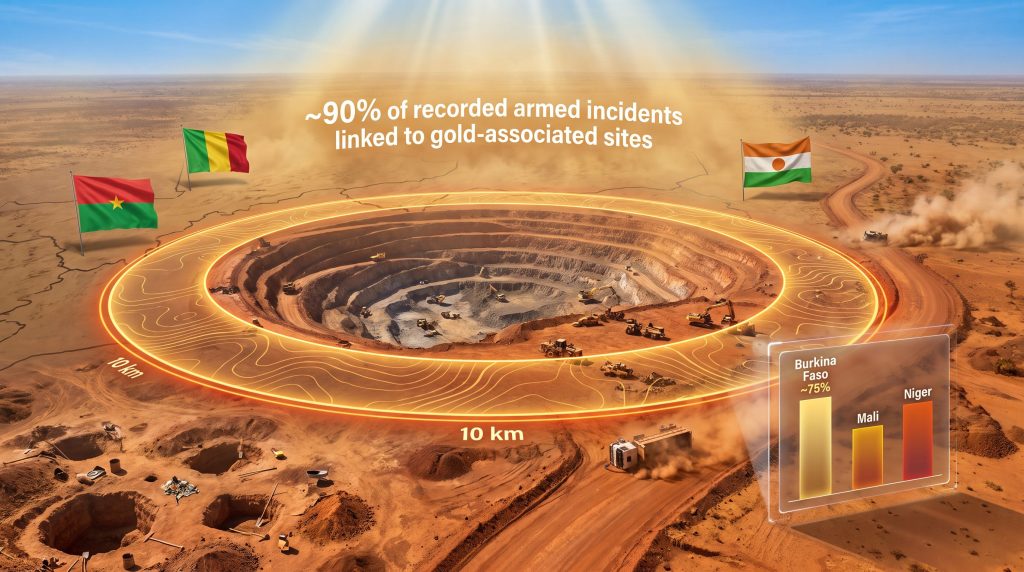
Data compiled by the Armed Conflict Location and Event Data Project (ACLED) reveals the scale of this overlap in striking terms. Gold-related sites account for approximately 90% of all recorded armed incidents across Burkina Faso, Mali, and Niger, with a significant clustering of events occurring within roughly 10 kilometres of mining concession boundaries. That perimeter is not arbitrary. It represents the operational zone within which armed groups can plausibly interdict supply chains, intimidate communities, and impose informal taxation without triggering the full defensive response that a direct assault on an industrial facility would demand.
Since 2015, Burkina Faso has absorbed approximately three-quarters of all mining-linked conflict incidents in the region. However, the trajectory in Mali and Niger is accelerating, suggesting not a geographic concentration effect but a deliberate regional diffusion of militant operational reach. This pattern carries significant implications for how investors and operators calibrate risk across the tri-border zone. For those tracking the geopolitical landscape for metals, this diffusion of risk is a critical variable to monitor closely.
Country-by-Country Risk Breakdown
| Country | Share of Mining-Linked Incidents (since 2015) | Primary Armed Actor | Major Operators Present |
|---|---|---|---|
| Burkina Faso | ~75% | JNIM | Endeavour Mining, Allied Gold |
| Mali | Growing (post-2021) | JNIM / ISSP | Barrick Mining, B2Gold |
| Niger | Emerging exposure | ISSP / ISIS-Sahel | Smaller concession holders |
Who Is Operating in the Sahel's Mining Corridors?
JNIM: The Dominant Armed Actor
Jama'at Nusrat al-Islam wal-Muslimin, commonly abbreviated as JNIM, is an al-Qaeda affiliate that has established itself as the dominant non-state armed actor across the tri-border region. Its expansion into mining corridors reflects a deliberate strategic logic rather than opportunistic raiding. Researchers tracking violent extremism in the Sahel have documented how this group's reach has expanded systematically across resource-rich terrain.
JNIM's preference is not to seize industrial assets directly. Large-scale mining operations maintain security infrastructure, communication systems, and international visibility that make direct assault both resource-intensive and tactically inadvisable. Instead, JNIM has perfected a model of peripheral pressure: attacking roads and transport corridors, disrupting supply chains, intimidating surrounding communities, and establishing parallel administrative authority in areas where state presence has collapsed.
This approach achieves multiple objectives simultaneously. It generates revenue through informal taxation of artisanal and small-scale miners (ASM) operating in ungoverned areas. It builds territorial legitimacy by positioning the group as a governance substitute in communities abandoned by the state. And it imposes costs on formal mining operations without requiring the resources that a direct assault would demand.
ISSP and the Competitive Dynamic
The Islamic State Sahel Province (ISSP), sometimes referred to as ISIS-Sahel or ISWAP in regional contexts, represents a secondary but expanding threat actor in the same geography. Where JNIM tends to favour influence-building and peripheral disruption, ISSP has demonstrated a higher tolerance for direct confrontation and territorial seizure.
The rivalry between these two organisations is itself a risk multiplier. When two armed factions compete for the same resource-rich territory, the resulting instability is less predictable than a single-actor insurgency. Communities and operations caught between competing groups face pressure from multiple directions, and the normal logic of engagement, where paying one group provides some protection, breaks down when a rival group views that payment as evidence of collaboration with an enemy.
How Armed Groups Monetise Mining Zones
The financial architecture that Islamist militants in Sahel mining zones have constructed around gold production is more sophisticated than simple looting. Several distinct revenue mechanisms operate simultaneously:
-
ASM taxation: Artisanal and small-scale miners operating in or near conflict-affected zones are subjected to systematic extraction of fees, described variously as taxes, protection payments, or zakat. These payments are recurring, not one-time, creating a stable income stream for armed groups.
-
Territorial control of ungoverned sites: In areas where state authority has effectively dissolved, armed groups assume quasi-administrative functions, controlling access to mining sites and capturing revenue that would otherwise flow to formal operators or government royalties.
-
Gold as a financing vehicle: Physical gold offers properties that make it particularly valuable to militant financing operations. It is portable, high-value per unit of weight, globally liquid, and exceptionally difficult to trace through informal trade networks. Gold smuggled across the Sahel's porous borders can be converted to cash with minimal documentation requirements.
-
Supply chain leverage: By controlling key roads and border crossings, armed groups can extract payments from fuel suppliers, equipment transporters, and food suppliers servicing mining operations, without ever directly engaging the mine itself.
Beyond pure revenue, mining zones provide recruitment pools drawn from economically marginalised communities, access to explosives and heavy equipment through mining supply chains, and logistical infrastructure for militant movement across vast, sparsely populated terrain. A Reuters investigation into gold and Islamists in Africa has further detailed the sophisticated nature of these financial networks.
Gold mines in conflict-affected Sahel zones function simultaneously as revenue sources, recruitment environments, and logistical nodes, making them strategically valuable to armed groups far beyond the mineral content alone.
The Asymmetric Vulnerability of Smaller Operations
One of the least appreciated dimensions of this threat landscape is how dramatically exposure varies by operational scale. ACLED's analysis confirms that attacks tend to cluster around the fringes of mining operations rather than targeting industrial sites directly, precisely because the latter demands more resources and carries greater tactical risk for armed groups.
Smaller, semi-mechanised operations represent a fundamentally different risk profile. They typically lack the private security infrastructure, community relations programmes, and intelligence-sharing arrangements that major producers have developed. They often operate with thinner capital buffers, meaning operational disruptions translate more rapidly into financial distress. And they are frequently located in more remote areas where state security forces cannot respond reliably.
The kidnapping risk dimension illustrates this asymmetry acutely. Approximately a dozen incidents involving Chinese nationals were recorded over the past year, with victims predominantly associated with smaller operations rather than the major industrial producers. This pattern signals a deliberate targeting logic: smaller operations offer accessible targets with lower defensive risk and potentially significant ransom or leverage value.
For a mid-tier operator with a concession within 10 kilometres of a contested road network, the compounding effect of these risks is severe. Supply disruption, workforce intimidation, potential informal taxation by armed actors, and kidnapping exposure can all operate simultaneously, yet the operator lacks the resources to address any of them with the same sophistication available to a major producer.
State Capacity Constraints and the Security Vacuum
Understanding the operating environment for Islamist militants in Sahel mining zones requires confronting an uncomfortable structural reality: the governments of Burkina Faso, Mali, and Niger face profound limitations in protecting dispersed mining concessions across territories that dwarf their effective security reach.
Military junta governance in both Burkina Faso and Mali has fundamentally altered the security partnership landscape for international mining companies. The withdrawal of Western security assistance, including French military operations and various international capacity-building programmes, removed a meaningful layer of deterrence without being replaced by equivalent capability. The Russian-linked Wagner Group's presence in Mali, subsequently operating under the Africa Corps branding, has introduced a different set of security dynamics that international operators must navigate carefully.
Corporate responses have evolved along several tracks:
-
Intelligence-led threat assessment frameworks that map incident patterns to operational decision-making around workforce deployment and supply scheduling.
-
Enhanced private security contractor engagement to fill gaps that state security forces cannot reliably cover around concession perimeters.
-
Community engagement investment designed to reduce the information asymmetry that armed groups exploit and to build local relationships that improve early warning of threat activity.
-
Operational pauses and strategic reassessment of concession viability in the most severely affected areas.
The artisanal mining sector remains an almost entirely unprotected vulnerability. ASM communities bear the greatest direct exposure to militant taxation and coercion, yet formalising ASM operations in conflict-affected zones, which would reduce armed group financial access, requires state capacity and governance stability that simply does not exist at the required scale.
The next major ASX story will hit our subscribers first
Three Scenarios for the Sahel Gold Sector
The trajectory of this situation admits meaningfully different outcomes depending on how several variables interact over the next five years.
Scenario 1: Managed Containment. Security conditions stabilise around major industrial operations through enhanced private and state security coordination. Junior operators and ASM communities continue to bear disproportionate risk, but gold output from major producers is maintained. Expansion investment stalls but does not reverse. This scenario requires no significant improvement in state capacity, only successful ring-fencing of the most productive formal operations.
Scenario 2: Progressive Deterioration. Militant territorial expansion continues at recent pace, gradually pushing the effective 10-kilometre risk perimeter outward. Major operators begin strategic withdrawal or operational consolidation around their most defensible assets. Regional gold output contracts meaningfully, with supply-side pressure feeding through to global gold markets already supported by strong demand fundamentals.
Scenario 3: Structural Transformation. Sustained militant control over key mining corridors triggers a fundamental restructuring of the Sahel's gold sector. Informal and militant-controlled gold flows increasingly replace formal production as the dominant output mechanism. International investment retreats entirely, and the region's gold economy informalises in ways that are exceptionally difficult to reverse without sustained political and security transformation.
Disclaimer: Scenario projections involve inherent uncertainty and should not be interpreted as forecasts or investment recommendations. Security and geopolitical environments can shift rapidly and unpredictably.
What This Means for Global Gold Markets and ESG Frameworks
Burkina Faso and Mali collectively represent a meaningful share of African gold production, and Africa's growing importance in global gold supply makes sustained instability in the Sahel a factor that commodity analysts increasingly cannot ignore. If Scenario 2 or 3 materialises, the supply-side constraint effect could contribute structural upward pressure on gold prices over a multi-year horizon, compounding the demand-side drivers already operating through central bank accumulation and safe-haven positioning.
For institutional investors applying ESG risk frameworks to mining equity portfolios, the Sahel situation presents a challenge that sits uncomfortably across multiple categories. It is simultaneously a security risk, a governance risk, a human rights exposure, and an operational continuity concern. The growing evidence of militant financing through gold trade networks also raises questions about supply chain due diligence obligations that responsible investment frameworks are only beginning to grapple with at the practical level.
The scale gap between large-cap operators and junior concession holders is not merely an operational risk variable. It is increasingly an ESG differentiator, with smaller operators less able to implement the community engagement, security infrastructure, and supply chain transparency measures that institutional investors are beginning to require. In addition, understanding gold as a strategic investment in 2025 means accounting for these geopolitical and security dynamics as core inputs, not peripheral considerations.
For a broader view of how these forces are shaping commodity valuations, the gold market investment outlook for 2025 provides important context on how supply disruptions in key producing regions translate into price dynamics.
Furthermore, analysts monitoring gold price record highs in 2025 should incorporate Sahel instability as a structural supply-side variable alongside the more commonly cited demand factors.
Frequently Asked Questions: Islamist Militants and Sahel Mining Zones
Which armed groups are most active in Sahel mining zones?
JNIM, an al-Qaeda affiliate, is the most consistently active group across Burkina Faso, Mali, and Niger. The Islamic State Sahel Province represents a secondary but expanding threat actor operating across overlapping geography.
Why do militants target areas around mines rather than the mines themselves?
Large industrial operations maintain security infrastructure that makes direct assault both resource-intensive and operationally risky. Peripheral targets, including roads, supply routes, smaller operations, and surrounding communities, offer lower-risk opportunities for disruption, informal taxation, and territorial influence.
What percentage of Sahel conflict incidents are linked to gold sites?
Conflict monitoring data from ACLED indicates that gold-related sites account for approximately 90% of recorded armed incidents across Burkina Faso, Mali, and Niger, with significant concentration occurring within roughly 10 kilometres of mining concession boundaries.
How do militants financially benefit from mining zones?
Armed groups derive financial benefit through multiple mechanisms: direct taxation of artisanal miners, protection fee systems imposed on communities and supply chains, territorial control of mining sites in ungoverned areas, and access to informal gold trade networks that provide portable and difficult-to-trace revenue.
Which countries face the highest mining-linked conflict exposure?
Burkina Faso has historically accounted for approximately three-quarters of mining-adjacent conflict incidents in the region since 2015, though Mali and Niger have recorded accelerating exposure in more recent periods.
What does this mean for gold investors?
Sustained instability in two of Africa's largest gold-producing nations introduces supply-side uncertainty that can affect both equity valuations for affected operators and broader commodity price dynamics. Investors should treat Sahel security conditions as a live variable in both single-stock and thematic commodity analysis. This is not financial advice; readers should consult qualified financial professionals before making investment decisions.
Want to Stay Ahead of Major ASX Mineral Discoveries Shaping Global Commodity Markets?
As geopolitical pressures and supply-side disruptions increasingly influence gold valuations, Discovery Alert's proprietary Discovery IQ model delivers real-time alerts on significant ASX mineral discoveries, translating complex market signals into actionable investment opportunities the moment they emerge — begin your 14-day free trial today to gain a market-leading edge, or explore Discovery Alert's dedicated discoveries page to understand how historic mineral finds have generated substantial returns.