August 24, 2026
When the Financial System Shuts You Out, Gold Becomes the Last Key
There is a scenario that most sovereign treasurers treat as a theoretical edge case: complete exclusion from the global financial system. No dollar-clearing access. No SWIFT connectivity. No ability to sell foreign bonds or draw on international credit lines. For most nations, this remains an abstract contingency. For Russia in 2026, it is the operating reality, and Russia selling gold to support its economy is providing one of the most instructive case studies in reserve asset design that financial analysts have seen in decades.
The way Russia is managing this constraint, specifically through the monetisation of domestically held gold, is reshaping how policymakers, investors, and geopolitical risk analysts think about what sovereign reserves are actually for. Furthermore, the implications extend well beyond Russia's borders, influencing how central banks worldwide approach reserve composition.
When big ASX news breaks, our subscribers know first
Russia's Decade-Long Preparation for Economic Isolation
The story of Russia selling gold to support its economy does not begin in 2026. It begins in 2014, when the Bank of Russia responded to the first wave of Western sanctions following the annexation of Crimea by launching a systematic and aggressive gold accumulation programme. Understanding Russia gold reserves requires examining this longer strategic arc.
Over the six years that followed, from 2014 to 2020, the Bank of Russia added approximately 1,244 tonnes (roughly 40 million ounces) to its gold reserves. Critically, this accumulation occurred while gold was trading in a relatively compressed price range of approximately $1,100 to $1,500 per ounce, establishing a cost basis well below current market valuations.
This was not passive portfolio management. The deliberate scale and consistency of Russia's gold buying during that period reflected a strategic calculation that the country's financial infrastructure needed to be hardened against a future in which access to Western-controlled financial systems could not be guaranteed.
Alongside the central bank's accumulation, Russian authorities made a further pre-positioning move before the February 2022 invasion of Ukraine. The National Wealth Fund (NWF) portfolio was restructured to hold approximately 60% in Chinese yuan and 40% in gold, deliberately eliminating exposure to dollar, euro, and sterling assets. According to research published by the RAND Corporation, this repositioning was a clear signal that Russia was anticipating intensified Western economic pressure. That anticipation proved accurate.
When sweeping sanctions were imposed following the invasion, roughly half of Russia's total reserves, those held in Western currency-denominated instruments, were effectively frozen. The yuan and gold holdings remained fully accessible. The pre-positioning had functioned precisely as designed.
The Scale of Russia's 2026 Gold Sales
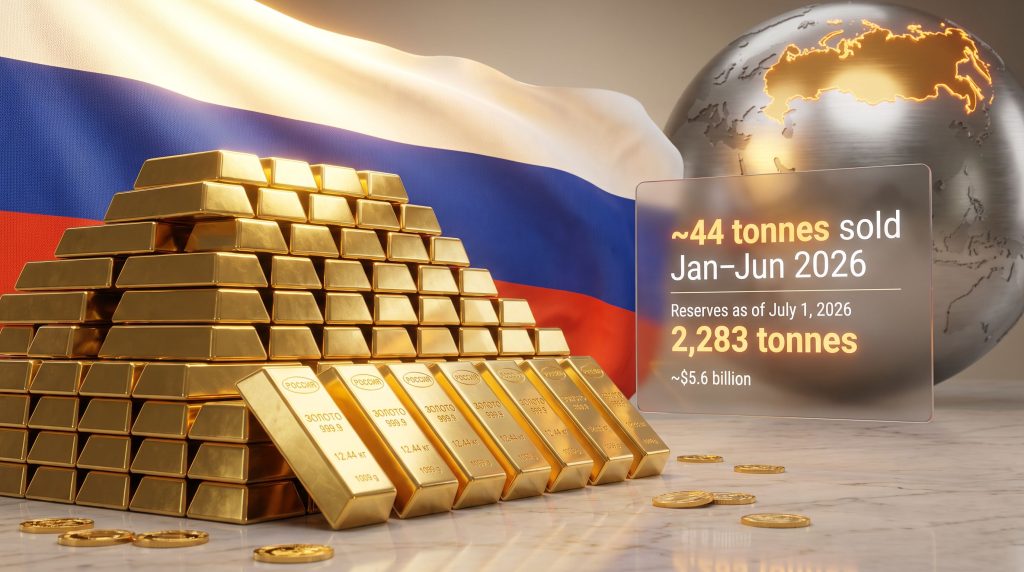
Against that backdrop, the current pace of Russian gold sales becomes both understandable and historically significant. According to data compiled by the World Gold Council, Russia has sold approximately 44 tonnes of gold between January and June 2026, with the Bank of Russia reducing its reserves by nearly 10 tonnes in June alone. The Moscow Times characterised the current drawdown as the largest in decades, a description the underlying data supports clearly.
The following table summarises the key metrics of Russia's 2026 gold drawdown:
| Metric | Estimated Figure |
|---|---|
| Total gold sold (January to June 2026) | ~44 tonnes |
| Gold sold in June 2026 alone | ~10 tonnes |
| Q1 2026 sales (January to March) | ~21.8 tonnes |
| January 2026 sales | ~300,000 ounces |
| February 2026 sales | ~200,000 ounces |
| Estimated total proceeds | ~$5.6 billion |
| Gold reserves as of July 1, 2026 | 2,283 tonnes (73.4 million ounces) |
| Reserve level context | Lowest since February 2020 |
To contextualise the magnitude of this drawdown, consider the pandemic comparison. Between July 2020 and April 2021, a period of severe economic disruption, Russia sold approximately 7.6 tonnes of gold to support the ruble and shore up fiscal accounts. That figure represents roughly one-sixth of what has been sold in the first half of 2026 alone.
What Is Actually Driving the Selldown
Fiscal Pressures and Shrinking Hydrocarbon Revenues
Russia's government budget deficit has widened to approximately ₽7 trillion, equivalent to around $89 billion USD. This expansion is being driven by the compounding cost of the ongoing conflict in Ukraine, rising military expenditure, and sanctions-related disruptions to the country's primary revenue source.
Hydrocarbon revenues, which historically fund a substantial portion of Russia's federal budget, have fallen below the thresholds mandated by the country's fiscal rule mechanism. Under that framework, when energy revenues drop below a defined baseline, the government is required to draw on reserve assets to offset the shortfall. This is not a discretionary choice, it is a structural rule-based response embedded in Russia's fiscal architecture.
The Mechanics of Domestic Gold Monetisation
What makes Russia's gold operations particularly notable is the channel through which they are being conducted. Rather than selling into international gold markets, which would require access to global financial infrastructure that sanctions have largely closed off, the Bank of Russia has been selling gold directly into the domestic market. Kitco News has reported extensively on how this domestic mechanism functions under sanction constraints.
This mechanism works as follows:
- The Bank of Russia sells physical gold to domestic buyers, primarily Russian commercial banks and financial institutions.
- Those transactions are settled in rubles, generating domestic currency liquidity.
- That ruble liquidity flows into the financial system, supporting government expenditure without requiring any interaction with Western-controlled payment infrastructure.
The Finance Ministry has been conducting parallel operations through the NWF using a similar approach. The dual-channel structure allows Russia to convert its gold reserves into budget support at a pace that matches fiscal need, without triggering the sanctions exposure that international market operations would create.
Why Gold Works When Everything Else Doesn't
Three structural characteristics make gold uniquely functional for a sanctions-constrained sovereign, reinforcing gold's safe-haven role in extreme circumstances:
- Physical domestic custody: Russia's gold is stored within Russian territory and is entirely outside the jurisdictional reach of Western asset-freezing mechanisms. Unlike dollar or euro reserves, which exist as claims on foreign financial institutions, physical gold held domestically cannot be frozen remotely.
- Counterparty independence: Gold carries no issuer risk. It is not a claim on any government, central bank, or financial institution. This means no third party can unilaterally devalue, freeze, or restrict access to it.
- Appreciated value: Because Russia accumulated the bulk of its gold between $1,100 and $1,500 per ounce, and gold has since traded substantially higher, every tonne sold today generates significantly more revenue than its original acquisition cost. The embedded gain on Russia's gold stockpile represents a meaningful fiscal buffer built over years of patient accumulation.
Russia's experience makes clear that gold's value as a reserve asset is most visible precisely when conventional financial infrastructure becomes inaccessible. It is the asset that functions when all others have been neutralised.
Two Competing Frameworks for Interpreting the Selldown
Analysts have not reached consensus on how to characterise the nature of Russia's gold sales. Two distinct interpretive frameworks exist:
The emergency liquidation view holds that the scale of selling, unprecedented in recent decades and dwarfing pandemic-era drawdowns by a factor of approximately six, signals acute and deepening fiscal stress. Under this reading, Russia is monetising reserves out of necessity rather than by choice, and the pace of drawdown limits future fiscal flexibility.
The structural mechanism view holds that these transactions are the automatic output of Russia's fiscal rule system, not a panicked policy response. When hydrocarbon revenues fall below the threshold stipulated in the rule, the Bank of Russia executes offsetting transactions using liquid reserve assets. The gold sales are technically mandated by the fiscal framework, not by a specific government decision to sell gold.
The most analytically defensible position sits between these poles. Russia is operating a rules-based fiscal mechanism that happens to be drawing on gold reserves, but it is doing so under conditions of genuine and compounding fiscal stress. The mechanism is functioning as designed, but the conditions driving it are historically severe.
What Russia's Strategy Reveals About Sovereign Reserve Design
The Counterparty Risk Lesson
Prior to 2022, Russia held approximately half of its total reserves in Western currency-denominated assets, primarily dollars, euros, and sterling. Those assets were frozen within days of the February 2022 invasion, effectively removing half of Russia's reserve capacity from any operational use.
The contrast with its gold and yuan holdings is stark. Assets held in physical form domestically, or denominated in the currency of a non-sanctioning counterpart, remained fully accessible. This bifurcation between accessible and inaccessible reserves has become a core data point in global discussions about central bank gold reserves and optimal reserve composition.
The Broader Implications for Central Bank Reserve Allocation
Russia's experience has not gone unnoticed by other sovereign reserve managers. Central bank gold demand has been rising globally, particularly in emerging market economies, as a hedge against potential financial system exclusion. This is a structural demand trend increasingly shaped by geopolitical risk rather than purely by monetary policy considerations or inflation expectations.
The strategic calculus being applied by a growing number of central banks reflects the following logic:
- Gold produces no yield, which is a real cost in high-rate environments.
- However, gold held in domestic physical custody is immune to sanctions, counterparty default, and third-party policy decisions.
- In scenarios where conventional reserve assets become inaccessible, gold held domestically may be the only deployable reserve asset.
- Therefore, the yield cost of holding gold is better understood as an insurance premium against financial system exclusion risk.
Russia's current position demonstrates that this insurance, when needed, can generate billions of dollars in fiscal support under conditions where no other mechanism is available. Consequently, discussions about gold in the monetary system have taken on renewed urgency among policymakers worldwide.
The next major ASX story will hit our subscribers first
Frequently Asked Questions
How much gold has Russia sold in 2026?
Russia has sold approximately 44 tonnes of gold between January and June 2026, raising an estimated $5.6 billion in proceeds. The Bank of Russia reduced reserves by nearly 10 tonnes in June 2026 alone, with some estimates placing cumulative proceeds above $4 billion by May.
Why is Russia selling gold rather than other reserve assets?
Western sanctions have frozen or restricted access to Russia's dollar, euro, and sterling-denominated reserve assets. Gold held domestically is beyond the jurisdictional reach of those restrictions, making it one of the few liquid assets Russia can actually access and deploy.
Is Russia running out of gold?
As of July 1, 2026, Russia holds approximately 2,283 tonnes (73.4 million ounces) of gold, the lowest level since February 2020 but still a substantial sovereign holding. The current pace of drawdown is historically elevated, but the reserve base remains significant.
How is Russia selling gold under sanctions?
The Bank of Russia is selling gold directly into the domestic market, transacting with Russian commercial banks and financial institutions. This converts gold into ruble liquidity without requiring access to international financial infrastructure that sanctions have closed off.
What is the revenue being used for?
Proceeds are directed toward covering the government's widening budget deficit, supporting ruble liquidity, and financing state expenditure amid structurally reduced hydrocarbon revenues.
Key Takeaways for Investors and Market Observers
Russia selling gold to support its economy in 2026 is not a sign of reserve collapse. It is, however, the activation of a financial contingency architecture that was deliberately constructed over more than a decade, built on the insight that gold held domestically is the one reserve asset that remains deployable under conditions of complete financial system exclusion.
For investors and market observers, the episode reinforces several important principles:
- Sovereign gold demand is increasingly driven by geopolitical risk diversification, not purely by inflation hedging or monetary policy cycles.
- The location and custody structure of reserve assets matters as much as their nominal value, a lesson with direct implications for how private investors think about gold ownership.
- Russia's embedded cost basis advantage, having accumulated at $1,100 to $1,500 per ounce, illustrates the long-term value of accumulating gold during periods of price suppression.
- The gap between Russia's 2020–21 pandemic-era gold sales (7.6 tonnes) and its 2026 first-half sales (44 tonnes) underscores how much more severe the current fiscal environment is compared to prior stress episodes.
Disclaimer: This article is intended for informational and educational purposes only and does not constitute financial or investment advice. All figures referenced reflect estimates and publicly reported data available at the time of writing. Readers should conduct their own research and consult qualified financial professionals before making any investment decisions.
Want to Understand Why Gold Remains the Ultimate Reserve Asset?
Discovery Alert's proprietary Discovery IQ model scans ASX announcements in real time, delivering instant alerts on significant gold and mineral discoveries so investors can act on opportunities well ahead of the broader market — explore historic discoveries and their extraordinary returns to see why early positioning matters, then begin your 14-day free trial to gain a genuine market-leading edge.