July 29, 2026
Island Nation Energy Security: Navigating the Complex Infrastructure Challenge
Small island nations face unique energy security challenges that mainland countries rarely encounter. Geographic isolation creates fundamental vulnerabilities in power generation, fuel storage, and grid stability that require specialised infrastructure solutions. These nations must balance energy independence against economic constraints while managing seasonal demand variations and climate-related supply disruptions, making energy security trends increasingly critical for strategic planning.
New Zealand exemplifies this challenge. The country's electricity grid depends heavily on hydroelectric generation, creating significant exposure to drought cycles that can reduce power output during critical periods. When rainfall patterns shift or extended dry spells occur, the nation's energy security becomes compromised, forcing difficult decisions about resource allocation between industrial users and residential consumers.
Recent industrial disruptions highlight these vulnerabilities. Major chemical and metals processing facilities have experienced production cuts when gas supplies were diverted to electricity generation during peak demand periods. This cascade effect demonstrates how energy shortfalls in one sector ripple through the broader economy, affecting manufacturing competitiveness and export revenues.
The economic impact extends beyond immediate production losses. Rising electricity costs during supply constraints burden both businesses and households, while uncertainty about future availability discourages long-term industrial investment. These factors combine to create a compelling case for energy infrastructure diversification, even when such projects require substantial capital investment and regulatory approval.
When big ASX news breaks, our subscribers know first
Technical Infrastructure Requirements for Coastal LNG Operations
Establishing LNG import capabilities requires sophisticated coastal infrastructure designed to handle specialised vessel operations and high-pressure gas processing systems. The technical complexity extends far beyond simple port modifications, encompassing marine engineering, safety systems, and integration with existing energy networks.
Water depth represents a critical constraint for LNG carrier access. Large-scale carriers require minimum depths of 10-12 metres at berth positions, with additional clearance for safe manoeuvring during loading operations. Furthermore, port authorities must conduct detailed bathymetric surveys and potentially undertake dredging projects to accommodate these vessel specifications.
Key Infrastructure Components:
- Specialised berthing facilities with cryogenic transfer systems
- High-capacity regasification units rated for continuous operation
- Pressure reduction stations for pipeline network integration
- Emergency shutdown systems with marine environment protection
- Storage facilities designed for liquefied gas handling
Safety protocols for LNG operations near populated coastal areas require extensive risk assessment and emergency response planning. These systems must address potential release scenarios, fire suppression capabilities, and evacuation procedures while maintaining operational efficiency during normal loading cycles.
Integration with existing pipeline networks presents additional engineering challenges. New compression stations, flow control systems, and metering facilities must be designed to handle variable supply patterns while maintaining grid stability. The distance between import terminals and major industrial users directly affects project economics and technical feasibility.
Strategic Location Analysis: Taranaki Basin Advantages
The Taranaki region offers compelling advantages for New Zealand LNG import terminal development. This area already hosts significant energy infrastructure, including existing natural gas fields, pipeline networks, and industrial facilities that can leverage imported gas supplies. However, the proximity to established energy corridors reduces connection costs and regulatory complexity compared to alternative locations.
Geographic factors strongly favour the Taranaki basin for maritime operations. Natural harbour depths and sheltered coastal conditions provide suitable environments for large LNG carrier operations. In addition, the region's experience with offshore energy projects contributes technical expertise and regulatory familiarity that benefits complex infrastructure development.
Location Comparison Factors:
| Criteria | Taranaki Basin | Alternative Ports |
|---|---|---|
| Water depth at berth | 12-15 metres | 8-12 metres |
| Existing pipeline access | <20 kilometres | 50-150 kilometres |
| Industrial user proximity | <100 kilometres | 200+ kilometres |
| Weather protection | Excellent | Variable |
The existing gas pipeline infrastructure in Taranaki significantly reduces capital requirements for terminal development. Connection distances of less than 50 kilometres to major transmission lines enable cost-effective integration compared to greenfield locations requiring extensive new pipeline construction.
Environmental impact assessments for coastal development must address marine ecosystem effects, coastal erosion patterns, and interaction with existing industrial activities. The Taranaki region's established energy sector provides baseline environmental data and regulatory frameworks that can expedite approval processes.
Industrial proximity represents another strategic advantage. Major chemical processing facilities and steel production sites within 100 kilometres of the proposed terminal location can utilise imported gas for feedstock and energy requirements. This geographic clustering enhances project economics by providing multiple demand sources for terminal output.
Financial Impact Assessment: Consumer Cost Analysis
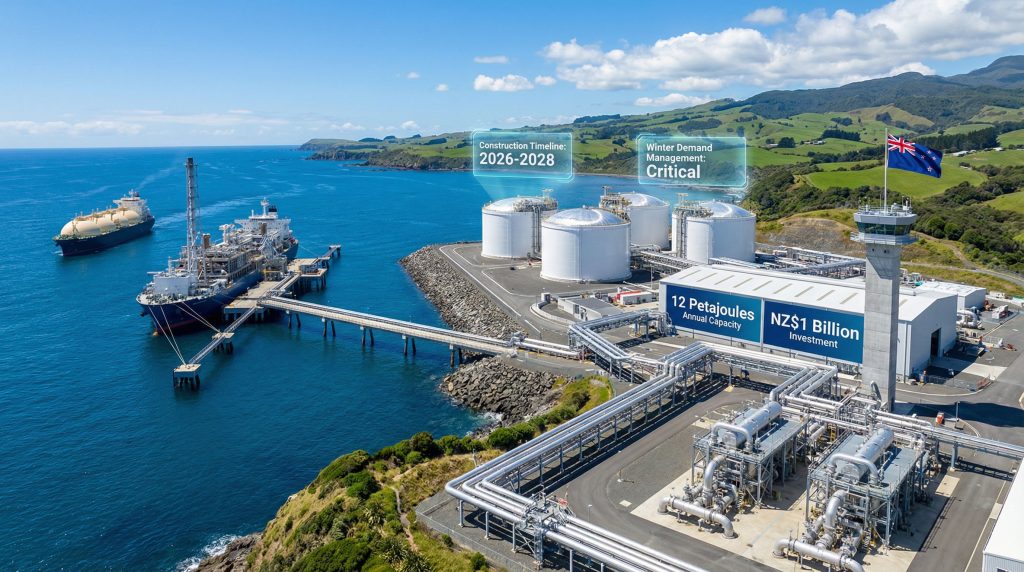
The New Zealand LNG import terminal project involves substantial financial commitments that will be distributed across energy sector participants through industry levy mechanisms. Capital expenditures exceeding NZ$1 billion position this as one of the country's largest energy infrastructure investments in recent decades.
Government proposals establish an industry levy structure of NZ$2-4 per megawatt-hour to fund terminal operations. This mechanism distributes costs across electricity market participants while providing dedicated revenue streams for debt service and operational expenses. For instance, the levy represents a relatively modest impact compared to typical electricity price volatility in New Zealand markets.
Project Cost Breakdown:
- Total capital investment: Above NZ$1 billion ($600 million USD)
- Annual operational costs: NZ$170-210 million per year
- Industry levy rate: NZ$2-4 per MWh
- Projected consumer benefit: NZ$10 per MWh savings
The economic justification rests on avoiding significantly higher costs during supply shortage periods. Historical analysis demonstrates that electricity price spikes during winter months or drought conditions can exceed NZ$100 per megawatt-hour above normal levels, making the terminal's capacity valuable for price stabilisation.
Landing costs for imported LNG are estimated at $10.12-10.37 per million BTU based on feasibility studies conducted in 2025. These figures include transportation, regasification, and distribution expenses but exclude potential price premiums during high-demand periods or supply disruptions in global LNG markets.
Consumer impact modelling suggests that the levy costs will be offset by reduced electricity price volatility and improved industrial competitiveness. The ability to supplement domestic generation during peak demand periods should moderate wholesale electricity prices and reduce the frequency of supply shortage events that drive consumer cost increases.
Economic Impact Summary
Government analysis indicates that terminal operations could deliver net consumer benefits of approximately NZ$10 per megawatt-hour through reduced price volatility and improved energy security, significantly outweighing the proposed industry levy costs.
Technology Solutions and System Integration
The terminal project incorporates advanced regasification technology capable of processing 12 petajoules (320 million cubic metres) of gas during peak winter demand periods. This capacity represents approximately half of New Zealand's strategic fuel reserve requirements, providing substantial buffer capacity for seasonal demand management.
Regasification systems must handle extreme temperature differentials while maintaining consistent output pressure for pipeline injection. Consequently, modern facilities utilise ambient air vaporizers supplemented by seawater heating systems to achieve efficient gas processing without excessive energy consumption. These systems require sophisticated control mechanisms to manage varying LNG composition and heating requirements.
Technical Specifications:
- Peak regasification capacity: 12 PJ annually (320 million m³)
- Storage tank specifications: Multi-tank configuration for operational flexibility
- Pipeline injection pressure: Designed for existing transmission network compatibility
- Control systems: Automated flow management with emergency shutdown capabilities
Storage tank design considerations balance operational flexibility against capital cost constraints. Multiple smaller tanks provide greater operational control compared to single large-capacity installations, enabling maintenance scheduling and inventory management during varying demand periods. Tank sizing must accommodate LNG cargo volumes while providing adequate working gas storage for daily demand fluctuations.
Integration with New Zealand's existing gas transmission network requires pressure regulation stations and flow measurement systems designed for variable injection rates. The terminal must accommodate both steady-state operations during normal demand periods and rapid ramp-up capabilities during emergency supply situations.
Pipeline distribution network modifications may be necessary to handle increased gas flows to major industrial users. Compression station upgrades and new transmission lines could extend the terminal's effective service area to chemical processing facilities and power generation plants throughout the North Island.
Implementation Timeline and Procurement Process
Government procurement schedules target contractor selection by mid-2026 from a shortlist of six leading international proposals. This timeline reflects the political urgency surrounding energy security concerns and the desire to complete construction before potential policy changes following the November 2026 election.
The accelerated development schedule aims for terminal commissioning between mid-2027 and early 2028. This represents an ambitious timeline for LNG import facility construction, requiring careful coordination of engineering design, regulatory approval, and construction sequencing to avoid critical path delays.
Project Timeline Milestones:
- Contractor selection: Mid-2026 contract signing
- Final design completion: Q4 2026
- Construction commencement: Q1 2027
- Systems commissioning: Mid-2027 to early 2028
- Commercial operations: Winter 2028 demand season
Seasonal demand patterns drive project urgency, as New Zealand's peak gas requirements typically occur during winter months when electricity demand increases and hydroelectric generation may be constrained by drought conditions. Missing the 2027 winter season would delay operational benefits by a full year and potentially expose the country to another period of energy supply vulnerability.
Risk factors for schedule adherence include weather delays during coastal construction, equipment delivery timelines for specialised regasification systems, and regulatory approval processes for environmental permits. International LNG terminal projects have historically experienced schedule overruns due to technical complexity and safety requirement compliance.
Political considerations add another dimension to timeline pressures. The current government's commitment to energy infrastructure development may not survive potential policy changes following the 2026 election, creating incentives for rapid project advancement before political transition occurs.
The next major ASX story will hit our subscribers first
Competitive Contractor Landscape
Six international engineering firms have advanced to the final contractor selection process, representing a competitive field of companies with proven LNG terminal development experience. The diversity of technical approaches and financing structures among bidders provides the government with multiple viable implementation pathways.
International LNG terminal specialists typically offer different approaches to floating versus onshore facility configurations. Floating storage and regasification units (FSRUs) provide faster deployment timelines but may have higher operational costs compared to permanent onshore installations. The choice between these approaches significantly affects project economics and long-term operational flexibility.
Contractor Selection Criteria:
- Technical capability: Proven LNG terminal construction experience
- Financial capacity: Ability to manage billion-dollar infrastructure projects
- Local partnerships: New Zealand construction and engineering alliances
- Timeline commitments: Ability to meet aggressive commissioning schedules
- Technology solutions: Equipment reliability and operational efficiency
Financing arrangements vary substantially among competing proposals. Some contractors offer turnkey development with long-term service contracts, while others focus on construction-only agreements that transfer operational responsibility to government entities. These structural differences affect risk allocation and long-term cost implications for New Zealand taxpayers.
Risk allocation models proposed by different contractors reflect varying approaches to technical, financial, and operational uncertainties. Performance guarantees, commissioning warranties, and operational support agreements create different risk profiles that government evaluators must assess against project objectives and budget constraints.
The exclusion of Beach Energy, operator of the existing Kupe gas plant, from significant new investment reflects broader industry concerns about political stability and regulatory predictability in New Zealand's energy sector. This situation may influence contractor proposals and risk premiums incorporated into bidding strategies.
What Are the Seasonal Energy Security Implications?
Winter demand management represents the primary justification for LNG import capabilities, as New Zealand's gas-fired power generation requirements increase substantially during cooler months. The terminal's 12 petajoule capacity provides approximately half of the country's strategic fuel reserve needs, offering significant buffer capacity for managing seasonal supply variations.
Industrial process continuity during drought years becomes critical when hydroelectric generation declines and gas supplies must prioritise electricity generation over manufacturing feedstock requirements. The 2024 production cuts at major chemical and metals processing facilities demonstrate how energy shortfalls cascade through industrial supply chains, affecting export revenues and employment.
Seasonal Demand Factors:
- Winter heating requirements: Residential and commercial natural gas consumption
- Power generation backup: Gas-fired plants during low hydroelectric periods
- Industrial process heat: Manufacturing facilities requiring consistent energy supply
- Grid stability services: Rapid-response generation for renewable energy intermittency
Emergency reserve capabilities extend beyond routine seasonal variations to include drought response and infrastructure failure scenarios. The terminal provides strategic flexibility for managing supply disruptions from domestic gas fields or transmission system outages that could otherwise trigger electricity shortages and industrial shutdowns.
Grid stability benefits from LNG imports include rapid-response generation capabilities that can complement intermittent renewable energy sources. As New Zealand expands wind and solar installations, having flexible gas-fired generation available becomes increasingly valuable for maintaining system reliability during variable weather conditions.
The economic value of avoiding supply shortage events significantly exceeds the terminal's operational costs. Historical electricity price spikes during winter demand peaks or drought conditions demonstrate the substantial costs imposed on consumers and businesses when energy security is compromised.
Environmental Considerations and Emissions Impact
Lifecycle emissions analysis for imported LNG versus domestic alternatives presents complex trade-offs between energy security and climate objectives. While LNG imports increase transportation-related emissions compared to domestic gas production, they may provide lower emissions intensity than coal-fired backup generation during supply shortages.
Marine ecosystem impact assessments for terminal operations must address potential effects on coastal fisheries, marine mammal populations, and sediment transport patterns. LNG operations involve substantial volumes of seawater for regasification cooling, requiring careful evaluation of thermal discharge effects and intake system impacts on marine life.
Environmental Assessment Areas:
- Marine discharge temperatures: Seawater cooling system thermal effects
- Coastal water quality: Potential impacts from terminal operations
- Air emissions: Regasification process and vessel traffic considerations
- Noise impacts: Marine traffic and industrial equipment effects
Carbon footprint calculations must account for the full supply chain of imported LNG, including production emissions in source countries, transportation via LNG carriers, and regasification energy requirements. These comprehensive assessments provide basis for comparing import strategies against domestic energy alternatives and renewable expansion scenarios.
Regulatory compliance with New Zealand's emissions reduction targets requires integration of terminal operations within broader climate policy frameworks. The facility must demonstrate compatibility with national carbon budgets and transition pathways toward net-zero emissions by 2050.
Alternative energy acceleration programmes, including wind and geothermal development, compete with LNG imports for investment resources and policy support. However, the government's liquefied natural gas import facility is expected to save New Zealanders millions by providing reliable backup capacity that enables greater renewable energy deployment without compromising grid stability.
Climate Policy Integration
Environmental assessments must demonstrate how LNG import capabilities support rather than undermine New Zealand's renewable energy transition by providing reliable backup capacity that enables greater renewable energy deployment without compromising grid stability.
Expert Analysis: Divided Perspectives on Terminal Necessity
Energy sector experts express divergent views on whether New Zealand LNG import terminal infrastructure represents optimal resource allocation for addressing energy security challenges. Economic modelling assumptions about future gas demand, renewable energy deployment rates, and demand response capabilities significantly influence cost-benefit assessments.
Political uncertainty surrounding energy policy creates additional complexity for long-term infrastructure planning. The Labour party's stated intention to reinstate offshore gas exploration bans, contrasted with the current government's support for domestic production incentives, creates regulatory uncertainty that affects private sector investment decisions.
Policy Uncertainty Factors:
- Exploration ban reversals: Potential policy changes affecting domestic gas development
- Renewable energy targets: Competing priorities for infrastructure investment
- Industrial competitiveness: Trade-offs between climate goals and economic growth
- Consumer cost distribution: Equity considerations for energy cost allocation
Alternative solutions including large-scale battery storage, demand response systems, and accelerated renewable deployment offer different pathways for managing seasonal energy variations. These approaches require comparison against LNG import capabilities on technical, economic, and environmental dimensions to evaluate optimal resource allocation.
Industry perspectives vary based on sectoral interests and risk tolerance for supply security. Chemical and metals processing facilities prioritise reliable gas availability for feedstock and process heat requirements, while renewable energy advocates emphasise investment in zero-emission generation capacity rather than fossil fuel infrastructure.
Financial market analysts question whether the terminal's economic benefits justify its substantial capital requirements, particularly given uncertainties about future gas prices and demand patterns. Furthermore, risk-adjusted return calculations must account for potential stranded asset scenarios if renewable energy deployment accelerates faster than current projections.
The November 2026 election timeline adds political pressure to infrastructure decisions, as different parties advocate substantially different approaches to energy security and climate policy. This electoral uncertainty affects both government decision-making and private sector willingness to commit resources to long-term energy projects.
How Does This Impact National Energy Independence Strategy?
The New Zealand LNG import terminal represents a strategic shift toward greater reliance on international energy markets rather than domestic resource development. This approach trades potential price volatility and supply chain risks against reduced domestic exploration and production investments in a politically uncertain environment, reflecting broader energy transition challenges facing developed nations.
Strategic energy independence traditionally emphasises domestic resource development and reduced import dependencies. However, small island nations often lack sufficient indigenous energy resources to meet growing demand, requiring careful balance between self-reliance objectives and economic competitiveness through diversified supply sources.
Energy Independence Trade-offs:
- Import dependency risks: Exposure to global LNG market volatility and supply disruptions
- Domestic resource constraints: Limited gas reserves and exploration restrictions
- Infrastructure investment: Competing capital allocation between imports and renewable development
- Economic competitiveness: Industrial cost structures and export sector viability
Regional energy cooperation opportunities with Australia could provide alternative approaches to energy security through interconnection projects or coordinated resource development. However, substantial geographic distances and technical challenges limit the feasibility of physical interconnection between the countries.
Long-term transition planning toward renewable energy dominance must accommodate interim requirements for reliable backup capacity during the multi-decade deployment period. LNG import capabilities could provide bridge infrastructure that enables more aggressive renewable deployment without compromising grid reliability.
The terminal's role in New Zealand's energy future depends significantly on renewable energy deployment rates, demand growth patterns, and technological developments in energy storage and grid management. These uncertainties require flexible infrastructure approaches that can adapt to changing circumstances over the facility's operational lifetime.
Industrial Competitiveness and Market Structure Effects
Chemical and metals processing facilities represent the primary industrial beneficiaries of improved gas supply security through LNG imports. These energy-intensive industries require consistent fuel availability for both process heat and chemical feedstock applications, making supply reliability often more important than marginal cost differences.
Manufacturing competitiveness in global markets depends substantially on predictable energy costs and supply availability. Production disruptions due to gas shortages impose costs that extend beyond immediate energy expenses to include customer relationship impacts, market share losses, and long-term investment deterrent effects.
Industrial Impact Assessment:
- Chemical processing: Feedstock security for methanol and ammonia production
- Steel and metals: Process heat reliability for continuous production operations
- Food processing: Energy cost stability for agricultural value-added exports
- Manufacturing: Competitive positioning relative to international production locations
Electricity market structure changes from LNG terminal operations could reduce wholesale price volatility and provide more predictable cost environments for industrial users. The facility's capacity to inject gas during high-demand periods should moderate peak electricity prices that disproportionately affect large industrial consumers.
Market structure effects extend beyond immediate cost impacts to include increased competition among gas suppliers and potential for more flexible supply contracting arrangements. Multiple supply sources reduce monopoly power of domestic producers and create opportunities for innovative pricing mechanisms and risk management products, particularly relevant given global oil price trends and their influence on energy markets.
Investment incentives for energy-intensive industries may improve substantially with enhanced supply security and reduced price volatility. Foreign direct investment in manufacturing sectors often depends heavily on reliable energy infrastructure and competitive cost structures compared to alternative production locations.
The terminal's contribution to New Zealand's industrial competitiveness must be evaluated against alternative policy approaches including renewable energy subsidies, demand response programmes, and energy efficiency investments that could achieve similar economic objectives through different mechanisms.
Future Implications for Energy Market Development
The establishment of LNG import infrastructure fundamentally alters New Zealand's energy market structure by introducing international price linkages and supply chain dependencies. This transformation affects long-term planning assumptions for renewable energy deployment, industrial development, and consumer pricing mechanisms.
Market integration with global LNG systems exposes New Zealand to international price volatility and supply chain risks that have historically been limited to oil imports. The correlation between natural gas price forecasts in major markets and domestic energy costs will increase significantly once terminal operations commence.
International supply contracts require long-term commitments that may conflict with renewable energy expansion plans or changing demand patterns. Balancing contractual obligations for LNG imports against variable renewable generation and seasonal demand fluctuations presents ongoing operational challenges for system operators.
The terminal's operational flexibility must accommodate scenarios where renewable energy deployment exceeds current projections, potentially reducing gas demand below contracted import levels. Take-or-pay provisions in international LNG contracts could create financial penalties for underutilisation of import capacity.
Technology developments in energy storage, demand response, and grid management may reduce the strategic value of gas-fired generation backup over the terminal's operational lifetime. These technological uncertainties affect long-term investment decisions and risk assessment for major infrastructure projects.
Political stability and regulatory predictability remain critical factors for attracting international investment in LNG supply chains and terminal operations. Moreover, the government shortlisted proposals to import LNG demonstrate commitment to energy security, though policy continuity across electoral cycles remains uncertain.
Regional energy market development, including potential expansion of LNG import facilities in other Pacific nations, could create opportunities for shared infrastructure or coordinated procurement that improves economics and supply security. However, geographic isolation limits practical cooperation options compared to continental energy systems.
This analysis incorporates available information from government announcements and industry sources as of February 2026. Project specifications, costs, and timelines remain subject to final contractor negotiations and regulatory approvals. Readers should consult official government sources for the most current project details and policy positions.
Ready to Discover the Next Big LNG and Energy Investment Opportunity?
Discovery Alert's proprietary Discovery IQ model delivers real-time notifications on significant ASX mineral discoveries, including critical energy infrastructure projects and commodity developments. Stay ahead of market movements with expert analysis on energy discoveries that could generate substantial returns, just as historic discoveries have proven. Begin your 14-day free trial today to position yourself ahead of the market with actionable investment insights.