May 14, 2026
IsoEnergy's strategic expansion through the IsoEnergy uranium acquisition strategy positions the company across multiple tier-one mining jurisdictions as global uranium supply constraints intensify. The company's systematic approach to geographic diversification and high-grade resource accumulation demonstrates sophisticated positioning for the projected uranium supply crisis extending through 2040.
Furthermore, traditional uranium development cycles, historically spanning 8-15 years from discovery to production, have extended to 10-20 years due to regulatory complexities and environmental review requirements. This timeline compression fundamentally alters the value proposition of existing uranium assets, particularly those with established permits or proven resource bases in stable jurisdictions.
Against this backdrop of supply scarcity and elongated development timelines, strategic positioning within tier-one mining jurisdictions has become critical for institutional capital allocation. The Fraser Institute's annual rankings of global mining jurisdictions serve as a benchmark for investment attractiveness, combining geological potential with policy stability metrics. Companies pursuing multi-jurisdictional strategies across highly-ranked territories position themselves to capture premium valuations as uranium market volatility intensifies through 2040.
Geographic Risk Distribution Through Tier-One Jurisdiction Selection
IsoEnergy's uranium acquisition strategy demonstrates systematic geographic diversification across jurisdictions that consistently rank within the Fraser Institute's top-performing territories. Saskatchewan secured third place globally on the 2026 Investment Attractiveness Index, marking its sixth top-ten placement across seven consecutive years. This sustained performance reflects the province's established uranium mining framework within the Athabasca Basin, where regulatory certainty and geological prospectivity converge.
Western Australia's ascent to sixth globally on the Investment Attractiveness Index and third on the Best Practices Mineral Potential Index represents the most significant jurisdictional improvement in the 2026 Fraser Institute survey. South Australia ranked fourth on the Investment Attractiveness Index, while Queensland placed thirteenth despite historical uranium mining lease restrictions. These rankings validate Australia's emergence as a preferred uranium development jurisdiction for institutional capital.
The Fraser Institute's ranking methodology combines two primary components: the Mineral Potential Index, which assesses geological prospectivity and resource endowment, and the Policy Perception Index, which evaluates regulatory frameworks, permitting timelines, and political risk. Utah's ranking of 38th overall on the Investment Attractiveness Index and 12th on the Policy Perception Index demonstrates policy stability advantages despite perceived mineral potential limitations.
Key Fraser Institute 2026 Rankings:
• Saskatchewan: 3rd globally (Investment Attractiveness Index)
• Western Australia: 6th globally (Investment Attractiveness Index), 3rd (Best Practices Mineral Potential Index)
• South Australia: 4th (Investment Attractiveness Index)
• Queensland: 13th (Investment Attractiveness Index)
• Utah: 38th (Investment Attractiveness Index), 12th (Policy Perception Index)
This geographic distribution reduces single-jurisdiction political risk while maintaining exposure to territories where institutional investors demonstrate confidence in deploying capital for long-term uranium development projects.
When big ASX news breaks, our subscribers know first
Resource Quality Versus Scale Economics in Portfolio Construction
The Hurricane deposit exemplifies high-grade resource concentration that differentiates IsoEnergy's uranium acquisition approach from traditional scale-focused consolidation strategies. With an Indicated Mineral Resource Estimate of 48.6 million pounds U3O8 at an average grade of 34.5%, Hurricane represents the highest-grade published Indicated uranium resource globally.
This exceptional grade profile contrasts sharply with industry averages, where most operating uranium mines process ore averaging 0.15-0.30% U3O8. Hurricane's grade advantage translates to reduced processing volumes, lower operational costs per pound of uranium produced, and enhanced project economics relative to lower-grade deposits requiring larger-scale infrastructure investments.
The deposit's technical specifications optimise development economics:
• Depth: 325 metres below surface
• Water coverage: None at surface level
• Mill proximity: 40 kilometres from McClean Lake processing facility
• Additional resources: 2.7 million pounds Inferred at 2.2% U3O8 grade
Processing infrastructure proximity reduces capital requirements through toll-milling arrangements, eliminating the need for new mill construction. The McClean Lake facility's established operational framework provides processing pathway certainty, reducing execution risk compared to greenfield development projects requiring integrated mining and processing infrastructure.
What Makes Hurricane Deposit Unique in Global Context?
The Hurricane deposit's exceptional 34.5% U3O8 grade represents a significant outlier in global uranium resource quality metrics. Most conventional uranium deposits globally average between 0.1-0.3% U3O8, making Hurricane's grade approximately 100 times higher than typical operations. This concentration reduces mining volumes by corresponding factors, fundamentally altering project economics.
In addition, the deposit's shallow depth of 325 metres positions it for potential underground development without the extreme depths characterising some Athabasca Basin operations. This accessibility factor, combined with the absence of surface water coverage, simplifies development logistics and reduces environmental complexity compared to deposits requiring extensive water management systems.
Strategic Value Creation Through Toro Energy Integration
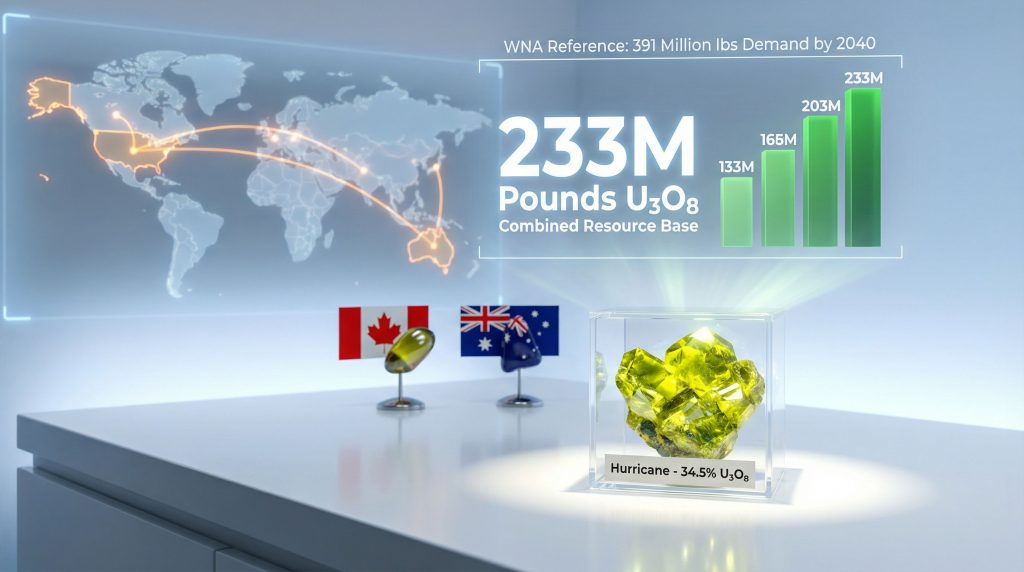
The Toro Energy acquisition, announced in October 2025, transforms IsoEnergy's resource profile from a high-grade development project to a diversified uranium platform spanning multiple deposit types and development stages. The transaction combines IsoEnergy's existing resource base with Toro's 69.1 million pounds U3O8 Measured and Indicated plus 4.5 million pounds Inferred at the Wiluna Uranium Project.
On a pro forma basis, the combined entity controls 133 million pounds Measured and Indicated plus 39 million pounds Inferred under NI 43-101 reporting standards, alongside historical resources of 154 million pounds Measured and Indicated and 88 million pounds Inferred. This scale positions IsoEnergy among the largest uranium resource holders globally outside of producing companies.
Pro Forma Resource Summary:
| Category | Pounds U3O8 (Million) | Reporting Standard |
|---|---|---|
| Measured & Indicated | 133 | NI 43-101 |
| Inferred | 39 | NI 43-101 |
| Historical M&I | 154 | Historical |
| Historical Inferred | 88 | Historical |
The Wiluna project's three-deposit structure creates opportunities for phased development and infrastructure sharing across the Lake Way, Centipede-Millipede, and Lake Maitland deposits. This multi-deposit configuration enables risk distribution while potentially reducing per-unit production costs through shared processing and support infrastructure.
Japan Australia Uranium and Itochu Corporation maintain a 35% project interest in Wiluna, providing established Asian market access and risk-sharing partnerships. These relationships offer pathway advantages for uranium marketing and potential development financing, reducing IsoEnergy's capital requirements and market exposure risks.
How Does Multi-Deposit Configuration Enhance Development Flexibility?
The Wiluna project's three-deposit structure provides sequential development optionality that single-deposit projects cannot match. Furthermore, Lake Way deposit's advanced permitting status enables potential first production, generating cash flow to support subsequent development at Centipede-Millipede and Lake Maitland. This phased approach reduces peak capital requirements while demonstrating operational capability to stakeholders.
Shared infrastructure across deposits includes potential processing facilities, transportation corridors, and support services. These synergies create economies of scale that improve project economics compared to standalone deposit development, while spreading infrastructure costs across larger resource bases.
Addressing the World Nuclear Association's Projected Supply Gap
The World Nuclear Association's 2025 World Nuclear Fuel Report projects global uranium requirements reaching approximately 391 million pounds U3O8 annually by 2040 under its Reference Scenario, escalating to 530 million pounds U3O8 under the Upper Scenario. Identified supply sources, comprising existing mines, development-stage projects, planned mines, prospective sources, and secondary supply, cover approximately 179 million pounds U3O8.
This supply coverage represents only 46% of Reference Scenario demand and 34% of Upper Scenario demand, creating what the WNA terms an "unspecified gap" requiring considerable exploration and timely investment to close. The association acknowledges that future demand cannot be met from identified supply sources, necessitating new uranium discovery and development.
2040 Supply-Demand Analysis:
| Scenario | Annual Demand (Million lbs U3O8) | Identified Supply | Coverage Percentage | Supply Gap |
|---|---|---|---|---|
| Reference | 391 | 179 | 46% | 212 |
| Upper | 530 | 179 | 34% | 351 |
IsoEnergy's pro forma resource base of 133 million pounds Measured and Indicated represents approximately 43% of the Reference Scenario supply gap, positioning the company as a material contributor to addressing projected uranium shortfalls. This resource concentration provides strategic leverage as supply constraints intensify through the 2030s.
The WNA's updated timeline estimate of 10-20 years from uranium discovery to production, extended from the previous 8-15 year range, reflects increased regulatory complexity and environmental review requirements. This timeline extension favours companies with existing resources and established development pathways over greenfield exploration programmes, highlighting the importance of uranium investment strategies focused on advanced projects.
Why Do Development Timelines Continue Extending?
Regulatory complexity increases stem from enhanced environmental assessment requirements, indigenous consultation processes, and water resource protection protocols. However, these extended timelines primarily affect greenfield discoveries rather than brownfield expansion or past-producing property reactivation, creating competitive advantages for companies with established operational histories.
In addition, mining permitting insights demonstrate that jurisdictional differences significantly impact development timelines. Tier-one jurisdictions typically offer more predictable permitting processes, though even these require substantial time investments for comprehensive environmental and social impact assessments.
Past-Producer Advantages and Permitting Acceleration
IsoEnergy's Utah operations demonstrate the strategic value of past-producing assets in constrained supply environments. The Tony M mine holds existing state and federal operating permits, representing an estimated 3-5 years of timeline advantage and over $1 million per mine in avoided permitting costs compared to greenfield development.
The mine's current NI 43-101 Indicated Mineral Resource Estimate totals 6.6 million pounds U3O8 at 0.28% grade, with additional 2.2 million pounds Inferred at 0.27% grade. While these grades appear modest relative to Hurricane, the existing permit structure enables rapid development decision implementation without extended regulatory approval processes.
Tony M Mine Specifications:
• Indicated Resource: 6.6 million pounds U3O8 at 0.28% grade
• Inferred Resource: 2.2 million pounds U3O8 at 0.27% grade
• Permit Status: State and federal operating permits held
• Processing: White Mesa Mill toll-milling arrangements
The 2,000-tonne bulk sampling programme underway as of March 2026 validates processing parameters at the White Mesa Mill, where uranium recovery rates exceed 90%. The Enhanced Evaporation Study confirmed that Landshark evaporators eliminate evaporation-pond expansion requirements, reducing both permitting complexity and capital expenditure.
White Mesa Mill represents the United States' sole operating conventional uranium mill, providing strategic processing access for all Utah operations within trucking distance. This infrastructure advantage eliminates processing pathway uncertainty while reducing transportation costs compared to more distant toll-milling alternatives.
Institutional Investment Correlation with Jurisdiction Rankings
Fraser Institute rankings demonstrate strong correlation with institutional capital allocation patterns in mining investment. Saskatchewan's sustained top-tier performance over seven consecutive years provides quantifiable evidence of regulatory stability and geological prospectivity that institutional investors require for large-scale capital deployment.
Western Australia's improvement to sixth globally represents the most significant jurisdictional advancement in the 2026 survey, potentially catalysing increased institutional interest in Australian uranium development projects. This ranking improvement reflects policy environment evolution and enhanced regulatory clarity for uranium mining operations.
Policy Environment Impact: Queensland's thirteenth-place Investment Attractiveness Index ranking gains significance given historical uranium mining lease restrictions. The Liberal National Party's October 2024 election victory creates potential for policy revision, though no official position on uranium mining restrictions has been announced.
The correlation between Fraser Institute rankings and institutional capital flows reflects fundamental investment criteria:
• Regulatory certainty reducing political risk premiums
• Permitting predictability enabling accurate project timeline forecasting
• Policy stability supporting long-term capital allocation decisions
• Rule of law consistency protecting shareholder interests
Companies operating across multiple top-tier jurisdictions demonstrate geographic risk distribution that institutional investors increasingly demand for uranium exposure, particularly given the sector's long development timelines and substantial capital requirements.
The next major ASX story will hit our subscribers first
Multi-Asset Development Sequencing and Capital Optimisation
IsoEnergy's parallel development approach across multiple assets creates optionality for capital deployment timing and risk distribution. Rather than sequential project advancement, the company pursues concurrent work programmes across its portfolio, including drilling at Hurricane, exploration in the Athabasca Basin and Henry Mountains, and technical studies supporting Tony M production decisions.
The 2026 winter drilling programme at Hurricane targets approximately 5,200 metres across 13 holes, focusing on resource expansion along Hurricane Main and South trends. Previous summer drilling returned 1.05% U3O8 over 0.5 metres in Area D, representing the strongest uranium intersection outside the Hurricane deposit itself.
This parallel development strategy provides several advantages:
• Timeline risk reduction through multiple development pathways
• Capital allocation flexibility based on market conditions and project readiness
• Geographic diversification reducing single-project dependency
• Market timing optionality for production sequencing
Near-term production potential from Utah past-producers could generate cash flow supporting Hurricane development, reducing external financing requirements. Medium-term Hurricane development provides high-grade production capability, while long-term Australian integration offers scale and resource depth.
How Does Concurrent Development Reduce Overall Risk?
Parallel development across multiple assets provides risk mitigation through diversification of technical, regulatory, and market timing risks. If Hurricane development encounters unexpected geological conditions, Utah operations can potentially accelerate to maintain project momentum. Conversely, if market conditions favour high-grade production, Hurricane development can prioritise while Utah operations remain in care-and-maintenance status.
This flexibility becomes particularly valuable during periods of US uranium market disruption, where geographic and operational diversification provides strategic advantages over single-jurisdiction exposure.
Financial Positioning and Strategic Shareholding Structure
IsoEnergy maintains a debt-free balance sheet with approximately C$143.8 million in pro forma cash and equivalents and an equity portfolio valued at C$55.8 million as of February 2026. This financial flexibility supports acquisition opportunities and development capital requirements without immediate dilution pressures.
NexGen Energy's 30% strategic shareholding provides sector expertise and potential operational synergies, given NexGen's leadership position in Athabasca Basin uranium development. This shareholding structure aligns strategic interests while providing access to technical expertise and development experience.
Current analyst coverage includes eight firms maintaining Buy ratings with price targets ranging from C$18.00 to C$28.25 per share. This unanimous positive sentiment reflects confidence in the company's strategic positioning relative to projected uranium supply constraints.
The combination of strong balance sheet positioning, strategic shareholder alignment, and positive analyst sentiment creates favourable conditions for continued acquisition activity and development capital deployment as uranium market fundamentals strengthen.
Processing Infrastructure Integration and Toll-Milling Economics
Strategic processing relationships provide competitive advantages through capital requirement reduction and operational cost optimisation. Hurricane's 40-kilometre proximity to McClean Lake mill eliminates the need for new processing infrastructure development, while Utah operations benefit from White Mesa Mill toll-milling availability.
White Mesa Mill demonstrates uranium recovery rates above 90%, validating processing efficiency for IsoEnergy's Utah ore types. The mill's status as America's sole operating conventional uranium facility provides strategic processing access with established operational history and regulatory compliance.
Processing Infrastructure Advantages:
• Capital avoidance: No new mill construction required
• Operational certainty: Proven recovery rates and processing parameters
• Regulatory compliance: Established environmental and safety protocols
• Timeline acceleration: Immediate processing availability upon production decisions
Toll-milling arrangements reduce execution risk while enabling flexible production timing based on market conditions. Companies with secure processing access maintain production optionality that competitors developing integrated mining-milling operations cannot match during development phases.
What Are the Economics of Toll-Milling Versus Owned Processing?
Toll-milling arrangements typically involve processing fees ranging from $8-15 per pound U3O8 processed, depending on ore characteristics and recovery rates. However, this cost structure eliminates capital expenditure requirements of $200-500 million for new mill construction, significantly improving project economics and reducing development risk.
Furthermore, toll-milling provides operational flexibility during market volatility, allowing production scheduling adjustments without fixed infrastructure obligations. This flexibility proves particularly valuable during periods influenced by factors such as the US Senate ban on uranium imports, where market timing becomes critical for optimising revenues.
Policy Tailwinds and Domestic Supply Security Initiatives
United States domestic uranium supply security initiatives support favourable policy environments for US-based operations. Over 150 fuel cycle bills currently under consideration support domestic uranium production development, reflecting bipartisan recognition of supply chain vulnerability in critical energy materials.
These legislative initiatives complement broader energy security policy frameworks prioritising domestic production capabilities. Strategic uranium reserve concepts and domestic supply requirements create potential demand floors for US uranium producers, enhancing project economics and financing availability.
Queensland's policy environment evolution following the Liberal National Party's election victory creates potential for uranium mining restriction reassessment. While no official policy revision has been announced, the jurisdictional ranking improvement to thirteenth globally suggests enhanced investment attractiveness despite historical limitations.
Policy Framework Benefits:
• Supply security prioritisation supporting domestic production
• Regulatory streamlining reducing development timeline uncertainty
• Strategic reserve potential providing demand floor support
• Allied nation preference in supply chain security initiatives
Western allied jurisdiction positioning provides strategic advantages as nuclear fuel supply chains prioritise geopolitical stability and supplier reliability over purely economic considerations.
Competitive Positioning for Future Market Consolidation
IsoEnergy's multi-jurisdictional acquisition strategy creates platform company characteristics that position the entity for potential future consolidation opportunities. The combination of high-grade development assets, past-producing properties, and established resource base provides diversified uranium exposure attractive to larger strategic buyers.
Scale and quality metrics position IsoEnergy among top global uranium developers outside producing companies. The combined pro forma resource base rivals major uranium developers while maintaining higher average grades through Hurricane's exceptional 34.5% U3O8 resource.
Strategic Positioning Advantages:
• Multi-jurisdictional regulatory expertise across tier-one territories
• Diversified development timeline reducing single-asset risk concentration
• Established processing relationships providing operational pathway certainty
• Strong balance sheet positioning supporting continued acquisition activity
The uranium sector's projected supply constraints and extended development timelines favour companies with existing resources and development expertise. IsoEnergy's strategic positioning across multiple high-quality jurisdictions creates competitive advantages as institutional capital seeks uranium exposure through the approaching supply crisis.
Consequently, the IsoEnergy uranium acquisition strategy represents sophisticated positioning for the structural supply-demand imbalances projected through 2040. The company's systematic approach to geographic diversification, resource quality concentration, and strategic infrastructure relationships creates multiple pathways for value realisation as global uranium markets navigate unprecedented supply constraints.
This analysis incorporates forward-looking statements regarding uranium market projections, development timelines, and regulatory environments. Actual results may differ materially from projections due to market conditions, regulatory changes, operational challenges, or other factors beyond company control. Investment decisions should consider comprehensive due diligence and professional financial advice.
Are You Ready to Capitalise on the Next Major Uranium Discovery?
Discovery Alert instantly alerts investors to significant ASX mineral discoveries using its proprietary Discovery IQ model, turning complex mineral data into actionable insights across uranium and other critical commodities. Understand why major mineral discoveries can lead to substantial market returns whilst positioning yourself ahead of the market with your 14-day free trial.