
May 19, 2026
IsoEnergy drills strong uranium radioactivity in newly identified L Fault Zone has demonstrated significant exploration success through systematic geological reinterpretation of existing data. Unconformity-related uranium deposits in the Athabasca Basin represent some of the world's most concentrated uranium resources, with formation mechanisms that differ fundamentally from other uranium deposit types. These systems develop where uranium-bearing hydrothermal fluids encounter specific geochemical boundaries at the contact between Proterozoic sandstone and underlying basement rocks.
Understanding Structural Controls in Athabasca Basin Uranium Systems
The basement-sandstone unconformity serves as the primary control for uranium mineralisation in these systems. Hot, oxidised fluids carrying dissolved uranium migrate through porous sandstone until they encounter reducing conditions at or near the unconformity interface. This chemical reduction environment causes uranium to precipitate from solution, creating high-grade concentrations that can exceed 30% uranium oxide in optimal conditions.
Fault networks within this geological framework act as critical fluid pathways, channelling uranium-bearing solutions toward favourable precipitation sites. The intersection of these structural controls with the unconformity creates localised zones of intense uranium concentration, often extending along strike for hundreds of metres where geological conditions remain favourable.
Fault Zone Classification and Exploration Targeting
Primary structural controls in uranium exploration typically involve major fault systems that extend through both basement and sandstone units. Secondary structures, including subsidiary faults and fracture networks, provide additional fluid pathways that can host significant mineralisation when properly positioned relative to the main structural trends.
Strike length continuity assessment requires systematic evaluation of fault geometry, displacement patterns, and intersection relationships with the unconformity. Successful exploration programs focus on identifying underexplored fault corridors that show evidence of hydrothermal alteration but lack comprehensive drill testing.
Furthermore, the current uranium market volatility has increased focus on high-grade discoveries that can maintain economic viability across different market conditions.
When big ASX news breaks, our subscribers know first
What Makes the L Fault Zone Discovery Significant for Exploration Strategy?
The identification of the L Fault Zone through reinterpretation of existing geological data demonstrates how systematic structural analysis can unlock previously overlooked exploration targets. This discovery emerged from recognising that uranium mineralisation extended beyond the well-documented J and K fault zones into a separate structural corridor.
Structural Reinterpretation Methodology
Multi-fault system analysis involves examining the broader structural framework rather than focusing solely on individual fault zones. The east-striking structural trend identification revealed that the L Fault Zone represents a distinct mineralised system with its own geometric characteristics and alteration footprint.
Underexplored corridor prioritisation frameworks evaluate fault systems based on structural orientation, alteration intensity, and proximity to known mineralisation. The L Fault Zone satisfied these criteria but had received limited drill testing compared to more obvious targets.
However, recent developments in innovative uranium extraction techniques have highlighted the importance of precisely defining fault-controlled mineralisation.
Radioactivity Measurement and Grade Correlation Analysis
RS-125 spectrometer measurements provide real-time assessment of uranium content in drill core, with readings expressed in counts per second (cps). The 350 cps threshold represents the baseline for flagging potentially mineralised intervals, while readings exceeding 10,000 cps typically indicate significant uranium concentrations.
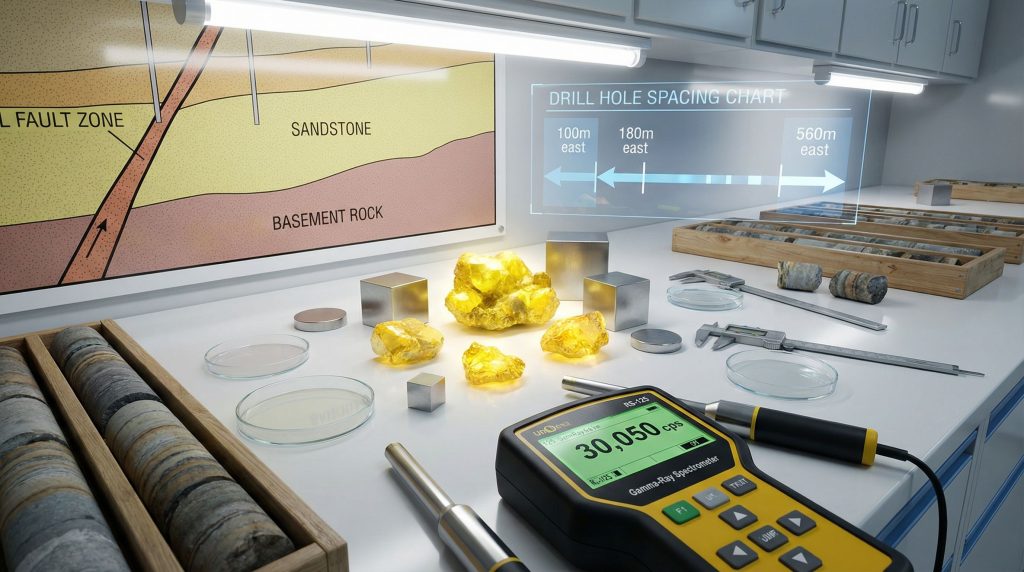
The 30,050 cps reading from drill hole LE26-248, with peak values exceeding the instrument's measurement capacity at 65,500 cps, suggests uranium grades substantially higher than typical exploration targets. These off-scale readings often correlate with uranium oxide grades exceeding 10-15%, placing such intercepts among the highest-grade uranium intersections globally.
| Drill Hole | Distance from LE26-248 | Peak Radioactivity (cps) | Interval Width | Geological Context |
|---|---|---|---|---|
| LE26-248 | Base hole | 30,050 (>65,500 peak) | 1.0m | L Fault Zone core |
| LE26-241 | 100m east | 3,712 | 0.5m | Fault extension |
| LE26-243 | 180m east | 10,000 | 0.5m | Structural corridor |
| LE26-234 | 560m east | 6,450 | 0.5m | Strike limit testing |
How Do Winter Drilling Programs Optimise Resource Definition Efficiency?
Northern Saskatchewan's winter drilling season provides optimal access to remote exploration targets through frozen ground conditions that support heavy equipment mobilisation. Winter programs typically achieve higher meterage per day compared to summer drilling due to improved site accessibility and reduced environmental restrictions.
Seasonal Drilling Campaign Design
Program expansion protocols allow exploration teams to capitalise on positive results by extending planned drilling campaigns. The expansion from 13 planned holes to 17 completed holes demonstrates how successful programs adapt to emerging geological understanding during execution.
Meterage allocation strategies balance comprehensive target testing with budget constraints. The increase from 5,200 planned metres to 6,804 completed metres reflects confidence in the geological model and the potential for significant resource expansion.
In addition, the winter drilling success confirms the technical advantages of seasonal drilling programmes in extreme northern conditions.
Step-Out Drilling Methodology for Strike Extension
Systematic spacing intervals for testing mineralisation continuity typically employ 100-200 metre step-outs along interpreted structural trends. This approach provides sufficient resolution to define grade distribution while maintaining cost-effectiveness across larger target areas.
Progressive eastward extension protocols involve drilling successive holes at increasing distances from initial discovery points until mineralisation grades diminish below economic thresholds. Structural intersection angle optimisation ensures drill holes intersect fault zones at optimal angles for maximum intersection width.
What Technical Factors Control High-Grade Uranium Precipitation?
High-grade uranium precipitation requires specific geochemical conditions that develop where oxidised uranium-bearing fluids encounter reducing environments. The intensity of this reduction zone directly correlates with the potential for uranium concentration and grade development.
Hydrothermal Alteration Recognition
Clay mineral assemblages provide critical indicators of hydrothermal fluid activity and uranium potential. Illite, chlorite, and mixed-layer clays typically develop in response to uranium-bearing fluid flow and help define exploration target zones.
Reduction zone geochemical signatures include elevated organic carbon content, pyrite development, and depleted uranium values in host rocks. These features indicate that uranium has been leached from surrounding rocks and concentrated at nearby precipitation sites.
Unconformity contact zone characterisation involves identifying specific alteration minerals, structural preparation, and geochemical signatures that indicate optimal uranium trapping conditions.
Grade Distribution Analysis Within Fault Systems
The 11,275 cps over 3.5 metres hosting the 30,050 cps peak demonstrates how high-grade uranium zones develop within broader mineralised intervals. This pattern reflects focused fluid flow along specific structural pathways within larger fault systems.
Structural control mechanisms for grade concentration involve fault intersection geometries, unconformity topography, and local reduction intensity. Understanding these controls enables more precise targeting of high-grade zones during follow-up exploration.
For instance, recent uranium investment strategies emphasise the importance of structural controls in deposit evaluation.
Why Are Multi-Trend Exploration Strategies Critical for Resource Growth?
Parallel structural corridors within uranium districts often host independent mineralised systems with distinct characteristics and resource potential. Multi-trend strategies recognise that uranium-bearing hydrothermal systems typically develop multiple fluid pathways rather than single isolated occurrences.
North Trend vs. South Trend Comparative Analysis
The 2,747 cps over 1.0 metre result from drill hole LE26-239 validates the North Trend as a legitimate exploration target with uranium mobility and alteration development. Parallel structural corridor development suggests that multiple fault systems within the same hydrothermal district can host economically significant uranium concentrations.
Geological continuity assessment between trend systems involves evaluating structural connections, alteration intensity, and geochemical signatures that indicate shared hydrothermal fluid sources and timing.
Greenfield Target Integration
Eastern and southern extension testing protocols expand exploration beyond immediate deposit areas to test the full scale of hydrothermal systems. These programs often reveal additional mineralised zones that contribute significantly to overall resource potential.
Hydrothermal system scale determination requires mapping alteration footprints, structural controls, and geochemical anomalies across kilometre-scale areas to understand the full resource potential within uranium districts.
Consequently, successful exploration of IsoEnergy drills strong uranium radioactivity in newly identified L Fault Zone requires systematic evaluation of multiple structural trends to maximise discovery potential.
How Do Assay Results Drive Resource Update Potential?
Laboratory confirmation of field radioactivity measurements provides the quantitative data required for resource estimation and deposit modelling. Saskatchewan Research Council Geoanalytical Laboratory processing follows international standards for uranium analysis and quality control.
Laboratory Confirmation Workflow
Radioactivity-to-grade correlation validation ensures that field measurements accurately reflect uranium content in drill core samples. This calibration process is critical for interpreting results and planning follow-up exploration programs.
Geochemical analysis integration provides additional data on alteration minerals, trace elements, and deposit genesis that enhance geological understanding and resource modelling accuracy.
Resource Estimation Impact Assessment
The current Hurricane deposit contains 48.6 million pounds of uranium oxide at 34.5% average grade in the Indicated category, representing exceptional uranium concentration by global standards. L Fault Zone contribution potential depends on confirming continuity, grade, and thickness through additional drilling.
Strike extension implications for deposit geometry could substantially increase the Hurricane resource base if high-grade mineralisation continues along the 540-metre corridor defined by current drilling.
Moreover, detailed high-priority drill targets have been generated through systematic geological evaluation.
The next major ASX story will hit our subscribers first
What Operational Advantages Support Continued Exploration Success?
Strategic infrastructure positioning provides significant advantages for uranium exploration and development projects. McClean Lake mill accessibility at 40 kilometres distance offers processing capacity without requiring new mill construction.
Infrastructure Proximity Benefits
Processing capacity utilisation optimisation enables efficient transition from exploration to production when economic deposits are defined. Existing infrastructure reduces capital requirements and accelerates project development timelines significantly.
Logistical cost reduction factors include established access routes, available power infrastructure, and experienced local workforce that support both exploration and potential development activities.
Furthermore, the proximity to existing uranium processing facilities reduces exposure to uranium tariff turmoil affecting international uranium trade.
Exploration Program Scalability
Summer 2026 follow-up campaign design principles will incorporate geological understanding developed through L Fault Zone drilling to optimise target selection and drill hole positioning for maximum effectiveness.
Gap-filling drill hole prioritisation focuses on testing mineralisation continuity between positive drill intersections to define resource boundaries and grade distribution patterns more precisely.
How Does This Discovery Compare to Global Uranium Exploration Trends?
Grade concentrations approaching 30,000+ counts per second place these results among the highest-grade uranium intersections reported globally in recent years. World-class uranium deposits typically require average grades exceeding 1% uranium oxide, with exceptional deposits like Hurricane achieving grades above 30%.
Grade Concentration Benchmarking
Athabasca Basin deposits consistently demonstrate superior grade characteristics compared to global averages, with many operations achieving grades 10-50 times higher than typical uranium mines worldwide. This grade advantage translates directly into lower mining costs, reduced environmental impact, and enhanced project economics.
High-grade resource scarcity in current uranium markets creates significant value premiums for deposits capable of producing uranium at costs substantially below market prices.
Exploration Success Rate Analysis
Fault-controlled discovery methodology demonstrates higher success rates than regional exploration approaches by focusing on specific geological controls rather than broad geochemical anomalies. Step-out drilling success ratios in similar geological settings often exceed 60% when properly executed.
Resource growth potential through structural reinterpretation offers established uranium companies opportunities to expand existing deposits through systematic re-evaluation of geological controls and exploration data.
However, broader market considerations include the impact of the US Senate uranium ban on global supply dynamics and exploration economics.
The discovery of IsoEnergy drills strong uranium radioactivity in newly identified L Fault Zone represents a significant advancement in understanding structural controls within the Hurricane deposit system. The results validate systematic geological reinterpretation approaches and demonstrate the potential for substantial resource expansion through targeted exploration programs.
"The L Fault Zone discovery demonstrates how systematic structural reinterpretation can unlock previously underexplored corridors within established uranium districts, with technical drilling methodologies proving critical for extending high-grade mineralisation beyond known deposit boundaries."
This analysis is for informational purposes only and should not be considered as investment advice. Uranium exploration involves significant risks, and actual exploration results may vary substantially from projections or expectations. Investors should conduct their own research and consult qualified professionals before making investment decisions.
Looking for the Next High-Grade Uranium Discovery?
Discovery Alert's proprietary Discovery IQ model delivers instant notifications on significant ASX mineral discoveries, including uranium exploration breakthroughs that could mirror IsoEnergy's exceptional drilling results. Visit Discovery Alert's discoveries page to explore how major mineral discoveries have historically generated substantial market returns, then begin your 14-day free trial to position yourself ahead of the next significant uranium or mineral discovery announcement.