
August 6, 2026
When the World's Largest Uranium Producer Cuts Output, the Math Stops Working
The uranium fuel cycle operates on timelines that most commodity markets cannot match. A nuclear power plant requires fuel procurement decisions made years in advance, processing and enrichment arranged across multiple jurisdictions, and a supply chain with almost zero tolerance for disruption. When that supply chain begins contracting at the same moment that reactor buildout is accelerating globally, the resulting imbalance is not a temporary pricing anomaly — it is a structural reconfiguration of the entire market, and the IsoEnergy uranium supply shortage thesis sits squarely at the centre of it.
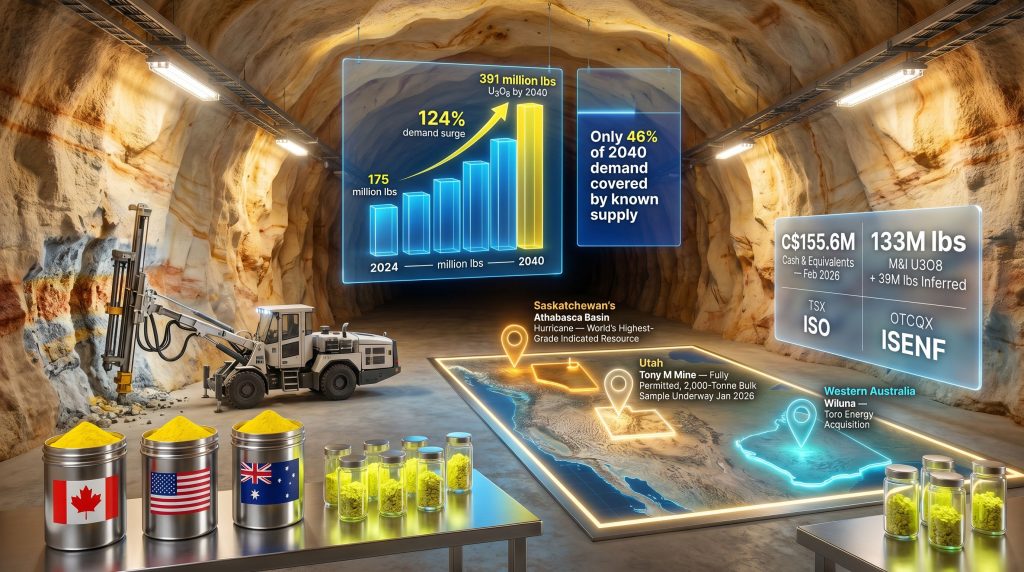
That reconfiguration is now underway. The World Nuclear Association's 2025 Fuel Report projects global uranium demand climbing from approximately 175 million pounds U3O8 in 2024 toward 391 million pounds by 2040, yet identified supply from all known sources is projected to cover less than half of that 2040 requirement. Simultaneously, the world's single largest uranium producer reduced its 2026 output target from 85 million pounds to 77 million pounds, compressing near-term availability at the worst possible moment.
Secondary supply buffers, including legacy stockpiles and government inventory drawdowns that historically smoothed short-term imbalances, are shrinking in volume and cannot be replenished. The uranium market deficit that analysts have long debated is no longer theoretical — it is measurable and widening.
This is the macro environment in which IsoEnergy Ltd. (TSX: ISO, OTCQX: ISENF) is executing a multi-jurisdictional strategy designed to deliver uranium into a market that will increasingly struggle to find it elsewhere.
When big ASX news breaks, our subscribers know first
Understanding the Uranium Supply Deficit in Structural Terms
Why the Gap Cannot Be Closed Incrementally
The IsoEnergy uranium supply shortage is fundamentally a lead-time problem. Bringing a new uranium mine from discovery to first production typically takes 10 to 15 years under ideal regulatory conditions, and longer in jurisdictions with complex permitting environments. That timeline means decisions made today about which projects to advance will determine supply availability in the late 2020s and 2030s, precisely the period during which demand growth is expected to accelerate most sharply.
The demand side of the equation is being driven by several converging forces:
- Reactor life extensions in North America and Europe, keeping operating capacity in service longer than previously planned
- New reactor construction across Asia, with China alone accounting for the majority of reactors currently under construction globally
- A wave of small modular reactor (SMR) development programmes in the United States, United Kingdom, Canada, and several emerging markets
- Restarts of previously idled reactors in Japan and Germany's reconsideration of its nuclear phase-out timeline
Furthermore, the uranium supply-demand volatility makes the investment case particularly compelling to analysts — not just because of the demand trajectory, but because of the structural rigidity of the supply response. Unlike oil, where production can be scaled through drilling campaigns measured in months, uranium production requires sustained investment across geological exploration, resource definition, feasibility studies, environmental permitting, mine construction, and mill commissioning.
The Forecasting Problem: Why Official Numbers May Understate Reality
One underappreciated dynamic in uranium market analysis is the systematic optimism bias embedded in supply forecasts. Industry projections typically model supply based on projects that are announced, permitted, or funded at the time of publication. They rarely account for the full attrition rate of announced projects that fail to reach production due to permitting delays, cost overruns, financing failures, or resource definition disappointments.
Historical uranium supply cycles have consistently demonstrated that the number of projects completing development on schedule is substantially lower than the number that enter planning. When official forecasts assume near-full conversion of announced projects into operating mines, they structurally overstate available supply.
This pattern creates an asymmetric risk environment: the downside scenario requires simultaneous success across dozens of independent development programmes, while the upside scenario requires only continued attrition of the kind that has characterised every prior uranium development cycle.
The Utility Contracting Cycle and What Triggers the Price Response
How Nuclear Utilities Procure Uranium and Why They Are Slow to Act
Understanding the investment case requires understanding how nuclear utilities actually buy fuel. Unlike industrial commodity consumers who purchase at or near spot prices, nuclear utilities operate long-term procurement programmes that typically cover five to ten years of forward fuel requirements. These programmes blend:
- Long-term contracts (typically 60–80% of annual requirements, negotiated years in advance)
- Medium-term contracts (typically covering 10–20% of requirements)
- Spot market purchases (typically less than 10% of annual needs, highly price-sensitive)
When existing long-term contracts provide adequate coverage, utilities have little incentive to enter the market proactively. This behaviour creates the illusion that demand is soft, when in reality the underlying fuel requirement is unchanged and coverage is simply running down.
The critical inflection comes when forward coverage drops below a threshold that utility procurement managers consider operationally safe, typically around three to four years of uncovered requirements. At that point, multiple utilities re-enter the contracting market simultaneously, competing for limited term supply from a small number of credible producers. Consequently, the divergence between spot versus term prices becomes a critical signal for investors tracking when this inflection arrives.
Trade Policy Uncertainty as a Contracting Accelerant
Beyond the natural drawdown cycle, shifts in uranium import trade conditions are introducing additional urgency into utility procurement timelines. U.S. utilities have historically sourced a significant proportion of their uranium requirements from Kazakhstan, Russia, and Uzbekistan. The Russian uranium import ban and growing geopolitical uncertainty around Central Asian supply chains are narrowing the pool of reliable foreign supply, increasing the relative attractiveness of North American production.
IsoEnergy's CEO Phil Williams has indicated that recent U.S. trade policy developments have the potential to pull forward the utility contracting cycle by creating supply security concerns that make long-term domestic contracting more attractive, even at premium pricing. When utilities do re-enter the market at scale, price discovery in uranium has historically been rapid and non-linear. The 2003–2011 uranium price cycle saw the spot price move from approximately $10 per pound to over $130 per pound within eight years, driven partly by supply disruptions and partly by a surge in long-term contracting demand.
IsoEnergy's Multi-Speed Portfolio: Matching Assets to Market Timelines
The Strategic Logic of Three-Jurisdiction Positioning
IsoEnergy has assembled a portfolio that maps onto the uranium supply shortage across three different timeframes simultaneously. This is not accidental architecture — it reflects a deliberate strategy to generate near-term production optionality through U.S. restart assets, long-duration high-grade value through its Canadian deposit, and geographic diversification through an Australian acquisition in progress.
| Asset | Jurisdiction | Stage | Primary Value Driver |
|---|---|---|---|
| Tony M Mine | Utah, USA | Bulk sample / pre-production | Permitted restart, existing infrastructure, toll mill access |
| Two additional Utah mines | Utah, USA | Permitted standby | Rapid activation optionality |
| Hurricane / Larocque East | Saskatchewan, Canada | Advanced resource delineation | World's highest-grade Indicated resource, expansion potential |
| Wiluna (via Toro Energy acquisition) | Western Australia | Preliminary economics complete | Large near-surface resource, Japanese partner option |
| Dorado (Purepoint JV) | Athabasca Basin, Canada | Exploration | New discovery, cost-shared exploration upside |
The combined pro forma portfolio carries Measured and Indicated resources of 133 million pounds U3O8 plus a further 39 million pounds Inferred — a scale that places IsoEnergy in the narrow band of developers with sufficient resource inventory to support production decisions rather than simply exploration narratives.
Financial position supports this positioning: as of early 2026, IsoEnergy held approximately C$144 to C$155.6 million in cash and equivalents, including an equity portfolio valued at roughly C$47 to C$55.8 million. That equity portfolio functions as a liquid strategic reserve capable of being monetised if market conditions change. For additional context on how these uranium market dynamics are shaping developer strategies more broadly, the competitive landscape has rarely been more consequential.
NexGen Energy holds approximately 30 to 31% of IsoEnergy's outstanding shares, providing institutional alignment with one of Canada's most capitalised uranium developers. All eight firms currently covering the TSX-listed shares carry Buy recommendations.
Tony M Mine: The Lowest-Capital Pathway to U.S. Uranium Production
What a Bulk Sample Actually Tests and Why It Matters
In early 2026, IsoEnergy advanced its US uranium mines toward potential production by resuming underground activity at the Tony M Mine in Utah's Henry Mountains for the first time in approximately two decades. The programme is a 2,000-tonne bulk sample: a carefully controlled extraction exercise designed to generate current-cycle cost data across mining operations, ore haulage to processing, and toll milling throughput.
The distinction matters enormously for investors evaluating restart risk. A bulk sample does not require the company to commit to capital expenditure at production scale before understanding what that capital will actually achieve. It generates the real-world data needed to underwrite a production decision with confidence rather than relying on desktop modelling or historical cost records from an operating period two decades prior.
Metallurgical test work has confirmed that Tony M ore can be pre-concentrated on site before haulage, upgrading uranium content in the material sent for toll milling and reducing the total volume requiring transport and processing. This is a meaningful operating cost lever that not all uranium restart candidates possess.
Processing flows through a toll milling arrangement with Energy Fuels Inc.'s White Mesa Mill in Utah, the only conventional uranium processing facility currently running in the United States, with a licensed annual capacity exceeding 8 million pounds U3O8. The toll milling model eliminates the need for IsoEnergy to fund or construct its own processing facility.
The Two Permitted Standby Mines
Beyond Tony M, IsoEnergy holds two further permitted past-producing uranium mines in Utah, both positioned to be activated on an accelerated timeline relative to new project development if market conditions warrant. These assets require no new permitting and carry the same infrastructure advantage as Tony M. They function as volume optionality — dormant at current capital allocation levels, but capable of contributing meaningful incremental production if contracted volumes justify the activation cost.
The Hurricane Deposit: Understanding What World-Class Grade Actually Means
Grade, Economics, and the Athabasca Basin Context
The Hurricane deposit on IsoEnergy's Larocque East property in Saskatchewan holds a distinction that carries real economic weight: it is the world's highest-grade Indicated uranium resource of its deposit type, as confirmed in a 2022 technical report prepared by SLR Consulting (Canada) Ltd.
Grade in uranium mining is not merely a geological metric — it is a direct determinant of operating economics. Higher ore grade means more uranium is recovered per tonne of rock extracted, processed, and managed as waste. At very high grades, the cost per pound of uranium produced can fall dramatically below industry averages, creating a competitive cost position that remains viable across a wide range of uranium price environments.
The Athabasca Basin in northern Saskatchewan is the geological setting that produces the world's highest-grade uranium deposits, including McArthur River and Cigar Lake, both of which have been among the world's lowest-cost uranium producers. The deposit sits approximately 40 kilometres from an existing uranium processing facility, a proximity that substantially reduces the future infrastructure capital burden.
April 2026 Drilling Results and the South Trend Extension
Drilling results released in April 2026 confirmed uranium mineralisation extending along the Hurricane South Trend beyond previously mapped boundaries. IsoEnergy's Vice President of Exploration Dan Brisbin described the results as continuing to demonstrate the prospectivity of that southern trend, noting that the geological team is actively reinterpreting the structural controls on uranium mineralisation in areas that remain underexplored.
A summer 2026 follow-up drill programme is being planned to test the newly identified extensions. In the Athabasca Basin, high-grade uranium deposits characteristically occur in clusters along structural corridors rather than as isolated bodies — meaning Hurricane's currently published resource may not reflect the full extent of the mineralised system.
The geological principle at play is straightforward but often underappreciated by non-specialist investors: in the Athabasca Basin, finding one high-grade deposit along a structure is almost always an indicator that the structure hosts more mineralisation elsewhere along its length. The question is not whether more uranium exists, but how much and at what grade.
Furthermore, a detailed review of IsoEnergy's grade, scale, and timing within uranium's supply crisis highlights why Hurricane's expansion potential is viewed so favourably by institutional analysts tracking the sector.
The next major ASX story will hit our subscribers first
The Toro Energy Acquisition and the Australian Dimension
Why Western Australia Adds Strategic Value
IsoEnergy's pending acquisition of Toro Energy adds the Wiluna Uranium Project in Western Australia to a portfolio previously concentrated in the northern hemisphere. Wiluna hosts a large uranium resource in near-surface deposits, a geological configuration that typically supports lower-capital open-cut or shallow mining methods.
A preliminary economic assessment has been completed, and a commercial arrangement with Japanese partners is already in place, giving those partners an option to acquire a project stake. Japan restarted multiple reactors through 2024–2026 and is actively seeking to secure medium-to-long-term uranium supply from geopolitically stable jurisdictions. Australia, as both a major uranium reserve holder and a country with strong Pacific Rim diplomatic relationships, fits that criteria precisely.
The Pacific Rim Demand Dimension
Australia's uranium resources are significant in global terms, yet the country's production history has been constrained by both policy environments and development timelines. South Korea, which sources nearly all of its uranium through imports, and Japan, which is rebuilding domestic reactor utilisation, represent natural end-markets for Australian uranium production. Adding Wiluna to IsoEnergy's portfolio creates optionality to serve these buyers directly, in addition to the nuclear capacity growth driving demand across the broader region.
Building the Commercial Capability: Why Selling Uranium Is Now as Strategic as Finding It
The Transition from Explorer to Contract Negotiator
IsoEnergy's appointment of Misty Urbatsch as Vice President of Strategy and Commercial signals a deliberate transition in the company's organisational DNA. Her background spans both technical geology and the commercial side of uranium transactions, including buying, selling, and structuring supply agreements with utilities. That combination of skills is uncommon in junior and mid-tier uranium developers.
In a supply-constrained uranium market, the ability to identify resources and bring them toward production is necessary but not sufficient. Companies that can negotiate long-term supply agreements with utilities at favourable pricing, structure contracts that protect revenue through uranium price cycles, and build relationships with procurement managers at nuclear power operators will capture substantially more value from the repricing environment than pure developers who rely entirely on spot market arrangements.
The Revenue Base Logic
IsoEnergy's strategic sequencing reflects a clear internal logic: establish a production revenue base through the U.S. assets to demonstrate operational capability and generate cash flow, while simultaneously building the long-term value of the Hurricane deposit through continued drilling and resource expansion. The Toro Energy acquisition adds a third development pathway and a Pacific Rim commercial relationship.
Phil Williams has articulated this plan clearly in company communications: U.S. production first to prove the operating model, Hurricane as the long-duration value creation engine, and disciplined portfolio management across all other holdings. The company enters the second half of 2026 with sufficient capital to execute this plan without requiring near-term equity raises — an important distinction in a development environment where dilution risk constrains many junior uranium developers.
Three Scenarios for IsoEnergy in a Tightening Uranium Market
The range of outcomes for IsoEnergy across the next three to five years depends substantially on which uranium market scenario materialises. Three distinct pathways can be modelled:
Scenario 1: Utility contracting accelerates ahead of consensus (2026–2027)
Tony M bulk sample confirms competitive restart economics and a production decision is made ahead of schedule. Hurricane South Trend drilling expands the resource inventory. Toro Energy acquisition closes and Wiluna development planning advances. IsoEnergy enters supply contract negotiations with multiple utilities simultaneously, capturing above-spot pricing on the strength of its permitted near-production U.S. assets.
Scenario 2: Market tightening follows consensus timeline (2028–2030)
Tony M enters initial production at modest volumes through the White Mesa Mill toll arrangement. Hurricane resource grows through successive drilling programmes and development studies are initiated. The equity portfolio is partially monetised to fund accelerated development activity. Wiluna preliminary economics advance toward feasibility-level assessment.
Scenario 3: Supply disruption creates accelerated price discovery
Geopolitical or operational disruptions to major producing nations compress available global supply further and compress the timeline for utility contracting. IsoEnergy's three permitted U.S. assets become disproportionately valuable as domestic supply security premiums emerge. Hurricane is fast-tracked through development studies. The company transitions from developer to active contract negotiator across multiple utility relationships simultaneously.
This article contains forward-looking statements and scenario analyses that involve assumptions about future uranium market conditions, production timelines, resource expansion outcomes, and regulatory environments. These scenarios are speculative and should not be construed as financial advice or as guarantees of future performance. Investors should conduct independent due diligence and consult qualified financial advisors before making investment decisions in the uranium sector or in any individual mining company.
What the IsoEnergy Uranium Supply Shortage Thesis Means for Sector Investors
The structural case for uranium is not difficult to construct. Demand is growing faster than credible supply can be developed. The world's largest producer has cut output. Secondary supply buffers are diminishing. Utilities have not yet fully re-entered the contracting market. When they do, price discovery will be rapid and developers with permitted, near-production assets will occupy the strongest negotiating position.
IsoEnergy's particular positioning within this environment combines near-term production optionality through permitted U.S. restart assets, a world-class high-grade Canadian deposit that is still expanding through active drilling, and a new Australian acquisition that adds resource scale and Pacific Rim commercial relationships. Supported by a cash position that eliminates near-term dilution risk and a shareholder structure anchored by NexGen Energy, the company sits at an intersection of resource quality, jurisdictional diversification, and commercial readiness that few junior uranium developers can match.
The IsoEnergy uranium supply shortage thesis is not a narrative requiring imagination. It is a function of arithmetic: too little confirmed supply, too much projected demand, and a development pipeline that cannot bridge the gap through incremental effort alone. However, for investors seeking to understand how this broader crisis is reshaping the sector, the Iran conflict and western supply constraints driving long-term nuclear fuel deficits provide important additional context for where the market is headed.
Want to Know When the Next Major Uranium Discovery Hits the ASX?
Discovery Alert's proprietary Discovery IQ model scans ASX announcements in real time, delivering instant alerts on significant mineral discoveries — including uranium — so subscribers can act ahead of the broader market. Explore historic discoveries and their returns, then begin your 14-day free trial at Discovery Alert to position yourself at the forefront of the next major find.