
May 22, 2026
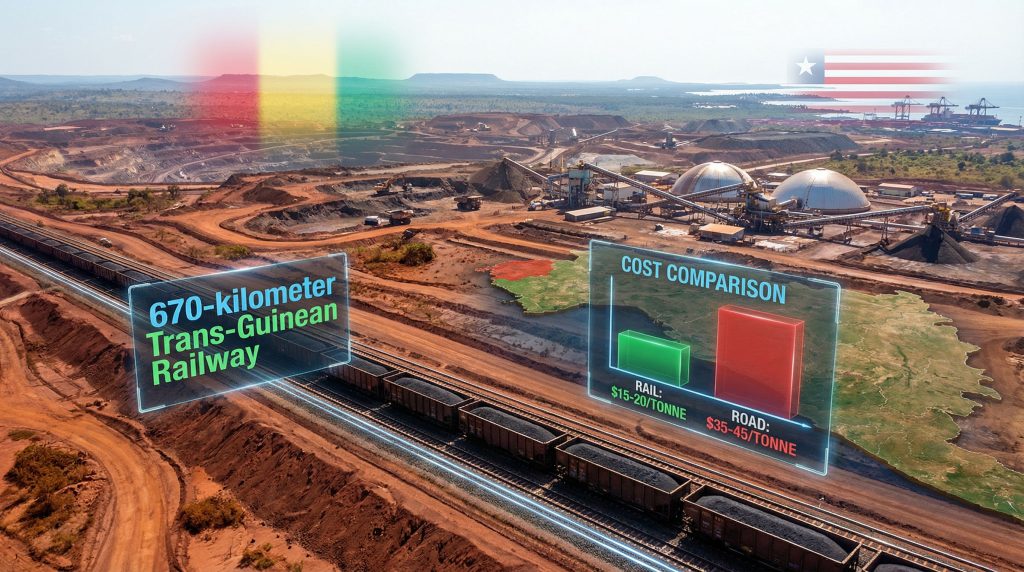
Resource extraction projects across West Africa face escalating infrastructure bottlenecks that fundamentally reshape investment risk profiles and market entry strategies. Complex regulatory frameworks, competing export corridors, and geopolitical tensions increasingly determine project viability before geological assessments or market conditions enter consideration. Ivanhoe Atlantic rail access challenges exemplify how these structural constraints create cascading effects throughout regional mining development, where single infrastructure operators can effectively control market access for entire sectors.
Infrastructure Control Points and Market Access Dynamics
Transport infrastructure monopolies in West Africa represent critical chokepoints that determine mining project economics long before ore reaches international markets. Single-operator railway systems create strategic leverage points where infrastructure controllers can influence regional resource flows through capacity allocation, pricing mechanisms, and access priorities.
The economic mathematics underlying these constraints demonstrates why rail access remains paramount for iron ore competitiveness. Over distances exceeding 200 kilometers, railway transport reduces per-tonne costs by approximately 60-70% compared to road alternatives. Furthermore, this makes rail corridors essential for projects targeting international commodity markets where margin compression leaves little room for transport premium costs.
Key Infrastructure Control Mechanisms:
• Capacity allocation systems that prioritise existing operators
• Technical specification requirements limiting compatibility
• Maintenance scheduling that affects third-party access windows
• Pricing structures that reflect infrastructure investment recovery
• Operational coordination challenges across multiple users
ArcelorMittal's control of the Yekepa-Buchanan corridor exemplifies how established operators maintain strategic advantages through integrated operations. The steelmaker's recent expansion activities at Yekepa potentially constrain available capacity for alternative users. Consequently, this creates competitive dynamics where infrastructure access becomes as valuable as mineral reserves themselves.
Multi-user railway frameworks, while legislatively approved in countries like Liberia, face practical implementation challenges around scheduling coordination. However, understanding mining permitting fundamentals becomes crucial when navigating maintenance responsibility allocation and dispute resolution mechanisms. These operational complexities often favour established operators with existing traffic volumes and operational expertise.
Alternative Transport Economics and Feasibility Analysis
Mining companies facing rail access constraints must evaluate alternative transport solutions that typically involve significant cost premiums and extended project timelines. Road transport networks, while more accessible, impose operational constraints that affect project scale and profitability calculations.
Comparative Transport Cost Analysis:
| Transport Method | Capital Investment | Operating Cost/Tonne | Distance Limitations | Time to Implementation |
|---|---|---|---|---|
| Existing Rail Access | Low to Medium | $15-20 | 500+ km viable | 2-3 years |
| New Rail Construction | $2-3 billion | $12-18 | Unlimited | 7-10 years |
| Road Transport | Medium | $35-45 | 200 km optimal | 3-4 years |
| Pipeline Concentrate | High | $25-35 | 300+ km viable | 5-7 years |
The capital requirements for new railway construction often exceed entire project development budgets. In addition, this explains why alternative corridors remain theoretical rather than practical solutions for most operators. Pipeline transport for iron ore concentrate represents an emerging technology solution, though implementation complexity and environmental approval requirements create additional regulatory hurdles.
Regional Export Corridor Competition and Strategic Positioning
Guinea's prioritisation of internal infrastructure development fundamentally alters regional export route economics and creates competitive tensions between established and emerging transport corridors. The 670-kilometer Trans-Guinean Railway linking the Simandou mining complex to Morebaya port represents a strategic infrastructure investment. Moreover, this redirects regional resource flows away from traditional Liberian export routes.
Chinese enterprise involvement in Guinea's infrastructure development extends beyond simple construction contracts to encompass integrated mining-transport-export operations. The Winning Consortium Simandou, incorporating Winning International Group, China Hongqiao Group, and Yantai Port Group, demonstrates how state-linked enterprises create vertically integrated supply chains that limit access for independent operators.
Chinese Infrastructure Integration Components:
• Mining operations through Aluminum Corporation of China (Chinalco)
• Steel sector involvement via Baowu Steel Group partnerships
• Railway construction through China Railway Construction Corporation
• Port development and management capabilities
• Financial backing through state development banks
This integrated approach creates competitive advantages that extend beyond simple cost considerations to encompass preferential access, coordinated scheduling, and strategic alignment between different project phases. Furthermore, independent mining companies face structural disadvantages when competing for infrastructure access against operators with integrated supply chain control.
Guinea's governmental preference for internal infrastructure developments reflects broader strategic considerations around resource control, economic sovereignty, and partnership alignment. Projects that align with national infrastructure priorities receive preferential treatment in approval processes. However, alternative corridor proposals face extended regulatory review periods where modern rail haulage operations become increasingly complex.
Environmental and Regulatory Constraint Analysis
The Mount Nimba Strict Nature Reserve presents a complex regulatory framework that affects project development timelines and approval certainty for operations in proximity to protected areas. UNESCO World Heritage site protection requirements impose additional environmental assessment protocols. Consequently, these extend approval processes and create compliance uncertainty.
Environmental impact assessment protocols for projects adjacent to protected areas typically involve multiple stakeholder consultation phases, biodiversity impact studies, and mitigation measure implementations. For instance, these can extend approval timelines by 18-36 months compared to standard mining permits.
Environmental Approval Framework Components:
• UNESCO compliance certification requirements
• Biodiversity offset calculation and implementation
• Community consultation and consent protocols
• Water resource impact assessment and mitigation
• Long-term monitoring and reporting obligations
Government revenue considerations create tension between environmental protection objectives and economic development priorities. Mining projects near protected areas face enhanced scrutiny but may receive approval when economic benefits and environmental mitigation measures demonstrate sustainable development alignment. Additionally, implementing mine reclamation innovation becomes essential for approval processes.
Geopolitical Influence and Strategic Competition Dynamics
U.S. strategic mineral policy initiatives reflect broader supply chain security concerns that prioritise alternative sourcing arrangements to reduce Chinese dependency in critical commodity markets. The Department of Defense strategic mineral requirements create investment incentives for projects that align with allied-nation resource access objectives.
Diplomatic engagement around West African mining investments increasingly involves security cooperation frameworks, infrastructure financing alternatives, and strategic partnership arrangements. Furthermore, these extend beyond traditional commercial relationships. U.S. Embassy facilitation of mining agreements demonstrates how diplomatic channels support strategic resource access objectives.
The estimated $1.8 billion rail corridor agreement between U.S.-backed entities and the Liberian government illustrates how infrastructure investments become tools of strategic competition. However, implementation success depends on regulatory approval coordination across multiple jurisdictions and infrastructure access negotiations with existing operators. This alignment with a comprehensive critical minerals strategy becomes increasingly important for project viability.
Strategic Competition Framework Elements:
• Alternative financing mechanisms to Chinese development banks
• Security cooperation integration with resource access agreements
• Technology transfer requirements and local content provisions
• Supply chain alignment with allied nation strategic objectives
• Diplomatic support for regulatory approval processes
Chinese influence in West African mining extends beyond individual projects to encompass comprehensive economic partnership frameworks. In addition, these integrate infrastructure development, trade finance, and technical cooperation. This systematic approach creates competitive advantages that individual project-based approaches struggle to match.
Executive Leadership Challenges and Industry Response Patterns
Leadership transitions in complex regulatory environments typically reflect underlying project development challenges rather than individual performance considerations. Executive departures during extended approval processes often signal investor reassessment of project timelines, risk profiles, and capital allocation priorities.
Ivanhoe Atlantic rail access challenges exemplify how infrastructure constraints affect management decision-making and strategic positioning. When core project assumptions around transport access become uncertain, leadership changes often accompany strategic reviews and alternative development pathway evaluations.
Management Transition Indicators:
• Regulatory approval timeline extensions beyond planning assumptions
• Infrastructure access negotiations extending past projected deadlines
• Investor scrutiny over strategic alignment and compliance frameworks
• Market entry delay impacts on competitive positioning
• Capital requirement reassessment following constraint identification
Industry response patterns during infrastructure constraint periods typically involve portfolio diversification, alternative market evaluation, and partnership strategy modifications. Companies facing single-project concentration risks often pursue geographic diversification to reduce dependency on specific regulatory or infrastructure frameworks.
Investor confidence indicators during extended development phases include capital raising success, partnership formation capabilities, and strategic option preservation. Projects maintaining development momentum despite regulatory challenges demonstrate operational resilience that supports continued investor engagement.
Financial Impact Assessment and Risk Mitigation Strategies
Infrastructure access constraints create cascading financial impacts that affect project valuation, funding availability, and investment return calculations. Revenue timing delays associated with transport access uncertainty compound capital cost escalation and operational complexity increases throughout project development phases.
Project economics under different infrastructure scenarios reveal how transport access fundamentally alters investment return profiles. Delayed market entry affects net present value calculations while alternative transport solutions impact operational cost structures and competitive positioning.
Financial Risk Assessment Framework:
• Capital cost escalation during extended approval periods
• Revenue timing delays affecting cash flow projections
• Alternative transport cost premiums impacting margin calculations
• Insurance and guarantee requirements for infrastructure access
• Political risk exposure during multi-jurisdictional approval processes
Investment risk mitigation strategies increasingly incorporate infrastructure access guarantee mechanisms, political risk insurance arrangements, and alternative financing structures. However, these approaches typically involve higher capital costs but provide operational flexibility during constraint periods.
Infrastructure access negotiations often require substantial financial commitments before project approval certainty. Consequently, this creates capital allocation challenges for development-stage companies. Successful projects typically maintain financial flexibility through staged investment approaches and contingent funding arrangements.
Technology Solutions and Operational Innovation
Digital logistics optimisation represents an emerging solution set for maximising existing infrastructure utilisation efficiency. Advanced scheduling systems, predictive maintenance frameworks, and capacity optimisation algorithms can increase effective infrastructure throughput. Furthermore, implementing digital mining innovation becomes crucial without requiring physical expansion.
Pipeline transport technology for iron ore concentrate continues advancing as an alternative to traditional rail and road systems. While capital intensive, pipeline solutions offer operational advantages including weather independence, reduced environmental impact, and lower long-term operating costs for high-volume operations.
Technology Integration Opportunities:
• Automated scheduling systems for multi-user rail coordination
• Predictive maintenance reducing infrastructure downtime
• Digital monitoring improving capacity utilisation efficiency
• Alternative transport technology development and implementation
• Port optimisation reducing bottleneck impacts
Port capacity expansion alternatives include modular terminal development, automated handling systems, and storage optimisation. These can accommodate increased throughput without major infrastructure reconstruction. Additionally, these solutions typically offer faster implementation timelines compared to railway construction alternatives.
Alternative Development Models and Regional Integration
West African mining corridor integration possibilities increasingly focus on shared infrastructure investment models that distribute development costs across multiple projects. Furthermore, these improve utilisation efficiency whilst addressing Ivanhoe Atlantic rail access challenges and similar constraints facing other operators.
Regional cooperation frameworks could address current capacity constraints through coordinated infrastructure development and operation. Cross-border regulatory harmonisation opportunities include standardised environmental assessment protocols, coordinated approval processes, and shared infrastructure access frameworks that reduce administrative complexity for multi-jurisdictional projects.
Regional Integration Framework Components:
• Shared infrastructure financing and ownership models
• Coordinated regulatory approval processes across borders
• Technical standardisation for equipment and operational compatibility
• Joint environmental monitoring and protection protocols
• Integrated supply chain optimisation across national boundaries
Successful regional infrastructure cooperation examples from other mining regions demonstrate potential frameworks for West African implementation. Australia's multi-user railway systems and South American mining corridor developments provide operational models that could inform regional development strategies.
The emergence of alternative development partnerships between Western and regional investors represents a potential pathway for balancing strategic competition concerns. In addition, these partnerships address practical infrastructure development requirements through technology transfer, local content development, and long-term supply chain commitments.
Moreover, recent developments show how Ivanhoe Atlantic's rail negotiations demonstrate the complex dynamics between infrastructure access and strategic positioning. Furthermore, broader geopolitical tensions continue shaping mining investment decisions across the region.
Disclaimer: This analysis contains forward-looking assessments regarding infrastructure development, regulatory changes, and market dynamics. Actual outcomes may differ significantly due to political, economic, and technical factors beyond current forecasting capabilities. Investment decisions should incorporate comprehensive due diligence and professional advisory services.
Ready to Capitalise on West Africa's Infrastructure Investment Opportunities?
Discovery Alert's proprietary Discovery IQ model delivers real-time alerts on significant ASX mineral discoveries, instantly empowering subscribers to identify actionable opportunities as mining companies navigate complex global infrastructure challenges. Explore how major mineral discoveries can generate substantial returns and begin your 14-day free trial today to position yourself ahead of the market.