May 13, 2026
Underground Mine Access Is Being Reinvented From the Ground Up
For most of the twentieth century, underground mine access development followed a predictable formula: drill, blast, muck, support, repeat. The drill-and-blast cycle defined the pace of underground development globally, from copper porphyries in the Americas to gold systems in West Africa. That formula worked, but it carried embedded risk at every step. Ground support requirements varied unpredictably. Groundwater management added cost and schedule uncertainty. In geologically complex settings, the gap between planned and actual advance rates could stretch timelines by months or years.
The gradual adoption of tunnel boring machines in underground mining contexts reflects a growing recognition that mechanised, continuous excavation can deliver something drill-and-blast fundamentally cannot: consistency. The Ivanhoe Electric Robbins TBM Santa Cruz Copper Project acquisition announced in May 2026 is one of the most technically detailed expressions of this shift in the US mining sector, and its implications extend well beyond a single equipment purchase. Furthermore, with a critical minerals demand surge reshaping global project economics, this timing is particularly significant.
When big ASX news breaks, our subscribers know first
What the Crossover XRE Was Built to Solve
Single-Mode TBMs and the Geology Problem
Standard tunnel boring machines are optimised for specific ground conditions. Hard-rock machines use disc cutters at high thrust loads to fracture competent rock. Earth pressure balance machines are configured for soft, cohesive, water-bearing ground. The engineering gap between these two modes has historically forced project teams to choose the machine best suited to the majority of ground along a planned alignment, accepting that performance would degrade when conditions changed.
In underground mining, where decline alignments traverse multiple geological units, lithological transitions, fault zones, and aquifer intersections, that compromise has real consequences. A hard-rock machine encountering a saturated fault zone faces face instability risk. An EPB machine grinding through competent hard rock suffers accelerated wear and reduced advance rates. Neither outcome is acceptable in a capital-intensive mine development context where schedule is directly tied to production revenue.
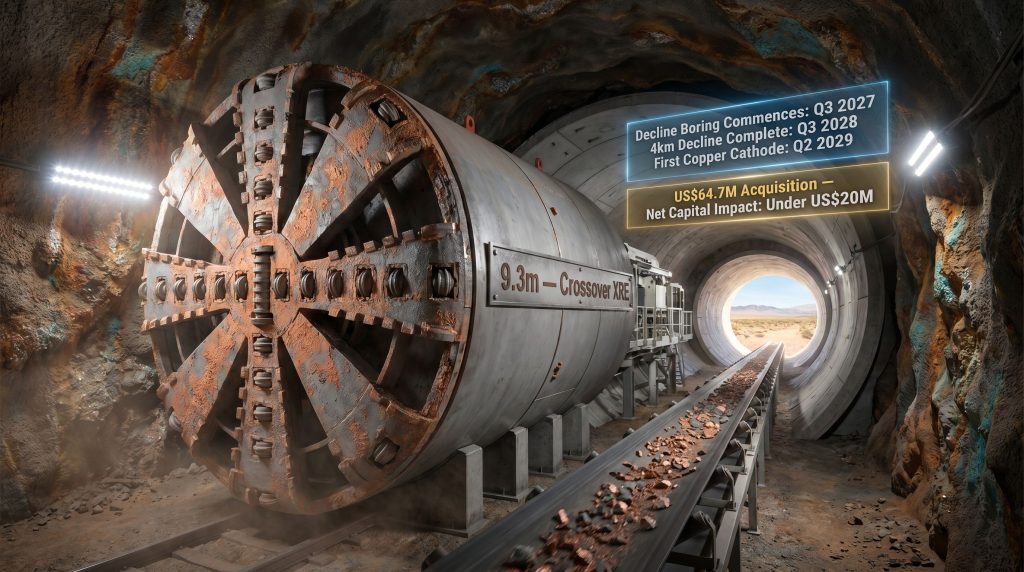
The Robbins Crossover XRE platform was engineered specifically to remove this compromise. Its 9.3-metre diameter bi-directional cutterhead is configured to excavate across soft soils, mixed-face transitional zones, and competent hard rock formations within a single continuous drive, without requiring intervention, machine changeout, or drive interruption.
The Earth Pressure Balance Advantage at Santa Cruz
Arizona's subsurface hydrology is a defining challenge for the Santa Cruz decline alignment. Water-bearing zones and aquifer intersections along the planned path represent a face stability risk that conventional development methods historically manage through external chemical grouting, specifically silica gel grouting programs requiring a Class V Underground Injection Control (UIC) permit under US Environmental Protection Agency regulations.
That permitting pathway introduces two distinct risks. First, UIC permit processes carry timeline uncertainty that can place key regulatory milestones on the critical development path. Second, chemical grouting programs carry their own cost variability and execution risk in complex hydrology.
The Crossover XRE's earth pressure balance capability resolves both issues through a fundamentally different mechanism. By pressurising the cutterhead chamber to match the combined stress of overlying geology and groundwater head, the machine maintains face equilibrium without external intervention. Water inflow at aquifer intersections is directly controlled through the pressurisation system, eliminating both the need for chemical grouting and the UIC permit dependency that comes with it.
The removal of the Class V UIC permit requirement from the Santa Cruz critical path is not a minor administrative convenience. It eliminates a regulatory uncertainty that could otherwise introduce months of schedule risk into a timeline targeting first copper cathode production in Q2 2029.
Technical Specifications: What US$64.7 Million Buys
The acquisition cost of US$64.7 million covers the machine purchase, a comprehensive refurbishment program managed by The Robbins Company, geological customisation for Santa Cruz conditions, and the integrated material handling system. The scope of this investment is detailed below:
| Technical Parameter | Specification |
|---|---|
| Cutterhead diameter | 9.3 metres |
| Ground capability | Hard rock, wet ground, mixed-face geology (single continuous drive) |
| Cutterhead design | Bi-directional |
| Drive system | High-torque / high-speed |
| Groundwater management | Earth pressure balance (EPB) pressurisation |
| Expected advance rate | ~10 metres per day |
| Projected 4km decline duration | ~12 months |
| Refurbishment scope | Full cutterhead rebuilding |
| Cutterhead manufacturing location | Ohio, USA |
| Scheduled site delivery | Q1 2027 |
| Decline boring commencement | Q3 2027 |
Beyond the raw specifications, the machine's integrated lining installation system is a particularly consequential feature. During excavation, the TBM installs a continuous, fully supported, steel-reinforced concrete segmental lining in real time. This produces a sealed decline structure simultaneously with the bore, eliminating separate lining cycles and delivering permanent geotechnical integrity as an inherent output of the excavation process rather than a subsequent program.
The resulting decline geometry is flat-bottomed, a profile specifically suited to life-of-mine infrastructure including conveyor installation and heavy mobile equipment operation. The material handling component of the TBM system includes construction of a permanent conveyor serving both development mucking during excavation and ore transport during production phases, effectively combining two capital programs into one.
A Machine With a Mining Pedigree
Why Operational History in Mining Matters
A critical but often overlooked distinction in TBM selection for underground mining applications is the provenance of the machine's operational history. TBMs sourced from civil tunnelling contexts — metro systems, road tunnels, and water infrastructure projects — have accumulated hours in conditions that do not replicate the specific challenges of underground mine environments. Ore zone intersections, mineralised groundwater, and the need for life-of-mine structural durability in a production context create a different performance benchmark.
The Robbins Crossover XRE being acquired by Ivanhoe Electric for the Ivanhoe Electric Robbins TBM Santa Cruz Copper Project deployment has a confirmed underground mining operational history. Prior to the purchase, Robbins reacquired the machine from Anglo American, where it had been deployed at the Grosvenor underground coal mine in Queensland, Australia. At Grosvenor, the machine completed two separate underground decline drives, accumulating a combined 1.8 kilometres of excavated decline across more than 1,000 operating hours.
This background validates the machine's performance specifically in the context where it will next be used: underground mine access development in variable geological conditions. For a capital commitment of this scale, that distinction carries meaningful risk-reduction value.
Refurbishment: Engineering for Santa Cruz, Not Just Rebuilding
The refurbishment program being executed by Robbins is not a general-purpose overhaul. The scope includes full rebuilding of the 9.3-metre cutterhead, with the replacement cutterhead manufactured in Ohio. Beyond the rebuild, additional technical upgrades are being engineered specifically for the geological conditions anticipated along the Santa Cruz decline alignment.
This customisation approach reflects a recognition that the transition from Grosvenor's coal-measure geology to Arizona's copper porphyry and mixed geology requires targeted engineering rather than standardised refurbishment. The involvement of Robbins in this customisation work also creates a form of technical accountability: the company manufacturing and refurbishing the machine is directly invested in its performance against the specific ground conditions it will encounter.
What the TBM Replaces: A True Apples-to-Apples Comparison
The prior Santa Cruz development plan was not a placeholder. It was a detailed methodology built around roadheader-based decline excavation with Rail-Veyor material handling, silica gel grouting for groundwater management, and the associated Class V UIC permit pathway. Replacing that plan with a TBM-based approach requires genuine technical and financial justification, not just conceptual preference.
The comparison is instructive on multiple dimensions:
1. Structural permanence
The roadheader approach produces an excavated profile requiring separate lining cycles to achieve structural permanence. The TBM installs permanent segmental concrete lining continuously during excavation, eliminating sequential work phases and reducing total programme duration.
2. Regulatory pathway
Roadheader-based development with silica gel grouting requires a Class V UIC permit, introducing regulatory timeline risk. The TBM's EPB system eliminates this permitting requirement entirely.
3. Material handling infrastructure
The prior plan incorporated Rail-Veyor systems, adding mechanical complexity and dedicated capital requirements. The TBM system integrates a permanent conveyor serving both development and production phases, combining two capital programmes into one infrastructure investment.
4. Schedule predictability
Drill-and-blast and roadheader methods produce excavation at rates that vary with ground conditions, requiring ground support intervention cycles and generating schedule variability. Mechanised TBM excavation at a consistent advance rate of approximately 10 metres per day delivers a more predictable development timeline.
5. Net capital impact
Ivanhoe Electric has indicated the net capital impact of the TBM approach compared to the prior development plan is under US$20 million, meaning a technically superior method is also financially more efficient when all replaced components are accounted for.
Capital efficiency in pre-production mining projects is not simply about minimising headline expenditure. It is about maximising the value delivered per dollar deployed. A US$64.7 million investment that replaces a more expensive conventional programme while delivering superior structural outcomes and removing a critical permitting dependency represents a qualitatively different use of capital.
The Development Timeline: Sequence and Dependencies
| Development Milestone | Target Date |
|---|---|
| TBM option secured | Late 2025 / March 2026 |
| Purchase agreement finalised | Before end of May 2026 |
| Casa Grande Site Development Plan approved | March 2026 |
| Boxcut construction commences | August 2026 |
| TBM site delivery and assembly | Q1 2027 |
| Phase II Aquifer Protection Permit expected | Mid-2027 |
| Decline boring commences | Q3 2027 |
| Surface infrastructure construction | Q3 2027 to Q3 2028 |
| 4km decline completion | ~Q3 2028 |
| Underground mine development commences | Q3 2028 |
| First oxide copper ore on heap leach pads | Q4 2028 |
| First copper cathode production | Q2 2029 |
A notable structural feature of this timeline is the relationship between the Phase II Aquifer Protection Permit and the TBM operational schedule. The permit is anticipated mid-2027, at which point the TBM will have commenced boring operations in Q3 2027. The permit is therefore expected to land concurrent with operational activity rather than as a prerequisite gating milestone, reducing its critical-path significance substantially.
All initial construction permits were confirmed as in place at the time of the May 2026 announcement, and the Casa Grande Site Development Plan received formal approval in March 2026, clearing the path for boxcut construction to commence in August 2026.
The next major ASX story will hit our subscribers first
The Texaco Deposit: From Single-Project Cost to Multi-Deposit Asset
Why Proximity Changes the Investment Calculation
Located approximately 2 kilometres from the primary Santa Cruz development area, the Texaco Deposit introduces a dimension to the TBM acquisition that is not captured in single-project capital analysis. Ivanhoe Electric's executive chair Robert Friedland confirmed at the time of the purchase announcement that the machine's mobility gives the company's engineering team the ability to pursue a phased expansion of the project incorporating the Texaco Deposit as a future development target.
The practical implication is significant. The US$64.7 million acquisition is not a single-project capital expenditure that is amortised over the Santa Cruz initial mine life alone. It is a reusable capital tool that can be redeployed without a second major access development programme to open up a high-grade copper target less than 2 kilometres away.
This redeployment logic transforms the unit economics of the investment. The permanent decline infrastructure constructed at Santa Cruz also creates the physical foundation for future underground expansion into deeper sulphide zones, extending the project's mine life and resource base beyond the initial oxide copper heap leach operation.
Porphyry Copper Systems and the Phased Development Logic
High-grade porphyry copper systems like Santa Cruz typically host multiple mineralised zones at varying depths and lateral positions. The initial production phase at Santa Cruz targets oxide copper ore amenable to heap leach processing, delivering copper cathode through solvent extraction-electrowinning (SX-EW) circuits. This represents the most accessible and capital-efficient entry point for production.
Deeper sulphide zones and satellite deposits like Texaco represent the next tier of value in a phased development model. Access to these zones requires the same type of permanent, large-diameter decline infrastructure being built for the initial oxide operation. The TBM's redeployment capability means this second-phase access programme does not require procuring, refurbishing, or mobilising a new machine, consequently compressing both the timeline and capital requirement for phase two development.
Robbins and the Technology's Credibility Foundation
The Robbins Company holds a foundational position in the global tunnel boring machine industry, credited with pioneering the modern TBM and accumulating a project portfolio exceeding 1,000 global deployments across mining and civil infrastructure applications. The Crossover XRE platform represents the company's response to a well-documented operational failure mode in complex geology: single-mode machines encountering ground conditions outside their design envelope.
Robert Friedland noted at the acquisition announcement that Robbins has driven forward tunnelling innovation for more than half a century across mining and civil engineering projects worldwide, a characterisation consistent with the company's documented role in global underground infrastructure development. This long-standing expertise is directly relevant to the copper expansion plans being pursued across the industry more broadly.
The company's dual involvement as both the machine's refurbisher and the source of geological customisation engineering for Santa Cruz conditions creates a level of technical integration unusual in equipment procurement. Rather than a transactional equipment sale, the arrangement reflects a performance-aligned relationship where Robbins' engineering credibility is directly connected to the machine's success in conditions it helped engineer for.
The Ohio-based manufacturing of the replacement cutterhead also reinforces the domestic supply chain positioning of the project, with the primary engineered component of the refurbished machine produced within the United States. This aligns with the broader US mineral production push that has elevated domestic copper projects to strategic priority status.
Financial Dimensions: Balance Sheet Context and Financing Strategy
The scale of the TBM acquisition sits within a broader capital context that investors in the Ivanhoe Electric Robbins TBM Santa Cruz Copper Project story should understand clearly.
| Financial Metric | Figure |
|---|---|
| Total TBM acquisition cost | US$64.7 million |
| Net capital impact vs prior plan | Under US$20 million |
| Recent financing round raised | US$231 million |
| Most recent reported net loss | US$105.9 million |
The US$231 million financing round completed ahead of the acquisition provides Ivanhoe Electric with the balance sheet capacity to absorb the TBM commitment without immediate financing pressure. The net capital impact figure of under US$20 million versus the prior development plan is critical context: it means the incremental cost of the superior methodology, after accounting for eliminated programmes including roadheaders, Rail-Veyor systems, and silica gel grouting, is less than one-third of the headline acquisition price.
Financing pathways under active consideration include discussions with the US Export-Import Bank regarding project financing, parallel evaluation of commercial bank debt financing, and exploration of non-debt capital sources. This diversified approach reflects the range of financing structures available to pre-production critical mineral projects in the current US policy environment. Those exploring copper investment strategies will recognise this financing diversification as a hallmark of well-structured project development.
Disclaimer: The financial figures and timelines discussed in this article are based on information available at the time of Ivanhoe Electric's May 2026 announcement. Forward-looking statements including production targets, cost estimates, and financing outcomes involve material uncertainty. Investors should review company announcements and independent financial advice before making investment decisions.
Frequently Asked Questions
What is the Robbins Crossover XRE TBM?
The Robbins Crossover XRE is a purpose-engineered tunnel boring machine designed to excavate through hard rock, soft ground, and mixed-face geology within a single continuous drive. Its defining features include a 9.3-metre bi-directional cutterhead, an earth pressure balance pressurisation system for groundwater management, and a high-torque drive system capable of maintaining advance rates through structurally complex formations. These characteristics make it particularly suited to underground mine access development in geologically variable environments.
Why did Ivanhoe Electric choose a TBM over conventional decline development?
The TBM approach delivers five specific advantages over the prior roadheader-based plan: it installs permanent segmental concrete lining during excavation, eliminates the Class V UIC permitting requirement by replacing chemical grouting with EPB groundwater management, integrates a permanent conveyor into the development process, produces a flat-bottomed decline geometry optimised for life-of-mine use, and delivers more predictable schedule performance through mechanised continuous excavation.
How much did the Robbins TBM cost Ivanhoe Electric?
The total acquisition cost is US$64.7 million, covering the machine purchase, comprehensive refurbishment, geological customisation for Santa Cruz conditions, and the material handling system. Ivanhoe Electric has stated the net capital impact compared to the prior development plan is under US$20 million, reflecting the cost of eliminated conventional development components.
When will the TBM arrive at the Santa Cruz site?
The refurbished Robbins Crossover XRE is scheduled for delivery and on-site assembly at Casa Grande, Arizona in Q1 2027, with decline boring expected to commence in Q3 2027.
How long will the Santa Cruz decline take to excavate?
The TBM is expected to complete the 4-kilometre single decline in approximately 12 months, advancing at a target rate of around 10 metres per day.
What role does the Texaco Deposit play in this acquisition?
The Texaco Deposit is a high-grade copper target located approximately 2 kilometres from the primary Santa Cruz development area. The TBM is designed for redeployment to develop access to this deposit in a subsequent phase, transforming the capital investment into a multi-deposit asset rather than a single-project expenditure.
When is first copper production expected?
First oxide copper ore is expected to be placed on heap leach pads in Q4 2028, with first copper cathode production targeted for Q2 2029.
What This Development Signals for US Copper
The Ivanhoe Electric Robbins TBM Santa Cruz Copper Project acquisition is not a straightforward equipment procurement story. It is a case study in how technically rigorous mine planning can simultaneously improve engineering outcomes, reduce schedule risk, simplify regulatory pathways, and deliver better capital efficiency than the conventional methods it replaces. In addition, it speaks directly to a worsening copper supply crunch that is making efficient, fast-track development approaches increasingly valuable.
The combination of a mining-proven machine, purpose-engineered refurbishment, EPB groundwater management, integrated permanent infrastructure, and multi-deposit redeployment potential creates a development approach that is qualitatively different from what most North American underground copper projects have attempted at this scale.
Several key takeaways emerge for those following the project:
- The TBM replaces a more complex and expensive conventional programme at a net incremental cost of under US$20 million, demonstrating that technical sophistication and financial discipline are not in tension here.
- Removing the Class V UIC permit from the critical path eliminates one of the most common schedule-risk sources in Arizona copper development.
- The machine's Grosvenor coal mine operational history in underground mining applications provides a validated performance baseline that civil-sourced TBMs cannot offer.
- The Texaco Deposit redeployment option means the US$64.7 million acquisition generates optionality beyond the initial Santa Cruz mine life, adding long-term strategic value that does not appear in single-project financial models.
- Ohio-based cutterhead manufacturing reinforces the domestic supply chain dimension of the project at a time when US copper production and critical mineral development carry heightened strategic relevance.
For further technical detail on the official acquisition announcement, Ivanhoe Electric's full release provides comprehensive project documentation. For ongoing coverage of tunnel boring machine applications across global mining and infrastructure projects, GeoDrilling International publishes regular updates at geodrillinginternational.com.
Want to Catch the Next Major Copper Discovery Before the Market Does?
Discovery Alert's proprietary Discovery IQ model delivers real-time alerts on significant ASX mineral discoveries — instantly cutting through complex geological and commodity data to surface actionable opportunities for both short-term traders and long-term investors. Explore Discovery Alert's dedicated discoveries page to understand how major mineral finds have historically generated extraordinary returns, and begin your 14-day free trial today to position yourself ahead of the market.