
June 11, 2026
West Africa's Gold Belt Is Rewriting the Global Supply Map
The global gold mining industry is quietly shifting its centre of gravity. While established producers across North America and Australia grapple with declining ore grades, rising energy costs, and increasingly complex permitting environments, a different story is unfolding across West Africa's ancient Precambrian shield. Within this geological corridor, one nation is advancing with unusual consistency: Ivory Coast, a country whose identity has long been anchored to cocoa but whose ambitions are increasingly written in gold.
Understanding the Ivory Coast gold output expansion requires looking beyond individual mine announcements. What is unfolding is a structural transformation, shaped by geology, deliberate regulatory design, and compounding capital commitment from some of the world's most experienced gold operators. Furthermore, the gold exploration importance in this region cannot be overstated when contextualising what is driving this momentum.
When big ASX news breaks, our subscribers know first
Why the West African Craton Matters to Gold Investors
Geological Foundations Driving Exploration Interest
Ivory Coast sits atop the West African Craton, one of the world's most mineralogically significant Precambrian geological formations. This ancient rock sequence, which solidified more than 2 billion years ago, hosts the class of deposit known as orogenic gold, formed when gold-bearing hydrothermal fluids were forced into fracture zones during ancient tectonic collisions.
Orogenic systems are prized in the mining industry for several reasons:
- They tend to produce high-continuity ore bodies that are more predictable to mine than structurally complex deposits
- Gold grades within orogenic systems can remain consistent over hundreds of metres of vertical extent, improving underground mine economics
- The same craton extends across Burkina Faso, Mali, Senegal, and Ghana, creating a regionally unified but nationally competitive exploration landscape
What distinguishes Ivory Coast within this geological setting is not just deposit quality but the relative political stability the country has maintained compared to several of its Sahelian neighbours, where security deterioration has disrupted active mining programs.
Investors familiar with greenstone belt geology will recognise Ivory Coast's structural position as directly analogous to the Eastern Goldfields of Western Australia or the Abitibi Belt in Canada, two of the world's most prolific orogenic gold provinces. In addition, current gold exploration trends indicate that capital continues to flow toward jurisdictions offering geological quality combined with regulatory stability.
A Decade of Output Growth: The Numbers Behind the Story
From 23 Metric Tons to a Projected 69: The Production Trajectory
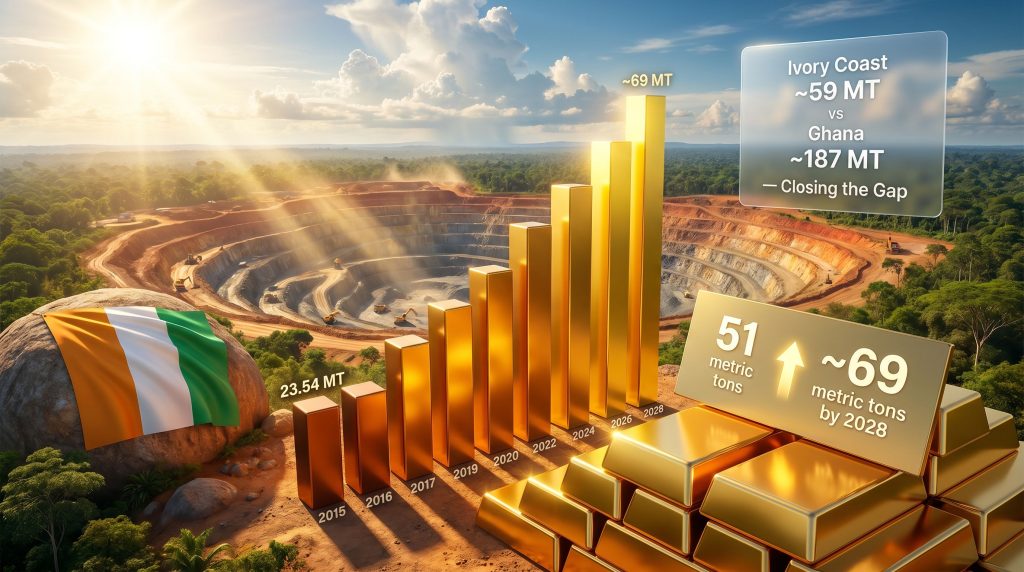
Few emerging gold jurisdictions can point to a production record as consistent as Ivory Coast's over the past decade. Output has grown from roughly 23.54 metric tons in 2015 to an estimated 59.33 metric tons in 2025, representing more than a doubling of national production in ten years.
| Year | Estimated Gold Output (Metric Tons) |
|---|---|
| 2015 | 23.54 |
| 2023 | 51.19 |
| 2024 | ~58.00 |
| 2025 | ~59.33 |
| 2026 (Projected) | 62.00 |
| 2027 (Projected) | 63.00 |
| 2028 (Projected) | ~69.00 |
Source: Government economy ministry data and industry production forecasts
According to Ivory Coast's Director General of Mines Seydou Coulibaly, as reported by Reuters in June 2026, output is forecast to reach 62 metric tons in 2026, climb to 63 metric tons in 2027, and approach 69 metric tons by 2028. This trajectory is not a speculative projection; it is underpinned by confirmed mine commissioning schedules and capital-committed expansion programs already in execution.
What makes this growth curve particularly notable is that it has been achieved without a single dominant mega-mine distorting the figures. Instead, it reflects a diversified multi-operator production base, a characteristic that provides resilience against the single-asset concentration risk that plagues many smaller producing nations. The broader gold price outlook also remains broadly supportive of continued capital deployment in jurisdictions such as this.
The Mines Driving Ivory Coast's Gold Output Expansion
Three New Operations Reshaping the Production Count
The country currently operates 14 active gold mines, a figure confirmed by government officials and scheduled to increase meaningfully over the next three years. According to Côte d'Ivoire's gold production data, the sector has benefited from sustained regulatory support and infrastructure investment:
- Kone mine: Expected to commission within two years, bringing the operational count to 15
- Doropo project: Scheduled to reach production in the subsequent year
- Tanda project: Coming online alongside Doropo, pushing the total to 17 active mines
Each incremental addition to the mine count compounds the national production base in a way that structurally reduces dependence on any single operator's performance.
Lafigué: The New Production Anchor
The Lafigué mine commenced commercial production in October 2024, and its contribution has already begun materialising in national output figures. Annual production guidance for Lafigué sits in the range of 180,000 to 210,000 ounces, making it one of the most significant mine openings in the country's recent history.
For context, 200,000 ounces converts to approximately 6.2 metric tons annually, a meaningful addition to a national base of roughly 59 metric tons. The ramp-up trajectory at Lafigué is widely regarded as a primary catalyst for the step-change in output expected between 2025 and 2026.
Yaouré's Underground Extension: Long-Term Capital Commitment
Perseus Mining's Yaouré operation exemplifies a different but equally important growth driver: the deepening of existing high-quality deposits through underground development. Perseus secured a six-year permit extension pushing Yaouré's operating horizon to 2036, following the identification of additional subsurface gold resources.
The company has committed A$170 million to an underground development program scheduled to begin in 2026. Once operational, the underground component is projected to account for approximately 50% of Yaouré's total annual output, fundamentally extending the mine's economic life and production contribution.
A capital commitment of this scale from an Australian mid-tier operator signals more than project confidence. It reflects a considered assessment of sovereign risk, regulatory continuity, and long-term gold price economics that endorses Ivory Coast as a preferred jurisdiction for long-life capital deployment.
Closing the Gap With Ghana: A Strategic National Objective
The Production Distance in Perspective
Ghana produced approximately 187 metric tons of gold in the most recent reporting year, maintaining its position as Africa's largest gold producer by a considerable margin. Ivory Coast's current output of roughly 59 metric tons represents less than a third of Ghana's production.
| Metric | Ivory Coast | Ghana |
|---|---|---|
| Current Annual Output | ~59-62 metric tons | ~187 metric tons |
| Active Gold Mines | 14 (rising to 17 by 2028) | Multiple large-scale operations |
| 2028 Production Target | ~69 metric tons | Established market leader |
| Regional Ranking | Rising challenger | Africa's #1 producer |
Source: World Gold Council data; government ministry forecasts
Ivorian authorities have explicitly framed narrowing this production gap as a national economic objective, and the approach extends beyond simply bringing new mines online. It encompasses regulatory accessibility, infrastructure investment, and proactive foreign direct investment attraction through vehicles like the SIREXE international extractive resources and energy exhibition, scheduled for Abidjan from November 18 to 22. Consequently, this Ivory Coast gold output expansion strategy is increasingly attracting attention from global operators seeking new long-life jurisdictions.
The Investment Climate: Permit Activity as a Leading Indicator
Exploration Applications Tell a More Precise Story Than Headlines
One of the most telling signals of a jurisdiction's mining investment climate is not headline production data but exploration permit activity, which is a leading indicator of future production by five to ten years. The data from Ivory Coast across 2023 to 2025 presents a clear positive trend:
| Year | Applications Received | Permits Granted | Approval Rate |
|---|---|---|---|
| 2023 | 189 | 151 | ~80% |
| 2024 | 203 | 160 | ~79% |
| 2025 | 225 | 171 | ~76% |
Source: Ivory Coast Ministry of Mines, Petroleum and Energy
The year-on-year growth in application volumes, from 189 in 2023 to 225 in 2025, is the more significant signal here. It is not simply that the government is approving permits at a high rate; it is that more companies are seeking entry into the jurisdiction each year. The compound effect of 482 permits granted across three years represents a substantial latent production pipeline that will take years to fully manifest in output statistics.
Furthermore, interpreting gold drill results from active programmes across these newly permitted tenements will be critical in determining which projects progress to feasibility and, ultimately, to mine construction.
International Operators Already Anchored in the Market
The diversity of established international operators provides an important validation signal for prospective entrants:
- Endeavour Mining (United Kingdom) operates the Ity mine, among other assets
- Perseus Mining (Australia) operates Yaouré with the A$170 million underground expansion underway
- Resolute Mining (Australia) maintains active operations within the country
- Roxgold (Canada) forms part of the established operator base
The presence of operators from three different jurisdictions across multiple regulatory systems reflects a broad-based institutional endorsement of Ivory Coast's investment framework. In addition, gold M&A activity at the global level continues to reinforce strategic interest in high-quality, growth-oriented jurisdictions such as this.
The next major ASX story will hit our subscribers first
Structural Risks Investors Should Not Overlook
Four Risk Vectors Deserving Rigorous Assessment
A production growth story of this magnitude warrants careful scrutiny of the risks that could impair the trajectory:
-
Gold price sensitivity: All project economics, including Lafigué's ramp-up and Yaouré's underground investment, are calibrated against gold price assumptions. Sustained price weakness would compress operator margins and potentially defer discretionary capital expenditure
-
Regional geopolitical spillover: The deterioration of security conditions in neighbouring Burkina Faso and Mali has not materially disrupted Ivorian operations to date, but the risk of contagion from Sahelian instability is a genuine consideration for multi-year investment horizons
-
Infrastructure constraints: Expanding from 14 to 17 active mines requires commensurate investment in power generation, roads, water supply, and processing capacity. Bottlenecks in any of these areas can delay ramp-up timelines regardless of permitting progress
-
Permit-to-production conversion: High approval rates and rising application volumes are necessary but not sufficient conditions for output growth. The critical variable is the fraction of exploration-stage permits that ultimately convert to development decisions and mine construction
Scenario Analysis: Three Pathways to 2028
What Could Accelerate, Sustain, or Slow the Growth Curve
| Scenario | Key Assumptions | 2028 Output Range |
|---|---|---|
| Base Case | Kone, Doropo, Tanda commission on schedule; Yaouré underground delivers as planned | ~69 metric tons |
| Upside Case | Exploration permit conversions accelerate; additional pipeline projects reach production early | 72-75 metric tons |
| Downside Case | Project delays, sustained gold price weakness, or infrastructure bottlenecks slow ramp-up | 62-65 metric tons |
The base case is well-supported by confirmed capital commitments and operator guidance. The upside case rests on a speculative but plausible assumption: that a meaningful fraction of the 482 permits granted between 2023 and 2025 progress through feasibility and into construction decisions faster than historical averages suggest.
The Cocoa-Gold Diversification Model: A Macroeconomic Lens
Why Ivory Coast's Dual-Commodity Identity Matters to Long-Term Investors
Ivory Coast's structural position as both the world's leading cocoa producer and a rapidly scaling gold producer creates a rare macroeconomic dynamic. The two commodities have historically displayed low price correlation, meaning that periods of cocoa market weakness are not systematically accompanied by gold price declines.
This dual-commodity revenue base provides a degree of export earnings resilience that most Sub-Saharan African economies cannot replicate. National development strategy explicitly positions mining as a structural counterweight to cocoa price volatility, a policy commitment that provides long-term regulatory continuity for operators navigating multi-decade investment decisions.
The trajectory toward 69 metric tons of annual gold production by 2028 is not simply a mining story. It is an economic diversification story playing out in real time, backed by geological endowment, confirmed capital, and a regulatory framework that has demonstrated consistent accessibility to international operators. However, realising this potential will require sustained commitment from both government and the private sector to address infrastructure, permitting efficiency, and regional stability considerations in equal measure.
Readers seeking additional context on West African gold sector dynamics and Ivory Coast's mining development trajectory can explore related industry reporting at Mining.com. This article is intended for informational purposes only and does not constitute financial or investment advice. Production forecasts, project timelines, and financial projections referenced herein are subject to change and involve inherent uncertainties.
Ready to Capitalise on the Next Major Gold Discovery Before the Broader Market?
Discovery Alert's proprietary Discovery IQ model delivers real-time alerts on significant ASX mineral discoveries, transforming complex geological data into actionable investment insights — explore the historic returns major discoveries have generated to understand what is at stake, then begin a 14-day free trial at Discovery Alert to position yourself ahead of the market.