June 4, 2026
Japan's strategic commitment to advance biocarbon usage represents a critical milestone in industrial decarbonization, positioning the nation as a global leader in sustainable thermal fuel adoption. The convergence of mandatory emissions trading systems, renewable energy mandates, and technological maturity has created unprecedented opportunities for biocarbon deployment across power generation and heavy manufacturing sectors. Furthermore, Japan's approach offers valuable energy transition insights for other developed economies pursuing rapid carbon neutrality targets.
Understanding Japan's Strategic Biocarbon Initiative
Japan's acceleration of torrefied biomass projects represents a comprehensive industrial transformation targeting both power generation and heavy manufacturing sectors. The initiative centers on biocarbon deployment across thermal power plants, steel production facilities, and industrial manufacturing operations, driven by the upcoming mandatory emissions trading system commencing in April 2026.
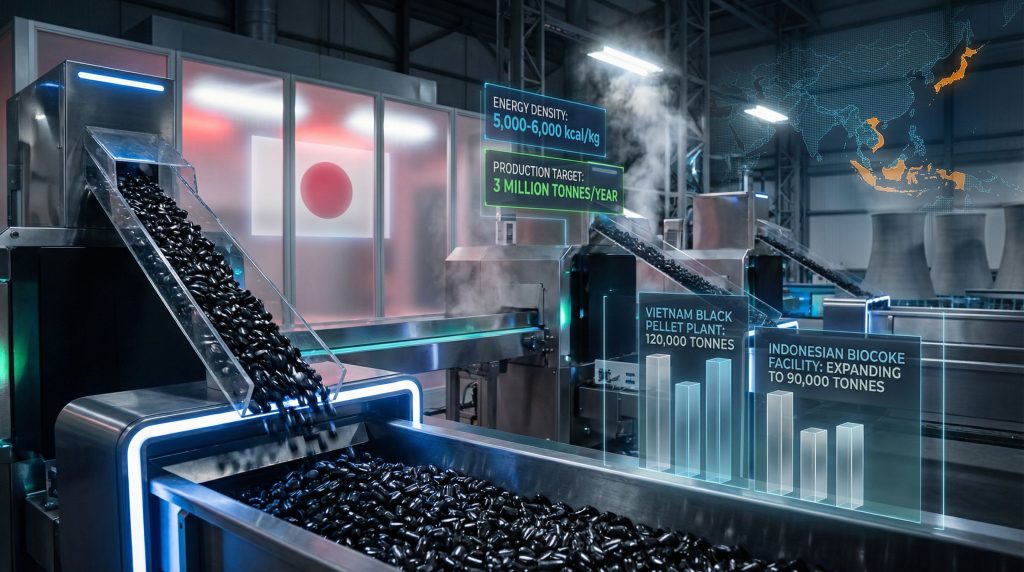
Current operational capacity stands at 135,000 tonnes annually across two primary facilities, with aggressive expansion plans targeting 3 million tonnes per year by the 2030s. This represents a 25-fold capacity increase from existing operations, positioning Japan as a global leader in biocarbon adoption.
The strategic framework encompasses domestic production using Japanese forestry waste alongside international supply chains leveraging Southeast Asian agricultural residues. Companies are establishing integrated operations spanning feedstock procurement, torrefaction processing, and finished product distribution to Japanese industrial consumers.
Key regulatory drivers include Japan's 2050 carbon neutrality commitment, mandatory emissions trading implementation, and renewable energy portfolio standards across utility sectors. These policy frameworks create immediate economic incentives for carbon-neutral fuel substitution, particularly in thermal power generation where biocarbon can replace conventional coal at ratios up to 35% without major facility modifications.
When big ASX news breaks, our subscribers know first
What Makes Biocarbon a Game-Changer for Japanese Industry?
Technological Advantages Over Conventional Biomass
Biocarbon's fundamental advantage lies in its enhanced material properties achieved through thermal torrefaction processes. Black pellets deliver calorific values of 5,000-6,000 kcal/kg, approaching coal-equivalent energy density while maintaining carbon neutrality credentials. This energy concentration represents a significant improvement over conventional wood pellets, enabling direct substitution into existing coal infrastructure.
Critical Performance Characteristics:
• Superior water resistance compared to standard biomass
• Enhanced grindability enabling compatibility with coal grinding systems
• Improved storage stability reducing degradation during transportation
• Direct compatibility with existing coal handling infrastructure
The torrefaction process fundamentally alters biomass structure, creating a fuel that behaves similarly to coal in industrial applications. This compatibility eliminates the need for major facility renovations, reducing capital expenditure requirements for thermal power plants and industrial facilities considering biocarbon adoption.
Japanese utilities have validated co-firing ratios up to 35% biocarbon substitution in laboratory conditions, though commercial deployment strategies focus on more conservative 10-20% substitution rates to ensure operational reliability and supply security. These developments align with broader renewable energy solutions being implemented across industrial sectors.
Economic Viability in High-Energy-Cost Markets
Despite commanding approximately double the price of conventional wood pellets, biocarbon demonstrates compelling economics within Japan's regulatory environment. The April 2026 implementation of mandatory emissions trading creates immediate financial incentives for carbon-neutral fuel adoption, improving biocarbon's relative economics versus conventional coal.
Economic Drivers Supporting Adoption:
• Carbon pricing penalties under mandatory trading systems
• Renewable energy mandate compliance requirements
• Energy security benefits reducing import dependency
• Infrastructure compatibility minimising transition costs
Market participants confirm that biocarbon's premium pricing is offset by avoided carbon penalties and renewable energy compliance benefits. The regulatory framework transformation positions biocarbon as an economically viable solution for utilities facing carbon pricing pressures and renewable energy mandates.
Industrial manufacturers similarly benefit from biocarbon adoption through carbon footprint reduction and regulatory compliance, particularly in sectors subject to mandatory emissions trading coverage beginning April 2026. This demonstrates the critical role of Japan to advance biocarbon usage within broader sustainability frameworks.
Which Industries Are Leading Japan's Biocarbon Adoption?
Power Generation Sector Transformation
Japanese utilities are implementing large-scale biocarbon co-firing strategies across thermal power generation facilities. Two major utility projects alone are expected to drive several hundreds of thousands of tonnes of annual biocarbon demand, demonstrating the sector's commitment to carbon-neutral fuel adoption.
Planned Co-firing Deployment:
| Utility Project | Power Unit Size | Co-firing Ratio | Expected Annual Demand |
|---|---|---|---|
| Major Utility A | 600 MW | 20% black pellet substitution | Significant volume |
| Major Utility B | 700 MW | 10% black pellet substitution | Substantial tonnage |
Test product distribution has already reached approximately 20 Japanese customers, including power producers and industrial manufacturers, validating market acceptance and operational compatibility. Japanese firms are advancing their biocarbon initiatives through comprehensive testing and commercial preparation phases.
The conservative approach to commercial co-firing ratios reflects utilities' focus on operational risk management and supply chain security. While laboratory validation supports up to 35% biocarbon substitution, planned deployment at 10-20% ratios ensures reliable fuel supply and stable power generation operations.
Full-scale commercial shipments are scheduled to commence in 2026, with existing Vietnamese production facilities ready to supply Japanese utilities' initial biocarbon requirements.
Steel Industry Innovation Through Biocoke
Cast iron and steel manufacturers are developing biocoke production capabilities targeting complete coking coal replacement in metallurgical applications. The advanced biocoke technology enables 100% coking coal substitution in cast iron melting furnaces while maintaining equivalent thermal performance.
Biocoke Production Infrastructure:
| Operator | Location | Current Capacity | Target Capacity | Timeline | Feedstock |
|---|---|---|---|---|---|
| Aisin Takaoka | West Kalimantan, Indonesia | 15,000 t/yr | 90,000 t/yr | ~2031 | Palm kernel shells |
Production economics require 3-4 tonnes of palm kernel shells to produce 1 tonne of biocoke, utilising agricultural waste from palm oil processing operations. This feedstock strategy leverages abundant Southeast Asian agricultural residues while creating value-added applications for previously low-value waste streams.
Commercial Implementation Timeline:
• Production commencement: December 2025
• Commercial deployment: Q1 2026
• Sales structure: 50% third-party sales, 50% internal use
• Target industries: Automotive, machinery, cast iron manufacturing
The 50-50 split between internal consumption and third-party sales demonstrates confidence in both supply adequacy and market demand across Japanese industrial sectors. Biocoke's comparable calorific value to coking coal enables seamless integration into existing metallurgical processes without performance compromises.
Strategic Partnership Development:
Kobe Steel's collaboration with Mitsubishi Ube Cement represents another significant industry initiative, targeting black pellet deployment in steelmaking operations. The partnership leverages MUCC's proprietary torrefaction technology and seven-year operational track record in thermal power plant co-firing applications.
MUCC's existing production capacity of 60,000 tonnes annually at its Ube factory provides established infrastructure for steel industry biocarbon supply. The collaboration aims to integrate black pellets into blast furnace operations at Kobelco's Kakogawa steelworks, demonstrating scalable deployment across Japanese steel production.
How Will Production Capacity Scale to Meet Demand?
Current Manufacturing Infrastructure
Operational Facilities (January 2026):
| Production Facility | Annual Capacity | Feedstock Source | Target Market | Status |
|---|---|---|---|---|
| Idemitsu Vietnam Black Pellet Plant | 120,000 t/yr | Local Vietnamese biomass | Japanese utilities | Commercial since October 2025 |
| Aisin Takaoka Indonesia Biocoke Facility | 15,000 t/yr | Palm kernel shells | Cast iron industry | Production commenced December 2025 |
| Kumagai Gumi/Shinko Shoji Ehime Prefecture Plant | 30,000 t/yr | Domestic Japanese bark | Co-firing applications | Planned Q4 2026 commencement |
Total current operational capacity reaches 135,000 tonnes annually, with the Ehime Prefecture facility adding 30,000 tonnes upon completion in Q4 2026. This domestic production complements international supply chains, reducing import dependency and transportation costs for Japanese consumers.
The Vietnamese facility represents the largest single production unit, achieving full commercial operations in October 2025 and positioned to supply Japanese utilities' initial biocarbon requirements. Local Vietnamese biomass feedstocks provide sustainable raw material sources while establishing Southeast Asian production hubs.
Strategic Expansion Plans Through 2030s
Production capacity scaling targets 3 million tonnes annually by the 2030s, requiring new facility construction across multiple geographic regions. Strategic locations under consideration include Indonesia, Malaysia, and the United States, leveraging locally secured biomass feedstocks and favourable production economics.
Expansion Strategy Components:
• Geographic diversification reducing supply chain risks
• Local feedstock procurement minimising transportation costs
• Technology transfer and licensing arrangements
• Joint venture structures with regional partners
Aisin Takaoka's Indonesian facility expansion exemplifies the scaling approach, targeting capacity increases from 15,000 tonnes to 90,000 tonnes by approximately 2031. This six-fold expansion demonstrates confidence in market demand and feedstock availability within Southeast Asian production hubs.
Additional bark pellet facilities are planned across Japan, each designed for 30,000 tonnes annual capacity using domestically secured bark materials. This domestic production network reduces import dependency while supporting Japanese forestry waste utilisation.
Southeast Asian expansion plans include new facilities leveraging agricultural waste streams such as Vietnamese acacia and palm kernel shells, providing abundant feedstock sources for large-scale biocarbon production. These developments reflect broader green transition dynamics shaping renewable fuel markets globally.
What Are the Key Technical Specifications Driving Adoption?
Performance Metrics Comparison
Black pellets achieve superior technical performance across multiple operational parameters compared to conventional biomass alternatives. The torrefaction process creates fundamental material property improvements enabling seamless integration into existing coal infrastructure.
Technical Performance Advantages:
• Calorific Value: 5,000-6,000 kcal/kg (approaching coal equivalency)
• Water Resistance: Superior moisture protection during storage and transport
• Grindability: Enhanced compatibility with existing coal grinding systems
• Handling Properties: Direct compatibility with coal conveying and combustion equipment
Critical Industry Insight: Black pellets' infrastructure compatibility eliminates the need for major facility modifications, enabling thermal power plants to adopt biocarbon without significant capital expenditure requirements.
These technical specifications enable biocarbon deployment across existing industrial infrastructure while maintaining operational performance standards. The elimination of facility modification requirements significantly reduces adoption barriers for utilities and industrial manufacturers.
Co-firing Optimisation Ratios
Laboratory validation has confirmed successful co-firing ratios up to 35% black pellets with coal, though commercial deployment focuses on more conservative substitution rates. Japanese utilities are planning operational ratios of 10-20% biocarbon substitution for 600-700MW generation units.
Co-firing Implementation Strategy:
• Laboratory validated maximum: 35% biocarbon substitution
• Commercial deployment target: 10-20% substitution
• Power unit applications: 600-700MW thermal generation
• Operational priorities: Reliability and supply security
The conservative commercial approach reflects utility sector risk management priorities, ensuring stable power generation while building operational experience with biocarbon fuel sources. Gradual deployment allows for supply chain development and performance validation before higher substitution ratios.
Trial operations at Japanese thermal power plants have successfully validated technical compatibility and performance reliability, providing confidence for commercial-scale deployment beginning in 2026. These initiatives represent key industry innovation trends influencing global renewable fuel adoption.
Where Are the Primary Supply Chain Developments Occurring?
Southeast Asian Production Hubs
Vietnam and Indonesia are emerging as primary biocarbon production centres, leveraging abundant agricultural waste streams and favourable production economics. These regions offer strategic advantages including feedstock availability, cost-effective processing, and established logistics infrastructure for Japanese market supply.
Vietnamese Production Development:
• Idemitsu's 120,000 tonne facility operational since October 2025
• Local biomass feedstock procurement reducing raw material costs
• Direct shipping connections to Japanese utility consumers
• Additional Vietnamese acacia testing for expanded feedstock sources
Indonesian Manufacturing Hub:
• Palm kernel shell processing for biocoke production
• Agricultural waste utilisation from palm oil operations
• Strategic location in West Kalimantan for efficient logistics
• Expansion potential leveraging abundant feedstock supplies
Companies are establishing integrated supply chains encompassing feedstock procurement, processing operations, and finished product delivery. This vertical integration approach ensures supply security while maintaining cost competitiveness for Japanese industrial consumers.
Joint venture structures with regional partners provide local expertise and operational support while enabling technology transfer and knowledge sharing across international operations.
Domestic Japanese Manufacturing
Parallel domestic production development focuses on bark-based biocarbon utilising Japanese forestry waste streams. The Ehime Prefecture facility represents the first large-scale domestic production unit, designed for 30,000 tonnes annual capacity using locally secured bark materials.
Domestic Production Benefits:
• Reduced import dependency and transportation costs
• Utilisation of Japanese forestry waste streams
• Enhanced supply security for domestic consumers
• Support for local forestry industry development
Additional domestic facilities are planned across Japan, each targeting 30,000 tonnes annual capacity and utilising regional biomass resources. This distributed production network reduces logistics costs while supporting rural economic development through biomass utilisation.
The domestic production strategy complements international supply chains, providing diversified sourcing options and enhanced supply security for Japanese biocarbon consumers. Additionally, the biocarbon market outlook suggests growing global demand will support continued expansion.
The next major ASX story will hit our subscribers first
Why Is Timing Critical for Japan's Biocarbon Strategy?
Regulatory Alignment with Carbon Trading
Japan's mandatory emissions trading system implementation in April 2026 creates immediate economic incentives for biocarbon adoption across covered industrial sectors. The regulatory framework fundamentally alters the economics of carbon-intensive fuels, improving biocarbon's competitive position versus conventional coal and petroleum coke.
Regulatory Impact Timeline:
• April 2026: Mandatory emissions trading commences
• 2026-2027: Initial biocarbon commercial deployment
• 2030s: Large-scale biocarbon market maturation
• 2050: Carbon neutrality target achievement
The alignment of biocarbon production capacity expansion with regulatory implementation creates optimal market conditions for rapid adoption. Companies positioning themselves ahead of regulatory requirements gain competitive advantages through early supply chain development and operational experience.
Carbon pricing mechanisms will quantify the economic benefits of biocarbon adoption, making previously marginal projects economically viable. Industrial facilities subject to emissions trading coverage face direct financial incentives to reduce carbon intensity through biocarbon substitution.
Global Supply Chain Competition
Early positioning in biocarbon supply contracts provides strategic advantages as European and North American markets expand renewable fuel mandates. Global competition for high-quality biocarbon supplies is intensifying, making secured supply relationships increasingly valuable.
Competitive Dynamics:
• Limited global production capacity relative to projected demand
• Technology and feedstock constraints limiting rapid expansion
• First-mover advantages in securing supply contracts
• Quality specifications and certification requirements
Japanese companies' early investment in biocarbon production infrastructure positions them advantageously within emerging global markets. The operational experience and supply chain development create barriers to entry for later market entrants.
International expansion plans targeting Indonesia, Malaysia, and the United States provide geographic diversification while securing feedstock sources for long-term supply security.
What Investment Opportunities Are Emerging?
Joint Venture Structures
Strategic partnerships between Japanese manufacturers and Southeast Asian producers are creating innovative investment structures combining technology transfer, operational expertise, and market access. These collaborations typically feature ownership stakes designed around 50% domestic use and 50% third-party sales.
Investment Structure Examples:
• Aisin Takaoka and Triputra partnership in West Kalimantan
• Kobe Steel and Mitsubishi Ube Cement collaboration
• Kumagai Gumi and Shinko Shoji joint venture in Ehime Prefecture
Joint ventures provide risk sharing while combining complementary capabilities including technological expertise, feedstock access, and market knowledge. The 50-50 sales distribution strategy demonstrates confidence in both internal consumption requirements and external market demand.
Partnership structures enable Japanese companies to establish international production capabilities while leveraging local partners' operational knowledge and feedstock relationships. This approach reduces investment risks while accelerating market entry timelines.
Technology Transfer and Licensing
Japanese companies are developing proprietary torrefaction technologies for licensing to international partners, creating recurring revenue streams beyond direct production operations. Technology licensing arrangements provide scalable growth opportunities without proportional capital investment requirements.
Technology Commercialisation Strategies:
• Proprietary torrefaction process development
• Equipment manufacturing and supply
• Technical consulting and operational support
• Quality certification and testing services
MUCC's seven-year operational track record in thermal power plant co-firing demonstrates proven technology reliability, enhancing licensing value and market acceptance. Established operational performance provides confidence for technology adoption across international markets.
Technology transfer arrangements often include ongoing technical support, maintenance services, and quality assurance protocols, creating long-term partnership relationships beyond initial licensing agreements. These developments support comprehensive sustainability transformation across multiple industries.
How Will This Impact Global Biocarbon Markets?
Price Discovery and Market Maturation
Japanese demand is expected to drive global biocarbon price discovery, establishing benchmark pricing for industrial-grade torrefied biomass across Asia-Pacific markets. The large-scale procurement requirements and quality specifications will influence international pricing structures and market development.
Market Development Impact:
• Benchmark pricing establishment for Asia-Pacific region
• Quality specification standardisation across international markets
• Supply chain infrastructure development requirements
• Technology performance validation and certification
Current pricing shows biocarbon commands approximately double the cost of conventional wood pellets, reflecting superior technical performance and infrastructure compatibility benefits. As production scales and supply chains mature, pricing dynamics may evolve based on feedstock availability and manufacturing efficiency improvements.
Japanese utilities' conservative co-firing approach at 10-20% substitution rates provides market stability while building operational confidence. Successful commercial deployment will likely encourage higher substitution ratios and expanded market adoption across regional utilities.
Supply Chain Standardisation
Large-scale Japanese procurement requirements are driving international standardisation of biocarbon specifications, quality metrics, and logistics protocols. These standards will influence global market development and technology deployment across multiple geographic regions.
Standardisation Areas:
• Technical specifications for calorific value and material properties
• Quality control and testing methodologies
• Logistics and handling protocols
• Environmental certification and sustainability standards
The establishment of industry standards reduces market fragmentation while enabling technology transfer and equipment standardisation across international operations. Standardised specifications facilitate supply chain development and quality assurance across diverse feedstock sources and processing facilities.
Japanese market requirements for infrastructure compatibility are driving product development focused on coal-equivalent handling properties, influencing global biocarbon production technologies and quality targets.
What Challenges Must Be Overcome for Successful Implementation?
Feedstock Security and Sustainability
Ensuring sustainable feedstock supplies without competing with food production requires careful supply chain management and certification protocols. The 3-4 tonnes of palm kernel shells required per tonne of biocoke demonstrates the substantial feedstock requirements for large-scale production.
Sustainability Challenges:
• Agricultural waste availability and seasonal variations
• Competing uses for biomass feedstock materials
• Sustainability certification and environmental standards
• Long-term feedstock supply security arrangements
Palm kernel shells and other agricultural wastes provide ideal feedstock sources as they utilise materials with limited alternative applications. However, scaling to 3 million tonnes annual production requires securing vast quantities of sustainable biomass inputs across multiple geographic regions.
Certification protocols must ensure feedstock sustainability while avoiding food security competition. The utilisation of agricultural waste streams and forestry residues provides environmentally beneficial applications for previously low-value materials.
Infrastructure Investment Requirements
Scaling production to meet projected demand necessitates significant capital investment in specialised torrefaction equipment and logistics infrastructure. The 25-fold capacity increase from current operations to targeted 2030s production requires substantial industrial development.
Infrastructure Development Needs:
• Specialised torrefaction processing equipment
• Feedstock handling and preparation facilities
• Storage and logistics infrastructure
• Quality control and testing capabilities
• Transportation and distribution networks
The infrastructure requirements extend beyond production facilities to encompass supply chain development, including feedstock procurement networks, transportation systems, and storage facilities. International operations require additional complexity for cross-border logistics and quality assurance.
Technology development costs for proprietary torrefaction processes require ongoing investment in research and development, equipment optimisation, and operational refinement. These investments create competitive advantages but demand substantial capital commitments.
Future Outlook: Japan's Role in Global Biocarbon Leadership
Market Size Projections
Japan's biocarbon market is projected to reach multi-billion dollar valuations by 2030, driven by utility sector adoption and steel industry transformation. The target production capacity of 3 million tonnes annually represents substantial economic value creation across multiple industrial sectors.
Market Development Timeline:
• 2026-2027: Commercial deployment initiation
• 2028-2030: Rapid market expansion and capacity scaling
• 2030s: Market maturation and technology optimisation
• Post-2030: Potential export market development
The utility sector's planned co-firing projects requiring several hundreds of thousands of tonnes annually demonstrate immediate large-scale demand. Steel industry biocoke adoption adds additional substantial market volume through coking coal replacement applications.
Economic impact extends beyond direct biocarbon production to encompass equipment manufacturing, technology services, and supply chain development across multiple countries and regions.
Technology Export Potential
Japanese biocarbon technologies and production methodologies are positioned for global export, particularly to other high-energy-cost developed markets facing similar decarbonisation pressures. The operational experience and technological development create exportable intellectual property and consulting opportunities.
Export Market Opportunities:
• Technology licensing to international producers
• Equipment manufacturing and export
• Technical consulting and operational support
• Quality certification and testing services
Countries implementing carbon pricing mechanisms and renewable energy mandates represent primary export markets for Japanese biocarbon technologies. The proven operational performance and infrastructure compatibility provide competitive advantages in international technology transfer arrangements.
Strategic Implications for Stakeholders
Japan's biocarbon advancement represents a systematic industrial transformation influencing global renewable fuel markets, supply chain development, and technology transfer patterns. The integration across power generation and heavy industry sectors demonstrates scalable pathways for other developed economies pursuing rapid decarbonisation.
Stakeholder Impact Analysis:
Utilities and Power Producers:
• Immediate carbon compliance solutions without major infrastructure investment
• Operational experience with carbon-neutral fuels ahead of regulatory requirements
• Supply security through diversified international sourcing arrangements
Industrial Manufacturers:
• Direct coking coal replacement opportunities in metallurgical applications
• Carbon footprint reduction supporting sustainability commitments
• Technology development and licensing revenue potential
International Investors:
• Joint venture opportunities combining technology and market access
• Supply chain investment requirements across multiple countries
• Technology transfer and equipment manufacturing prospects
Policy Makers:
• Demonstrated pathway for industrial decarbonisation without economic disruption
• International cooperation models for sustainable biomass development
• Technology export opportunities supporting economic development
The Japanese approach demonstrates that Japan to advance biocarbon usage requires coordinated policy frameworks, technological development, and international partnership structures. Success depends on sustainable feedstock development, infrastructure investment, and operational experience across multiple industrial applications.
Investment and Market Outlook:
The biocarbon sector presents compelling opportunities for investors seeking exposure to industrial decarbonisation trends while supporting sustainable economic development across multiple regions. The combination of regulatory drivers, technological maturity, and market demand creates favourable conditions for sustained growth through the 2030s.
Moreover, the initiative showcases how Japan to advance biocarbon usage serves as a model for other nations pursuing similar energy transition goals. The comprehensive approach integrating regulatory frameworks, technological innovation, and international partnerships provides a replicable blueprint for sustainable industrial transformation.
Disclaimer: This analysis is based on publicly available information and industry reports. Investment decisions should consider additional factors including regulatory changes, technological developments, and market conditions. Projections and forecasts represent estimates based on current information and may vary significantly from actual outcomes.
Want to Discover the Next Big Mining Breakthrough?
Discovery Alert's proprietary Discovery IQ model provides real-time notifications when significant ASX mineral discoveries are announced, helping investors identify lucrative opportunities before the broader market catches on. Access proven discovery outcomes and begin your 30-day free trial today to position yourself ahead of market-moving announcements.