August 14, 2026
Strategic Partnership Dynamics in Asia-Pacific Investment Flows
The evolving landscape of international capital allocation reflects deeper geopolitical shifts reshaping regional economic partnerships. As traditional investment corridors face scrutiny, alternative markets emerge as focal points for long-term strategic positioning. Japan investment in India exemplifies this transformation, creating opportunities for nations to establish new frameworks for economic cooperation whilst addressing critical infrastructure and technology development needs.
When big ASX news breaks, our subscribers know first
Japan's Investment Infrastructure Enhancement Strategy
Japan's establishment of a dedicated investment facilitation center within its foreign ministry represents an unprecedented institutional commitment to streamlining overseas business operations. This center addresses three fundamental operational challenges that have historically constrained corporate expansion efforts, particularly in navigating complex regulatory environments.
Regulatory Navigation Framework
The complexity of multi-layered compliance requirements across different jurisdictions creates significant barriers for international businesses. Japanese companies face particular challenges when navigating state-level regulations that vary considerably in implementation and interpretation. Furthermore, the new support infrastructure provides specialised guidance on:
- State-specific compliance protocols for manufacturing and service sectors
- Investment approval processes across different regulatory frameworks
- Operational licensing requirements for technology and infrastructure projects
Tax System Clarity Initiative
India's multi-tiered taxation structure presents ongoing challenges for foreign investors seeking operational efficiency. The goods and services tax implementation varies across states, creating complexity in financial planning and compliance strategies. Moreover, transfer pricing regulations and multiple tax authority jurisdictions require specialised expertise that the investment center now provides through dedicated consultation services.
Legal Transparency Enhancement
Inconsistent application of regulatory frameworks has been identified as a primary concern for international businesses. However, the investment support mechanism focuses on bridging information gaps between policy formulation and practical implementation, ensuring companies have access to current interpretations of commercial law and investment regulations.
Current Investment Performance Metrics and Analysis
Japan's investment in India demonstrates significant growth momentum despite operational challenges that have historically limited expansion efforts. The scale of commitment reflects confidence in long-term market potential whilst acknowledging infrastructure development needs that require sustained attention.
Operational Footprint Assessment
Current Corporate Presence (2024 Data):
| Country | Japanese Companies | Market Maturity | Strategic Focus |
|---|---|---|---|
| India | 1,434 | Emerging growth | Technology transfer |
| Singapore | 4,500 | Established hub | Regional operations |
| Thailand | 6,000 | Manufacturing base | Supply chain integration |
Investment Flow Metrics:
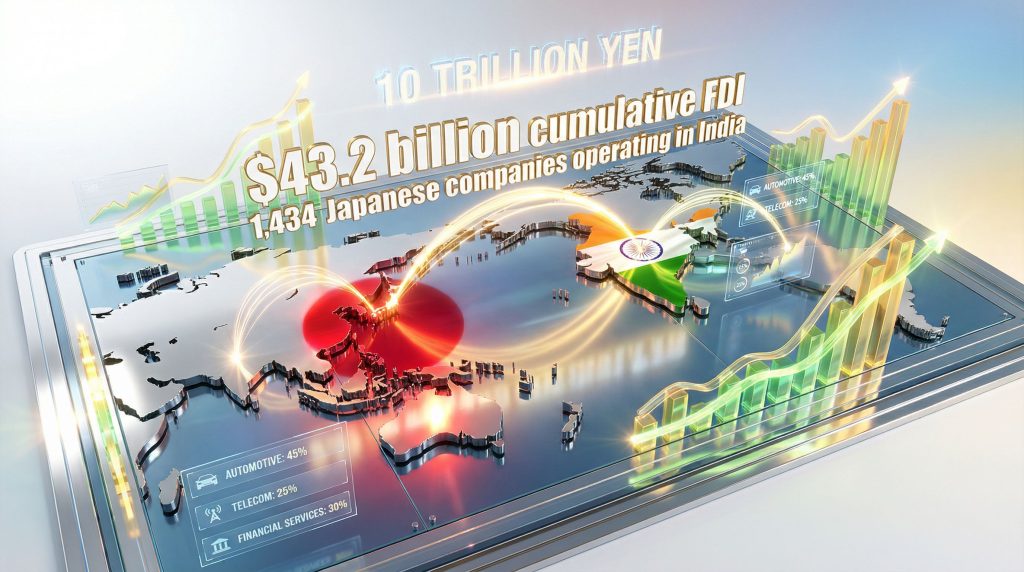
- Total FDI commitment: $43.2 billion (2000-2024)
- India's ranking: 5th largest FDI recipient from Japan
- Market share growth: 60% of companies reported increased performance in 2024
Sectoral Distribution and Strategic Priorities
In addition to these metrics, Japan investment in India concentrates in sectors aligned with both countries' economic development objectives. The automotive sector serves as the primary manufacturing hub, leveraging India's production capabilities and growing domestic market demand.
Primary Investment Sectors:
- Automotive manufacturing: Production facilities and technology transfer
- Electrical equipment: Industrial modernisation support
- Telecommunications: Digital infrastructure development
- Pharmaceuticals: Healthcare market expansion
- Financial services: Banking and insurance integration
Comparative Analysis of Regional Investment Patterns
The shift in Japanese capital allocation reflects broader strategic considerations beyond traditional market factors. For instance, investment flows to India have exceeded China-directed investments for two consecutive years, marking a historic realignment in regional economic partnerships that addresses mining permits challenges affecting regional supply chains.
Strategic Pivot Dynamics
This investment reallocation demonstrates confidence in India's regulatory environment and growth trajectory whilst reflecting broader supply chain diversification objectives. Consequently, Chinese investment in India has reached its lowest levels since 2014, influenced by enhanced scrutiny mechanisms implemented since 2020.
Investment Flow Comparison:
- Japanese investment momentum: Sustained growth trajectory
- Chinese investment trends: Declining since regulatory changes
- Policy environment impact: Enhanced foreign investment screening processes
Major Investment Initiatives and Strategic Projects
Several large-scale investments demonstrate the depth of commitment to long-term economic partnership. These projects span financial services, manufacturing expansion, and infrastructure development initiatives that complement the broader mining industry evolution occurring across the region.
Financial Sector Investment Leadership
Mitsubishi UFJ Financial Group executed the largest foreign investment in India's financial sector with a $4.4 billion commitment to Shriram Finance. This transaction represents confidence in India's financial services growth potential and demographic dividend opportunities.
Manufacturing Capacity Expansion
Daikin's Production Scale Strategy:
- Current expansion target: 5 million units annually by 2030
- Long-term production goal: 10 million units capacity
- Market rationale: India's growing air conditioning demand driven by urbanisation
Infrastructure Development Portfolio
Japan's infrastructure commitments demonstrate comprehensive economic integration strategies:
- Mumbai-Ahmedabad High-Speed Rail: Shinkansen technology transfer
- Northeast India road infrastructure: 750+ kilometre development
- Delhi Metro Phase IV: Urban transportation enhancement
- Smart city initiatives: Technology and planning support
Technology and Innovation Partnership Framework
The bilateral relationship increasingly emphasises technology transfer and innovation ecosystem development. Digital Partnership 2.0 initiatives focus on emerging technologies with strategic importance for both economies, including AI-driven mining technology that enhances resource extraction efficiency.
Clean Energy Investment Initiatives
Japan's $408 million bamboo-to-biofuel project in Assam represents the largest clean energy investment in Northeast India. This initiative aligns with broader environmental sustainability objectives whilst creating regional economic opportunities.
Semiconductor and AI Collaboration
Technology Partnership Areas:
- Semiconductor manufacturing: Production facility development
- Artificial intelligence research: Joint development programmes
- Startup ecosystem support: Innovation hub creation
Venture Capital and Digital Economy
Furthermore, Japanese firms have established significant positions in India's digital economy through strategic investments in unicorn companies including Paytm, Ola, and Flipkart. SoftBank's portfolio demonstrates confidence in India's technology sector growth potential.
The next major ASX story will hit our subscribers first
Operational Challenges and Business Environment Analysis
Despite positive investment trends, Japanese companies consistently identify operational challenges that constrain expansion efforts. Whilst India ranks as the most promising overseas location for four consecutive years in manufacturer surveys, the number of operating companies has not increased proportionally.
Regulatory Framework Complexities
Key Operational Barriers:
- Multi-layered compliance: State and federal requirements often overlap
- Implementation inconsistencies: Policy interpretation varies across regions
- Approval process delays: Complex foreign investment procedures
Infrastructure and Logistics Considerations
Japanese manufacturers report specific concerns regarding operational infrastructure that affects production efficiency and cost management:
- Logistics bottlenecks: Transportation network limitations
- Power supply reliability: Energy infrastructure variations
- Digital connectivity: Broadband access disparities across regions
Future Investment Targets and Strategic Implementation
The bilateral partnership established an ambitious target of achieving 10 trillion yen ($62.6 billion) in private sector investment over the next decade. This goal was formalised at the August 2025 summit and represents a significant scaling of economic cooperation that connects to innovation expo insights showcased at recent industry conferences.
Implementation Timeline Framework
Strategic Investment Phases:
- 2026-2028: Infrastructure and manufacturing capacity expansion
- 2028-2032: Technology transfer and innovation partnerships
- 2032-2035: Comprehensive economic integration achievements
Investment Fund Mechanisms
The India-Japan fund, capitalised with $600 million, provides structured investment vehicles for bilateral cooperation. However, this fund emphasises environmental sustainability and low-carbon emission strategies, including support for a battery-grade lithium refinery in India to strengthen the supply chain for renewable energy technologies.
Economic Partnership Implications for Regional Development
As India approaches economic parity with Japan by 2026, the investment relationship evolves from traditional donor-recipient dynamics to strategic partnership between comparable economies. This transition creates new opportunities for technology sharing and market development that benefit both nations.
Supply Chain Resilience Strategy
Japan investment in India reflects broader supply chain diversification objectives, reducing dependency on single-country manufacturing concentrations whilst accessing India's growing consumer market. This strategy strengthens Indo-Pacific economic architecture and creates alternative supply chain routes outside traditional networks.
Long-term Market Positioning
The deepening economic partnership positions both countries to leverage complementary strengths in manufacturing, technology development, and market access. India's demographic dividend and Japan's technological expertise create synergies that support sustained economic growth for both economies. Consequently, this collaboration establishes a model for bilateral cooperation that other nations may follow in developing strategic partnerships.
Disclaimer: This analysis contains forward-looking statements and projections based on current market conditions and policy frameworks. Investment outcomes may vary based on regulatory changes, market dynamics, and implementation challenges. Readers should conduct independent research before making investment decisions.
Looking to Capitalise on Strategic Investment Shifts in Asia-Pacific Markets?
Discovery Alert's proprietary Discovery IQ model delivers real-time notifications on significant ASX mineral discoveries, enabling investors to identify emerging opportunities positioned to benefit from evolving regional capital flows and infrastructure development. Stay ahead of market movements with instant alerts that transform complex geological data into actionable insights—begin your 14-day free trial today to secure your competitive advantage.