June 26, 2026
The Infrastructure Paradox at the Heart of Asia's Energy Transition
Decarbonisation narratives tend to fixate on what must be replaced. Yet some of the most commercially viable pathways to net-zero emissions are built not on demolishing existing infrastructure, but on repurposing it. Nowhere is this logic more evident than in Japan's city gas sector, where decades of investment in one of the world's most sophisticated urban gas distribution networks is being repositioned from a fossil fuel liability into a renewable energy delivery mechanism.
The concept is deceptively straightforward. E-methane and biomethane are chemically identical to conventional natural gas. They flow through the same pipelines, combust in the same appliances, and serve the same industrial burners. The only thing that changes is the carbon accounting. For a country that has committed to reducing greenhouse gas emissions by 46% before 2030 and reaching net-zero by 2050, this infrastructure compatibility is not a minor convenience. It is the strategic foundation of the entire Japan low-carbon city gas programme.
When big ASX news breaks, our subscribers know first
Why Eliminating Gas Is Not Japan's Strategy
The Hard-to-Abate Problem No Electrification Roadmap Solves
Japan's industrial base includes a significant proportion of high-temperature manufacturing processes, including ceramics, glass, steel, and chemical production, where electrification faces both technical and economic barriers that remain unresolved at commercial scale. Gas-fired industrial heat operating above 1,000°C cannot simply be swapped for electric resistance heating in facilities designed around combustion systems built to last decades.
This reality shapes Japan's approach in a fundamental way. Rather than committing exclusively to electrification, policymakers have adopted a dual-track model:
- Electrify sectors where the technology is mature and cost-competitive, including residential heating, light transport, and commercial cooling
- Decarbonise the gas itself for hard-to-abate industrial applications, high-temperature heat, and dense urban distribution networks where gas infrastructure already exists
The result is a strategy that treats low-carbon city gas not as a competitor to renewable electricity, but as its complement. Together, the two pathways are designed to cover the full emissions profile of Japan's economy rather than leaving industrial sectors structurally stranded. Furthermore, renewable energy solutions across broader sectors reinforce this dual-track approach by reducing pressure on gas networks in electrifiable segments.
What Is Low-Carbon City Gas? A Technical and Commercial Framework
Defining the Two Pathways: E-Methane vs. Biomethane
The Japan low-carbon city gas programme operates across two distinct production pathways. Both produce fuel that is pipeline-compatible, appliance-compatible, and chemically equivalent to fossil-derived methane. The differences lie in how each is produced, where it comes from, and how its carbon neutrality is verified.
| Attribute | E-Methane (Synthetic Methane) | Biomethane |
|---|---|---|
| Production Method | Power-to-Gas: H₂ + captured CO₂ via Sabatier reaction | Anaerobic digestion or landfill gas upgrading |
| Carbon Source | Industrial CO₂ capture | Biogenic carbon from organic/landfill waste |
| Primary Supply Geography | Domestic production (Japan) | Import-capable (e.g., US landfill biogas) |
| Infrastructure Compatibility | Fully compatible with existing pipelines | Fully compatible with existing pipelines |
| Key Technology | Catalytic or biological methanation | Biogas upgrading and purification |
| 2030 Efficiency Target | 60% energy conversion efficiency minimum | Varies by feedstock and upgrading method |
| Certification Mechanism | Clean gas certificate programme (pilot) | Environmental attribute certification (in development) |
How Power-to-Gas Methanation Works
The e-methane production process, known as Power-to-Gas or PtG, follows a well-defined sequence that converts electrical energy and captured carbon into a storable, distributable fuel:
- Hydrogen sourcing – Green or low-carbon hydrogen is procured from electrolysis or industrial suppliers such as Iwatani
- CO₂ capture – Carbon dioxide is extracted from industrial point sources, such as gas processing facilities
- Sabatier reaction – Hydrogen and CO₂ are combined under controlled heat and pressure using a catalyst to produce synthetic CH₄ and water vapour
- Gas conditioning – The resulting e-methane is processed to meet city gas pipeline quality specifications
- Grid injection – Conditioned e-methane is blended into or supplied through existing natural gas distribution networks
- Certificate issuance – Clean gas certificates are generated to verify decarbonisation impact for carbon accounting purposes
Technical threshold: Japan's national methanation roadmap requires a minimum energy conversion efficiency of 60% by 2030. This figure is not arbitrary. It determines both the commercial viability of the process and the integrity of emissions accounting. Methanation below this threshold risks undermining the lifecycle carbon savings that justify the investment.
Japan's Decarbonisation Milestones: Quantifying the Transition
The Phased Injection Roadmap
Japan's targets for low-carbon city gas are structured as a phased ramp, with 2030 representing the commercialisation threshold and 2050 representing near-total fossil methane displacement. In addition, LNG supply dynamics continue to shape the baseline against which these targets are measured, particularly given Japan's historical dependence on imported gas.
| Milestone | Target | Significance |
|---|---|---|
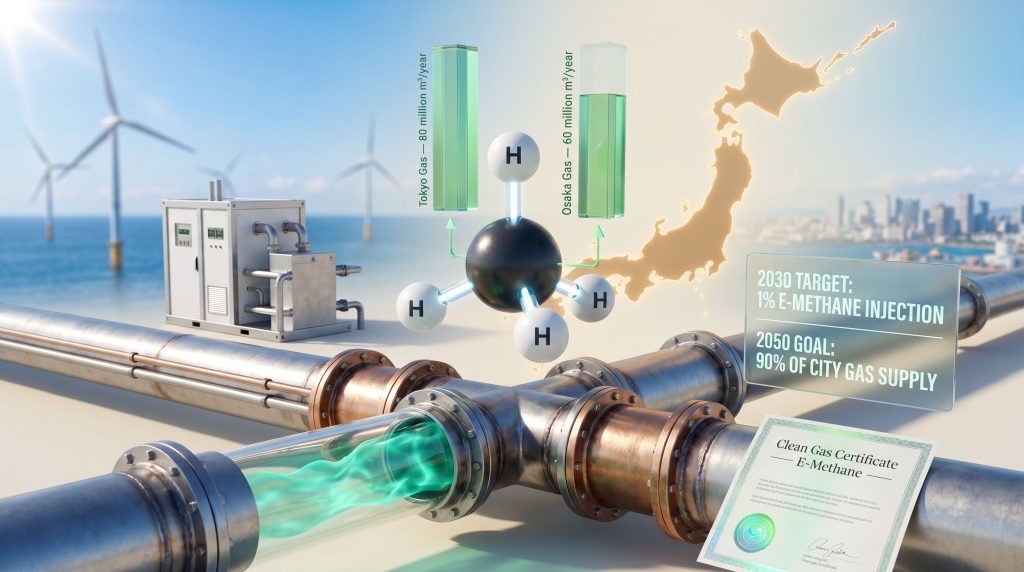
| 2030 E-Methane Injection | 1% of total city gas sales (FY2020 baseline) | Proof-of-concept commercialisation at national scale |
| 2050 E-Methane Goal | 90% of city gas supply | Near-complete fossil methane displacement |
| Tokyo Gas 2030 Target | 80 million m³/year of e-methane or biomethane | Largest single-utility commitment in Japan |
| Osaka Gas 2030 Target | 60 million m³/year | Second-largest utility commitment |
| Tokyo Gas Hydrogen (2030) | ~2.9 thousand tonnes embedded in gas network | Supporting national hydrogen demand generation |
| Osaka Gas Hydrogen (2030) | ~2.2 thousand tonnes | Contributing to scalable hydrogen demand |
The gap between the 1% injection target for 2030 and the 90% target for 2050 represents the most capital-intensive phase of Japan's energy transition. The intervening two decades will require sustained investment in domestic methanation capacity, international biomethane supply chains, and the certification infrastructure needed to give these molecules commercial value.
How Japanese Gas Utilities Are Executing the Strategy
Domestic E-Methane: The Inpex and Osaka Gas Model
The most advanced domestic e-methane demonstration in Japan is anchored at Inpex's Koshijihara natural gas processing facility in Nagaoka city, Niigata Prefecture. This location was selected as the CO₂ capture source precisely because it provides an industrial-scale carbon feedstock, a factor that is often underappreciated in discussions of methanation viability.
The hydrogen supply chain component is handled through a procurement arrangement with Iwatani, one of Japan's principal industrial gas distributors. This partnership establishes a replicable procurement model that other domestic PtG projects could adopt as the market matures.
The commercial milestone came on 25 June 2026, when Inpex formalised a tripartite agreement with the City of Nagaoka and regional utility Hokuriku Gas. Under this arrangement, Hokuriku Gas will deliver verified low-carbon city gas, produced from Inpex and Osaka Gas's co-manufactured e-methane, to public facilities within Nagaoka. This marks Japan's first certified municipal delivery of e-methane under a clean gas certificate framework.
The Clean Gas Certificate: A New Market Instrument
Understanding the clean gas certificate mechanism is essential to grasping how Japan's low-carbon city gas market will actually function at scale. The certificate operates on a principle familiar to anyone who has worked with renewable energy certificates in electricity markets: it decouples the environmental attribute from the physical commodity.
When e-methane is injected into the city gas network, it becomes physically indistinguishable from conventional methane within the pipeline. A clean gas certificate allows the verified decarbonisation impact of that injection to be assigned to a specific end user, enabling that organisation to claim verified Scope 1 emissions reductions under Japan's GHG accounting standards without requiring physical segregation of molecules.
Market parallel: The clean gas certificate functions in the gas sector much as guarantees of origin or renewable energy certificates function in electricity markets. The key insight is that this financial instrument can drive decarbonisation at a pace that outstrips physical infrastructure upgrades, because the certificate can be traded independently of where the low-carbon gas is actually injected.
This architecture has significant implications for corporate sustainability reporting. Industrial manufacturers, commercial real estate operators, and public sector bodies that rely on city gas can now access verified carbon accounting benefits without waiting for low-carbon gas to physically reach their facility through the network. Moreover, energy transition demand across adjacent sectors is amplifying corporate pressure to adopt such instruments rapidly.
Imported Biomethane: The Tokyo Gas and Fuji Film Pilot
While Inpex and Osaka Gas are advancing the domestic production pathway, Tokyo Gas is simultaneously testing the import route. In March 2024, Tokyo Gas received Japan's first commercial import of certified biomethane, sourced from landfill-originated biogas produced in the United States and shipped via Japanese trading house Mitsui.
The end-use destination for this imported biomethane is Fuji Film's Ashigara Works manufacturing facility in Kanagawa Prefecture, an industrial application that demonstrates the cross-sector reach of the low-carbon city gas programme. The planned delivery window is the fiscal year running from April 2026 to March 2027.
The primary objectives of this pilot are operational rather than volumetric. Tokyo Gas is focused on testing handling protocols and establishing cost benchmarks that will inform future procurement decisions for imported biomethane at commercial scale.
Comparing the Two Delivery Models
| Dimension | Inpex/Osaka Gas (Domestic E-Methane) | Tokyo Gas (Imported Biomethane) |
|---|---|---|
| Gas Type | Synthetic methane via PtG | Biological methane from landfill gas |
| Production Location | Niigata Prefecture, Japan | United States (landfill sites) |
| Supply Chain | Domestic CO₂ capture plus H₂ procurement | International shipping via Mitsui |
| End User | Nagaoka City public facilities | Fuji Film Ashigara Works (industrial) |
| Certification | Clean gas certificate (active municipal pilot) | Environmental attribute certification (under development) |
| Primary Objective | Validate domestic PtG supply chain | Test import logistics and cost benchmarks |
| Delivery Timeline | Active (FY2025-2026) | April 2026 to March 2027 |
The Infrastructure Inheritance Advantage
Why Pipeline Compatibility Changes the Economics
The commercial case for e-methane and biomethane over high-concentration hydrogen blending rests almost entirely on infrastructure compatibility. Japan's city gas distribution network, which was the world's first to commercialise LNG for urban supply in 1969, represents decades of capital investment in pipelines, metering systems, pressure regulation equipment, and end-user appliances. Replacing or materially modifying this infrastructure would add enormous cost and time to any decarbonisation programme.
E-methane and biomethane require no pipeline modifications at any blending concentration. High-concentration hydrogen injection, by contrast, raises material compatibility concerns in steel pipelines at concentrations above approximately 20%, requires appliance modifications or replacement across the entire customer base, and introduces different safety management requirements related to hydrogen's lower energy density and wider flammability range. According to the IEA's analysis of low-carbon gas pathways, this compatibility advantage is central to the economic rationale for prioritising methane-based routes in existing gas networks.
This comparison matters not only for Japan but for every LNG-dependent economy evaluating its decarbonisation options:
- E-methane/biomethane pathway: Leverage existing infrastructure, require no end-user equipment changes, maintain identical energy density
- High-concentration hydrogen pathway: Require significant pipeline material upgrades, safety system modifications, and appliance replacement programmes across millions of residential and commercial customers
METI's Dual Mandate and the Hydrogen Demand Connection
Japan's Ministry of Economy, Trade and Industry has identified e-methane as serving two distinct national objectives simultaneously. The first is decarbonising city gas supply itself. The second, less widely understood, is generating scalable demand for green and low-carbon hydrogen at a volume that can support the broader national hydrogen economy.
This dual mandate creates a feedback loop. As domestic methanation capacity scales to meet e-methane injection targets, hydrogen procurement volumes increase proportionally. This demand signal is intended to support the business case for expanding domestic electrolysis capacity and green hydrogen production infrastructure, linking city gas sector reform directly to Japan's national hydrogen strategy.
The intersection of city gas decarbonisation with Japan's Green Transformation, or GX, economic policy programme adds a further layer of regulatory certainty for long-term utility investment in methanation capacity. Anticipated regulatory developments include the expansion of clean gas certification frameworks and the potential introduction of mandatory blending requirements after 2030.
The next major ASX story will hit our subscribers first
Scenario Analysis: Three Futures for Japan's Low-Carbon City Gas Market
Scenario 1: Accelerated Domestic E-Methane Penetration
Under conditions of rapid cost reduction in green hydrogen production and successful scaling of domestic methanation capacity, e-methane injection could exceed 5% of city gas supply by 2035, well ahead of the trajectory implied by the 2030 1% target. Japan's domestic PtG industry could emerge as an exportable technology platform, particularly relevant for South Korea, Taiwan, and other LNG-dependent Asian economies.
Key risk: Green hydrogen production costs remain the primary constraint. If electrolysis costs do not follow the decline curves projected by the International Energy Agency, domestic e-methane economics will remain challenged.
Scenario 2: Import-Led Biomethane Expansion
If domestic e-methane scaling proceeds more slowly than anticipated, while international biomethane supply chains from the United States, Europe, and Southeast Asia mature faster, Japan could become a major biomethane import market alongside LNG by 2035. This scenario repositions Mitsui and other trading houses as critical infrastructure intermediaries for a new commodity class. However, geopolitical supply risks embedded in international supply chains add a layer of complexity that purely domestic production avoids.
Key risk: Feedstock sustainability certification, shipping emissions accounting, and geopolitical supply chain exposure introduce risks that do not apply to domestically produced e-methane.
Scenario 3: A Liquid Certificate Market as the Primary Scaling Mechanism
The most structurally interesting scenario involves clean gas certificates scaling independently of physical supply volumes. If corporate demand for certified low-carbon gas, driven by Scope 1 emissions targets and supply chain sustainability commitments, grows faster than physical blending capacity, a liquid domestic market for clean gas certificates could allow utilities and industrial buyers to meet decarbonisation targets through attribute trading rather than waiting for physical gas molecules to change.
Key risk: Certification integrity and double-counting risks could undermine market confidence if the regulatory framework governing certificate issuance is not sufficiently robust or internationally aligned.
Japan as a Reference Market for Asia's Low-Carbon Gas Transition
Japan's position as both the originator of commercial LNG supply for city gas and the current frontrunner in low-carbon city gas commercialisation gives it an unusual degree of soft power in shaping regional energy transition standards. The certification frameworks, methanation efficiency thresholds, and import protocols being developed through the Inpex, Tokyo Gas, and Osaka Gas pilots are likely candidates to become reference standards for other economies in the region. Consequently, green steel pricing and other emissions-sensitive industrial markets across Asia will be closely shaped by how these gas decarbonisation standards evolve.
For investors and commodity market participants, the commercial outlook presents several distinct opportunity vectors:
- Domestic methanation capacity as a long-cycle capital investment requiring green hydrogen cost certainty
- Imported biomethane supply chains as a near-term commodity market with distinct pricing, certification, and logistics dynamics distinct from conventional LNG
- Industrial anchor customers such as Fuji Film as early adopters whose procurement decisions de-risk supply chain investment for utilities
- Clean gas certificate market infrastructure, including verification, registry, and trading platforms, as an emerging financial market segment
Furthermore, research into low-carbon city development across East Asia highlights how Japan's gas sector reforms sit within a broader regional pattern of urban decarbonisation strategies, reinforcing the significance of the frameworks being established domestically.
Disclaimer: The scenarios and investment perspectives presented in this article are analytical in nature and do not constitute financial advice. Forward-looking projections regarding market development, cost trajectories, and regulatory timelines are subject to material uncertainty.
The transition from fossil methane to low-carbon city gas in Japan is not a single technology bet. It is a portfolio strategy that uses existing infrastructure as its foundation, certification markets as its scaling mechanism, and a combination of domestic production and international imports as its supply base. Whether the 2050 target of 90% e-methane penetration ultimately proves achievable depends on variables that remain unresolved. What is already clear is that Japan has chosen to run the experiment at national scale, and the rest of Asia is watching closely.
Want to Track the Commodity Opportunities Emerging From Asia's Energy Transition?
Discovery Alert's proprietary Discovery IQ model instantly scans ASX announcements to identify significant mineral discoveries tied to the critical materials underpinning low-carbon energy systems — delivering real-time, actionable alerts to subscribers before the broader market reacts. Explore historic discovery returns on Discovery Alert's discoveries page and begin your 14-day free trial to position yourself ahead of the next major find.