
June 26, 2026
When the Rule Book Stops Working: Investing Through Stagflation in Australia
Every investor eventually encounters a market environment where the familiar tools stop functioning as expected. Interest rate cuts are supposed to revive growth. Falling demand is supposed to cool prices. Yet stagflation violates both of these assumptions at once, producing a condition where economic weakness and persistent inflation coexist in a way that renders conventional policy responses largely ineffective. For Australian investors navigating 2026, this is not a theoretical concern. It is the operating environment.
Understanding why stagflation is so structurally disruptive is the essential first step toward building a portfolio capable of surviving it. The second step is knowing precisely which asset classes, sectors, and portfolio adjustments have historically generated real returns during these conditions. The stagflation investing playbook in Australia looks meaningfully different from standard bull-market or recessionary strategies, and that distinction matters enormously right now.
When big ASX news breaks, our subscribers know first
Why the Standard Portfolio Architecture Fails in Stagflation
The classic 60/40 portfolio, divided between growth equities and nominal bonds, operates on a simple premise: when equities fall, bonds rise, and vice versa. This inverse relationship holds reliably during normal recessionary cycles because falling demand reduces inflation, allowing central banks to cut rates and push bond prices higher while simultaneously stimulating equity recoveries.
Stagflation dismantles this mechanism entirely. When inflation remains elevated despite slowing growth, central banks cannot deliver meaningful rate cuts without risking a further acceleration in prices. That leaves both sides of the traditional portfolio exposed simultaneously. Growth equities face compressed earnings multiples as discount rates stay elevated and consumer spending contracts. Long-duration nominal bonds face price erosion as real yields remain under pressure from persistent inflation.
The defining challenge of stagflation is not simply that returns fall. It is that the instruments investors typically rely on for portfolio protection actively work against them at the same time.
The critical distinction between a standard recession and a stagflationary squeeze is that recessions are ultimately curable through monetary policy. Stagflation is not. The toolkit that normally rescues portfolios is precisely what cannot be deployed, which means investors must build protection into their asset selection rather than relying on macro policy to do it for them. Furthermore, understanding this distinction is what separates investors who merely survive the cycle from those who genuinely preserve real capital.
Reading Australia's 2026 Macro Configuration
The Indicators Worth Watching
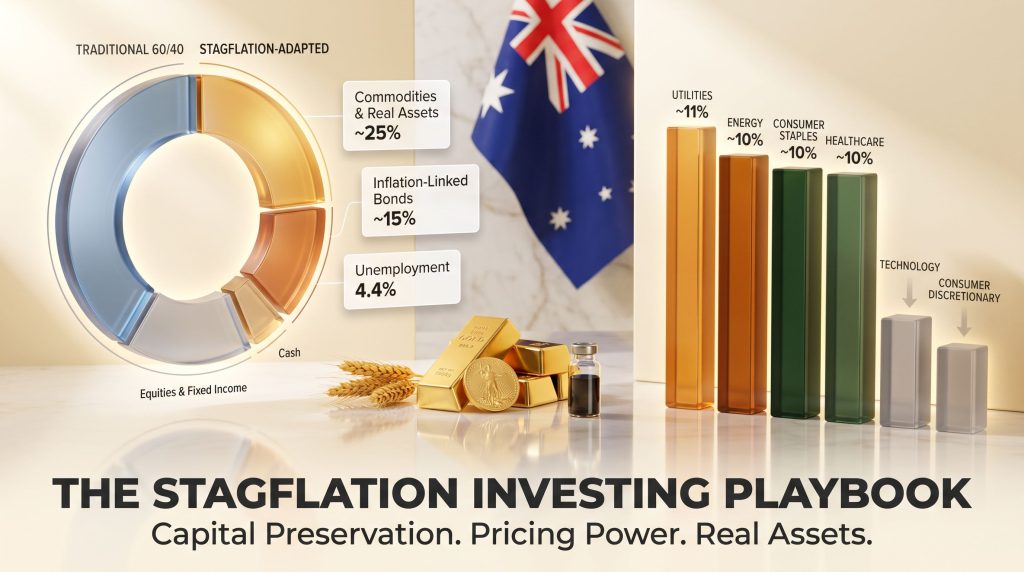
Australia in 2026 does not replicate the full severity of the 1970s stagflation crisis, but the directional signals are difficult to dismiss. Unemployment has climbed to 4.4%, inflation continues to sit above the Reserve Bank of Australia's target band, productivity growth remains weak, and household consumption is being compressed by sustained mortgage servicing burdens and elevated living costs. Real wage growth is lagging behind the consumer price index, meaning that even employed Australians are experiencing a gradual erosion of purchasing power.
The table below illustrates how the current configuration compares to the 1970s stagflationary episode across key indicators:
| Indicator | 1970s Stagflation (US/AU) | Australia 2026 Conditions |
|---|---|---|
| Unemployment trend | Rising sharply | Climbing to 4.4% |
| Inflation vs. target | Significantly above target | Persistently above RBA band |
| Productivity growth | Weak | Weak |
| Real wage growth | Negative | Lagging behind CPI |
| Policy response room | Limited | Constrained by rate sensitivity |
Whether Australia meets the technical definition of full stagflation is less important than what this configuration implies for portfolio construction. The macro pressures shaping investment outcomes in 2026 are stagflationary in character, and that is sufficient to demand a response.
What Is Structurally Different Today
Unlike the 1970s episode, which was primarily driven by oil supply shocks and deeply entrenched wage-price spirals, the current Australian environment reflects a more complex combination of global supply chain fragmentation, persistent services inflation, and domestic mortgage sensitivity. The household sector is far more leveraged relative to income than it was fifty years ago, which means the transmission of rate pressure into consumption weakness is faster and more severe.
This structural difference actually intensifies the stagflationary dynamic for equity markets, even if headline inflation metrics appear less extreme than the 1970s peak. Consequently, a new investing playbook is essential for navigating what amounts to the worst of both worlds simultaneously.
Asset Classes That Historically Outperform During Stagflation
The Case for Real Assets as Portfolio Anchors
Real assets share a defining characteristic that makes them valuable during stagflation: their returns are intrinsically linked to the price level rather than the nominal interest rate environment. Commodities, infrastructure, and certain property types generate revenue streams that either directly track inflation or benefit from the same price pressures that erode purchasing power elsewhere.
Key real asset categories worth considering include:
- Broad commodity baskets encompassing energy, agricultural inputs, and industrial metals, which benefit directly from the price-level increases that characterise stagflation
- Gold and silver as monetary stores of value, with gold as a safe haven particularly effective when currency purchasing power is being steadily eroded and real interest rates remain suppressed
- Infrastructure assets with regulated revenue models, where tariff structures are frequently adjusted upward with inflation, creating a compounding advantage over time
- Critical minerals and rare earths, where the intersection of critical minerals demand and supply concentration creates structural pricing power largely independent of the domestic economic cycle
Inflation-Linked Bonds: The Underappreciated Hedge
Australian inflation-linked government bonds and their US equivalents, Treasury Inflation-Protected Securities (TIPS), adjust their principal value in line with inflation indices, preserving real purchasing power in a way that standard nominal bonds cannot. The significance of 10-year real TIPS yields reaching multi-decade highs is worth noting carefully.
Elevated real yields compress the present value of existing inflation-linked bonds in the short term, but they simultaneously create more attractive entry points for long-term allocators building a genuine inflation hedge. Duration management is the critical variable. Concentrating exposure in shorter-duration inflation-linked instruments reduces this tension considerably.
Defensive Equities: Pricing Power as the Primary Selection Filter
Historical analysis of stagflationary periods spanning from 1957 to the present reveals a consistent pattern of sector outperformance. The sectors that generate positive excess returns during stagflation share one defining characteristic: the ability to pass rising input costs through to end customers without triggering significant demand destruction. This concept, known as pricing power, is the single most valuable equity quality factor in a stagflationary environment.
| Sector | Annualized Return (Stagflation Periods) | Outperformance vs. S&P 500 |
|---|---|---|
| Communication Services | ~11% | +4% |
| Utilities | ~11% | +3% |
| Energy | ~10% | +3% |
| Consumer Staples | ~10% | +3% |
| Healthcare | ~10% | +3% |
| Real Estate / Financials | Slight outperformance | Marginal |
| Technology / Industrials | Significant underperformance | Negative |
| Consumer Discretionary | Significant underperformance | Negative |
An important distinction applies here between defensive stocks and genuinely stagflation-resilient quality businesses. Low volatility alone does not confer protection. A business with thin margins, high debt, and weak brand positioning may display low volatility during normal conditions but face severe cash flow compression when both input costs and financing costs rise simultaneously.
Restructuring the Australian Portfolio for Stagflationary Conditions
Moving Beyond the 60/40 Framework
The practical reallocation implied by a stagflation scenario involves a substantial shift away from growth equities and long-duration nominal bonds toward real assets, inflation-linked fixed income, and short-duration instruments. For investors evaluating options, understanding the difference between physical gold vs ETFs is an important consideration when building real asset exposure. The table below illustrates the directional magnitude of this overall shift:
| Asset Class | Traditional 60/40 Weight | Stagflation-Adapted Weight |
|---|---|---|
| Growth and cyclical equities | ~45% | ~15% |
| Defensive equities | ~15% | ~15% |
| Long-duration nominal bonds | ~30% | ~10% |
| Commodities and real assets | ~5% | ~25% |
| Inflation-linked bonds | ~0% | ~15% |
| Short-duration fixed income | ~0% | ~10% |
| Cash and alternatives | ~5% | ~10% |
This reallocation framework is a scenario-responsive positioning strategy, not a permanent portfolio design. Investors should monitor evolving macro signals and rebalance progressively as conditions develop rather than making an abrupt wholesale restructuring.
Why Duration Is the Most Underappreciated Risk Variable
Concentrating fixed-income exposure in bonds with maturities under three years significantly reduces sensitivity to ongoing rate movements while still delivering yield. The lesson from the 1970s is that staying actively engaged with short-duration, high-quality credit through an elevated yield environment consistently outperformed passive long-duration strategies, even accounting for the higher transaction costs involved in active management.
In addition, investors seeking broader commodity exposure may find that a commodity ETCs guide provides useful context for implementing real asset positions efficiently within a diversified portfolio structure.
ASX Sectors With Structural Stagflation Positioning
Energy Infrastructure and the Pricing Power Advantage
Energy infrastructure businesses, particularly those operating regulated gas pipeline and transmission networks, represent a compelling stagflation position on the ASX. Companies like APA Group operate under regulatory frameworks that permit periodic revenue resets tied to inflation indices, creating a built-in mechanism for maintaining real returns as price levels rise.
Beyond pure energy infrastructure, businesses connected to critical minerals supply chains carry an additional dimension of pricing power. The concentrated global supply of materials like rare earth elements, lithium, and uranium means that demand growth driven by energy transition technologies intersects with genuine supply scarcity, producing durable pricing leverage largely uncorrelated with the domestic economic cycle.
Gold Producers: A Dual Tailwind for Australian Investors
Gold's historical function as a monetary hedge becomes most pronounced precisely when real interest rates are suppressed and currency purchasing power is being steadily eroded. This is the environment Australia faces in 2026. What makes this particularly relevant for Australian investors is that gold is priced in US dollars globally. When the AUD weakens against the USD, as tends to occur when domestic economic conditions deteriorate, the AUD-denominated gold price received by Australian producers rises independently of any movement in the underlying USD gold price.
This creates a dual tailwind unique to ASX-listed gold producers that is not available to investors in other markets. The distinction between owning physical gold, gold ETFs, and ASX-listed gold producers matters significantly from a risk-return perspective:
- Physical gold and gold ETFs provide direct commodity exposure with minimal operational risk but no earnings leverage
- ASX-listed gold producers offer leveraged exposure to the gold price through operating margins, but introduce company-specific risks including production costs, resource quality, and management execution
- Diversified resource majors with gold exposure provide commodity breadth but dilute the specific gold hedge
Healthcare and Consumer Staples: Demand Inelasticity as Protection
Healthcare spending occupies a unique position in household budgets because it is structurally non-discretionary. Regardless of economic conditions, demand for medical devices, pharmaceutical products, diagnostic services, and hospital care remains relatively stable. This demand inelasticity translates directly into revenue resilience when consumer belts tighten across the rest of the economy.
Consumer staples companies with dominant market positions and essential product categories operate similarly. When households reduce discretionary spending, they concentrate remaining expenditure on essential goods, which can actually benefit category leaders in food, beverages, and household products. The dividend yield advantage of these sectors adds a further dimension of value in a low-growth, high-inflation environment where capital gains are likely to be modest.
The next major ASX story will hit our subscribers first
What to Reduce or Avoid in a Stagflationary Environment
The asset classes most exposed to stagflationary conditions share an inverse relationship to the qualities described above:
| Category | Stagflation-Resilient | Stagflation-Vulnerable |
|---|---|---|
| Equities | Utilities, Healthcare, Staples, Energy | Technology, Consumer Discretionary, Industrials |
| Fixed Income | Short-duration, Inflation-linked | Long-duration nominal bonds |
| Real Assets | Gold, Commodities, Infrastructure | Speculative property, Growth REITs |
| Business Quality | Pricing power, low debt, strong FCF | High leverage, thin margins, rate-sensitive |
High-multiple growth stocks face a compounding problem during stagflation: discount rates remain elevated, compressing the present value of future earnings at precisely the moment when revenue growth is slowing. Consumer discretionary businesses face demand destruction as households prioritise essential over optional spending. Highly leveraged businesses confront rising debt servicing costs while free cash flow stagnates.
Superannuation and the AUD as Structural Advantages
Leveraging Australia's Unique Capital Architecture
Australia's superannuation system represents a structural vehicle for implementing a stagflation-resilient allocation that many international investors simply do not have access to. Super fund members can audit their existing allocation across growth, balanced, and defensive options and redirect contributions toward options with greater exposure to infrastructure, real assets, and inflation-linked instruments. Tax-advantaged contributions made during periods of market uncertainty also function as a capital efficiency mechanism, reducing the effective cost of building a stagflation-resistant position.
The AUD's status as a commodity-linked currency provides a natural hedge dimension for internationally diversified Australian investors. During commodity price rallies, the AUD tends to strengthen, which moderates the cost of hedging overseas asset exposures. During domestic economic deterioration, AUD weakness amplifies the AUD-denominated returns from internationally priced commodities like gold and oil, creating a partial automatic stabiliser within a well-constructed portfolio.
A Practical Construction Checklist for Australian Investors
Building a stagflation-resilient portfolio is a process of progressive adjustment rather than a single restructuring decision. The following step-by-step framework, informed by portfolio positioning guidance from financial researchers, provides a practical starting point:
- Audit the full portfolio across superannuation, brokerage accounts, and other vehicles to map current concentration in vulnerable asset classes
- Reduce long-duration nominal bond exposure and shift toward short-duration, high-quality fixed income with maturities below three years
- Build real asset exposure through commodity ETFs covering broad baskets, energy, and gold, alongside infrastructure and inflation-linked bond allocations
- Rotate equity positioning toward defensive sectors including utilities, healthcare, consumer staples, energy, and communication services
- Screen explicitly for pricing power by focusing on businesses with demonstrated histories of passing cost increases through to customers without significant volume loss
- Prioritise dividend yield and balance sheet strength using robust free cash flow generation and low debt-to-earnings ratios as key financial quality filters
- Maintain adequate liquidity reserves to avoid forced selling of long-term holdings at cyclical lows
- Minimise fee drag because in a structurally low-return stagflationary environment, cost reduction has a direct and compounding impact on net real returns
- Diversify internationally to reduce concentration in Australian domestic conditions if local deterioration outpaces offshore markets
- Remain patient and tactical because stagflation is a capital preservation environment, not an aggressive capital growth window
What the ASX Is Signalling Beneath the Surface
Interpreting the All Ordinaries Range-Bound Pattern
The All Ordinaries Index trading within the 8,800 to 9,200 point range is less a story of market stagnation than a story of contested directional conviction. Buyers and sellers are broadly offsetting each other at the index level, but the sector composition of that equilibrium has shifted meaningfully. Materials and Energy sectors have experienced declines of over 4% on a weekly basis, while Consumer Discretionary and Healthcare have risen by more than 3% over the same period. Consumer Staples have added over 2%.
This divergence is not noise. It represents capital rotation in real time, with institutional investors repositioning away from cyclical resource exposure and toward defensives with earnings stability. Among individual names, the contrast is equally sharp. Healthcare technology and diagnostics companies have outperformed by wide margins, while high-multiple technology and growth-oriented names have faced double-digit percentage declines within the same week.
The Longer-Term Resource Thesis
The current consolidation phase in Materials and Energy should not be misread as a structural reversal of Australia's commodity advantage. Every technological revolution, from electric vehicles and grid-scale storage to artificial intelligence data centre infrastructure, ultimately depends on real-world physical inputs. Critical minerals, energy resources, and industrial materials remain the foundational layer upon which these technologies are constructed.
The more nuanced observation is that investor attention tends to cycle between the physical input layer and the technology application layer of the global economy. When attention returns to the physical foundation, Australia's market has historically attracted renewed global capital flows given its disproportionate endowment of critical resource assets.
Frequently Asked Questions: Stagflation Investing in Australia
What is stagflation and why does it create such difficulty for investors?
Stagflation combines persistently elevated inflation with stagnant or contracting economic growth and rising unemployment. This combination undermines both traditional equity growth strategies and standard bond hedging approaches simultaneously, because the monetary policy tools that normally provide relief cannot be deployed without worsening one of the two problems.
Which ASX sectors perform best during stagflation?
Historical analysis consistently identifies utilities, energy, consumer staples, healthcare, and communication services as outperformers during stagflationary periods. These sectors share structural demand inelasticity and meaningful pricing power, the two qualities most valuable in this environment.
Should investors sell all their equities during stagflation?
No. The stagflation investing playbook in Australia is about strategic reallocation and quality filtering rather than wholesale liquidation. The objective is to reduce exposure to structurally vulnerable sectors while concentrating toward businesses with genuine pricing power, strong balance sheets, and reliable income streams.
Is gold a good investment for Australians during stagflation?
Gold has historically functioned as an effective monetary hedge during stagflationary periods when real interest rates are suppressed. Australian investors receive the additional benefit of gold's USD pricing, which can amplify AUD-denominated returns when the domestic currency weakens in response to deteriorating local economic conditions.
What is the most common strategic mistake during stagflation?
Maintaining a conventional growth-oriented or standard 60/40 portfolio without adjusting for the changed macro environment. Holding long-duration bonds and high-multiple growth equities simultaneously during stagflation creates compounding losses from both rising rates and decelerating earnings growth.
This article is intended for informational purposes only and does not constitute financial advice. All portfolio construction decisions should be made in consultation with a licensed financial adviser who can assess your individual circumstances, risk tolerance, and investment objectives. Past performance of asset classes during historical stagflationary periods does not guarantee equivalent performance in future conditions.
Want to Identify ASX Mineral Discoveries Before the Broader Market Does?
In a stagflationary environment where real assets and commodities offer some of the most compelling portfolio protection, staying ahead of significant ASX mineral discoveries can make a decisive difference — Discovery Alert's proprietary Discovery IQ model delivers real-time alerts the moment major discoveries are announced, turning complex geological data into actionable investment insights. Explore historic discoveries and their returns to understand the opportunity, then begin a 14-day free trial to position yourself ahead of the market.