
August 13, 2026
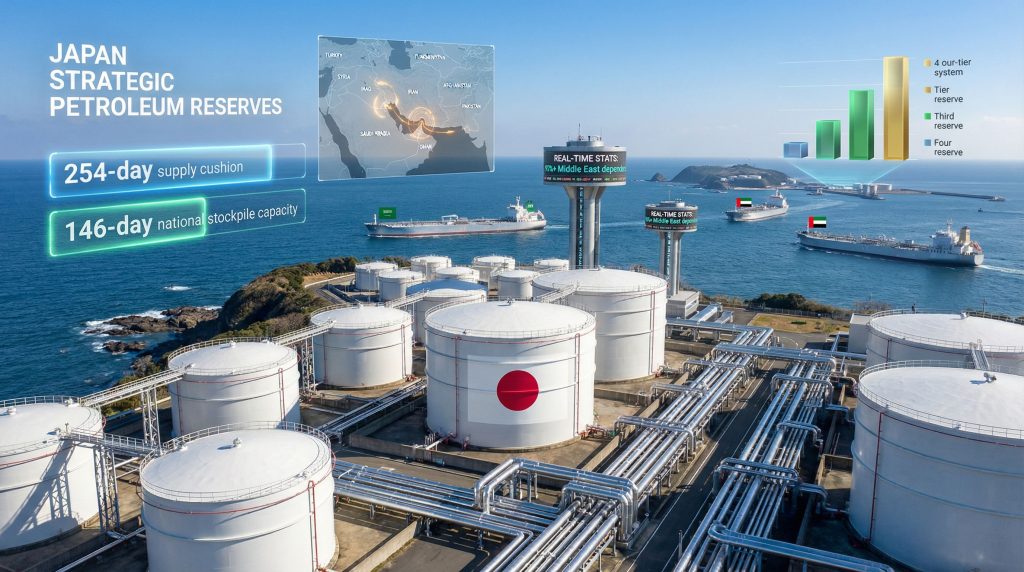
Japan's energy crisis response capabilities demonstrate sophisticated strategic planning when Japan refiners tap strategic petroleum reserves during Middle Eastern supply disruptions. The interconnected nature of modern energy systems means that disruptions in one geographic region cascade through multiple markets simultaneously, forcing nations to activate emergency protocols designed for precisely such scenarios.
Furthermore, Japan's energy infrastructure represents one of the world's most sophisticated strategic reserve frameworks, built through decades of careful planning and international partnerships. The current activation of these systems during Middle Eastern supply disruptions provides valuable insights into how advanced economies manage energy security during geopolitical crises.
Understanding Japan's Multi-Layered Strategic Petroleum Reserve Architecture
Japan maintains a comprehensive three-tier energy security system designed to withstand prolonged supply disruptions. As documented in recent government data, the nation's total strategic depth extends to 254 days of complete oil supply coverage as of late 2025, representing one of the most robust reserve systems globally.
The foundation layer consists of national stockpiles providing 146 days of supply buffer, maintained directly by government mandate and controlled through Ministry of Economy, Trade and Industry protocols. These reserves function as the ultimate backstop during severe crisis conditions, activated only when commercial and bilateral arrangements prove insufficient.
Moreover, private sector inventories form the second layer, contributing 101 days of commercial reserves that refiners maintain for operational flexibility. These stocks serve dual purposes: ensuring continuous refinery operations during normal periods while providing the first line of defense during supply chain disruptions.
The most sophisticated component involves joint stockpiling programs delivering 7 days of emergency allocation through carefully structured bilateral agreements. Under these arrangements, international partners maintain pre-positioned crude oil on Japanese territory, creating integrated supply chains that transcend traditional buyer-seller relationships.
Critical Infrastructure Distribution and Storage Capacity
Japan's strategic reserves are distributed across multiple geographic locations to minimize single-point-of-failure risks. The Kiire facility in Kyushu maintains capacity exceeding 46 million barrels, while the Okinawa terminal can store more than 8 million barrels of crude oil and refined products.
These facilities operate under sophisticated leasing arrangements where international partners participate directly in Japan's strategic infrastructure. Saudi Aramco leases space at both Kiire and Okinawa locations, creating physical presence that enables rapid supply activation during crisis periods.
Consequently, the geographic positioning across Japan's island chain ensures that even localised infrastructure damage or transportation disruptions cannot compromise the entire reserve system. This distributed approach reflects lessons learned from natural disasters and military considerations during the system's development.
When big ASX news breaks, our subscribers know first
Why Japan Refiners Tap Strategic Petroleum Reserves During Crisis Conditions
The decision to access government reserves represents a calculated response to supply chain mathematics that favour conservation over normal commercial operations. Japan's dependency on Middle Eastern crude oil exceeds 90 percent of total imports, creating acute vulnerability when the Strait of Hormuz experiences closure or significant disruption.
Current crisis conditions have prompted refiners to fundamentally recalibrate their operational priorities. At least one major Japanese refiner has cancelled March-loading exports of gasoline, jet fuel, and diesel to prioritise domestic usage, demonstrating how quickly commercial export revenues become subordinated to domestic supply security.
Additionally, our oil price trade moves analysis shows how geopolitical tensions directly impact global energy markets and refiner decision-making processes.
Operational Challenges in Reserve Access
Refiners face timing challenges when accessing government stockpiles through standard procurement procedures. Industry sources indicate that potentially lengthy bidding processes may delay supply delivery, prompting requests for expedited access protocols that bypass normal administrative timelines.
The complexity stems from reserves being held in two distinct categories requiring different authorisation procedures: government-controlled national stockpiles and oil stored in facilities leased to international producing companies. Each category operates under separate legal frameworks and activation mechanisms.
This operational friction reveals a fundamental tension between emergency response requirements and bureaucratic procurement systems designed for normal-period transparency. Refiners require supply certainty within days, while government procedures may require weeks for full activation.
Economic Impact Calculations
The economic rationale for reserve deployment extends beyond simple supply replacement. Refiners must balance fuel export suspension protocols against domestic market stabilisation, calculating opportunity costs of foregone international sales against crisis-period supply security.
Processing allocation strategies require immediate rebalancing of gasoline, jet fuel, and diesel production to match domestic consumption patterns rather than export market demands. This operational pivot affects refinery efficiency and margin calculations across all product streams.
However, market stabilisation mechanisms depend on government intervention to prevent excessive price volatility that could cascade through energy-dependent industries. The reserve deployment signals government commitment to maintaining supply continuity, often proving as important for market psychology as for physical supply replacement.
Bilateral Energy Partnership Structures and Crisis Activation
Japan's joint stockpiling agreements with Saudi Arabia, the United Arab Emirates, and Kuwait represent sophisticated energy diplomacy that transcends traditional commercial relationships. Under these bilateral frameworks, crude oil is normally used to supply Asian markets, with Japan maintaining priority purchasing rights during emergency conditions.
The operational mechanics involve pre-positioned inventory that serves regional markets during normal periods while creating dedicated access channels for Japan during crises. This arrangement provides partner nations with strategic Asian market presence while offering Japan supply security that doesn't depend solely on spot market availability.
Furthermore, saudi exploration licenses have expanded regional cooperation, creating additional supply security partnerships across the Middle East.
Reserve Release Decision-Making Protocols
The activation hierarchy follows escalating intervention levels based on crisis severity and duration projections:
| Crisis Level | Reserve Category | Coverage Duration | Activation Method |
|---|---|---|---|
| Level 1 | Private sector stocks | 101 days | Market-driven coordination |
| Level 2 | Bilateral arrangements | 7 days | Diplomatic consultation |
| Level 3 | National reserves | 146 days | Government emergency powers |
| Level 4 | Combined deployment | 254 days | Full crisis mobilisation |
The structured approach ensures proportional response while conserving the most strategic reserves for prolonged disruptions. Each escalation level involves different stakeholders and authorisation procedures, reflecting the increasing severity of intervention required.
Emergency activation protocols enable reserve access within 24-48 hours of government authorisation, though actual supply delivery depends on logistics coordination between storage facilities and refineries. The speed advantage comes from pre-positioned inventory and established transportation infrastructure.
Regional Energy Security Coordination Across Asian Markets
The current crisis has triggered coordinated conservation measures across multiple Asian economies, demonstrating recognition that regional demand destruction represents a viable crisis response strategy. China's government has directed the country's largest refiners to suspend diesel and gasoline exports, while Thailand has announced complete cessation of fuel shipments.
This coordinated approach reflects sophisticated crisis management where individual nations balance domestic conservation with regional stability concerns. The synchronised export suspensions reduce overall Asian demand for Middle Eastern crude, potentially moderating price impacts while each nation preserves domestic supply security.
In addition, us oil production decline has affected global supply dynamics, according to a Reuters report documenting how regional conflicts disrupt oil supplies to Asian countries dependent on Middle Eastern resources.
Supply Chain Diversification Initiatives
Asian nations are simultaneously pursuing alternative sourcing strategies to reduce structural dependency on Middle Eastern supplies. These initiatives include:
- Western Hemisphere partnerships: Enhanced procurement agreements with North and South American producers
- African supply arrangements: Expanded relationships with West African crude exporters
- Domestic production maximisation: Accelerated development of indigenous energy resources
- Alternative logistics networks: Development of supply routes bypassing traditional chokepoints
The diversification efforts require years to fully implement but provide long-term structural resilience against similar future disruptions. Current crisis conditions accelerate decision-making on projects that might otherwise face lengthy evaluation periods.
Regional cooperation extends beyond individual national responses to include coordinated research on alternative supply sources and shared logistics infrastructure. This collaborative approach distributes the costs and risks of supply chain diversification across multiple economies.
Market Dynamics and Strategic Reserve Release Impacts
Strategic petroleum reserve releases create complex market effects that extend far beyond simple supply replacement. The announcement of potential government intervention often provides market stabilisation benefits before physical crude reaches refineries, as traders factor reserve availability into price formation mechanisms.
Coordinated release timing with other consuming nations amplifies market impacts while distributing the burden across multiple national reserve systems. Japan's coordination with International Energy Agency protocols ensures that reserve deployments complement rather than conflict with global crisis response efforts.
Moreover, oil price stagnation analysis reveals how various geopolitical factors affect market stability during crisis periods.
Economic Multiplier Effects Throughout Energy-Dependent Industries
The cascade effects of strategic reserve activation influence transportation, manufacturing, and service sectors that depend on stable energy pricing for operational planning and cost management.
Reserve releases signal government commitment to maintaining energy price stability, providing confidence for industrial planning and investment decisions during crisis periods. This psychological effect often proves as valuable as the physical supply replacement, particularly for industries with long production cycles and high energy intensity.
The multiplier effects extend to currency markets and trade balances, as reduced energy import requirements during reserve deployment periods alter foreign exchange demands and current account calculations.
Lessons for International Energy Security Strategy Development
Japan's reserve management system offers multiple best practices for other nations developing strategic stockpiling capabilities. The multi-tier architecture combining government, private, and international partnership stocks provides redundancy while distributing costs and operational responsibilities across different stakeholders.
Geographic diversification across distributed storage locations minimises infrastructure vulnerability while enabling regional supply optimisation during both normal and crisis periods. The integration of international partner storage within domestic facilities creates operational efficiencies that benefit all parties.
Crisis Response Optimisation Methodologies
Effective reserve systems require early warning capabilities that monitor geopolitical developments for proactive reserve planning rather than reactive crisis response. The integration of diplomatic intelligence with supply chain analysis enables anticipatory positioning before disruptions fully materialise.
Stakeholder coordination protocols between government agencies and private sector refiners ensure rapid communication during crisis conditions. These relationships must be established and tested during normal periods to function effectively when speed becomes critical.
Alternative supply activation requires pre-negotiated contracts with non-traditional suppliers that can be triggered rapidly during crisis conditions. These arrangements involve higher costs during normal periods but provide valuable optionality when primary supply sources become unavailable.
The next major ASX story will hit our subscribers first
Long-Term Evolution of Japan's Energy Security Framework
The current crisis experience will likely accelerate Japan's energy security evolution beyond traditional petroleum stockpiling toward more comprehensive supply chain resilience. Supply source diversification initiatives aim to reduce Middle Eastern dependency through expanded partnerships with producers in other regions.
Domestic energy development programmes face renewed political support as the strategic value of indigenous production becomes evident during international supply disruptions. These initiatives require substantial investment and technological development but provide ultimate supply security independence.
Furthermore, analysis of opec production impact suggests that global production coordination will continue shaping energy security strategies worldwide.
Strategic Reserve Modernisation and Capacity Enhancement
Future reserve system development may target capacity expansion beyond current 254-day capability to provide additional buffer against prolonged disruptions. The optimal reserve duration depends on assessments of likely crisis duration and alternative supply development timelines.
Technology integration initiatives could enhance monitoring and deployment systems for more efficient reserve management and rapid activation capabilities. Advanced inventory management and predictive analytics may optimise reserve utilisation while maintaining security margins.
International partnership expansion through additional joint stockpiling arrangements with diverse producer nations would reduce concentration risk while expanding emergency supply options. These agreements require careful diplomatic and commercial structuring to benefit all participants.
According to an Economic Times report, Japanese oil firms have actively sought release of national reserves amid ongoing supply concerns from regional conflicts.
The experience of Japan refiners tap strategic petroleum reserves during the current Middle Eastern crisis provides valuable insights for energy security planning worldwide. The integration of government reserves, private sector stocks, and international partnerships creates resilience that no single approach could achieve independently. As geopolitical risks continue evolving, the sophisticated framework Japan has developed offers a model for other nations seeking comprehensive energy security in an increasingly uncertain global environment.
This analysis is based on publicly available information and should not be considered as investment advice. Energy market conditions and government policies may change rapidly during crisis periods, affecting the accuracy of projections and strategic assessments.
Looking to Capitalise on Energy Market Volatility?
Discovery Alert's proprietary Discovery IQ model delivers real-time alerts on significant ASX mineral discoveries, instantly empowering subscribers to identify actionable opportunities in energy and commodities markets ahead of the broader market. Begin your 14-day free trial today and secure your market-leading advantage while energy sector dynamics create exceptional investment potential.