August 14, 2026
The Architecture of Vulnerability: Why a Single Waterway Holds Asia's Energy Future Hostage
Every major energy disruption in modern history has ultimately revealed the same structural weakness: the assumption that tomorrow's supply chain will look like yesterday's. For Japan, South Korea, China, and India, that assumption has been built on the reliable passage of crude oil tankers through a waterway barely wider than a mid-sized city. When that passage closes, the entire industrial metabolism of the world's most economically dynamic region begins to seize.
The successful Japanese oil tanker Strait of Hormuz transit completed by the VLCC Idemitsu Maru in late April 2026 represents far more than a single vessel clearing a maritime checkpoint. It is a data point in a much larger story about energy dependency, geopolitical leverage, and the fragility of supply chains that billions of people depend on without ever thinking about them.
When big ASX news breaks, our subscribers know first
The Strait That Moves the World
The Strait of Hormuz is not simply a shipping lane. It is the circulatory valve of the global oil system, and its dimensions are startling in their modesty given the weight they carry. At its narrowest navigable point, the strait contracts to approximately 33 to 34 kilometres, flanked by Iran to the north and Oman to the south. Through this compressed corridor, the U.S. Energy Information Administration (EIA) estimates that more than 20% of the world's total petroleum supply transits under normal conditions, encompassing crude oil, condensate, and refined petroleum products bound primarily for Asian markets.
The exposure profile of Asian economies to any Hormuz disruption is not evenly distributed across the global economy. It is concentrated with unusual intensity in a small number of major import-dependent nations, and understanding the importance of oil to these economies helps contextualise the severity of any supply disruption:
- Japan sources approximately 85 to 90% of its crude oil imports from Persian Gulf producers, with Saudi Arabia alone supplying roughly 30 to 35% of Japan's total crude needs (Ministry of Economy, Trade and Industry, Japan, 2023)
- South Korea and China each source 70 to 80% of crude imports from Persian Gulf nations
- India draws 40 to 50% of its crude oil from Middle Eastern suppliers
These are not marginal dependencies. They are structural commitments baked into refinery configurations, long-term supply contracts, and national energy planning frameworks that cannot be reoriented on short notice.
How the Iran Conflict Transformed Routine Transit Into Crisis
Following U.S. and Israeli military strikes on Iran in late February 2026, Iran moved to restrict maritime passage through the Strait of Hormuz, reducing tanker traffic through the corridor to near-zero levels. The effect on Japan's shipping sector was immediate and severe. An estimated 45 Japan-affiliated vessels found themselves stranded inside the Persian Gulf, unable to exit through the closed strait. Of those, approximately 12 were crude oil tankers representing substantial cargo volumes and escalating operational costs for every day they remained stationary.
The near-shutdown of Hormuz transit activity represents one of the most severe maritime energy disruptions in decades, creating cascading effects across Asian refining economies that depend almost entirely on Gulf crude for their industrial feedstock.
This was not merely an inconvenience. For Japanese operators, idle VLCCs accumulate costs at rates that concentrate financial pressure rapidly. Under normal market conditions, VLCC day rates range from approximately $30,000 to $50,000 per day; however, during crisis periods characterised by supply scarcity and elevated insurance premiums, those rates can spike to $80,000 to $150,000 per day (Clarksons Research, Tanker Market Review, 2023). With 12 idle crude carriers and additional vessel types stranded, the aggregate commercial exposure across the Japanese shipping sector reached substantial proportions within the first weeks of the disruption.
Japan's Structural Energy Dependency in Context
Understanding why the Idemitsu Maru transit matters requires understanding the depth of Japan's structural exposure to Persian Gulf supply lines. Unlike European economies that can draw on pipeline networks connecting multiple production regions, or North American markets with significant domestic production buffers, Japan has zero terrestrial pipeline access to any crude oil source. Every barrel of crude that enters Japan's refining system arrives by sea, and the overwhelming majority of those barrels originate in the Persian Gulf.
The International Energy Agency's review of Japan's energy policy framework confirms that meaningful supply diversification would require decade-long infrastructure investment and would yield only 10 to 20% substitution capacity even under optimistic scenarios (IEA, Japan 2022: Energy Policy Review). This is not a problem that can be solved between quarterly earnings reports.
An additional technical dimension compounds Japan's vulnerability. Japanese refineries are configured specifically for medium-heavy gravity crude sourced from Persian Gulf producers, typically in the API gravity range of 25 to 35 degrees. Switching to lighter crude streams from alternative suppliers, such as U.S. shale producers, requires technical modifications to hydrocracking and desulphurisation units. The Japan Petroleum Energy Association estimates that rapid feedstock switching increases per-barrel processing costs by 5 to 12%, a margin that adds up quickly across Japan's refining capacity (JPEA, Refinery Configuration Report, 2023).
The Economics of Stranded Vessels and Emergency Workarounds
With 45 Japan-linked vessels immobilised at the peak of the disruption, Japanese operators deployed a multi-pronged emergency adaptation framework rather than simply waiting for the strait to reopen:
- Ship-to-ship (STS) transfers conducted in open waters well outside the Persian Gulf, enabling cargo continuity without Hormuz exposure, though at significantly higher operational cost
- Alternative crude sourcing from U.S. suppliers transported on smaller Aframax and Suezmax class tankers, bypassing the need for VLCC Gulf access
- Flag-state diversification, leveraging Indian-flagged affiliate vessels to access Iran-approved transit corridors
- Prolonged anchorage strategies, holding vessels in safe holding positions northwest of Abu Dhabi while awaiting diplomatic or operational clearance windows
The cost premium embedded in these workarounds is not trivial. U.S. WTI crude typically trades at a $2 to $5 per barrel discount to Brent, but transport costs for non-VLCC tankers transiting to Japan add approximately $3 to $6 per barrel, partially or fully eroding the price advantage. Furthermore, STS transfers in exposed open-water conditions add operational costs estimated at $100,000 to $200,000 per operation, plus war risk insurance surcharges (Clarksons Research, 2023).
| Metric | Estimated Figure |
|---|---|
| Japan-linked vessels stranded at peak | ~45 |
| Of which crude oil tankers | ~12 |
| Cargo aboard the Idemitsu Maru | 2 million barrels |
| Vessel build year | 2007 |
| Flag state | Panama |
| Cargo loading terminal | Juaymah, Saudi Arabia |
| Cargo loaded | Early March 2026 |
| Estimated arrival in Nagoya, Japan | May 18, 2026 |
| Duration idle near Abu Dhabi | More than one week |
The Transit Itself: How the Idemitsu Maru Cleared the Strait
The sequence of events that produced the first confirmed Japanese oil tanker Strait of Hormuz transit since the conflict began followed a pattern that maritime analysts will study for some time. According to Reuters, the Idemitsu Maru's passage marked a significant moment in the ongoing maritime crisis.
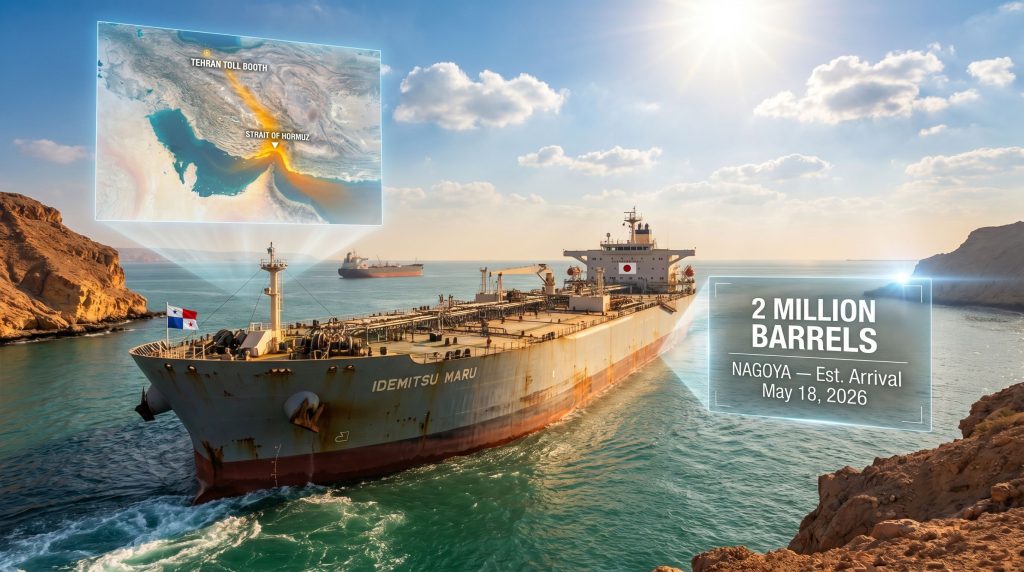
The Idemitsu Maru, a 2007-built, Panama-flagged VLCC operated by the tanker division of Japanese energy conglomerate Idemitsu Kosan, had entered the Persian Gulf shortly before the conflict escalated in late February 2026. The vessel loaded approximately 2 million barrels of Saudi Arabian crude at the Juaymah terminal in early March, then found itself stranded as transit conditions deteriorated. For more than a week, the tanker sat stationary northwest of Abu Dhabi, one of dozens of vessels in a similar predicament.
Late on Monday, April 28, the Idemitsu Maru began moving toward the strait. The vessel navigated a Tehran-approved northern corridor passing near the islands of Qeshm and Larak, and successfully cleared the strait on Tuesday, April 29, according to tanker-tracking data compiled by Bloomberg. The vessel is now signalling Nagoya, Japan as its destination, with an estimated arrival of May 18, 2026. At standard VLCC transit speeds of 12 to 14 knots, the roughly 4,500 nautical mile journey from the Hormuz exit to Nagoya is consistent with that arrival timeline.
The "Tehran Toll Booth" Dynamic and Why Flag State May Have Mattered
Iran's willingness to permit certain transits while maintaining a near-total blockade creates what maritime analysts have informally characterised as a tiered access system with significant strategic implications. The International Crisis Group's analysis of Iran's historical behaviour during maritime crises identifies Iran's use of selective vessel transit permissions as a documented tool of negotiation and leverage, with flag state, cargo classification, and diplomatic relationships all functioning as potential variables in access decisions (ICG, Iran and the Strait of Hormuz: Patterns of Containment, 2020).
The Idemitsu Maru's Panama flag registration may have been a relevant factor in securing passage. Panama's open registry status represents approximately 40% of the global merchant fleet according to UNCTAD data, and Panama-flagged vessels occupy a distinct diplomatic position compared to vessels flying the flags of nations directly party to, or aligned with, parties in the conflict.
The absence of AIS transponder signals does not confirm vessel detention. In conflict-adjacent maritime zones, deliberate transponder suppression is a standard risk-mitigation strategy, meaning actual transit volumes may exceed publicly trackable data by 15 to 40%.
The International Maritime Organization acknowledges that vessels in high-risk zones frequently disable Automatic Identification System (AIS) transponders to reduce targeting risk, and GPS spoofing has been documented in the Hormuz region during periods of elevated tension (IMO, MSC.1/Circ.1352, 2019). The implication is that the Idemitsu Maru transit, while appearing to be the first publicly confirmed crude tanker passage, may not represent the absolute first transit to have occurred.
A Graduated Reopening: The Vessel Chronology That Preceded the VLCC Transit
The Idemitsu Maru did not transit in isolation. A sequential pattern of Japan-linked vessel movements through the strait preceded the crude oil supertanker's passage, revealing what appears to be a deliberate, graduated reopening dynamic rather than a sudden blanket permission. As reported by the Maritime Executive, the LNG carrier passage represented the first significant breach of the effective blockade.
| Vessel | Type | Flag | Transit Date | Destination | Notable Detail |
|---|---|---|---|---|---|
| Sohar LNG | LNG Tanker | Panama | Early April 2026 | Undisclosed | First Japan-linked vessel and first LNG tanker to cross since early March 2026 |
| Green Sanvi | LPG Tanker | Indian | ~April 4, 2026 | India | India-facilitated passage; crew, cargo, and hull confirmed safe |
| Green Asha | LPG Tanker | Indian | ~April 6, 2026 | India | Mitsui O.S.K. Lines subsidiary |
| Idemitsu Maru | VLCC (Crude) | Panama | April 29, 2026 | Nagoya, Japan | First Japanese crude supertanker transit since the conflict began |
The progression from LNG carrier to LPG tanker to laden VLCC carrying Saudi crude represents a qualitative escalation at each step. LNG and LPG cargoes may present different strategic considerations for Iran compared to crude oil, since crude represents the primary revenue source for Gulf producers aligned with Iran's adversaries. A laden VLCC carrying 2 million barrels of Saudi Arabian crude is a fundamentally different cargo profile, making the Idemitsu Maru's successful passage the most commercially significant transit to date.
India's Facilitation Role and the New Geography of Maritime Diplomacy
The successful transits of the Indian-flagged LPG carriers Green Sanvi and Green Asha, affiliated with Mitsui O.S.K. Lines subsidiaries, introduced an important new dimension to the crisis. India's diplomatic positioning, maintaining functional relationships with both Iran and Western powers simultaneously, has created a unique intermediary capacity that Japan appears to have leveraged through its shipping subsidiaries.
UNCTAD analysis confirms that flag-state selection increasingly functions as a strategic instrument in maritime crisis management, with open registries and diplomatically neutral flags providing operational flexibility that vessels flying the flags of conflict-aligned nations cannot access (UNCTAD, Review of Maritime Transport, 2023). For Japanese operators, structuring cargo movements through Indian-flagged subsidiaries is not opportunism but rational risk mitigation within an extremely constrained operational environment.
Historical Precedents and What Makes 2026 Different
The Strait of Hormuz has been weaponised before. The Tanker War of the 1980s, prosecuted during the Iran-Iraq conflict, saw 544 commercial vessels attacked between 1984 and 1988 according to UNCTAD records, establishing the foundational precedent for wartime targeting of commercial shipping in the Persian Gulf. The 2019 tanker seizures and mine attacks near the strait foreshadowed the current escalation pattern, though those incidents involved targeted harassment rather than systematic closure.
What distinguishes the current situation from historical precedents is a combination of factors that collectively represent an unprecedented maritime energy crisis. In addition, the US-China trade war has further complicated global energy trade routes and diplomatic leverage across the region:
- The scale of closure: reducing strait traffic to near-zero for an extended period exceeds the severity of most historical disruptions, which involved elevated risk rather than effective prohibition
- The dual-blockade dynamic: simultaneous U.S. restrictions on Iranian vessels and Iranian restrictions on non-Iranian transit creates a layered constraint environment that has no direct modern precedent
- The concentration of stranded cargo: with 45 Japan-linked vessels immobilised, the exposure falls disproportionately on a single importing nation whose refining infrastructure is specifically configured for the blocked supply source
- The strategic reserve calculus: Japan maintains petroleum reserves equivalent to approximately 150 to 160 days of net imports, among the world's largest reserve buffers, but an extended multi-month disruption tests the limits of even well-prepared reserve systems
Each historical disruption of the Hormuz corridor has subsequently accelerated investment in strategic petroleum reserves, alternative supply route development, and energy diversification among affected Asian importers. Consequently, the 2026 disruption, given its unprecedented severity, can be expected to produce a similar acceleration in long-term diversification planning, even if short-term adaptive options remain limited.
The next major ASX story will hit our subscribers first
What the Idemitsu Maru Transit Signals for Asian Energy Security
A single successful transit does not signal the end of the Hormuz disruption. The graduated reopening pattern observed across April 2026 suggests Iran is managing access strategically, calibrating permissions to extract maximum diplomatic value while maintaining the credibility of its broader blockade posture. The broader context of commodities market volatility throughout this period has amplified the commercial consequences of each transit decision.
For Japan's energy sector, the episode functions simultaneously as a proof of concept and a stress test. The Japanese oil tanker Strait of Hormuz transit demonstrates that Hormuz passage remains physically achievable under specific conditions, but the conditions required, specific flag state, cargo classification screening, and diplomatic back-channel facilitation, suggest that normalised transit remains a managed outcome rather than an automatic entitlement.
The longer-term strategic implications extend across several dimensions:
- Flag-state portfolio strategy: Japanese operators may accelerate diversification of vessel registry across diplomatically neutral open registries, reducing exposure to flag-based access restrictions in future conflicts
- Refinery feedstock flexibility: the cost premiums incurred through emergency U.S. crude sourcing will sharpen commercial pressure on Japanese refiners to invest in processing flexibility for non-Gulf crude streams
- Strategic reserve expansion: the 150 to 160 day reserve buffer, while substantial, may be reviewed upward in light of the demonstrated capacity for extended strait closures
- India as logistics intermediary: the facilitation role played by Indian-flagged Mitsui subsidiaries establishes a commercial and diplomatic template that other Japanese operators may seek to replicate
This crisis has effectively stress-tested Japan's energy supply chain architecture and exposed the structural fragility of an import model constructed almost entirely around a single maritime chokepoint, with few viable alternatives accessible at speed.
Furthermore, monitoring crude oil price trends throughout the disruption period reveals the extent to which market participants have priced in both the physical supply constraints and the diplomatic uncertainty surrounding future Hormuz access. The tariff and trade war environment has added an additional layer of complexity to these already-strained supply chain calculations.
FAQ: Japanese Oil Tanker Strait of Hormuz Transit
What is the Strait of Hormuz and why does it matter for global oil supply?
The Strait of Hormuz is a narrow maritime passage between Iran and Oman connecting the Persian Gulf to the Gulf of Oman and the broader Arabian Sea. Under normal conditions, more than 20% of the world's total petroleum supply transits through it annually according to EIA data, making it the single most critical chokepoint in global energy infrastructure. Its closure, even partially, creates immediate price pressure and supply anxiety across Asian and global markets.
Why were Japanese tankers stranded in the Persian Gulf?
Following the onset of military conflict involving U.S. and Israeli strikes on Iran in late February 2026, Iran restricted maritime passage through the Strait of Hormuz. This effectively trapped approximately 45 Japan-affiliated vessels inside the Persian Gulf, including around 12 crude oil tankers, as operators suspended transit attempts due to safety, insurance, and diplomatic concerns.
What route did the Idemitsu Maru use to exit the Persian Gulf?
The vessel navigated a Tehran-approved northern corridor passing near the islands of Qeshm and Larak, which represents the standard deep-water shipping lane through the strait that Iran has selectively permitted for certain vessels during the conflict period.
How much crude oil was the tanker carrying and where did it come from?
The Idemitsu Maru carried approximately 2 million barrels of crude oil originally loaded at Saudi Arabia's Juaymah export terminal in early March 2026. The vessel's destination is Nagoya, Japan, with an estimated arrival of May 18, 2026.
Is AIS tracking data reliable for monitoring Strait of Hormuz transits?
AIS data provides a useful but inherently incomplete picture. Vessels operating in conflict-adjacent zones frequently deactivate transponders as a deliberate risk-mitigation strategy, and GPS signal interference has been documented in the Hormuz region. IMO guidance acknowledges these limitations, noting that actual transit volumes may exceed publicly trackable figures by a meaningful margin.
What alternative strategies have Japanese energy companies used during the blockade?
Japanese refiners have deployed several emergency workarounds: conducting ship-to-ship transfers in open waters outside the Persian Gulf, sourcing supplementary crude from U.S. producers transported on smaller non-VLCC tankers, leveraging Indian-flagged affiliate vessels to access Iran-approved transit corridors, and maintaining extended anchorage positions near Abu Dhabi while awaiting viable transit opportunities.
Why is the crude oil tanker transit more significant than the earlier LNG and LPG transits?
LNG and LPG carriers represent different cargo profiles that Iran may have strategic reasons to treat with greater flexibility. A laden VLCC carrying 2 million barrels of Saudi Arabian crude directly challenges the economic logic of Iran's blockade in a way that gas tankers do not, making the Idemitsu Maru transit the most commercially and politically significant passage confirmed since the conflict began.
Disclaimer: This article is intended for informational and educational purposes only and does not constitute financial, investment, or trading advice. The events described involve an active geopolitical conflict; developments remain fluid and conditions may have changed since publication. Readers should consult current news sources and professional advisors before making any decisions based on information contained herein.
Want to Stay Ahead of the Market Disruptions Reshaping Global Commodities?
Geopolitical shocks like the Hormuz crisis ripple directly into commodity markets and ASX-listed resource stocks — and Discovery Alert's proprietary Discovery IQ model scans ASX announcements in real time, delivering actionable alerts on significant mineral discoveries the moment they emerge, so subscribers can identify opportunities ahead of the broader market. Explore how historic discoveries have generated substantial returns on Discovery Alert's dedicated discoveries page, and begin your 14-day free trial today to position yourself at the front of the market.