July 28, 2026
The aviation industry faces unprecedented challenges as global markets witness an extraordinary jet fuel price surge that has fundamentally disrupted cost structures across the sector. Current pricing dynamics reveal vulnerabilities in specialised fuel distribution networks that extend far beyond conventional petroleum market analysis, with implications for airlines, consumers, and energy security frameworks worldwide.
How Supply Chain Vulnerabilities Exposed Aviation Fuel Market Weaknesses
The concentration of critical energy infrastructure creates systemic fragilities that extend across multiple refined product categories. Modern fuel distribution networks rely heavily on specialised chokepoints where geographic constraints amplify market volatility beyond what crude oil price movements alone would suggest.
The Critical Infrastructure Dependencies
Singapore jet fuel prices experienced a 140% surge to approximately $230 per barrel during the week following February 28, 2026, compared to baseline pricing just days earlier. This dramatic escalation illustrates how product-specific supply constraints can create pricing dislocations that exceed crude oil volatility by substantial margins.
European northwest jet fuel markets demonstrated even more severe stress, with prices trading at $88-$91 per barrel premiums to North Sea Dated and ICE Brent futures. These levels represent jet fuel trading at nearly double the price of crude oil, a market condition that historically occurs only during the most severe supply disruptions.
The Strait of Hormuz passage represents a critical vulnerability point through which approximately 20% of global jet fuel exports normally transit. This geographic concentration doubles the exposure level compared to diesel movements through the same waterway, creating asymmetric risk for aviation fuel specifically.
Geographic Concentration Risks in Energy Markets
Gulf producers' medium sour crude barrels possess inherently different molecular compositions that yield higher percentages of middle distillates during refining processes. When these specific crude grades become unavailable, alternative supply sources from African and South American producers feature lighter molecular characteristics that favour gasoline and naphtha production rather than jet fuel output.
Furthermore, this technical incompatibility means that global refining capacity cannot rapidly substitute alternative crude feedstocks to maintain jet fuel production volumes. Unlike diesel and gasoline, which benefit from blending flexibility and multiple production pathways, jet fuel requires specific refinery configurations optimised for kerosene-range hydrocarbons.
Storage infrastructure limitations compound geographic concentration risks. Jet fuel requires specialised tank storage with enhanced safety protocols compared to other refined products, limiting global inventory buffers available during supply disruptions.
When big ASX news breaks, our subscribers know first
Why Jet Fuel Markets React More Violently Than Crude Oil
Aviation fuel markets demonstrate extreme price sensitivity due to technical specifications that prevent the substitution options available for other refined products. International standards (ASTM D1655 and DEF STAN 91-91) mandate precise molecular characteristics for jet fuel that cannot be achieved through blending alternative sources.
Product-Specific Market Dynamics
The 350% year-over-year increase in jet fuel crack spreads represents the most dramatic refining margin expansion among all petroleum products during the current crisis. Historical norms for jet fuel premiums typically range from $10-$25 per barrel above crude benchmarks, making the current $88-$91 premiums unprecedented in scope.
Market analysis indicates that if crude oil prices had matched jet fuel's proportional price movement, Brent crude would trade around $175 per barrel. The fact that actual Brent prices remained significantly lower demonstrates the product-specific nature of the supply stress rather than broad-based crude inflation.
Technical certification requirements create demand inelasticity that distinguishes jet fuel from other refined products. Airlines cannot reduce consumption or switch fuels in response to price spikes without substantial operational modifications and regulatory approvals that require months to implement.
Demand Elasticity Challenges
Jet fuel molecules must meet rigorous specifications including:
- Flash point temperature minimum of 43°C
- Freeze point requirements of -40°C or colder depending on application
- Thermal stability parameters for high-altitude operations
- Corrosion inhibition properties for aircraft systems
These technical requirements necessitate crude slates that undergo specific refining processes optimised for middle distillate yields. Medium sour Gulf crude naturally yields higher percentages of molecules in the kerosene/jet fuel boiling range (approximately 150-300°C) compared to light, sweet crudes that produce larger volumes of gasoline-range hydrocarbons.
The refinery process for jet fuel involves hydrotreatment and distillation configurations that cannot be rapidly reconfigured without substantial downtime and capital investment. Consequently, this technological inflexibility creates supply bottlenecks during crude supply disruptions.
Economic Ripple Effects Across Global Aviation Markets
Aviation industry cost structures amplify fuel price volatility through operational leverage effects that vary significantly across carrier types and route categories. Fuel represents approximately 20-25% of airline operating expenses, creating direct margin exposure to commodity price movements.
Airline Cost Structure Transformation
At peak crisis pricing levels, an airline consuming 5,000 barrels daily faces incremental costs of approximately $700,000 to $1,050,000 daily compared to baseline pricing. This translates to $255-$384 million in annualised incremental costs from fuel price increases alone, representing substantial margin compression for most operators.
| Aircraft Category | Consumption Rate | Cost Impact per Flight Hour |
|---|---|---|
| Wide-body Long-haul | 12,000-15,000 kg/hour | $8,400-$10,500 |
| Narrow-body Short-haul | 2,400-2,800 kg/hour | $1,680-$1,960 |
| Regional Aircraft | 800-1,200 kg/hour | $560-$840 |
Regional carriers and low-cost operators face disproportionate financial impacts compared to major legacy airlines with established hedging programmes. Airlines with sophisticated forward contracting and options positions can mitigate short-term exposure, whilst unhedged competitors experience direct margin compression that may force capacity reductions or route cancellations.
Consumer Price Impact Analysis
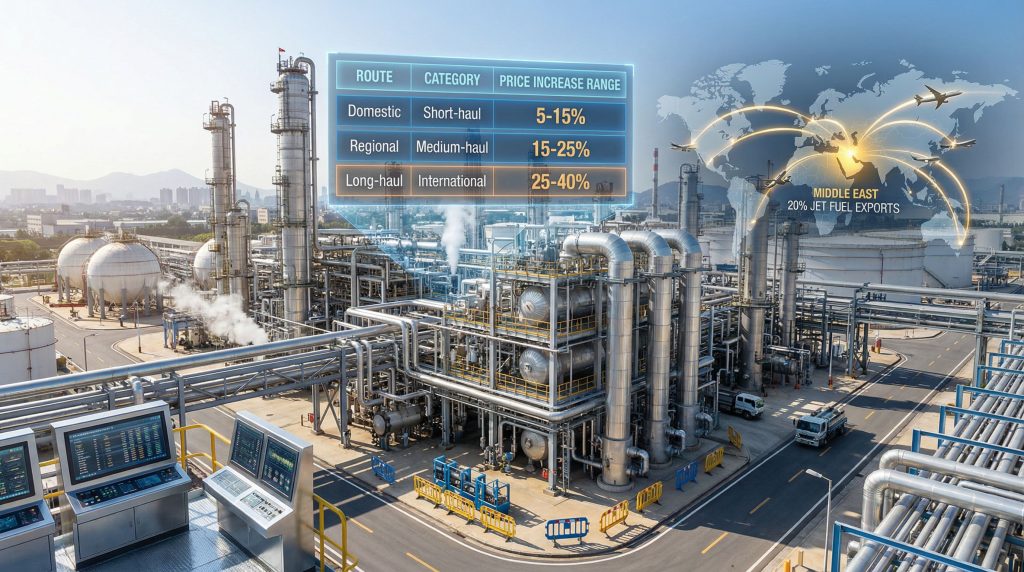
Price transmission to consumers follows predictable patterns based on route characteristics and competitive dynamics:
| Route Category | Price Increase Range | Implementation Timeline |
|---|---|---|
| Domestic Short-haul | 5-15% | Immediate |
| Regional Medium-haul | 15-25% | 2-4 weeks |
| Long-haul International | 25-40% | 1-2 months |
Low-cost carriers operating price-sensitive routes face particular challenges implementing surcharges without demand destruction. Premium carriers with strong brand equity and captured business travel customers demonstrate greater pricing power during fuel crises.
In addition, the differential impact between hedged and unhedged carriers creates competitive distortions where financial sophistication determines operational survival during prolonged jet fuel price surge periods.
How Refinery Economics Drive Fuel Price Premiums
Record-high refining margins signal structural supply constraints rather than temporary market dislocations. The 350% year-over-year increase in jet fuel crack spreads indicates refiners receive unprecedented profits for converting crude oil into aviation fuel.
Crack Spread Dynamics and Market Signals
Refinery yield optimisation requires analysing crude assay data to predict output volumes and quality across different product streams. Gulf medium sour barrels yield approximately 20-28% middle distillates depending on specific grade and refinery configuration, whilst African and South American light crudes yield only 12-18% middle distillates.
When refineries face crude cargo disruptions, the choice of alternative feedstocks becomes critical for maintaining product mix. Refiners preferentially seek crude grades that maximise jet fuel yields, even at premium prices, because extreme crack spreads justify higher feedstock costs.
For instance, the complex relationship between crude selection and jet fuel production affects global supply chains in ways that traditional oil price rally analysis might not fully capture.
Processing Rate Adjustments and Output Optimisation
Asian refineries initiated processing rate cuts as crude supply chains faced extended delays through the Strait of Hormuz. These operational adjustments reduce output of all refined products but disproportionately affect middle distillates that require specific crude inputs.
The crack spread calculation for jet fuel equals:
Jet Fuel Price (per barrel) – Crude Oil Price (per barrel) = Refining Margin
Current premiums of $88-$91 represent extraordinary value-added through refining processes, after accounting for crude feedstock, energy costs, and maintenance expenses. When refineries cut processing rates, they intentionally reduce output of lower-margin products whilst attempting to maximise higher-value middle distillates.
What Historical Precedents Reveal About Recovery Timelines
Previous supply disruption episodes provide framework for understanding potential market recovery patterns, though each crisis presents unique characteristics that influence resolution timelines. However, recent developments differ significantly from past events due to evolving geopolitical factors and infrastructure dependencies.
Previous Supply Disruption Case Studies
The 1990-91 Gulf War impact on aviation fuel markets demonstrated similar but less severe pricing dynamics, with jet fuel premiums reaching approximately $45-$55 per barrel above crude benchmarks during peak disruption periods. Recovery required approximately 8-12 months following conflict resolution.
The 2019 Saudi Aramco attacks created temporary supply constraints that elevated crack spreads for 4-6 weeks before normalisation. Nevertheless, this incident affected individual facilities rather than strategic waterways, limiting its scope compared to current disruptions.
COVID-19 demand destruction represented the inverse scenario where oversupply and collapsed demand created negative crack spreads for certain refined products. The recovery from this demand-side shock required 18-24 months as travel patterns normalised.
Market Structure Evolution Post-Crisis
Strategic petroleum reserve utilisation proves less effective for refined products compared to crude oil releases. Government stockpiles typically focus on crude rather than specific product categories, limiting policy intervention options during product-specific crises.
Historical patterns suggest that supply chain diversification investments accelerate following major disruptions, though implementation requires 3-5 years for meaningful capacity additions. Alternative fuel infrastructure development may receive renewed focus as airlines seek supply security.
Furthermore, these patterns often align with broader trade war impacts that can exacerbate existing vulnerabilities in global supply chains.
Strategic Implications for Energy Security and Market Structure
Current market dynamics expose fundamental vulnerabilities in global energy infrastructure that extend beyond traditional crude oil security frameworks. Product-specific supply chains require dedicated risk management approaches.
Policy Response Mechanisms
Government intervention options for refined product markets remain limited compared to crude oil policy tools. Strategic product reserves exist in few countries and typically focus on heating oil or gasoline rather than aviation fuels.
International coordination frameworks for emergency supply sharing operate primarily at the crude level through International Energy Agency protocols. Product-specific sharing arrangements require bilateral agreements between nations with compatible refining capacity.
Investment and Infrastructure Adaptation
Capital allocation priorities for energy security enhancement must consider product-specific vulnerabilities alongside crude supply diversification. Refinery capacity additions require 4-7 years from project initiation to commercial operation, limiting short-term supply response capability.
Technology solutions for supply chain resilience include advanced inventory management systems, alternative transportation routes, and flexible refinery configurations capable of processing diverse crude grades. These investments require substantial capital commitments with uncertain return timelines.
Additionally, the broader context of US oil production decline may influence global capacity planning and strategic energy considerations for many nations.
The next major ASX story will hit our subscribers first
Frequently Asked Questions About Jet Fuel Price Volatility
Why can't airlines switch to alternative fuels quickly?
Technical certification requirements for aviation fuel standards mandate extensive testing and regulatory approval processes that typically require 12-18 months minimum. Infrastructure compatibility concerns include fuel system corrosion, performance at altitude, and storage requirements that differ substantially from conventional jet fuel.
Economic barriers to rapid fuel transition include aircraft modification costs, pilot retraining, maintenance procedure updates, and airport infrastructure upgrades. Sustainable aviation fuel availability remains limited to approximately 0.1% of total jet fuel consumption globally.
How long do fuel surcharges typically remain in effect?
Historical analysis indicates fuel surcharges persist for 6-18 months following initial implementation, depending on underlying commodity price movements and competitive dynamics. Airlines face customer resistance to permanent surcharges, preferring to absorb costs through base fare adjustments when market conditions permit.
Competitive response patterns show that surcharge duration depends heavily on industry-wide implementation. Individual carriers removing surcharges prematurely often gain market share advantages, creating pressure for coordinated industry approaches.
Future Market Outlook and Risk Assessment
Market structure vulnerabilities exposed during the current crisis suggest persistent volatility risk for specialised fuel categories even following geopolitical resolution. These challenges coincide with broader energy export challenges affecting global supply chains.
Short-term Price Trajectory Scenarios
Geopolitical resolution scenarios range from diplomatic settlement to escalated conflict, each presenting different timeline expectations for supply normalisation. Optimistic projections suggest 3-6 months for waterway reopening, whilst pessimistic scenarios extend disruption timelines to 12-24 months.
Seasonal demand patterns through peak travel periods may amplify pricing pressure during summer months when aviation fuel consumption reaches annual highs. Inventory rebuilding requirements following disruption resolution typically require 6-12 months for normalisation.
Long-term Structural Changes
Supply chain redundancy investments will likely focus on alternative export routes, enhanced storage capacity, and flexible refinery configurations. These adaptations require substantial capital investment with implementation timelines extending 5-10 years.
Regional market development priorities may shift toward domestic refining capacity in major fuel-consuming regions to reduce dependence on concentrated production hubs. Technology adoption acceleration in fuel efficiency improvements and alternative fuel development may receive increased investment focus.
Disclaimer: This analysis is for informational purposes only and should not be considered as investment advice. Energy market investments involve substantial risk of loss, and past performance does not guarantee future results. Readers should conduct their own research and consult with qualified financial advisors before making investment decisions.
Looking to Capitalise on Energy Market Volatility?
Discovery Alert's proprietary Discovery IQ model provides instant alerts on significant ASX mineral discoveries across energy commodities, helping investors identify opportunities ahead of market-moving announcements. With jet fuel price surges highlighting energy supply vulnerabilities, understanding which exploration companies may benefit from shifting commodity dynamics becomes crucial for positioning portfolios strategically.