June 17, 2026
The Engineering Reality Behind Europe's Most Consequential Upstream Decision
When energy analysts debate European supply security, the conversation almost always gravitates toward liquefied natural gas import terminals, pipeline rerouting, and renewable capacity additions. Yet beneath those headline-grabbing infrastructure themes lies a quieter, more technically demanding challenge: how do you prevent a world-class oil field from entering irreversible production decline while the continent it supplies depends on every barrel it produces?
That question sits at the heart of Johan Sverdrup Phase 4, a subsea tie-back development targeting newly identified reservoir volumes within the broader Johan Sverdrup licence area on Norway's Continental Shelf. Understanding why this project matters requires stepping back from the raw resource numbers and examining the reservoir physics, partnership economics, and geopolitical landscape that together make Johan Sverdrup one of the most consequential upstream assets operating anywhere in Europe today.
When big ASX news breaks, our subscribers know first
Johan Sverdrup's Role in the European Crude Supply Architecture
Norway's position as Europe's most reliable non-OPEC crude supplier did not happen by accident. The Norwegian Continental Shelf operates under a regulatory and fiscal framework administered by the Norwegian Petroleum Directorate (NPD) that prioritises long-term recovery maximisation over short-term extraction rates. This philosophy, embedded in Norwegian petroleum law, creates a structural incentive for operators to invest in field life extension programmes rather than simply harvesting peak production and walking away.
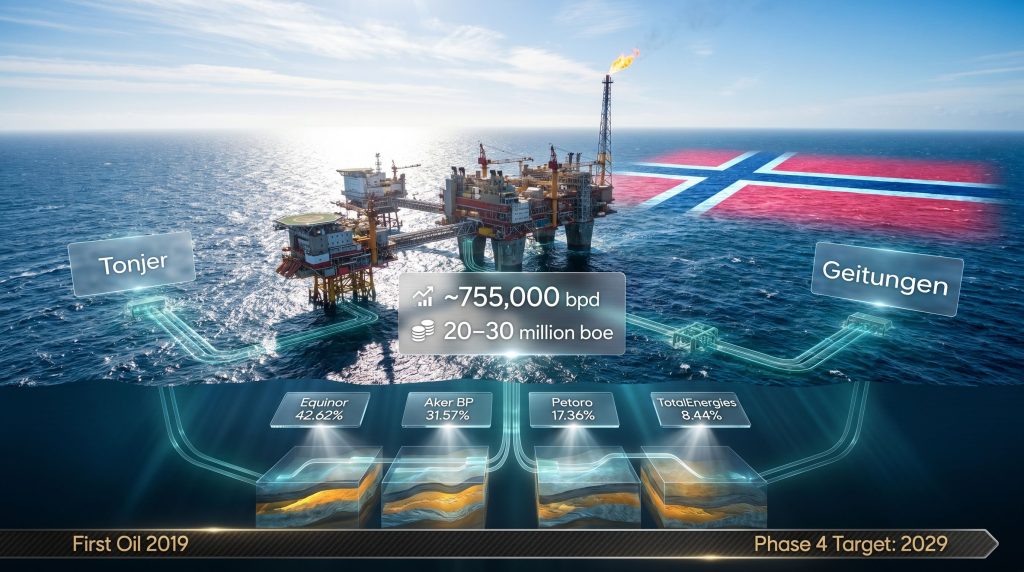
Johan Sverdrup sits at the top of this architecture. Producing approximately 755,000 barrels per day (bpd), the field accounts for roughly one-third of Norway's total national oil output. Since achieving first oil in 2019, it has grown into the anchor asset of Norwegian export volumes, supplying European refiners with a high-quality, low-sulphur crude stream that integrates well into complex refinery configurations designed to process light, sweet grades.
The field's crude quality is a frequently underappreciated commercial advantage. Johan Sverdrup crude carries an API gravity of approximately 28 degrees with a sulphur content of around 0.7%, positioning it as a medium-sour grade that commands a consistent market among North Sea-oriented European refineries. Unlike ultra-light shale crude, which can overwhelm distillation units configured for heavier feedstocks, Johan Sverdrup's profile slots cleanly into the existing refinery infrastructure of its primary customers.
Furthermore, the strategic relevance of Johan Sverdrup extends well beyond production volume. In a post-2022 European energy markets landscape reshaped by the removal of large volumes of Russian crude from continental supply chains, having a politically stable, infrastructure-rich, and operationally consistent supplier of this scale has shifted from a commercial preference to a structural necessity.
What Johan Sverdrup Phase 4 Actually Involves
Phase 4 is a subsea tie-back development connecting two distinct discovery areas within the Johan Sverdrup licence to the field's existing offshore processing and export infrastructure. The two reservoir targets are known as Tonjer and Geitungen. Both were identified through appraisal drilling and sidetrack programmes conducted within the licence area, and both require further subsurface modelling before a final investment decision can be sanctioned.
The preliminary resource estimates currently sit at approximately 20 million barrels of oil and up to 30 million barrels of oil equivalent (boe) when associated gas volumes are included. These figures remain subject to revision as additional subsurface analysis is completed. For more detail on Equinor's advancement of Phase 4 following new discoveries, additional reporting is available from specialist energy outlets.
| Parameter | Preliminary Estimate |
|---|---|
| Recoverable oil | ~20 million barrels |
| Total recoverable resources | ~20-30 million boe |
| Development concept | Subsea tie-back to existing infrastructure |
| Targeted production start | 2029 |
| FID status | Under maturation; FID pending |
| Operator | Equinor (42.62%) |
The subsea tie-back model is particularly well-suited to satellite discoveries of this scale. Rather than constructing a new fixed or floating production platform, which would require capital expenditure potentially running into multiple billions of dollars and a development timeline stretching well beyond 2029, a tie-back routes production through subsea wellheads and flowlines directly into Johan Sverdrup's existing processing platform. This approach compresses both development cost and carbon intensity per barrel produced.
Why Reservoir Connectivity Is the Critical Technical Variable
One of the less-discussed technical challenges in subsea tie-back developments is the question of hydraulic connectivity between the new reservoir targets and the existing producing formation. If Tonjer and Geitungen are hydraulically connected to the main Johan Sverdrup reservoir, Phase 4 production could theoretically influence pressure dynamics in currently producing wells, potentially accelerating depletion in certain segments of the reservoir. Subsurface engineers must model these interactions carefully before sanctioning the tie-back design.
Conversely, if the new targets are sufficiently isolated from the main reservoir, they can be produced independently without interference risk, but this would also mean they don't benefit from any existing pressure support mechanisms. Getting this analysis right is one reason why the FID timeline remains open-ended, and why Equinor has emphasised that further subsurface work is required before the project can move forward.
The Partnership Structure and Its Strategic Implications
Johan Sverdrup Phase 4 is not solely an Equinor story. The licence partnership reflects a deliberate concentration of Norwegian and European energy interests in a single, strategically important asset.
| Partner | Equity Stake | Strategic Role |
|---|---|---|
| Equinor | 42.62% | Operator; leading FID maturation |
| Aker BP | 31.57% | Second-largest partner; publicly aligned with Phase 4 maturation |
| Petoro | 17.36% | Norwegian state commercial vehicle; sovereign revenue exposure |
| TotalEnergies | 8.44% | European major; continental supply chain interest |
Petoro's presence in the partnership is particularly significant from a Norwegian fiscal perspective. As the state's commercial vehicle for NCS licence interests, Petoro channels its share of production revenues directly into the framework that ultimately feeds Norway's Government Pension Fund Global, commonly known as the sovereign wealth fund. Every barrel produced from Phase 4 therefore has a direct financial connection to Norwegian state finances, creating a political alignment between project success and national economic outcomes.
Aker BP's publicly stated characterisation of Phase 4 as a maturation step toward FID signals that the two largest partners are strategically aligned on the development timeline, which reduces the partnership governance risk that can sometimes delay subsea tie-back projects when operator and non-operator interests diverge.
The Decline Curve Problem: Why 30 Million Barrels Carries Outsized Weight
A common analytical mistake when evaluating mature field development projects is to measure their significance purely against headline reserve numbers. By that metric, 20 to 30 million boe looks modest against Johan Sverdrup's total resource base, which spans multiple billions of barrels.
The correct analytical lens is the decline curve, not the absolute volume.
All oil fields experience natural production decline as reservoir pressure depletes and the relative proportion of produced water increases. For a field producing at ~755,000 bpd, even a natural annual decline rate of 5% represents a loss of approximately 37,750 bpd per year without active intervention. Over a five-year period without additional development activity, cumulative production loss would approach 750,000 barrels per day in aggregate terms, a figure that ironically mirrors the field's entire current daily output.
Phase 4's tie-back volumes work against this trajectory. The strategic calculation is not about what 30 million boe adds to the production ledger in absolute terms. It is about how many months or years of accelerated decline the development can offset, preserving hundreds of thousands of barrels per day of output that European refiners currently depend on.
This is the core logic of mature field management: the value of preventing decline often exceeds the value of the incremental barrels themselves, because the alternative is a faster reduction in baseline production from an asset that is very difficult and expensive to replace.
Johan Sverdrup in the Context of NCS Maturation Strategy
Phase 4 reflects a structural shift underway across the Norwegian Continental Shelf that energy market participants would benefit from understanding more deeply. Norway's NCS has been producing hydrocarbons since the early 1970s, and the basin is now firmly in its mature phase. The Norwegian Petroleum Directorate estimates that improved recovery from existing fields represents one of the largest remaining resource opportunities on the shelf. In addition, a broader Nordic mining overview reveals how this recovery-led thinking is reshaping the entire regional extractive sector.
The dominant development archetypes for the next decade are expected to include:
- Infill drilling within established reservoir drainage areas to capture bypassed oil
- Enhanced oil recovery (EOR) programmes, including water alternating gas (WAG) injection and polymer flooding, targeting residual reservoir volumes
- Step-out drilling to appraise and develop satellite structures adjacent to existing infrastructure
- Subsea tie-back developments connecting smaller discoveries to existing processing platforms, exactly the model Phase 4 employs
- Field life extension programmes that maintain infrastructure beyond original design lifetimes to capture long-tail production
Johan Sverdrup's multi-phase development sequence, with Phases 3 and 4 now being matured as parallel but distinct workstreams, exemplifies this recovery-led operational model. The parallel workstream structure is itself a sophisticated project management decision. By developing multiple reservoir targets simultaneously rather than sequentially, Equinor can optimise capital deployment, drilling campaign efficiency, and production timing across different parts of the Johan Sverdrup licence area.
The Carbon Intensity Dimension
An often overlooked advantage of the subsea tie-back model is its carbon intensity per barrel profile. Johan Sverdrup already holds the distinction of being one of the lowest carbon intensity producing fields in the world, with its production powered substantially by electricity from shore rather than offshore gas turbines. Subsea tie-back developments that leverage this existing low-carbon infrastructure inherit its emissions efficiency advantage.
Furthermore, the role of renewable energy in mining and extractive industries more broadly demonstrates how electrification strategies are becoming a core part of operational planning across the sector. For European energy companies operating under increasingly stringent ESG reporting requirements and emissions reduction targets, this characteristic makes Phase 4-type developments significantly more defensible from a sustainability governance perspective than their resource volumes alone might suggest.
The next major ASX story will hit our subscribers first
Key Risks That Could Affect the Phase 4 Timeline
Several categories of risk could influence whether Phase 4 achieves its targeted 2029 production start. Investors and energy market participants should consider the following:
Technical and Subsurface Risks
- Resource estimate uncertainty remains material; the 20-30 million boe range is preliminary and subject to upward or downward revision
- Reservoir connectivity modelling between Tonjer, Geitungen, and the main Johan Sverdrup reservoir system is ongoing and could affect development design
- Production interference risk between Phase 4 wells and existing producing infrastructure requires careful pressure management analysis
Commercial and Market Risks
- Subsea tie-back economics are more resilient to oil price weakness than standalone platforms, but long-term price scenario analysis will still form part of the FID process
- Norwegian offshore service sector cost inflation, which has remained elevated since 2022, could affect subsea installation and drilling campaign costs
- FID delays beyond 2026 or 2027 would likely push the 2029 start-up target into the early 2030s, extending the period during which natural decline is not offset by new Phase 4 production
However, commodity price impacts on project economics remain a broader consideration across all upstream developments of this type, and Phase 4 is no exception.
Frequently Asked Questions: Johan Sverdrup Phase 4
What is the expected start-up date for Johan Sverdrup Phase 4?
Equinor has indicated a targeted production start of 2029, subject to a final investment decision. The project is currently being matured, with additional subsurface analysis underway to refine resource estimates and development design.
How much oil will Johan Sverdrup Phase 4 produce?
Preliminary resource estimates place recoverable volumes at approximately 20 to 30 million barrels of oil equivalent. These figures remain subject to revision as further appraisal work is completed.
What development concept is being used for Phase 4?
Phase 4 will use a subsea tie-back to Johan Sverdrup's existing offshore processing and export infrastructure. This approach reduces capital expenditure, shortens the development timeline, and lowers per-barrel carbon intensity compared to a standalone platform development.
Who are the partners in Johan Sverdrup Phase 4?
The licence partnership comprises Equinor (42.62%, operator), Aker BP (31.57%), Petoro (17.36%), and TotalEnergies (8.44%).
Why is Johan Sverdrup Phase 4 strategically important beyond its resource volumes?
Phase 4 is primarily designed to mitigate natural production decline at one of Europe's most important crude supply assets. Preserving high output volumes from a field producing ~755,000 bpd carries far greater market significance than the incremental barrels of a single development project.
Is Phase 4 the same as Phase 3?
No. Johan Sverdrup Phase 3 is being developed as a separate and parallel workstream. Phase 4 specifically targets the Tonjer and Geitungen discovery areas through subsea tie-back technology and has its own independent development timeline and FID process.
The Broader Investment and Energy Security Perspective
For energy market participants, Johan Sverdrup Phase 4 functions as a leading indicator of how mature basin management will define upstream investment patterns across the North Sea and similar mature producing provinces over the coming decade. The era of straightforward volume growth through giant greenfield discoveries is largely behind the NCS. What replaces it is technically sophisticated, infrastructure-dependent, and capital-efficient recovery optimisation.
This shift has implications for how investors assess the long-term value proposition of companies with significant NCS exposure. An operator capable of systematically identifying, appraising, and developing satellite tie-back opportunities around existing infrastructure is demonstrating a form of capital efficiency that differs fundamentally from exploration-led growth models, and arguably offers a more predictable production profile in a world where energy security and supply reliability are priced at a premium.
The continued investment by Equinor, Aker BP, Petoro, and TotalEnergies in Johan Sverdrup's long-term productive capacity represents one of the most consequential upstream commitments currently active on the European continent. Phase 4 may appear modest in isolation. Within the full context of what Johan Sverdrup means to European crude supply, it is anything but.
This article contains forward-looking statements and preliminary estimates regarding Johan Sverdrup Phase 4. Resource figures, development timelines, and production forecasts are subject to change based on ongoing subsurface analysis and final investment decisions. Nothing in this article constitutes financial or investment advice.
Want to Track the Next Major Mineral Discovery Before the Broader Market Does?
Discovery Alert's proprietary Discovery IQ model delivers real-time alerts on significant ASX mineral discoveries, transforming complex geological data into actionable investment insights for both short-term traders and long-term investors — explore historic discoveries and their extraordinary returns, then begin your 14-day free trial at Discovery Alert to position yourself ahead of the market.