May 23, 2026
The Industrial Logic Behind India's Advanced Steel Ambition
The global steel industry is in the middle of a generational shift. Commodity-grade overcapacity, accelerating decarbonisation requirements, and increasingly sophisticated downstream demand are collectively forcing steelmakers to choose a strategic path: compete on volume and price, or move decisively up the value curve. In India, where infrastructure spending is reaching historic peaks and the automotive sector is expanding at a rate few economies can match, the answer to that question has never been more consequential.
India's crude steel production crossed 106 million tonnes in FY 2022-23, cementing its position as the world's second-largest steel producer according to the World Steel Association. However, production volume alone masks a critical structural gap. The country's automotive and precision manufacturing sectors have remained heavily dependent on imported high-grade steel, sourced primarily from Japan, South Korea, and Germany, because domestic producers have historically lacked the process technology to manufacture advanced grades at commercial scale.
According to Ministry of Steel data, India imported approximately 5.5 million tonnes of finished steel in FY 2022-23, with automotive-grade flat products representing a significant share of that inflow. It is precisely this gap that the JSW JFE Steel Limited joint venture in Odisha has been designed to close.
When big ASX news breaks, our subscribers know first
What the JSW JFE Steel Limited Joint Venture Actually Is
Formally unveiled on April 24, 2026, at a ceremony in Thelkoloi, Rengali, Sambalpur district, JSW JFE Steel Limited represents the structural crystallisation of a 15-year strategic partnership between JSW Steel, one of India's largest steel producers, and JFE Steel Corporation, the Tokyo-headquartered industrial giant with approximately 50 million tonnes of global crude steel capacity.
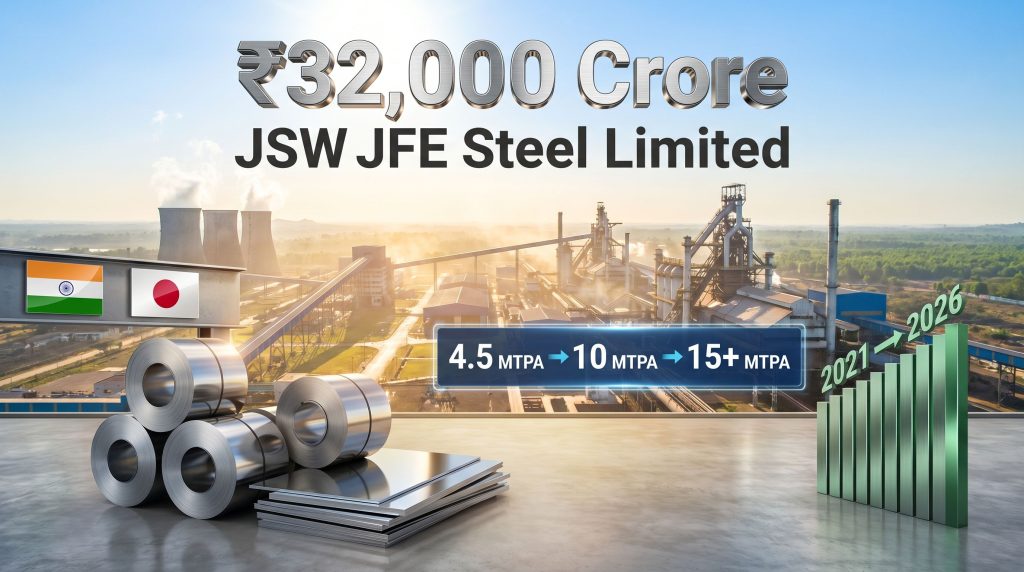
The entity is structured as an equal 50:50 joint venture, with structural completion confirmed on March 30, 2026, following Competition Commission of India regulatory approval. JFE Steel's total equity commitment is estimated at approximately ₹15,000 to ₹15,750 crore, deployed across two tranches of 25% each, as part of a broader investment programme totalling approximately ₹30,000 to ₹32,000 crore.
The venture is built on the foundations of the Sambalpur integrated steelworks, an asset with an industrial history that makes its current trajectory particularly remarkable.
From Distressed Asset to World-Class Facility: The BPSL Transformation
The Sambalpur plant's origins lie in Bhushan Power and Steel Limited (BPSL), a debt-laden facility that JSW Steel acquired through India's Insolvency and Bankruptcy Code (IBC) proceedings in 2019, with operational transfer completed in early 2020. At acquisition, crude steel output stood at approximately 2.9 MTPA.
What followed represents one of the more significant industrial turnarounds in India's recent manufacturing history. Without constructing a single greenfield facility, JSW's operational team drove capacity from 2.9 MTPA to approximately 4.5 MTPA through systematic investment in process optimisation, infrastructure rehabilitation, and workforce development. The facility was subsequently restructured and rebranded as JSW Sambalpur Steel Limited prior to the JFE partnership taking its final form.
The Sambalpur facility's revival from a distressed insolvency asset to a 4.5 MTPA integrated steelworks now serves as the operational and technological blueprint for JSW's broader Odisha industrial strategy.
Why This Alliance Took 15 Years to Reach This Point
The JSW and JFE relationship did not begin with a joint venture. It began with a conversation in 2009, when the two companies entered a Strategic Comprehensive Alliance that was, at its core, a framework for learning to work together before committing capital at scale.
The logic was grounded in complementary industrial strengths:
- JSW contributed operational scale across Indian manufacturing, raw material procurement expertise, entrepreneurial execution speed, and intimate knowledge of India's complex regulatory and commercial environment
- JFE contributed globally recognised advanced steelmaking process technology, decades of metallurgical research discipline, expertise in high-value product segments, and the long-horizon institutional patience that characterises Japan's finest industrial organisations
The alliance's first joint output was a collaboration in grain-oriented electrical steel (GOES), a technically demanding product category used in power transformers and electrical machinery. GOES production requires advanced cold-rolling and annealing technology, with precise magnetic permeability specifications that demand significant process control. Its successful joint production validated the partnership model and built the organisational confidence needed for deeper integration.
Alliance Timeline: From Handshake to ₹32,000 Crore Commitment
| Year | Milestone |
|---|---|
| 2009 | Strategic Comprehensive Alliance established between JSW Steel and JFE Steel |
| 2009–2024 | Technical cooperation in high-grade automotive steel; joint R&D programmes |
| 2019 | JSW Steel completes acquisition of BPSL through insolvency resolution process |
| 2020 | Operational transfer and revival of Sambalpur facility begins |
| 2020–2024 | Capacity expansion from ~2.9 MTPA to ~4.5 MTPA without greenfield construction |
| 2024–2025 | JFE acquires initial 25% stake tranche |
| March 30, 2026 | Structural completion of 50:50 JV following CCI approval |
| April 24, 2026 | JSW JFE Steel Limited formally unveiled at Sambalpur ceremony |
The Cultural Dimension: Why Japanese Precision and Indian Agility Create Something Neither Could Alone
Cross-cultural industrial partnerships frequently underperform expectations because the organisational differences that look complementary on paper prove difficult to reconcile in practice. The JSW-JFE relationship has navigated this challenge through 15 years of deliberate cultural investment.
Japanese industrial methodology is characterised by systematic process documentation, incremental improvement cycles, long-horizon planning, and an almost philosophical commitment to quality consistency. Indian industrial organisations like JSW, furthermore, are known for adaptive problem-solving, commercial responsiveness, and an ability to execute rapidly in unpredictable environments.
Rather than generating friction, these orientations have functioned as mutual reinforcements. According to JSW Steel's senior leadership, the two companies developed a hybrid working culture through shared site operations, cross-organisational exchanges, and joint research programmes. JSW Group Chairman Sajjan Jindal has characterised JFE as a partner that brought both the technology and the patience needed to build something lasting.
A phrase that has come to define the internal philosophy of the partnership draws from Japanese language: ichi tasu ichi wa juuichi, meaning one plus one equals eleven. It reflects a documented belief within both organisations that deeply aligned partnerships, when grounded in complementary capabilities and genuine mutual trust, can generate industrial outcomes that neither party could produce independently.
Sambalpur's Strategic Advantages: Why Location Matters
The geographic rationale for anchoring this joint venture in Sambalpur, western Odisha, is not incidental. It reflects a convergence of raw material security, logistics infrastructure, and regional industrial momentum.
Odisha produces approximately 127 million tonnes of iron ore annually, representing roughly 48% of India's total iron ore output according to Indian Bureau of Mines data for FY 2022-23. The state's iron ore reserves in Keonjhar, Mayurbhanj, and Sundargarh districts provide structural raw material security for steelmakers operating in the region, with proximity to ore sources translating directly into lower input logistics costs.
The Sambalpur facility benefits from multimodal connectivity through South Eastern Railway networks and National Highway 20, enabling efficient distribution to eastern, northern, and central Indian consumption markets. For high-volume flat steel products serving automotive and industrial clients, this inland positioning can reduce distribution costs by an estimated 12–18% compared to coastal facilities, according to logistics research analysis.
As of FY 2022-23, Odisha hosted approximately 35 MTPA of installed crude steel capacity across JSW Steel, ArcelorMittal, Vedanta, and public sector enterprises. The state has attracted over ₹1 lakh crore in committed industrial investments across heavy industry sectors, cementing its identity as a multi-sector heavy industry corridor.
Expansion Plans and Production Capacity Roadmap
The ₹32,000 crore investment programme is structured around a phased expansion of the Sambalpur facility from its current 4.5 MTPA output to a long-term target exceeding 15 MTPA.
| Phase | Capacity Target | Primary Focus |
|---|---|---|
| Current (2026) | ~4.5 MTPA crude steel | Flat and long products; value-added grades |
| Near-term expansion | ~10 MTPA | Advanced automotive steel; high-grade flat products |
| Long-term vision | 15+ MTPA | Full integrated steelworks; specialty and export-grade steel |
JSW Steel's Joint MD and CEO Jayant Acharya has confirmed that the facility's design supports scaling from the current 4.5 million tonne base to 10 million tonnes and beyond over time. This expansion framework is built around introducing JFE's advanced manufacturing capabilities into the production infrastructure, which is broadly consistent with the global crude steel outlook for high-value product differentiation.
Technology Priorities: What JFE Brings to the Production Floor
The technological dimension of this expansion is arguably its most strategically significant element. JFE Steel's global reputation rests substantially on its advanced steel grades for technically demanding applications. The specific technology priorities for JSW JFE Steel's expansion include:
- Introduction of high-grade automotive steel manufacturing capabilities, including High-Strength Low-Alloy (HSLA), Dual-Phase (DP), and Transformation-Induced Plasticity (TRIP) steels, which command 15–25% price premiums over commodity grades
- Advanced process technology for energy-efficient, environmentally optimised steelmaking, aligned with tightening global decarbonisation standards
- Specialty steel grades for precision industrial applications historically unavailable from domestic Indian producers
- Integration of JFE's environmental and low-carbon production methodologies, positioning the JV for compliance with evolving international trade frameworks
In addition, the broader context of hydrogen-based iron reduction technologies signals the direction in which JFE's process innovation pipeline is heading, and its integration into future phases of this facility remains a plausible strategic development.
Products, End Markets, and the Import Substitution Opportunity
The JSW JFE Steel Limited joint venture in Odisha will produce a comprehensive range of flat and long steel products, but its most strategically important output will be the advanced grades previously dependent on overseas sourcing.
Current and planned product portfolio:
- Hot-Rolled Coils (HRC): Primary flat product intermediates for automotive, appliance, and construction applications; thickness range 1.2–12mm
- Cold-Rolled Coils (CRC) and Cold-Rolled Sheets: Further-processed products with improved surface finish and dimensional tolerance; thickness range 0.4–3mm; essential for outer body panels in automotive manufacturing
- Bars and Wire Rods: Long products serving construction, infrastructure, and precision component manufacturing
- Pipes and downstream value-added products: Higher-margin specialty outputs for industrial applications
India's automotive industry, which produced approximately 21.64 million vehicles in FY 2022-23 according to Society of Indian Automobile Manufacturers data, has long sourced its most demanding steel requirements internationally. The landed cost differential between imported advanced automotive steel and domestically available commodity grades has been estimated at USD 200–300 per tonne, imposing ongoing cost penalties on Indian vehicle manufacturers.
India's domestic availability of advanced automotive steel grades would reduce supply chain lead times and improve cost competitiveness for Indian original equipment manufacturers, a shift that has been a consistent priority for the industry association representing domestic vehicle producers.
The Production-Linked Incentive (PLI) Scheme for automobiles, launched by the Department for Promotion of Industry and Internal Trade in June 2021, targets an additional ₹2 lakh crore in automotive production by FY 2026-27. This policy context creates an expanding addressable market for the advanced steel grades JSW JFE Steel is being built to supply.
The next major ASX story will hit our subscribers first
Competitive Positioning in a Structurally Challenging Global Market
The global steel industry faces three simultaneous headwinds: overcapacity concentrated in Chinese production, intensifying pressure to reduce carbon intensity, and demand fragmentation between commodity and specialty segments. The China steel market dynamics driving this overcapacity, furthermore, make the case for value-added differentiation increasingly urgent for producers outside China.
JSW JFE Steel's strategic architecture is explicitly designed to navigate this environment by occupying the high-value end of the product spectrum where volume-based price competition is less relevant. JFE's involvement, consequently, provides environmental manufacturing credentials that increasingly matter for both domestic regulatory compliance and access to export markets. The European Union's Carbon Border Adjustment Mechanism (CBAM), phased in from 2023, creates a direct economic incentive for Indian steel exporters to demonstrate low-carbon production credentials, and green steel pricing trends suggest that this premium is only set to grow.
At the domestic level, JSW's broader Odisha industrial strategy amplifies the JV's competitive logic. JSW Steel has separately announced greenfield steel plants in Keonjhar and Dhenkanal, each targeting 10 MTPA capacity. The Sambalpur JV functions simultaneously as an operational model and as an anchor investment that establishes JSW's technology credentials for subsequent Odisha developments.
Regional and National Economic Impact
The JSW JFE Steel Limited joint venture in Odisha generates economic consequences across multiple geographic scales.
At the facility level:
- Approximately 6,000 direct jobs expected at the expanded facility
- Significant indirect employment through ancillary industries, logistics providers, maintenance contractors, and downstream fabrication businesses across western Odisha
- Skills development through JFE's technical knowledge transfer programmes, creating a trained workforce in advanced steelmaking
At the state level:
- ₹32,000 crore in committed capital investment generating substantial tax revenue and state GDP contribution
- Sambalpur positioned as the anchor of western Odisha's industrial growth corridor, attracting downstream manufacturers
- Infrastructure demand stimulus as expanded plant logistics requirements accelerate road, rail, and utility development in surrounding districts
At the national level:
- Demonstrates the institutional maturity of India's industrial joint venture framework to global capital markets
- Reinforces India's positioning as a destination for Japanese industrial investment, consistent with bilateral economic partnership priorities
- Contributes to supply chain resilience across India's automotive, defence, and infrastructure sectors by reducing import dependency for advanced steel grades. Moreover, ongoing India coal trading reforms signal a broader transformation in how India manages its industrial commodity inputs at a national level
JFE Holdings President and CEO Yoshihisa Kitano has publicly characterised the Sambalpur steelworks as a project his organisation is committed to building into a facility of which both India and the global steel industry can be proud. Sajjan Jindal, Chairman of JSW Group, has described the JSW-JFE relationship as one built on mutual confidence, noting that JFE's decision to enter a 50:50 equity partnership reflects the trust accumulated through 15 years of practical collaboration rather than purely financial calculation.
What This Joint Venture Signals About India's Industrial Maturity
The deeper significance of JSW JFE Steel Limited extends beyond the steel industry. A 15-year strategic alliance between an Indian conglomerate and one of Japan's most technically sophisticated industrial corporations, culminating in an equal-equity joint venture backed by over ₹32,000 crore in committed investment, represents a data point about the quality of India's business environment that is difficult to replicate through policy statements alone.
For global industrial investors evaluating India as a long-term manufacturing destination, the JSW-JFE partnership provides evidence that:
- Cross-cultural industrial partnerships in India can sustain and deepen through multiple economic cycles
- India's insolvency resolution framework can transform distressed industrial assets into world-class production platforms when combined with capable acquirers
- Advanced technology transfer from global leaders into Indian manufacturing is viable at commercial scale
- The domestic market opportunity in advanced steel grades is large enough to justify major long-term capital commitments from internationally cautious institutional partners
The JSW JFE Steel Limited joint venture in Odisha is ultimately a story about what patient, trust-grounded industrial partnerships produce when both parties bring genuinely complementary strengths to a market that is ready for them. India's steel future is being built at Sambalpur, one tonne at a time.
Disclaimer: This article contains forward-looking statements regarding production targets, investment timelines, and economic projections. These figures are drawn from official company announcements and publicly available sources but are subject to change based on regulatory approvals, market conditions, and operational factors. This article does not constitute financial advice. Readers should conduct independent due diligence before making any investment decisions.
Want to Stay Ahead of the Next Major Mineral Discovery Powering India's Steel Ambitions?
As India's advanced steel sector accelerates — driving demand for iron ore, coking coal, and critical minerals — Discovery Alert's proprietary Discovery IQ model delivers real-time ASX mineral discovery alerts, turning complex geological data into actionable investment insights for both short-term traders and long-term investors. Explore how historic mineral discoveries have generated extraordinary returns or start your 14-day free trial today to position yourself ahead of the market.