
May 21, 2026
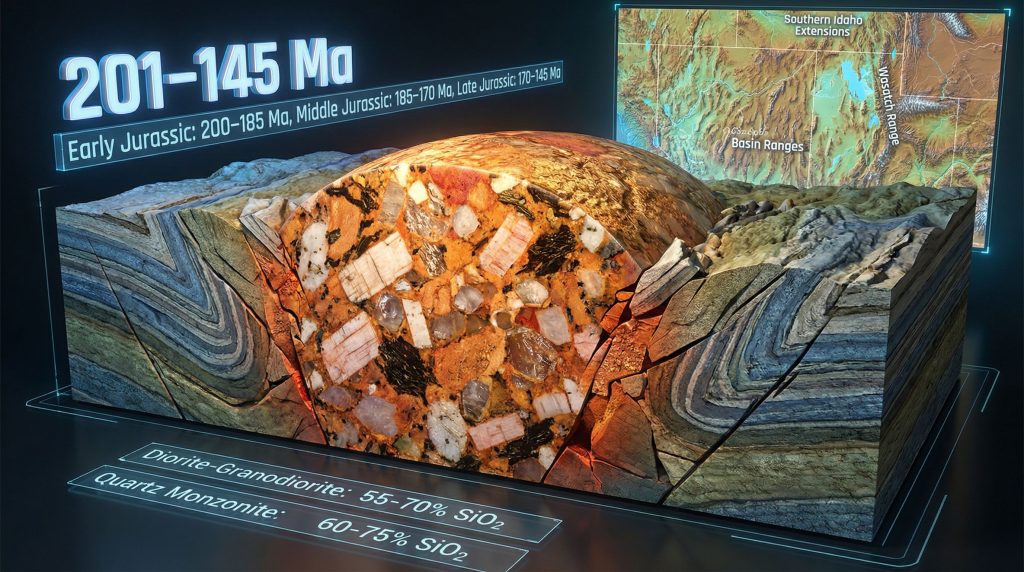
Magmatic processes operating within convergent margin settings demonstrate remarkable complexity when examined through the lens of deep crustal architecture. The formation of plutonic bodies during periods of sustained subduction creates distinctive patterns that reflect both temporal evolution and spatial relationships within ancient arc systems. Understanding these processes requires integration of structural geology, geochemistry, and geochronology to decode the mechanisms driving crustal modification.
Within the broader context of Cordilleran orogenic systems, plutonic intrusions represent frozen records of magmatic activity that shaped continental margins over geological timescales. The intermountain regions of western North America preserve particularly well-exposed examples of these processes, where Jurassic plutons in the intermountain terrains provide insights into subduction-related arc construction and subsequent tectonic modification.
Modern analytical techniques have revolutionised our understanding of plutonic emplacement mechanisms, revealing that magma generation, transport, and crystallisation occur within complex three-dimensional frameworks controlled by pre-existing structural architecture and evolving stress fields.
Plutonic Body Classification and Temporal Frameworks
Plutonic intrusions encompass a hierarchical classification system based on size, composition, and structural relationships within host terrains. Individual plutons typically occupy volumes ranging from several cubic kilometres to hundreds of cubic kilometres, while batholithic complexes may exceed 100,000 cubic kilometres and represent amalgamated intrusive sequences emplaced over millions of years.
The Jurassic Period, spanning 201.3 to 145 Ma according to the International Commission on Stratigraphy, encompasses three distinct temporal divisions that correspond to different phases of magmatic activity within convergent margin settings:
- Early Jurassic (201-174 Ma): Characterised by initial arc development and crustal thickening
- Middle Jurassic (174-163 Ma): Peak magmatic activity with extensive pluton emplacement
- Late Jurassic (163-145 Ma): Transitional magmatism reflecting changing tectonic conditions
Crystallisation rates within deep crustal environments typically allow mineral growth exceeding 2-5 millimetres, producing the coarse-grained textures characteristic of plutonic rocks. This contrasts dramatically with volcanic equivalents, where rapid surface cooling generates fine-grained or glassy textures.
The distinction between plutonic and volcanic processes extends beyond simple cooling rate differences to encompass fundamental differences in crustal residence time, differentiation mechanisms, and volatile behaviour during crystallisation.
When big ASX news breaks, our subscribers know first
Subduction Zone Magmatic Processes and Mantle Dynamics
Convergent margin magmatism represents one of Earth's most efficient mechanisms for generating continental crust through complex interactions between subducting oceanic lithosphere and overlying mantle wedge material. During the Jurassic, the Farallon plate system dominated Pacific basin tectonics, subducting beneath western North America at rates estimated between 5-15 centimetres per year based on palaeomagnetic and hotspot reference frame reconstructions.
Partial melting within mantle wedge environments initiates when temperatures reach 700-900°C at depths of 70-100 kilometres, triggered by water-induced depression of peridotite solidus temperatures. Fluids derived from dehydrating oceanic plates create hydrous conditions that promote 5-30% partial melting under typical arc pressure-temperature conditions.
The geochemical evolution of arc magmas reflects systematic processes operating during ascent through continental crust. Furthermore, these processes can be better understood through detailed drilling results interpretation that reveal the complex relationships between different geological units.
Primary Melting Mechanisms
Water-saturated peridotite melting occurs at significantly lower temperatures than dry melting, enabling magma generation in relatively cool mantle wedge environments. The addition of volatiles, particularly H₂O and CO₂, fundamentally alters silicate mineral stability fields and promotes incongruent melting reactions.
Fractional Crystallisation Pathways
Ascending mantle-derived melts undergo systematic compositional modification through removal of early-formed mineral phases. Olivine and pyroxene crystallisation drives residual liquids toward higher silica contents, following Rayleigh fractionation models that predict exponential changes in trace element concentrations.
Crustal Contamination Effects
Magma-crust interaction produces distinctive isotopic signatures traceable through radiogenic isotope systems. Initial ⁸⁷Sr/⁸⁶Sr ratios provide particularly sensitive indicators of crustal involvement, with mantle values typically ranging from 0.7024-0.7030 whilst crustal signatures exceed 0.7050.
Compositional Characteristics and Petrological Classification
Jurassic plutons in the intermountain terrains exhibit systematic compositional variations reflecting both source characteristics and differentiation processes. The International Union of Geological Sciences classification system provides standardised criteria for plutonic rock nomenclature based on modal mineralogy and chemical composition.
Major Element Classification
| Rock Type | SiO₂ Content | Primary Minerals | Tectonic Setting |
|---|---|---|---|
| Diorite-Granodiorite | 55-65 wt% | Plagioclase (40-60%), Hornblende (10-30%), Biotite (5-15%) | Volcanic arc roots |
| Quartz Monzonite | 65-72 wt% | K-feldspar (20-35%), Quartz (15-25%), Plagioclase (20-30%) | Back-arc environments |
| Granite | 70-77 wt% | Quartz (25-40%), K-feldspar (30-50%), Plagioclase (10-25%) | Crustal melting zones |
Trace Element Geochemistry
Incompatible element ratios provide powerful tools for distinguishing mantle versus crustal source contributions. Ba/Nb ratios typically exceed 20 in subduction-related magmas due to preferential Ba enrichment in slab-derived fluids, whilst Rb/Sr ratios increase systematically during fractional crystallisation and crustal assimilation processes.
Rare earth element patterns display characteristic features in arc-related plutons, which can be visualised effectively through modern 3D geological modelling techniques:
- Light REE enrichment reflecting source metasomatism by slab-derived fluids
- Negative Eu anomalies indicating plagioclase fractionation during differentiation
- Heavy REE depletion suggesting residual garnet in source regions or deep crustal hot zones
Isotopic Source Tracers
Neodymium isotopic compositions provide complementary information to strontium isotopes for source characterisation. ε(Nd) values ranging from +8 to +10 characterise depleted mantle sources, whilst enriched crustal components display ε(Nd) values between -5 and -20.
Lead isotope systematics track long-term uranium and thorium evolution in source materials. ²⁰⁷Pb/²⁰⁴Pb versus ²⁰⁶Pb/²⁰⁴Pb arrays distinguish recycled crustal components from primary mantle signatures through their distinctive evolutionary trajectories.
Geographic Distribution and Regional Complexes
Wasatch Range Intrusive Systems
The Wasatch Range occupies a critical position along the boundary between the Basin and Range province and Colorado Plateau, spanning approximately 241 kilometres north-south through northern Utah. This physiographic transition zone preserves well-exposed Jurassic plutonic complexes that demonstrate classic relationships between magmatic emplacement and structural control.
The Farmington Canyon Complex represents one of the most thoroughly studied Jurassic intrusive centres in the region, with U-Pb zircon ages clustering around 160-170 Ma during Late Jurassic time. Granodioritic to granitic compositions dominate the complex, consistent with emplacement in thickened crustal settings where extensive differentiation and crustal assimilation occurred.
Contact metamorphic aureoles surrounding Wasatch plutons extend 0.5-2 kilometres from intrusive contacts, with peak temperatures estimated at 600-750°C based on mineral assemblage thermobarometry. These thermal halos preserve prograde metamorphic sequences from outer chlorite-muscovite zones to inner garnet-biotite assemblages.
The Little Cottonwood Stock demonstrates classic skarn mineralisation where granodioritic magma intruded Palaeozoic carbonate sequences. Tungsten-bearing minerals developed within contact aureole rocks, indicating volatile-rich conditions during late-stage crystallisation phases. For additional context on ore-forming processes, comprehensive mineral exploration insights provide valuable understanding of these systems.
Nevada Basin Range Complexes
Eastern Nevada preserves numerous Jurassic plutonic exposures within the broader Basin and Range structural framework, though Cenozoic extensional tectonics has significantly modified original intrusive geometries. The Ruby Mountains-East Humboldt Range core complex exemplifies the complex interplay between Jurassic plutonic emplacement and subsequent Cenozoic exhumation.
Structural analysis of core complex architecture reveals that Jurassic protoliths underwent substantial modification during Oligocene-Miocene extension, when rapid cooling occurred as recorded by mica Ar-Ar ages ranging from 30-50 Ma. Ductile deformation fabrics in metamorphic rocks indicate north-south extension directions during core complex formation.
The Humboldt Range preserves multiple generations of plutonic intrusion, with Jurassic components requiring detailed geochronological analysis to distinguish from older and younger magmatic episodes. Structural orientations of emplaced plutons appear controlled by pre-existing fracture systems, suggesting accommodation of magma through dilational jog structures within regional fault networks.
Idaho Batholith Southern Extensions
The Idaho Batholith represents one of North America's largest plutonic complexes, encompassing approximately 400,000 cubic kilometres of granitic rocks emplaced over roughly 80 million years. Whilst Cretaceous magmatism dominates the batholith's volume, Jurassic components in southern extensions provide insights into early phases of crustal melting and arc construction.
Atlanta Lobe Jurassic components record emplacement depths of 8-15 kilometres based on contact metamorphic mineral assemblages and thermobarometric analysis. Migmatite zones adjacent to intrusive margins document partial melting of metasedimentary host rocks, contributing in-situ granitic melts to pluton growth through anatexis processes.
Boise Ridge intrusive relationships demonstrate variable contact geometries with metasedimentary host rocks, consistent with doming effects produced by subsiding magma chambers during protracted crystallisation intervals.
Structural Controls and Regional Deformation
Sevier Orogenic Integration
Jurassic pluton emplacement occurred synchronously with early phases of the Sevier orogeny, creating complex relationships between magmatic and structural processes. Thermobarometric analysis indicates crystallisation pressures of 3-5 kilobars, equivalent to depths of 9-15 kilometres, suggesting emplacement within moderately thickened crustal sections.
Structural fabrics preserved within plutonic rocks demonstrate that deformation continued during and after magma crystallisation. Ductile deformation textures in hornblende and biotite indicate temperatures exceeding 500°C during fabric development, constraining the temporal relationship between intrusion and regional compression.
Thrust belt development created accommodation space for ascending magmas through dilational structures associated with transpressional deformation. Fault-controlled magma ascent pathways help explain the linear arrangements of plutonic centres observed throughout the Sevier orogenic belt. For comprehensive understanding of deposit classification, a detailed mineral deposit guide provides essential context.
Basin and Range Overprinting
Cenozoic extensional tectonics profoundly modified original Jurassic plutonic geometries through normal fault systems and metamorphic core complex formation. Tertiary extension rates reached several millimetres per year locally, producing rapid exhumation of deep-seated plutonic rocks.
Detachment fault systems created distinctive structural relationships where brittlely deformed hanging wall rocks overlie ductilely deformed footwall mylonites. These geometric relationships provide key constraints on the magnitude and timing of post-Jurassic structural modification.
Modern topographic expression of ancient plutonic centres reflects the interplay between differential weathering resistance and structural exhumation processes operating over tens of millions of years.
Economic Mineralisation and Hydrothermal Systems
Porphyry-Style Mineralisation
The Bingham Canyon porphyry copper-molybdenum system represents world-class mineralisation associated with Jurassic plutonic activity. Stockwork vein development within plutonic host rocks created ore bodies containing over 20 billion tons of mineralised material, making it one of the largest copper deposits globally.
Hydrothermal alteration zoning around porphyry centres displays systematic spatial relationships:
- Potassic core zones with secondary biotite and K-feldspar
- Phyllic intermediate zones dominated by quartz-sericite-pyrite assemblages
- Propylitic outer halos containing chlorite-epidote-calcite minerals
Metal zonation reflects temperature gradients and fluid evolution during hydrothermal circulation, with molybdenum concentrating in high-temperature core zones whilst lead-zinc mineralisation develops in cooler peripheral environments.
Skarn and Contact Metamorphic Deposits
Iron-copper skarn formation occurs where plutonic magmas intrude carbonate-rich sedimentary sequences, creating ideal conditions for metasomatic replacement reactions. Garnet-pyroxene assemblages develop through reaction between silicate-bearing fluids and limestone protoliths.
Tungsten mineralisation within metamorphic aureoles reflects specialised fluid compositions enriched in tungsten, fluorine, and other high field strength elements concentrated during late-stage differentiation processes. Scheelite and wolframite represent the primary tungsten-bearing phases in these environments. Understanding these relationships requires detailed knowledge of mineralogy and ore economics, which governs deposit viability.
Gold-bearing quartz vein systems develop through multiple generations of hydrothermal fluid circulation, often overprinting earlier skarn assemblages. Structural control of vein emplacement reflects ongoing deformation during and after plutonic crystallisation.
Critical Mineral Occurrences
Specialised granitic compositions associated with highly differentiated magmatic systems concentrate critical minerals essential for modern technology applications:
- Rare earth element concentrations in alkaline plutonic phases reach economic grades where specialised minerals like monazite and bastnäsite crystallise
- Lithium pegmatite associations with evolved granitic compositions contain spodumene and lepidolite as primary lithium carriers
- Beryllium mineralisation occurs in specialised granite types through late-stage aqueous fluids carrying beryllium in solution
The next major ASX story will hit our subscribers first
Modern Analytical Methodologies
Geochronological Techniques
High-precision age determination relies on multiple complementary radiometric systems that record different aspects of cooling and crystallisation history:
U-Pb Zircon Dating:
- Records crystallisation ages with uncertainties typically ±0.5-2 million years
- Provides insights into pre-intrusion inheritance through xenocrystic core analysis
- Enables discrimination of magmatic versus metamorphic zircon growth
Ar-Ar Mica Dating:
- Documents cooling through 350-400°C temperature range
- Reveals post-emplacement thermal histories and exhumation rates
- Permits step-heating analysis to identify complex cooling patterns
Rb-Sr Whole-Rock Analysis:
- Constrains initial isotopic compositions and source characteristics
- Provides independent age information for mineral-poor samples
- Enables identification of post-crystallisation alteration effects
Geophysical Characterisation Methods
Three-dimensional pluton geometry determination employs integrated geophysical approaches that image subsurface intrusive architecture. Modern mineral resource assessment techniques have revolutionised our understanding of these complex systems.
Aeromagnetic Surveys detect magnetic susceptibility contrasts between plutonic rocks and country rock, enabling mapping of buried intrusive contacts and internal zonation patterns.
Gravity Modelling quantifies density variations associated with plutonic emplacement, providing constraints on intrusion thickness and root zone geometry through inversion algorithms.
Seismic Reflection Profiling images large-scale crustal structure across major intrusive complexes, revealing relationships between surface exposures and deep crustal architecture.
Advanced Petrological Analysis
Modern petrological investigation integrates high-resolution analytical techniques that characterise mineral chemistry and textural relationships at micrometre scales:
Electron Microprobe Analysis provides quantitative major element compositions for individual mineral grains, enabling thermobarometric calculations and petrogenetic modelling.
Scanning Electron Microscopy reveals textural relationships and replacement reactions that constrain crystallisation sequences and post-magmatic modification processes.
X-Ray Diffraction identifies mineral phases and structural modifications, particularly important for clay minerals and alteration products in hydrothermally modified rocks. The USGS mineral resources database provides comprehensive data on these analytical methods and their applications.
Cordilleran Evolution and Paleogeographic Reconstruction
Continental Margin Architecture
Jurassic plutons in the intermountain terrains provide critical constraints on ancient continental margin geometry and the evolution of subduction zone processes through time. Pluton distribution patterns define linear trends parallel to reconstructed continental margins, consistent with arc-normal magmatic segmentation observed in modern subduction systems.
Paleogeographic reconstruction indicates that Jurassic arc positions shifted systematically through time, reflecting changes in subduction zone geometry, slab dip angle, and upper plate motion. Migration of magmatic activity over 10-20 million year intervals suggests dynamic subduction zone processes rather than static geometric relationships.
Integration with modern crustal velocity structure reveals that Jurassic plutonic additions contributed significantly to crustal thickening and modification of continental margin architecture. Seismic reflection data indicate that many Jurassic intrusions extend to depths exceeding 15-20 kilometres, forming substantial additions to middle and lower crustal sections.
Terrane Assembly and Translation
The distribution of Jurassic plutons in the intermountain terrains across different terranes provides insights into the timing and mechanisms of terrane assembly within the Cordilleran orogen. Cross-cutting relationships between plutons and terrane boundaries constrain minimum ages for terrane juxtaposition and subsequent translation.
Palaeomagnetic analysis of Jurassic plutonic rocks reveals systematic declination and inclination patterns that track terrane motion relative to the North American reference frame. Apparent polar wander paths calculated from plutonic palaeomagnetic directions indicate significant northward translation and clockwise rotation of intermountain terranes during Cretaceous time.
Structural analysis of pluton-terrane relationships demonstrates that many intrusive bodies were emplaced prior to major terrane translation events, subsequently experiencing distributed deformation during large-scale tectonic transport.
Comparative Analysis with Other Mesozoic Systems
Triassic Precursor Relationships
Transitional characteristics between Triassic and Jurassic plutonic systems reflect evolving subduction zone dynamics and changing crustal architecture through the Mesozoic Era. Late Triassic (220-201 Ma) plutonic rocks typically display more primitive compositions and higher emplacement pressures compared to Jurassic equivalents.
Compositional evolution from Triassic to Jurassic time documents progressive crustal thickening and increasing degrees of crustal contamination in ascending magmas. Isotopic trajectories show systematic shifts toward more enriched signatures, indicating greater residence times in continental crust and enhanced assimilation processes.
Structural inheritance from Triassic deformation events influenced Jurassic pluton emplacement geometries through pre-existing weakness zones and crustal anisotropies that channelled ascending magmas along preferred orientations.
Cretaceous Successor Comparisons
Cretaceous (145-66 Ma) plutonic systems demonstrate fundamental differences from their Jurassic predecessors in terms of emplacement style, composition, and tectonic setting. Cretaceous batholiths achieved much larger volumes and display more systematic compositional zonation patterns.
Emplacement depths of Cretaceous plutons typically occurred at shallower crustal levels compared to Jurassic intrusions, reflecting different thermal gradients and crustal architecture during peak Cordilleran orogenic activity. Thermobarometric estimates indicate Cretaceous crystallisation pressures of 1-3 kilobars versus 3-5 kilobars for typical Jurassic systems.
Preservation potential differs significantly between Jurassic and Cretaceous plutonic rocks due to varying degrees of subsequent exhumation and erosional exposure. Many Jurassic plutons remain buried beneath younger cover sequences or have been removed by Cenozoic extension.
Future Research Directions and Applications
Emerging Analytical Technologies
High-resolution ion microprobe analysis enables unprecedented precision in U-Pb dating and trace element analysis of individual zircon domains, revealing complex crystallisation histories and inheritance patterns previously unresolvable with conventional techniques.
Machine learning approaches to geochemical data analysis provide powerful tools for pattern recognition and classification of plutonic suites, enabling identification of subtle petrogenetic processes and source characteristics through multivariate statistical methods.
Three-dimensional pluton modelling using LiDAR topographic data and photogrammetry creates detailed digital representations of plutonic exposures that facilitate volumetric calculations and structural analysis at multiple scales.
Climate Change and Geological Hazards
Plutonic terrains present unique challenges and opportunities in the context of climate change adaptation and geological hazard assessment:
Slope stability considerations in fractured plutonic rocks require understanding of joint systems and weathering patterns that develop differently in various plutonic compositions. Climate-driven freeze-thaw cycles may accelerate mass wasting processes in high-altitude plutonic terrains.
Groundwater flow patterns in fractured plutonic systems depend on fracture network connectivity and weathering depth, factors that may change significantly under altered precipitation and temperature regimes.
Geothermal resource potential associated with young plutonic systems offers opportunities for renewable energy development, particularly where high heat flow and fractured rock permeability create favourable conditions for geothermal circulation.
Integration with Regional Frameworks
Continental-scale geological synthesis benefits from detailed understanding of Jurassic plutonic systems through their role in crustal growth processes and tectonic evolution. Crustal growth rates calculated from plutonic addition volumes provide constraints on long-term continental margin evolution and global geochemical cycles.
Relationship to global Jurassic magmatic episodes reveals connections between regional tectonics and broader Earth system processes, including supercontinent breakup, sea level changes, and climate evolution during the Mesozoic greenhouse period.
Mineral resource exploration strategies increasingly rely on integrated geological frameworks that combine plutonic petrology, structural geology, and geochemistry to identify prospective terrains for critical mineral exploration.
Modern understanding of Jurassic plutons in the intermountain terrains continues evolving through integration of classical field geology with advanced analytical techniques and regional synthesis. These ancient magmatic systems provide windows into deep Earth processes operating during critical phases of continental margin evolution, whilst simultaneously offering insights relevant to contemporary challenges in resource exploration, hazard assessment, and environmental stewardship.
The complex interplay between magmatic processes, structural deformation, and surface processes preserved in Jurassic plutonic records demonstrates the value of integrated geological research approaches that combine multiple temporal and spatial scales of investigation. Future advances in analytical capabilities and computational modelling will undoubtedly reveal additional complexity within these remarkable geological archives.
Are You Exploring Investment Opportunities in Small-Cap Mineral Companies?
Discovery Alert's proprietary Discovery IQ model instantly identifies significant ASX mineral discoveries, transforming complex geological data into actionable investment insights for both short-term traders and long-term investors. Understanding how major mineral discoveries can generate substantial returns is crucial when evaluating opportunities in companies exploring similar geological settings to the intermountain plutonic systems discussed above—begin your 30-day free trial today to position yourself ahead of the market.