August 25, 2026
The Geological Rarity Driving Half a Billion Dollars Into East Africa
Not all nickel is created equal. Within the mining industry, geologists and project financiers draw a sharp distinction between two fundamentally different ore types: laterite deposits, which form through weathering of surface rocks in tropical climates, and sulphide deposits, which crystallise from magmatic processes deep within the earth. That distinction, largely invisible to the general public, is quietly reshaping where billions of dollars of Western capital flows in the global battery minerals race.
Sulphide nickel ores carry a processing advantage that laterites simply cannot match. They respond well to conventional flotation and smelting techniques, producing a high-grade concentrate without the energy-intensive and chemically complex high-pressure acid leach (HPAL) processing that laterite projects demand. HPAL plants are notoriously expensive to build, difficult to operate, and prone to costly commissioning delays. Several high-profile Australian laterite projects have demonstrated this the hard way, with capital overruns that permanently impaired investor returns.
This geological reality sits at the heart of why the Kabanga nickel project investment story is attracting the level of institutional attention it currently commands. Located in the Kagera region of northwestern Tanzania, Kabanga hosts one of the largest and highest-grade undeveloped nickel sulphide systems on the African continent. In a global nickel project pipeline increasingly dominated by lower-grade laterite developments, that distinction represents a meaningful competitive advantage.
When big ASX news breaks, our subscribers know first
What Makes Kabanga's Ore Body Genuinely Exceptional
Grade, Scale, and Mineralogy
Kabanga's deposit is hosted within a magmatic sulphide system associated with the East African Rift, a geological structure that has created some of the continent's most significant mineral endowments. Understanding magmatic nickel deposits is essential context here, as the ore body contains nickel alongside co-products including copper and cobalt, a polymetallic profile that meaningfully improves project economics by diversifying revenue streams beyond nickel alone.
The sulphide mineralogy at Kabanga means the nickel occurs in pentlandite, a mineral that responds efficiently to standard flotation processing. This produces a concentrate that can be refined through conventional smelting pathways to yield Class 1 nickel, the high-purity form required for lithium-ion battery cathode manufacturing. Not all nickel qualifies for battery-grade applications, and the pathway from ore to Class 1 product is substantially more straightforward from a sulphide starting point than from laterite. For more context on the nickel uses and properties that make this distinction commercially critical, the fundamentals are worth understanding before assessing any project of this scale.
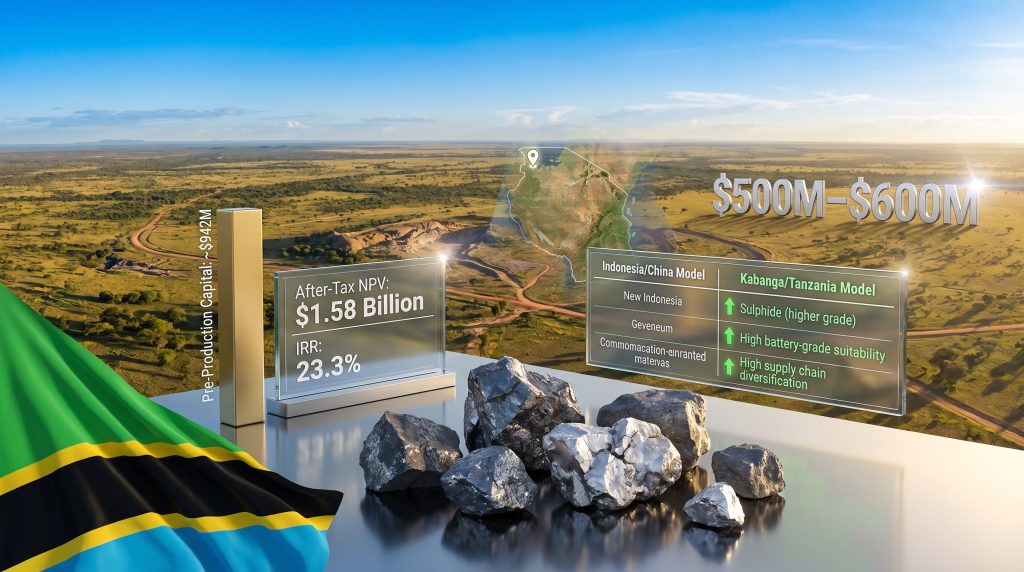
The project's July 2025 feasibility study delivered economics that benchmark favourably against global peers:
| Metric | Value |
|---|---|
| Pre-Production Capital Cost | ~$942 million |
| Previous Capital Estimate | ~$991 million |
| Total Life-of-Mine Capital | ~$2.49 billion |
| After-Tax NPV | $1.58 billion |
| Internal Rate of Return (IRR) | 23.3% |
| All-In Sustaining Cost (AISC) | $3.36/lb nickel |
| Lifezone Metals Ownership | 84% |
| Government of Tanzania Ownership | 16% |
The reduction in pre-production capital from $991 million to $942 million between study iterations signals genuine engineering maturation rather than mere optimism. A 5% capital reduction at this stage of feasibility development typically reflects better-defined scope, improved contractor engagement, and refined logistics planning.
The Hydromet Dimension
Lifezone Metals' Kabanga project has also developed a proprietary hydrometallurgical refining technology designed to process Kabanga concentrate in-country, producing refined nickel, copper, and cobalt metals within Tanzania rather than shipping concentrate offshore for processing. This in-country refining approach carries significant implications for both project economics and Tanzania's resource nationalism agenda, as it retains substantially more value within the host country. While hydromet processing technologies carry their own execution risks, particularly at commercial scale, the concept aligns directly with Tanzania's stated objectives for its mining sector.
Orion CMC and the Architecture of Western Mineral Capital
Who Is Committing $500M to $600M and Why
Following a competitive selection process, Lifezone Metals designated Orion CMC as its preferred equity partner for the Kabanga nickel project investment. The consortium was capitalised with $1.8 billion at inception, drawing institutional backing from two distinct sources: the US International Development Finance Corporation (DFC), Washington's primary bilateral development finance tool, and Abu Dhabi's L'imad Holding, representing Gulf sovereign capital seeking diversified exposure to strategic resource assets.
Under the proposed structure, Orion CMC would acquire a meaningful minority stake in Kabanga Nickel Limited while Lifezone retains operational control. The Government of Tanzania holds its 16% sovereign stake separately, creating a three-party ownership architecture that balances commercial investor interests with host-country participation.
The DFC recently approved an additional $900 million to expand Orion CMC's critical minerals investment pipeline beyond its initial capitalisation, signalling institutional confidence in the vehicle's mandate and the broader pipeline of assets it is targeting. This expansion of firepower places Orion CMC among the most substantively resourced dedicated critical minerals investors currently operating in the African context.
The combination of US development finance and Gulf sovereign wealth within a single investment vehicle is an emerging structural archetype in critical minerals dealmaking, designed to blend geopolitical mandate with commercial return discipline.
BHP's Exit and What It Reveals
BHP previously held a stake in Kabanga with commitments reaching up to $100 million, but exited its position during 2025. Rather than interpreting this departure as a negative signal about the project's fundamentals, it is more instructive to consider BHP's broader strategic repositioning. The major miner has concentrated its growth capital on copper, potash, and iron ore, and Kabanga's timeline to production may have sat awkwardly within BHP's near-term capital allocation priorities. BHP's exit created the opening for Orion CMC's entry, replacing a single large corporate backer with a geopolitically motivated consortium carrying substantially more capital.
The Indonesia-China Problem Driving Western Capital East
A Supply Chain Vulnerability Western Policymakers Cannot Ignore
Indonesia currently accounts for approximately 60% of global nickel production, a position built largely on the back of Chinese capital flowing into smelting and downstream processing infrastructure over the past decade. The Indonesian nickel industry has been extraordinarily effective at converting lower-grade laterite ore into nickel pig iron for stainless steel and, more recently, into mixed hydroxide precipitate (MHP) for battery applications through HPAL processing.
The problem, from a Western strategic perspective, is that the processing infrastructure controlling this output is predominantly Chinese-owned. Western battery manufacturers and electric vehicle producers have consequently found themselves structurally dependent on a supply chain where the key value-adding steps occur within facilities they do not control, in a jurisdiction whose strategic alignment sits increasingly outside the Western orbit.
| Supply Chain Factor | Indonesia/China Model | Kabanga/Tanzania Model |
|---|---|---|
| Ore Type | Laterite (lower grade) | Sulphide (higher grade) |
| Processing Route | HPAL (capital intensive) | Conventional flotation + refining |
| Ownership Structure | Predominantly Chinese-controlled | Western/Tanzanian co-ownership |
| Battery-Grade Suitability | Moderate, requiring additional processing | High, direct Class 1 pathway |
| Geopolitical Alignment | China-aligned | Western-aligned |
| Supply Chain Diversification Value | Low | High |
The DFC's Evolving Role in Critical Minerals
The DFC was originally conceived primarily as a development finance institution targeting poverty reduction and economic development in lower-income countries. Its growing involvement in critical minerals projects represents a genuine strategic evolution, using development finance architecture as an instrument of supply chain sovereignty rather than purely humanitarian impact. The Orion CMC vehicle institutionalises this dual mandate, pairing commercial return requirements with explicit geopolitical objectives around minerals security.
This matters for understanding the Kabanga nickel project investment thesis. The DFC's involvement does not guarantee project success, but it introduces a layer of institutional durability that purely commercial mining finance often lacks. Furthermore, bilateral investment frameworks that accompany DFC-backed transactions can also influence the risk calculus for other capital providers, including commercial lenders. The broader context of battery metals investment helps explain why vehicles like Orion CMC are becoming structurally important within critical minerals finance.
Full Financing Architecture: Building the Capital Stack
Multi-Source Capital Mobilisation
Lifezone has deliberately pursued a diversified financing strategy rather than concentrating Kabanga's capital requirements within a single relationship. The key components of the emerging capital structure include:
- Equity from Orion CMC: $500 million to $600 million for a meaningful minority stake in Kabanga Nickel Limited, subject to final negotiation and execution.
- Project debt arranged by Societe Generale: The appointment of a major international bank as debt arranger signals that project finance documentation is actively progressing, with institutional banking credibility adding structure to the overall package.
- Pre-FID funding: Lifezone raised $75 million during the second half of 2025 specifically to fund activities required before a Final Investment Decision, covering detailed engineering, environmental studies, and execution readiness work.
- Tanzanian sovereign participation: The government's 16% stake creates aligned incentives on the equity side and reduces the risk profile associated with host-country regulatory interference.
The Final Investment Decision is targeted for early 2026, with financial close of the full funding package expected to coincide with this milestone. If achieved on schedule, construction could commence at a point that positions first production to intersect with projected inflection points in EV battery demand growth later in the decade.
Risk Factors Every Investor Must Understand
Commodity Price Volatility
Nickel markets have experienced significant dislocation since 2023. The rapid scaling of Indonesian laterite processing capacity, backed by Chinese capital, contributed to a substantial surplus that drove benchmark nickel prices sharply lower. The London Metal Exchange nickel market also endured a historic short squeeze in 2022 that disrupted price discovery and damaged institutional confidence in the exchange's risk management. These dynamics create genuine uncertainty around the price environment that Kabanga will encounter when it eventually reaches production.
The project's AISC of $3.36/lb is genuinely competitive against historical nickel price ranges, providing meaningful downside protection relative to many higher-cost laterite operations. However, investors must stress-test return assumptions against bearish nickel price scenarios when evaluating a $942 million pre-production capital commitment in a frontier African jurisdiction.
Sovereign and Execution Risk
Tanzania's mining regulatory environment has historically included episodes of resource nationalism, including legislative changes in 2017 that significantly altered the terms of major mining projects and led to protracted negotiations between the government and existing operators. The 16% sovereign ownership stake at Kabanga creates a degree of host-country alignment that mitigates, though does not eliminate, this risk category. Investors should assess the sovereign risk premium embedded in any return modelling.
Execution risk in a frontier jurisdiction of this scale is material. Infrastructure requirements, local content obligations, logistics across a landlocked region of Tanzania, and workforce development all represent factors that can push costs above feasibility estimates. The 5% reduction in pre-production capital between study iterations is encouraging, but project finance lenders will demand significant contingency allowances before committing debt to a $942 million build.
Transaction Completion Risk
Preferred partner status for Orion CMC does not constitute a binding commitment. The transaction remains under negotiation, and full financial close requires alignment across multiple parties including Orion CMC, Lifezone, Societe Generale's debt syndicate, offtake counterparties, and the Tanzanian government. Each of these workstreams carries its own execution timeline and potential for delay or renegotiation.
Disclaimer: This article is informational only and does not constitute financial advice. Investing in mining development projects involves substantial risk, including the potential loss of capital. Readers should conduct independent due diligence before making any investment decisions.
The next major ASX story will hit our subscribers first
What the Kabanga Investment Signals for African Mining Broadly
A Template for Sovereign Co-Investment
Tanzania's 16% retained stake in Kabanga Nickel Limited may prove more influential as a structural precedent than its absolute size suggests. African governments have increasingly sought to move beyond royalty and taxation frameworks toward direct equity participation in major mineral developments, and Kabanga's ownership architecture demonstrates that this can be accommodated within a capital structure that remains attractive to sophisticated Western investors.
The broader critical minerals demand trajectory reinforces why this transaction type is gaining momentum. If the Orion CMC transaction closes and the FID proceeds on schedule in early 2026, Kabanga would enter construction as one of the most consequential nickel developments of the current decade. Its implications extend well beyond Tanzania, touching EV battery supply chain architecture, African mining investment frameworks, and the ongoing geopolitical contest over who controls the mineral inputs that will define the energy transition well into the 2030s.
The DFC's expanding $900 million pipeline signals institutional appetite for further transactions of this type across the African critical minerals landscape. Kabanga, if successfully executed, is unlikely to remain an isolated case. It may instead represent the opening chapter of a substantially larger reorientation of Western mineral capital toward African sulphide deposits that Chinese-backed Indonesian supply chains simply cannot replicate.
Want to Stay Ahead of the Next Major Critical Minerals Discovery?
Discovery Alert's proprietary Discovery IQ model instantly identifies significant ASX mineral discoveries across nickel, copper, cobalt, and more than 30 other commodities — translating complex geological data into clear, actionable investment insights before the broader market reacts. Explore historic discoveries and their returns, then start your 14-day free trial at Discovery Alert to position yourself ahead of the next major find.