July 24, 2026
The Derivatives Gap That AI Just Made Impossible to Ignore
Commodity markets have always lagged behind the economic realities that move them. When a structural shift in demand emerges, the instruments designed to trade that demand typically take years to catch up. The story of copper in the AI era is following exactly that pattern, and a fintech challenger is now positioning itself to close the gap with a product that did not exist in traditional commodity markets until very recently: the perpetual futures contract.
Understanding why Kalshi perpetual copper futures have entered the conversation requires stepping back from the news cycle and examining a confluence of forces that no single market participant anticipated when the current copper derivatives landscape was built.
When big ASX news breaks, our subscribers know first
Why Copper Is No Longer Just an Industrial Metal
For most of modern financial history, copper's price narrative was relatively straightforward. Chinese construction activity, emerging market urbanisation, and global manufacturing cycles drove demand. Mine supply disruptions provided the volatility. Traders positioned accordingly.
That framework is now structurally incomplete. Three demand categories have emerged that the existing copper futures infrastructure was never designed to price efficiently:
- AI data centres: Hyperscale computing facilities are dramatically more copper-intensive than conventional infrastructure, requiring dense power distribution networks, advanced cooling architecture, and high-bandwidth cabling systems that scale with processing density.
- Humanoid robotics: Each unit incorporates copper across electric motor windings, sensor arrays, and power management systems. S&P Global projections estimate this sector alone could require approximately 1.6 million tonnes of copper annually by 2040, equivalent to roughly 6% of current global production.
- Grid electrification: The buildout of transmission infrastructure to support both AI power demands and broader electrification mandates adds a third persistent demand layer.
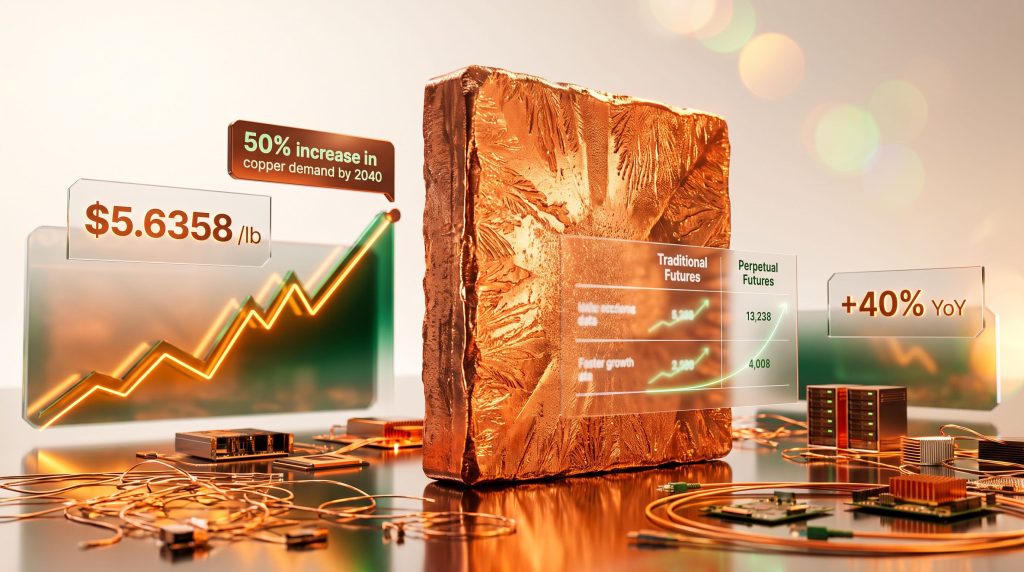
Collectively, S&P Global analysis indicates that AI-related demand could drive a 50% increase in global copper consumption by 2040. This is not a cyclical uptick. It is a structural reclassification of what copper is and who needs it.
The price data confirms the shift is already underway. Copper spot prices reached $5.6358 per pound in late July 2026, reflecting a 2.72% single-session gain against a backdrop of tightening supply fundamentals. Teck Resources reported realised copper prices averaging $6.05 per pound in Q2 2026, up from $4.32 per pound in the same quarter of 2025, a year-over-year increase of approximately 40%.
Furthermore, the copper price drivers underpinning these moves are not noise. They reflect a market beginning to reprice copper against a demand thesis that extends decades into the future, not quarters.
Supply-Side Constraints: The Other Half of the Equation
The demand acceleration story is only half the structural argument. The supply response to current copper pricing is constrained by geological and political realities that cannot be resolved quickly.
Project development timelines in copper mining typically span 10 to 15 years from discovery through to first production. This means any new supply response to today's price signals will not reach the market until the mid-2030s at the earliest.
The Cobre Panama situation illustrates the fragility of existing supply. One of the world's largest copper operations has remained offline since its 2023 shutdown. The Cobre Panama impacts continue to reverberate, as Panama weighs the creation of a state-owned mining entity as a potential pathway to restart operations, though no timeline has been confirmed and regulatory complexities remain substantial.
Exchange-registered stockpiles have been contracting, increasing the spot market's sensitivity to demand signals and reducing the buffer that traditionally absorbs short-term supply-demand mismatches. In addition, the ongoing copper supply crunch continues to tighten conditions across global markets.
The combination of structurally accelerating demand and constrained near-term supply creates precisely the kind of sustained price volatility environment in which a new derivatives instrument could find genuine utility.
Perpetual Futures: How the Mechanism Actually Works
Before evaluating Kalshi's specific proposal, it is worth understanding what makes perpetual futures structurally different from the instruments currently available to copper traders.
Traditional futures contracts carry fixed expiration dates. A trader holding a copper position must actively roll that contract forward at each maturity to maintain continuous exposure. This process involves transaction costs, spread risk, and operational complexity that disadvantages retail participants and creates friction even for institutional traders.
Perpetual futures eliminate expiration entirely. Positions can be held indefinitely, provided margin requirements are maintained. The mechanism that replaces natural convergence at expiry is the funding rate: a periodic payment exchanged between long and short position holders that keeps the perpetual contract price anchored to the underlying spot market.
The self-correcting logic works as follows:
- When the perpetual contract price rises above spot, long holders pay short holders, creating a financial incentive to sell and compress the premium.
- When the perpetual price falls below spot, short holders pay long holders, incentivising buying pressure to close the discount.
- This continuous feedback loop replaces expiry-driven convergence with a market-driven anchoring mechanism.
| Feature | Traditional Copper Futures | Perpetual Copper Futures (Proposed) |
|---|---|---|
| Expiration | Fixed monthly/quarterly | None |
| Rollover Required | Yes | No |
| Price Anchoring | Convergence at expiry | Funding rate mechanism |
| Leverage | Regulated, available | Margin-based, typically higher |
| Trading Hours | Exchange hours | Continuous |
| Primary Users | Institutional, commercial | Retail, speculative |
From Crypto to Commodities: The Institutional Lineage of Perps
Perpetual futures were not invented for commodities. They were pioneered within cryptocurrency markets, where 24/7 trading cycles and the absence of physical delivery logistics made no-expiry contracts a natural structural fit. Platforms including BitMEX popularised the format from 2016 onward, and it became the dominant derivatives structure across major crypto exchanges.
Kalshi brought the structure into U.S.-regulated territory in May 2026, launching the first domestically compliant crypto perpetual futures. That launch established the operational and compliance infrastructure that now forms the foundation for its proposed commodity expansion. You can learn more about perpetuals directly from Kalshi's own documentation.
The real-world validation of commodity perps came from an unexpected source. During the Iran conflict of 2026, perpetual futures emerged as one of the few instruments enabling retail traders to access oil price exposure around the clock when traditional exchanges were closed. The geopolitical stress test demonstrated that the structure serves legitimate price discovery and hedging functions beyond speculative crypto activity.
That episode matters for copper. It established that perpetual commodity contracts can function under real market stress conditions, not just in the relatively orderly environment of crypto trading.
Where Kalshi's Copper Plans Currently Stand
It is important to be precise about the regulatory status of Kalshi perpetual copper futures, because the product does not yet exist in any filing or live market.
Kalshi's current regulatory position:
- In late July 2026, Kalshi petitioned the CFTC seeking approval to expand perpetual contracts into precious metals, specifically gold, silver, and platinum.
- Copper and palladium have been publicly identified by the company's Chief Risk Officer as the next intended additions following regulatory clearance for the precious metals suite.
- As of the reporting date, no regulatory filing has been submitted for copper. The product remains in the strategic consideration phase.
- Kalshi's live perpetuals infrastructure currently lists only crypto-based contracts. The non-crypto perpetuals page displays no active commodity offerings.
Kalshi's Chief Risk Officer Udesh Jha stated publicly that the company is strongly considering copper and palladium as follow-on offerings, noting that copper carries a compelling structural narrative tied to AI infrastructure growth alongside its established industrial applications. This statement was made in an interview context and does not constitute a regulatory filing or product launch commitment.
Distinguishing Kalshi's Existing Copper Products From the Proposed Perp
Kalshi already operates active copper prediction markets. These are binary-style instruments where participants take positions on whether copper will reach specific price levels by a defined date. They are structurally distinct from perpetual futures in every meaningful dimension: no leverage in the traditional sense, fixed settlement events, and binary payoff structures.
The proposed copper perp would introduce continuous leveraged exposure with no fixed settlement, representing a fundamentally different risk profile and market function. Consequently, copper investment strategies would need to evolve considerably to account for this new instrument if and when it receives approval.
The next major ASX story will hit our subscribers first
The Competitive Landscape Kalshi Would Be Entering
Copper is not an underserved market from an institutional perspective. The derivatives ecosystem is well-developed:
- The London Metal Exchange serves as the global pricing benchmark for copper, with deep institutional liquidity and physical delivery infrastructure spanning decades of market history.
- Comex (CME Group) provides the primary U.S. price reference and hedging venue for commercial copper participants, offering futures and options across multiple tenors.
- Exchange-traded funds provide retail investors with passive copper exposure without leverage or margin complexity.
What none of these instruments provide is the combination of continuous 24/7 accessibility, no-expiry positioning, and leveraged retail participation in a single structure. This is the gap that Kalshi's proposed perpetual contract would target.
The practical significance of round-the-clock access has been demonstrated repeatedly in 2026. When geopolitical events move commodity prices outside standard exchange hours, retail participants currently have no liquid mechanism to respond in real time. Perpetual futures address this structural deficit directly. However, the broader copper trade impacts of shifting regulatory frameworks and new derivative structures remain an important consideration for market participants.
Risk Architecture: What Traders Must Understand
The accessibility advantages of perpetual futures come with a risk profile that requires clear-eyed assessment. The instrument's structural features amplify both opportunity and danger:
- Leverage amplification: A 10% adverse copper price movement can eliminate a 10x leveraged position entirely. Margin calls in volatile commodity markets can escalate rapidly.
- Funding rate drag: In strongly trending markets, the cost of maintaining a position through funding rate payments can erode profitability even when directional exposure proves correct.
- Liquidation cascades: Forced position liquidations in leveraged perpetual markets can amplify price dislocations, a dynamic observed repeatedly in crypto perp markets and potentially more consequential in physical commodity pricing ecosystems.
- Regulatory uncertainty: CFTC approval for non-crypto perpetual futures is not guaranteed. The regulatory framework remains under active development.
| Instrument | Leverage | Expiry Risk | Regulatory Status |
|---|---|---|---|
| LME Copper Futures | Moderate | Rollover required | Established |
| Comex Copper Futures | Moderate | Rollover required | Established |
| Copper ETFs | None | None | Established |
| Copper Prediction Markets | Limited | Event-based | Active (Kalshi) |
| Kalshi Copper Perps | High | None | Pending CFTC |
This article discusses proposed financial instruments that have not received regulatory approval. Nothing contained here constitutes investment advice. Perpetual futures involve substantial risk of loss, including the potential loss of the entire invested amount.
Broader Implications: What Regulatory Approval Would Signal
If the CFTC approves Kalshi's precious metals perpetuals petition, it would establish legal and structural precedent for commodity perps across asset classes. Reporting from the Wall Street Journal indicates Kalshi's longer-term expansion ambitions extend to foreign exchange, energy markets, broad equity indexes, and individual stocks, suggesting the copper application is one node in a much larger derivatives architecture.
A successful precious metals outcome followed by a copper filing could plausibly extend the timeline to a live copper perpetual product by 12 to 24 months beyond the initial regulatory submission, depending on review complexity and any required rule amendments. Competing platforms and traditional exchanges would likely accelerate their own perpetual contract development in response, potentially compressing that window through competitive pressure.
The structural mismatch between accelerating AI-driven copper demand and constrained near-to-medium-term mine supply is not a short-term market condition. It is a multi-decade dynamic. The derivatives market will need to evolve to reflect that reality, and Kalshi perpetual copper futures represent one proposed mechanism for doing so.
Whether that specific product reaches market, and in what form, depends on regulatory decisions that remain pending. What is clear is that the demand thesis driving its consideration is grounded in measurable, structural forces rather than speculative momentum.
For ongoing coverage of copper market fundamentals, price movements, and mining sector developments, MINING.COM provides continuous reporting on the full spectrum of copper market dynamics.
Want to Track the Next Major Copper Discovery Before the Broader Market Does?
Discovery Alert's proprietary Discovery IQ model delivers real-time alerts on significant ASX mineral discoveries — instantly translating complex data across 30+ commodities into actionable insights for investors at every level. Explore Discovery Alert's discoveries page to see the historic returns major mineral discoveries have generated, and begin your 14-day free trial today to position yourself ahead of the next structural shift in commodity markets.