July 27, 2026
Kamoa-Kakula copper smelter anode production represents a transformative advancement in copper processing technology, fundamentally reshaping the economics of modern mining operations through integrated smelting capabilities. Modern pyrometallurgical processes now enable direct conversion of copper concentrates to high-purity anodes through sophisticated thermal management systems, creating unprecedented opportunities for operational efficiency and margin enhancement. These technological breakthroughs represent a paradigm shift from traditional concentrate export models toward fully integrated value chains that capture previously unrealised economic potential.
Revolutionary Advances in Direct-to-Blister Processing Technology
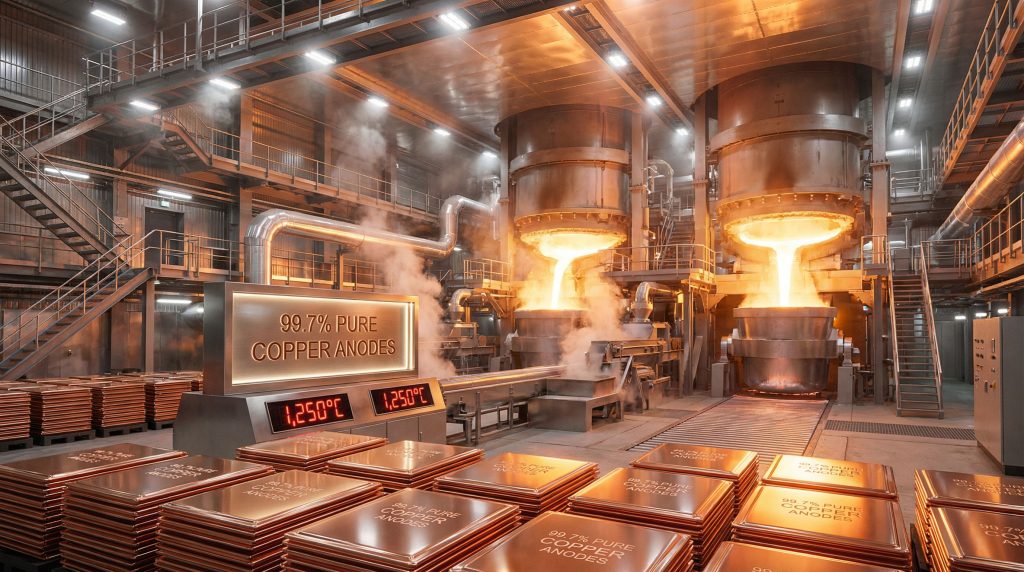
Modern flash smelting furnace technology has achieved remarkable precision in thermal control, with facilities now capable of maintaining operating temperatures of 1,250°C for extended periods whilst processing substantial concentrate volumes. The Kamoa-Kakula copper smelter anode production facility demonstrates this capability through its successful five-day temperature maintenance prior to concentrate introduction, showcasing the thermal engineering excellence required for consistent pyrometallurgical operations.
The 500,000-tonne annual capacity represents a significant scaling achievement in single-line smelter design, enabling concentrated processing power within a unified operational framework. This capacity translates to conversion from 25-30% copper concentrate inputs to 99.7%-pure copper anodes, demonstrating the remarkable efficiency gains possible through advanced metallurgical processes.
Heat recovery systems integrated within modern smelting operations maximise energy efficiency by capturing thermal energy from the pyrometallurgical process and redirecting it for secondary applications. This integration reduces overall energy consumption whilst maintaining the high-temperature requirements essential for optimal copper conversion rates.
Engineering Specifications Defining Industry Standards
Single-line configurations offer distinct advantages over multi-line systems through simplified operational control and reduced complexity in material handling systems. The furnace refractory materials must withstand extreme operational conditions whilst maintaining structural integrity throughout extended production cycles.
Automated feeding mechanisms ensure consistent concentrate delivery rates, eliminating variability that could disrupt the delicate thermal balance required for optimal metallurgical performance. Quality control systems continuously monitor anode purity specifications, ensuring final products meet international market standards for copper content and physical properties.
When big ASX news breaks, our subscribers know first
Enhanced Value Addition Through Vertical Integration
The transformation from concentrate exports to on-site anode production fundamentally restructures the economics of copper operations. Traditional concentrate exports typically contain 25-30% copper content, requiring significant transport capacity per unit of contained copper. In contrast, finished anodes achieve 99.7% copper purity, dramatically improving transport efficiency and reducing logistics costs per copper unit.
| Processing Stage | Concentrate Export | On-Site Smelting |
|---|---|---|
| Copper Content | 25-30% | 99.7% |
| Transport Efficiency | 45% payload utilisation | 99%+ payload utilisation |
| Value Addition | Minimal | Maximum |
| Logistics Costs | High per copper unit | 50% reduction potential |
| Market Flexibility | Limited | Enhanced |
Revenue optimisation through vertical integration eliminates third-party smelting fees whilst capturing previously external value streams. This approach enhances pricing negotiation power with end-users and reduces dependency on external processing capacity, creating greater operational autonomy and financial predictability. Furthermore, the record copper price highs witnessed in recent markets make this integration particularly advantageous.
The logistics cost reduction of approximately 50% results directly from the dramatic increase in copper content per transported unit. When copper content per truck load more than doubles from approximately 45% contained copper in concentrate to 99.7%-pure copper anodes, the efficiency multiplication creates substantial cost savings across the entire supply chain.
Technical Commissioning Protocols for Operational Excellence
The commissioning process for modern copper smelting facilities requires precise execution of heat-up protocols spanning approximately five weeks from initiation to first concentrate feed. This timeline allows for sequential temperature ramping that prevents thermal shock to refractory materials whilst enabling comprehensive system integration testing.
During the Kamoa-Kakula facility commissioning, the furnace successfully maintained 1,250°C operating temperature for five consecutive days prior to concentrate introduction, demonstrating the thermal stability essential for consistent pyrometallurgical operations. This temperature maintenance period validates refractory integrity and confirms automated control system functionality under operational conditions.
System Integration Complexities
Heat-up protocols involve coordinated commissioning of multiple interconnected systems:
- Furnace temperature ramping following prescribed thermal curves
- Boiler system integration for steam generation
- Acid circuit preparation for sulfuric acid production
- Concentrate dryer systems ensuring optimal feed moisture content
Feed integration requires precise control of concentrate characteristics, including moisture content optimisation, particle size distribution management, and chemical composition balancing for optimal metallurgical performance. The December 21, 2025 first concentrate feed at Kamoa-Kakula proceeded without operational disruptions, indicating successful specification achievement across all feed parameters.
Multi-Tier Power Infrastructure for Operational Continuity
Modern copper smelting operations require sophisticated power infrastructure to ensure uninterrupted operations despite grid instabilities common in many mining regions. The multi-tier approach provides redundant power security through complementary systems designed for different operational scenarios. However, these copper investment strategies must account for infrastructure challenges in emerging markets.
Comprehensive Power Security Framework
Tier 1: Grid Connection Infrastructure
- Primary power from national electricity infrastructure
- Voltage regulation systems managing supply fluctuations
- Load balancing across smelter operations
Tier 2: Uninterruptible Power Supply Systems
The 60-MW instantaneous backup capacity provides critical protection for flash smelting operations where sudden power interruptions could create operational hazards. The two-hour continuous operation capability ensures sufficient time for either grid restoration or orderly transition to alternative power sources.
Tier 3: Diesel Generation Capacity
Extended operational autonomy comes through 180-MW backup generation capacity, providing fuel-dependent operations during prolonged grid failures. Fuel storage systems support extended operations, though specific duration capabilities depend on consumption rates and storage volume.
Tier 4: Renewable Energy Integration
The 60-MW solar photovoltaic installation represents what management characterises as potentially "the largest of its kind in sub-Saharan Africa," providing sustainable power generation with battery energy storage systems enabling 24-hour renewable power availability. Expected operational capability from Q2 2026 will create additional operational autonomy whilst reducing long-term energy costs.
By-Product Revenue Streams Enhancing Project Economics
The pyrometallurgical process generates sulfur dioxide during copper smelting, which converts to sulfuric acid through established chemical processes. This by-product represents a significant additional revenue stream that enhances overall project economics beyond primary copper production.
Market Dynamics and Pricing
Annual sulfuric acid production capacity reaches 700,000 tonnes at steady-state operations, representing substantial volume relative to regional market demand. Recent spot acid prices have reached $700 per tonne in Kolwezi markets, reflecting strong regional demand dynamics.
The September 2025 Zambian export ban on sulfuric acid created a regional supply gap, positioning facilities like Kamoa-Kakula as strategic alternative suppliers. Local mining operations across the Central African Copperbelt require sulfuric acid for heap leaching and other metallurgical processes, creating established customer demand within practical transport distances. In addition, this situation aligns with global copper supply forecasts indicating increased regional processing needs.
"The first acid sale was completed concurrent with initial anode production, demonstrating immediate market acceptance and revenue generation capability from day one of smelter operations."
Strategic Market Positioning
Transportation cost advantages favour local production over distant suppliers, particularly given the logistics challenges common in Central African infrastructure. Long-term supply agreements can enhance revenue predictability whilst providing mining customers with reliable acid sourcing independent of export restrictions.
Advanced Dewatering Technology Impact on Mining Operations
Underground mining operations require sophisticated dewatering systems to access ore bodies below the water table. The staged implementation approach enables progressive access to higher-grade mining areas whilst maintaining operational flexibility.
Staged Implementation Strategy
Stage Two Completion Metrics:
- High-capacity submersible pump deployment achieving 19-metre water level reduction
- Pump repositioning enabling additional dewatering capacity
- Secondary pump systems positioned 20 metres lower in elevation for extended dewatering capability
Stage Three Rehabilitation Requirements:
Horizontal pump station recommissioning involves comprehensive infrastructure replacement, including new motor installations, substation upgrades, and electrical infrastructure replacement. The 5,600 litres per second total pumping capacity (excluding Stage Two infrastructure) represents substantial dewatering capability for steady-state mining operations.
Grade Enhancement Through Strategic Dewatering
Western side dewatering enables access to higher-grade areas, with head grade improvement from 3.5% to 4.0% copper expected by end of Q1 2026. Eastern side selective mining began ahead of schedule in December, demonstrating the operational acceleration possible through effective water management.
The next major ASX story will hit our subscribers first
Inventory Management Strategies for Cash Flow Optimisation
Strategic inventory management enables working capital optimisation through controlled destocking combined with favourable market timing. The approach maximises cash generation whilst maintaining operational flexibility. Consequently, this strategy becomes particularly relevant when considering copper and uranium investment opportunities in volatile markets.
| Period | Inventory Level | Strategic Action |
|---|---|---|
| Pre-Production | 37,000 tonnes copper content | Maximum stockpile |
| 2026 Target | 17,000 tonnes copper content | 20,000 tonne reduction |
| Sales Impact | +20,000 tonnes vs. production | Destocking premium |
| Market Timing | Q1-Q2 focus | High copper price capture |
The 20,000-tonne destocking during 2026 enables copper sales to exceed copper production by this amount, predominantly during the first half of the year when management aims to capitalise on near-record copper prices. This strategy demonstrates how inventory management can enhance revenue realisation through favourable market timing.
Working Capital Liberation Benefits
Reduced concentrate storage requirements decrease inventory carrying costs whilst enabling faster conversion to saleable products. Enhanced cash flow predictability results from shorter conversion cycles and reduced dependency on external processing schedules.
Logistics Transformation and Operational Margin Impact
The fundamental restructuring of logistics operations creates substantial margin enhancement opportunities through improved transport efficiency and reduced handling requirements. The transformation from concentrate exports to finished anode sales eliminates multiple cost centres whilst dramatically improving payload utilisation.
Transport Efficiency Multiplication
Copper content per transported unit increases from approximately 45% in concentrate form to 99.7% in finished anodes, creating a multiplication effect that reduces transport frequency and associated costs. Port handling cost reductions result from simplified cargo characteristics and reduced volume requirements per copper unit.
Shipping container utilisation improvements enable near-maximum payload capacity with finished products, contrasting with the weight and volume constraints inherent in concentrate transportation. Enhanced security requirements for higher-value finished products represent manageable additional costs relative to the substantial efficiency gains achieved. Furthermore, this transformation aligns with mineral exploration importance in maximising value extraction.
Cost Structure Reengineering
The elimination of concentrate handling fees removes external processing costs whilst simplifying export documentation processes. Reduced insurance costs reflect the improved value density of finished products, though absolute insurance values may increase due to higher shipment values.
Quality Control Systems Ensuring Product Specifications
Consistent anode quality requires comprehensive monitoring systems throughout the production process. Real-time furnace atmosphere analysis enables immediate adjustments to maintain optimal metallurgical conditions, whilst slag composition optimisation ensures efficient impurity removal.
Chemical and Physical Property Verification
Final product assay confirmation protocols verify copper purity meets 99.7% specifications required for international markets. Anode weight and dimension standardisation ensure compatibility with customer electrolytic refining equipment, whilst surface quality inspection procedures maintain visual and functional standards.
Electrical conductivity testing protocols confirm performance characteristics essential for electrorefining applications. Packaging and handling specifications protect product integrity during transport and storage, maintaining quality from production through delivery.
Industry Benchmark Setting Through Scale and Efficiency
The combination of scale, technology integration, and operational efficiency creates new industry benchmarks for copper smelting operations. Single-line capacity leadership in the African context demonstrates the viability of large-scale integrated processing in emerging market environments. For instance, Mining Weekly reports on the significance of this operational achievement in establishing regional processing capabilities.
Performance Metrics and Replication Potential
Energy efficiency per tonne of copper produced represents a critical performance indicator for sustainable operations. Environmental emissions per unit output reflect the technological sophistication of modern smelting processes, whilst safety performance during construction and operations validates the comprehensive risk management approaches employed.
Technology transfer opportunities enable replication of successful approaches in other operational contexts. Capital cost optimisation learnings from the development process provide valuable insights for future project development, whilst operational best practices development contributes to industry-wide performance improvements.
The facility's role as a regional industrial development catalyst demonstrates how large-scale mining infrastructure investments can create broader economic benefits beyond direct operational returns. This multiplier effect enhances the strategic value of integrated processing facilities in developing economic regions. In conclusion, the successful commissioning of Kamoa-Kakula copper smelter anode production establishes a new paradigm for copper processing efficiency and economic optimisation.
Disclaimer: This analysis is based on publicly available information and industry practices. Copper prices, production estimates, and operational timelines involve inherent uncertainties and may vary significantly from projections. Investment decisions should be based on comprehensive due diligence and professional financial advice.
Ready to Capitalise on Copper Processing Breakthroughs?
Discovery Alert's proprietary Discovery IQ model delivers real-time alerts on significant copper and mining discoveries, instantly empowering subscribers to identify actionable opportunities ahead of the broader market. Understand why historic discoveries can generate substantial returns by exploring Discovery Alert's dedicated discoveries page, showcasing exceptional outcomes from major mineral finds, and begin your 30-day free trial today to position yourself ahead of the market.