June 13, 2026
The global critical minerals landscape faces unprecedented supply chain pressures as demand for strategic commodities surges across multiple sectors. Traditional supply sources experience declining production profiles while consuming nations prioritise supply chain diversification away from geopolitically concentrated sources. Within this environment of structural undersupply and strategic realignment, large-scale projects capable of delivering multiple critical commodities simultaneously represent potential market transformation opportunities aligned with the emerging critical minerals strategy.
Modern mining developments must navigate complex technical, financial, and geopolitical considerations to achieve commercial viability. Projects offering dual-commodity profiles, superior geological characteristics, and strategic positioning within global supply chains can fundamentally alter competitive dynamics. The convergence of energy transition security demands, aerospace industry requirements, and supply chain nationalism creates unique value proposition opportunities for developments positioned to capture value across multiple end-use sectors.
What Makes Kasiya a Game-Changing Critical Minerals Development?
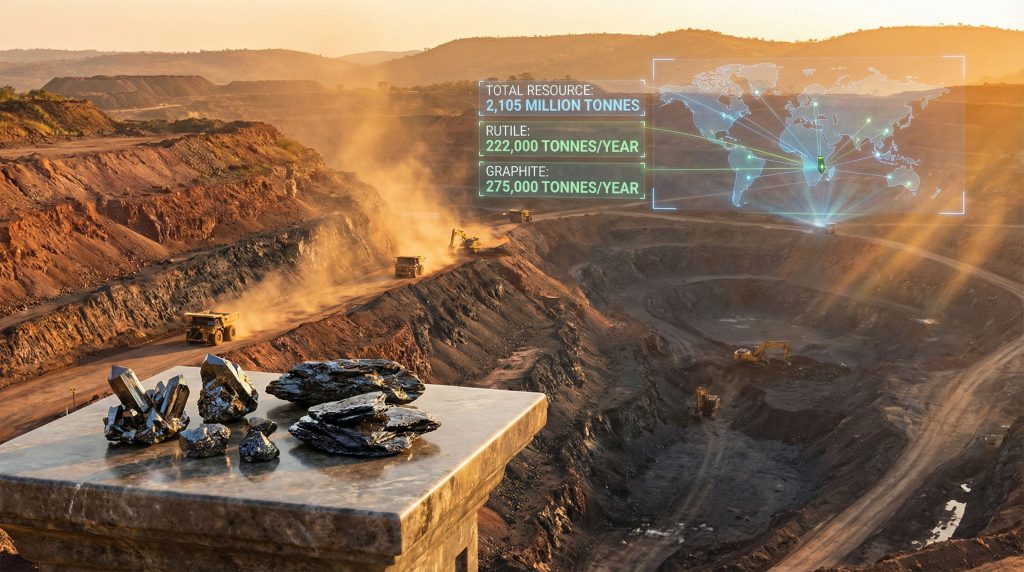
The Kasiya mining project in Malawi represents a convergence of geological advantages and market positioning that distinguishes it within the global critical minerals sector. The project's 2,105 million tonne mineral resource contains both rutile at 0.96% grade and graphitic carbon at 0.95% grade, creating a rare dual-commodity asset capable of addressing supply constraints in two distinct but equally strategic markets.
The geological configuration provides unprecedented operational advantages through its weathered saprolite structure. This friable material eliminates traditional hard-rock mining requirements, enabling direct excavation without drilling or blasting operations. The near-surface deposit characteristics reduce capital intensity while simplifying operational complexity compared to conventional mining methodologies.
Key Resource Metrics:
- Total mineral resource: 2,105 million tonnes
- Rutile content: 20.24 million tonnes contained
- Graphite content: 19.95 million tonnes contained
- Mining method: Direct excavation of weathered material
- Mine life: Minimum 25 years
Furthermore, the project's Managing Director emphasised the strategic partnerships assembled around the development, including Rio Tinto's technical expertise and alignment with International Finance Corporation Performance Standards. These collaborations reflect institutional validation of the project's technical viability and adherence to international environmental and social governance frameworks.
Saprolite deposits represent a distinct geological advantage within the mining sector. The weathered bedrock material has undergone natural chemical breakdown, creating excavatable characteristics without requiring conventional extraction methodologies. This configuration typically results in lower operational costs and reduced technical complexity compared to hard-rock mining operations, positioning projects to avoid the current supply chain crisis affecting traditional mining operations.
When big ASX news breaks, our subscribers know first
How Could Kasiya Transform the Global Rutile Market?
Global rutile markets face structural supply-demand imbalances as existing production sources experience declining output profiles. The United States maintains 100% reliance on imports for titanium sponge requirements, highlighting supply chain vulnerabilities in aerospace, defence, and medical device manufacturing sectors.
Kasiya's projected annual rutile production of 222,000 tonnes positions it to capture significant market share within a structurally undersupplied commodity market. The project's rutile demonstrates premium chemical characteristics including high titanium dioxide content, low impurity levels, and favourable particle size distribution, meeting stringent specifications for aerospace and high-specification applications.
Production and Financial Projections:
- Annual rutile output: 222,000 tonnes
- Total project revenue (25-year life): US$16.5 billion
- Annual EBITDA: US$476 million
- Capital requirement: US$727 million
In addition, the rutile market serves critical applications across multiple high-value sectors. Aerospace manufacturers require premium titanium feedstock for aircraft structures, engine components, and fastener systems where material purity directly impacts performance specifications. Defence applications demand consistent, high-quality titanium alloy inputs for military equipment requiring exceptional durability and performance characteristics.
Medical device manufacturing represents another premium market segment where rutile quality specifications are stringent. Titanium implants and surgical instruments require biocompatibility and corrosion resistance achievable only through high-purity feedstock materials. Kasiya's demonstrated chemical characteristics position it favourably within these premium market applications.
The characterisation of primary global rutile supply as being in structural decline creates market entry opportunities for new producers with superior cost positions. Existing rutile mines face resource depletion, geological challenges, or operational constraints that limit production growth potential, creating market gaps for alternative supply sources.
What Strategic Advantages Does the Dual-Commodity Model Provide?
The simultaneous production of rutile and graphite creates natural revenue diversification and risk mitigation advantages. Rutile markets operate on aerospace industry cycles and defence spending patterns, while graphite demand increasingly reflects electric vehicle adoption rates and energy storage deployment. These distinct market drivers provide hedging against single-commodity volatility.
Projected Annual Production:
- Rutile: 222,000 tonnes per year
- Graphite: 275,000 tonnes per year
- Combined market exposure across multiple end-use sectors
Non-binding offtake agreements already cover more than 50% of Stage 1 rutile production and more than 35% of Stage 1 graphite output, indicating market validation from major commodity traders and end-users. This level of pre-production market commitment suggests confidence in both product quality and long-term demand fundamentals.
The potential for rare earth elements extraction from the rutile production stream creates additional value-capture opportunities. Dysprosium, terbium, and yttrium recovery could provide a third income stream at minimal incremental cost, with these elements currently subject to Chinese export controls, enhancing their strategic value.
Graphite Applications:
- Electric vehicle battery anodes
- Energy storage systems
- Steel production additives
- Industrial lubricants and specialty applications
Rutile Applications:
- Aerospace-grade titanium production
- Defence industry feedstock
- Medical device manufacturing
- High-specification titanium alloy applications
Consequently, the processing methodology utilises conventional physical separation techniques for both commodities, creating operational synergies and shared infrastructure benefits. This approach reduces capital requirements compared to projects requiring specialised extraction technologies for individual commodity streams whilst supporting broader green transition trends.
Revenue diversification across multiple end-use sectors reduces exposure to cyclical downturns in individual markets. The aerospace industry experiences cyclical demand patterns, while electric vehicle markets show exponential growth trajectories. Graphite demand growth from energy storage applications provides additional market expansion opportunities.
How Significant Are the Geopolitical Supply Chain Implications?
The Kasiya mining project in Malawi emerges within a broader context of supply chain nationalism and strategic mineral security initiatives. The United States' complete reliance on titanium sponge imports creates national security implications for aerospace and defence manufacturing capabilities, while Chinese export controls on critical minerals heighten supply diversification urgency.
Strategic mineral security considerations have influenced offtake partner interest, with demand driven by U.S. and Japanese supply chain security priorities. This governmental backing provides validation of the project's perceived strategic importance beyond traditional commodity market dynamics.
Critical Supply Chain Factors:
- U.S. titanium sponge import dependency: 100%
- Chinese export controls on rare earth elements
- Supply chain diversification initiatives across consuming nations
- Strategic mineral stockpiling programmes
The project's location outside traditional mineral-producing regions creates new supply chain optionality for consuming nations seeking to reduce dependence on geopolitically concentrated sources. Malawi's position as an emerging mining jurisdiction provides alternative sourcing opportunities for strategic commodities.
However, rare earth elements potential within the project adds geopolitical significance. Dysprosium, terbium, and yttrium are subject to Chinese export controls, making alternative supply sources strategically valuable for consuming nations developing domestic clean energy and defence technologies.
The characterisation of Kasiya as a "globally strategic asset" reflects recognition of its potential role in supply chain reconfiguration efforts. Projects capable of delivering critical minerals outside traditional geopolitical frameworks gain enhanced strategic value as consuming nations prioritise supply diversification.
International partnership frameworks, including alignment with International Finance Corporation Performance Standards, position the project favourably for institutional investment and government strategic mineral procurement programmes. These frameworks demonstrate adherence to internationally recognised environmental and social governance standards.
What Are the Key Development Milestones and Timeline Projections?
The completion of the Definitive Feasibility Study represents a crucial advancement toward project bankability and commercial development. The study's quality and depth, characterised as rarely achieved by pre-production companies, reflects extensive technical validation and partnership collaboration.
Current Development Status:
- Definitive Feasibility Study: Completed April 2026
- Mining licence applications: In progress
- Environmental and social impact assessments: Underway
- Infrastructure development planning: Active
For instance, the phased development approach enables staged capital deployment and risk management. Phase 1 operations target initial throughput of 12 million tonnes per annum, allowing market establishment and customer relationship development before full-scale production expansion.
Development Timeline Framework:
- Phase 1: South Kasiya processing plant commissioning
- Phase 2: North Kasiya expansion to 24 million tonnes per annum
- Full production: Achievement of complete capacity utilisation
Capital requirements of US$727 million position the project within manageable financing parameters for a development of this scale. The staged approach allows for incremental funding arrangements and milestone-based capital deployment, reducing overall project risk.
Technical partnerships, including Rio Tinto's involvement, provide operational expertise and validation from established mining industry participants. This collaboration enhances technical confidence while demonstrating institutional support for the project's development approach, reflecting broader mining innovation trends across the sector.
Large-scale field trials completion, combined with experienced owner's team expertise, reinforces operational readiness for commercial development. These trials validate processing methodologies and operational parameters essential for successful project execution.
Community engagement and stakeholder consultation processes align with International Finance Corporation Performance Standards, demonstrating commitment to sustainable development practices. These frameworks are increasingly important for project financing and regulatory approval in emerging market jurisdictions.
How Could Market Timing Impact Project Economics?
Global rutile markets face structural tightening as existing mines experience production declines while demand from aerospace, defence, and medical sectors maintains growth trajectories. The timing of Kasiya's potential production aligns with projected supply gaps emerging in the mid-to-late 2020s.
Electric vehicle adoption rates drive exponential graphite demand growth scenarios. Battery anode applications require high-purity graphite materials, with demand projections exceeding current global production capacity as EV deployment accelerates across major automotive markets.
Market Timing Considerations:
- Rutile supply gap emergence in mid-2020s
- EV-driven graphite demand acceleration
- Energy storage deployment creating additional demand
- Aerospace industry recovery post-pandemic cycles
Furthermore, the project's positioning as potentially the lowest-cost graphite producer globally, even compared to Chinese producers, creates competitive advantages in price-sensitive markets. Cost leadership positions enable market share capture during demand growth phases while maintaining profitability during market downturns.
Currency considerations favour USD-denominated revenue streams against local operating costs, providing natural hedging for projects in emerging market jurisdictions. This structure protects against local currency devaluation while capturing value from global commodity pricing.
Base Case Market Assumptions:
- Rutile pricing at premium to synthetic alternatives
- Sustained graphite demand growth from EV sector expansion
- Energy storage market development creating additional demand streams
- Continued aerospace and defence sector titanium requirements
Supply chain security premiums increasingly influence commodity pricing as consuming nations prioritise reliable, geopolitically stable supply sources. Projects offering supply diversification benefits may command pricing premiums beyond traditional commodity fundamentals.
The characterisation of rutile supply as being in structural decline suggests favourable pricing dynamics for new producers entering the market. Declining production from existing sources creates pricing support while new demand from emerging applications drives market growth.
The next major ASX story will hit our subscribers first
What Operational Innovations Could Kasiya Introduce?
The conventional physical separation processing approach, while proven, enables technological enhancement opportunities and efficiency optimisation investments. The project's scale provides economic justification for advanced processing technologies that smaller operations cannot support.
Direct excavation of friable saprolite material eliminates traditional mining complexities associated with drill-blast cycles. This methodology reduces operational costs, simplifies mine planning, and enables more predictable production scheduling compared to hard-rock mining operations.
Processing Innovation Opportunities:
- Advanced physical separation technologies
- Automated material handling systems
- Real-time grade control optimisation
- Integrated commodity recovery systems
The dual-commodity processing configuration creates opportunities for operational synergies and shared infrastructure utilisation. Combined processing facilities reduce capital requirements while enabling operational efficiency gains through integrated material flow management.
Large-scale field trials validation provides operational confidence in processing methodologies and recovery rates. These trials demonstrate scalability from pilot operations to commercial production levels, reducing technical risk during project execution.
Staged Development Benefits:
- Risk mitigation through incremental capacity expansion
- Market feedback integration into operational planning
- Capital efficiency through phased infrastructure development
- Operational optimisation during initial production phases
In addition, the project's scale enables investment in advanced technologies that enhance recovery rates and reduce operating costs. Economies of scale in equipment procurement and operational efficiency create competitive advantages within both rutile and graphite markets.
Environmental and social governance frameworks, aligned with International Finance Corporation Performance Standards, demonstrate commitment to sustainable mining practices. These standards increasingly influence project financing availability and operational licensing requirements.
How Might Kasiya Influence Regional Development Patterns?
The Kasiya mining project in Malawi could catalyse broader economic development through infrastructure investment, skills development, and local procurement opportunities. Mining developments of this scale typically generate significant multiplier effects across multiple economic sectors.
Transportation and logistics infrastructure development necessitated by the project's inland location could benefit broader regional economic activity. Road, rail, and port infrastructure improvements enable other economic development opportunities beyond mining operations.
Regional Development Impacts:
- Infrastructure development catalysing additional economic activity
- Skills training and workforce development programmes
- Local procurement creating business opportunities
- Government revenue generation supporting public services
The project's success could establish Malawi as a significant player in the global critical minerals sector, potentially attracting additional exploration and development investment. This positioning could transform the country's economic profile from agriculture-dependent to diversified mineral production.
Workforce development requirements create opportunities for technical education and skills transfer programmes. Mining operations require specialised technical capabilities that generate human capital development with applications across multiple industries.
Government revenue streams from mining royalties, taxation, and export duties provide fiscal resources for public infrastructure and social programme development. These revenue streams can support broader economic development initiatives beyond direct mining activities.
Community Development Considerations:
- Local employment creation across multiple skill levels
- Business development opportunities in support services
- Infrastructure improvements benefiting broader communities
- Revenue sharing mechanisms supporting regional development
Consequently, supply chain development for mining operations creates opportunities for local and regional businesses to participate in procurement and service provision. These linkages generate economic activity extending beyond direct mining employment.
The establishment of international mining standards through International Finance Corporation Performance Standards alignment demonstrates commitment to sustainable development practices. These frameworks increasingly influence investment decisions and community acceptance for major projects.
What Risk Factors Could Impact Project Development?
Political and regulatory risks represent inherent challenges for mining developments in emerging market jurisdictions. Potential changes in mining codes, taxation regimes, or government policies affecting foreign investment could impact project economics and development timelines.
Market risks encompass both demand-side and supply-side factors that could influence commodity pricing and project viability. Electric vehicle adoption rate variations, aerospace industry cyclicality, and economic recession impacts could affect demand fundamentals for both rutile and graphite.
Demand-Side Risk Factors:
- EV adoption rate variations affecting graphite demand
- Aerospace industry cyclical downturns impacting rutile demand
- Economic recession reducing industrial commodity consumption
- Substitute material development affecting market demand
Supply-Side Risk Considerations:
- Competing project developments increasing market supply
- Technological disruption in processing methodologies
- Environmental regulatory changes affecting operations
- Community relations challenges impacting social licence
Operational risks include resource grade variability, processing recovery rate performance, and infrastructure development delays. While geological characteristics appear favourable, mining operations face inherent uncertainties regarding material consistency and processing efficiency.
Technical Risk Factors:
- Resource grade variability across deposit areas
- Processing recovery rates differing from laboratory results
- Infrastructure development delays affecting production schedules
- Skilled labour availability in emerging market locations
Currency and financial risks include local currency volatility, interest rate fluctuations, and commodity price volatility. While USD-denominated revenues provide some hedging, operational costs in local currencies create exposure to exchange rate movements.
However, environmental and social risks encompass community relations, environmental compliance, and social licence maintenance. Mining operations in emerging markets require ongoing stakeholder engagement and environmental stewardship to maintain operational permissions.
Regulatory Risk Assessment:
- Mining licence approval processes and timelines
- Environmental permitting requirements and compliance
- Taxation and royalty regime stability
- Export licensing and trade policy changes
Geopolitical risks include international trade policy changes, diplomatic relations affecting investment frameworks, and regional political stability considerations. These factors could influence project development timelines and operational parameters.
What Investment Implications Does Kasiya Present?
The project's dual-commodity profile requires sophisticated valuation methodologies that account for different market dynamics, price correlations, and operational synergies between rutile and graphite production streams. Traditional single-commodity valuation approaches may not capture the full value proposition.
Strategic investor interest patterns suggest institutional recognition of the project's long-term value potential. Major commodity traders and end-users have demonstrated commitment through offtake agreements, indicating confidence in product quality and market demand fundamentals.
Valuation Considerations:
- Dual-commodity revenue stream modelling
- Market correlation analysis between rutile and graphite
- Operational synergy quantification
- Strategic premium assessments for supply diversification
Current market capitalisations may not fully reflect the project's strategic importance or long-term cash flow potential. The completion of the definitive feasibility study represents a material de-risking milestone that could catalyse value recognition opportunities.
Investment Merit Assessment:
- Annual EBITDA projection: US$476 million
- Total revenue over mine life: US$16.5 billion
- Capital requirement: US$727 million
- Mine life: Minimum 25 years
The involvement of major institutional partners, including Rio Tinto's technical collaboration, provides validation of the project's technical viability and operational potential. These partnerships suggest confidence from experienced industry participants.
Government strategic mineral initiatives and supply chain security considerations create additional value drivers beyond traditional commodity fundamentals. Projects addressing strategic mineral supply diversification may command valuation premiums reflecting their geopolitical importance.
Risk-Adjusted Return Considerations:
- Political and regulatory risk assessments for emerging markets
- Commodity price volatility across dual-commodity exposure
- Operational execution risks in large-scale development
- Market development risks for long-term demand projections
The rare earth elements potential represents an additional value-capture opportunity not reflected in current feasibility study economics. Successful extraction of dysprosium, terbium, and yttrium could provide meaningful cash flow enhancement at minimal incremental cost.
Financing structure considerations include debt capacity assessment, equity dilution implications, and strategic partner participation opportunities. The project's scale and cash flow projections suggest multiple financing pathway options.
Assessing Kasiya's Transformative Potential
The Kasiya mining project in Malawi represents a convergence of geological advantages, market positioning, and strategic timing that could establish it as a cornerstone asset in global critical minerals supply chains. The project's dual-commodity profile, superior cost structure, and alignment with supply chain security priorities position it to capture significant value from ongoing energy transition and geopolitical reconfiguration trends.
Technical validation through comprehensive feasibility studies, strategic partnerships with major industry participants, and offtake commitments from end-users demonstrate market confidence in the project's commercial viability. The rare geological advantages provided by saprolite extraction methodology create operational benefits rarely achievable in conventional mining developments.
Transformative Factors:
- Dual-commodity production addressing multiple strategic markets
- Superior geological characteristics enabling low-cost operations
- Strategic timing aligned with supply gap emergence and demand growth
- Geopolitical positioning outside traditional supply concentration areas
Success will depend on execution across complex technical, financial, and stakeholder management workstreams. The project's fundamental advantages and strategic importance suggest potential to reshape competitive dynamics in both rutile and graphite markets while establishing new paradigms for critical mineral supply chain diversification.
The broader implications extend beyond individual commodity markets to encompass geopolitical supply chain strategies, regional economic development catalysis, and the ongoing transition toward more diversified and resilient critical mineral supply networks. Projects successfully delivering multiple strategic commodities could define new standards for mining industry development approaches.
Investment considerations must balance the project's exceptional resource characteristics and strategic positioning against inherent risks associated with large-scale development in emerging market jurisdictions. The completion of definitive feasibility studies represents a crucial milestone toward commercial development while maintaining significant value recognition potential as development milestones progress.
This analysis is based on publicly available information and company disclosures. Potential investors should conduct independent research and consider professional advice before making investment decisions. Mining investments carry inherent risks including commodity price volatility, operational challenges, and regulatory changes that could impact returns.
Ready to Discover the Next Kasiya-Scale Critical Minerals Opportunity?
Discovery Alert's proprietary Discovery IQ model delivers real-time alerts on significant ASX mineral discoveries, instantly empowering subscribers to identify actionable opportunities ahead of the broader market. Explore Discovery Alert's dedicated discoveries page to understand why major mineral discoveries can lead to substantial market returns, then begin your 14-day free trial today to position yourself ahead of the market.