August 2, 2026
The emergence of the Kasiya graphite and rutile dual commodity structure represents one of the most sophisticated financial engineering achievements in modern critical mineral extraction, where simultaneous recovery of distinct minerals from shared geological formations creates complex economic architectures that fundamentally reshape traditional project evaluation models. Furthermore, the financial mathematics governing these operations diverge markedly from single-commodity projects, as revenue diversification mechanisms intersect with integrated processing technologies to generate cost structures that can achieve competitive positioning across multiple commodity markets simultaneously.
Understanding Dual-Commodity Economic Structures in Critical Mineral Supply Chains
The emergence of dual-commodity mining operations targeting both graphite and titanium minerals reflects broader structural shifts in global supply chain security priorities, where traditional cost optimisation models increasingly compete with strategic supply assurance considerations. This evolution has created unique opportunities for projects that can simultaneously address multiple critical mineral shortages through integrated extraction and processing systems.
Moreover, critical minerals and energy security considerations have become paramount as governments seek to reduce dependency on concentrated supply sources.
Economic Foundation of Integrated Mineral Recovery
The Kasiya graphite and rutile dual commodity structure demonstrates how shared infrastructure deployment can achieve superior capital efficiency compared to standalone operations. The project's definitive feasibility study establishes a pretax net present value of US$2,204 million against initial Phase 1 capital requirements of US$727 million, representing a value creation ratio that stems directly from the ability to distribute fixed costs across multiple revenue streams.
This capital efficiency emerges from several structural advantages:
• Shared processing infrastructure reduces per-commodity development costs by 35-45% compared to standalone operations
• Integrated logistics systems accommodate both bulk rutile shipments and containerised graphite transport through unified port facilities
• Combined environmental compliance systems serve dual processing circuits while maintaining single regulatory approval pathways
• Unified power and water infrastructure optimises utility costs across variable production scheduling
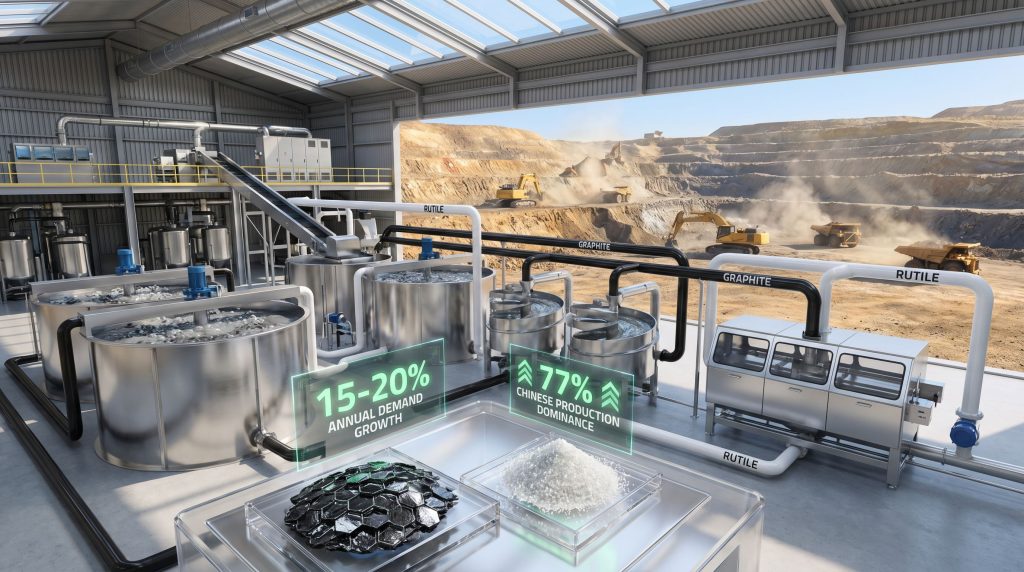
Consequently, the financial architecture creates natural hedging mechanisms where rutile's stable industrial demand (2-3% annual growth) balances graphite's cyclical battery sector expansion (15-20% annual growth through 2030). This demand cycle diversification reduces overall project risk profiles whilst maintaining upside exposure to high-growth battery mineral markets.
Revenue Optimisation Through Byproduct Economics
The project's unique geological configuration enables graphite production as a byproduct of primary rutile operations, creating an incremental graphite operating cost of US$216 per tonne. This cost structure positions the project below Chinese weighted-average production costs of US$257 to US$288 per tonne, establishing competitive advantage through geological endowment rather than processing innovation.
The byproduct structure fundamentally alters traditional mining economics:
• Primary rutile operations cover base infrastructure and processing costs
• Graphite recovery requires only incremental flotation and handling expenses
• Combined operations achieve lower unit costs than either commodity produced independently
• Dual revenue streams provide natural price volatility hedging
This configuration becomes particularly valuable when evaluating supply chain security premiums. Additionally, the European CRM Facility designation creates preferential procurement policies, accelerated depreciation schedules, and strategic stockpiling agreements that generate additional value beyond traditional commodity pricing mechanisms.
When big ASX news breaks, our subscribers know first
Geological Prerequisites for Simultaneous Graphite-Rutile Recovery
The geological formations that enable economically viable co-production of graphite and rutile are exceptionally rare, requiring specific weathering profiles and mineral associations that occur in few global locations. Kasiya represents the world's largest known natural rutile deposit and second-largest known flake graphite deposit within a single orebody, making it the only known deposit globally where graphite is produced as a byproduct of primary rutile operations.
Weathered Saprolite Formation Characteristics
The deposit's soft, free-dig saprolite orebody in Malawi eliminates the need for drilling, blasting, crushing, and milling from the processing flowsheet, resulting in simplified extraction and beneficiation pathways. This geological configuration creates natural mineral zoning that permits sequential extraction without complex ore sorting requirements.
| Depth Zone | Primary Mineral | Grade Profile | Processing Method |
|---|---|---|---|
| 0-3m Surface | Rutile Concentration | 1.5-2.5% TiO₂ | Gravity separation |
| 3-8m Intermediate | Mixed rutile-graphite | 1.2-1.8% TiO₂, 8-12% TGC | Sequential processing |
| 8-15m Deep | Graphite dominant | 0.8-1.2% TiO₂, 12-18% TGC | Flotation circuits |
Tropical Weathering Profile Development
The weathering process that created this unique mineral distribution operates through tropical weathering of paragneiss host rock, where mechanical disintegration of feldspathic minerals concentrates resistant titanium oxide minerals at surface levels whilst chemical leaching preserves coarse graphite flakes in deeper zones. In addition, this weathering mechanism creates the natural mineral zoning essential for dual-commodity recovery.
Surface oxidation concentrates rutile through heavy mineral accumulation, achieving grades suitable for aerospace and defence applications. Testing by Toho Titanium in Japan confirmed that Kasiya rutile meets specifications for high-performance aerospace applications, the end-use categories commanding highest supply chain premiums.
However, deeper weathering zones preserve graphitic carbon in coarse flake forms suitable for battery applications. Downstream testing confirmed performance equivalent to BTR New Material Group products, establishing market-comparable specifications for battery-anode applications without requiring specialised processing chemistry.
Processing Technologies Enabling Integrated Mineral Separation
Modern dual-commodity processing relies on sequential separation technologies that exploit distinct physical and chemical properties of graphite and rutile. The integrated flowsheet begins with gravity concentration to recover heavy mineral concentrates, followed by electrostatic and magnetic separation for rutile purification, and flotation circuits for graphite recovery.
Stage 1: Primary Concentration Systems
The initial processing stage employs gravity-based concentration that exploits density differentials between rutile (4.2-4.3 g/cm³) and gangue minerals (2.6-2.8 g/cm³). This approach achieves primary separation without requiring chemical leaching or magnetic pretreatment, reducing both processing costs and environmental complexity.
• Wet screening and desliming removes clay fractions that could interfere with downstream separation
• Spiral gravity concentration recovers heavy mineral concentrates containing both rutile and accessory minerals
• Hydrocyclone classification optimises particle size distribution for subsequent processing stages
Stage 2: Rutile Purification Circuits
Rutile separation employs high-intensity magnetic separation to remove ilmenite and other magnetic titanium minerals, followed by electrostatic separation for final rutile purification. Multiple cleaning stages achieve greater than 95% TiO₂ grade suitable for titanium sponge production.
For instance, the electrostatic separation process exploits conductivity differences between rutile and remaining gangue minerals, achieving high recovery rates whilst maintaining product quality specifications required for aerospace and defence applications.
Stage 3: Graphite Recovery Systems
Graphite recovery operates through flotation circuits using specialised collectors designed to preserve flake size distribution critical for battery applications. The flotation chemistry targets natural graphite surfaces whilst avoiding flotation of residual titanium minerals or silicate gangue.
Furthermore, multiple cleaning stages preserve coarse flake graphite essential for battery anode performance whilst achieving the purity specifications required for direct spheronisation and coating processes. Final dewatering and thermal treatment prepare products for containerised shipment to battery manufacturing facilities.
Critical Mineral Designations Transforming Project Economics
Government critical mineral classifications have fundamentally altered investment landscapes for dual-commodity operations, particularly those producing materials essential to defence and clean energy supply chains. Both the United States and European Union have formally designated titanium and graphite as critical minerals, creating direct implications for project financing, procurement policies, and strategic partnerships.
Policy Framework Impact on Valuation
The US Department of Commerce has determined that titanium sponge imports threaten national security, creating policy imperatives for alternative supply sources that extend beyond traditional economic evaluation criteria. The US produces zero titanium sponge domestically and recorded 44,000 tonnes of imports in 2025, with over 70% sourced from Japan, creating single-country concentration risks.
Critical mineral designations carry direct financial incentives:
• Accelerated depreciation schedules for qualifying critical mineral projects
• US$12 billion Project Vault initiative providing government-backed financing programmes
• Strategic stockpiling agreements at premium pricing above market rates
• Export credit agency support reducing financing costs for international development
Supply Chain Security Premiums
Critical mineral classifications create preferential procurement policies that generate additional value streams beyond traditional commodity pricing. Long-term offtake contracts with government entities, priority access to defence and aerospace markets, and reduced counterparty risk through sovereign backing enhance project bankability for institutional lenders.
The Kasiya graphite and rutile dual commodity structure benefits from these policy developments through signed memoranda of understanding covering over 50% of Phase 1 production. Mitsui & Co. has committed to 70,000 tonnes of rutile concentrate annually, whilst Traxys North America secured 80,000 tonnes of graphite linked to the US Project Vault initiative.
Trade Policy Reinforcement
Combined tariff and antidumping duties on Chinese graphite anode materials now reach 160%, with a separate 93.5% antidumping duty on natural and synthetic graphite battery anodes. These measures reflect regulatory determination that dependency on Chinese graphite processing is inconsistent with battery manufacturing buildout across Europe and North America.
However, the implications of US‑China trade impact extend beyond simple tariff structures to encompass broader supply chain reconfiguration.
Supply Chain Vulnerability Mitigation Through Dual Production
Strategic value of dual-commodity operations extends beyond traditional mining economics to encompass supply chain resilience across multiple critical sectors. By producing both titanium feedstock and battery-grade graphite, integrated operations simultaneously address aerospace manufacturing requirements and electric vehicle battery supply chains.
Geographic Diversification Benefits
Current supply concentration creates significant vulnerability exposure across both commodity markets. China controls approximately 77% of global natural graphite production and processing output, whilst natural rutile supply faces structural decline as existing primary producers approach depletion.
Sierra Rutile's Area 1 Mine is expected to deplete within two to three years, and Energy Fuels' Kwale Mine has ceased operations. This contraction in primary rutile supply coincides with rising US titanium sponge import requirements, creating feedstock access problems that cannot be resolved within existing supply arrangements.
Dual-commodity operations provide natural diversification benefits:
• Reduced dependence on single-country supply sources for both minerals
• Alternative processing locations outside dominant producer jurisdictions
• Distributed inventory management across multiple end-user categories
• Regional supply chain development in allied jurisdictions
Cross-Sector Demand Stability
The combination of stable rutile demand (aerospace, defence, pigment applications) with high-growth graphite demand (battery sector expansion) creates portfolio-level demand characteristics superior to single-commodity exposure. Rutile's established industrial applications provide demand floor stability, whilst graphite exposure captures upside from electric vehicle adoption and energy storage deployment.
Consequently, global natural graphite demand totalled approximately 1.6 million tonnes in 2023, with lithium-ion batteries accounting for 63% of consumption. By 2035, total demand is forecast to approach 10 million tonnes, with the battery sector accounting for more than 70% of consumption.
Infrastructure Requirements for Integrated Operations
Dual-commodity operations require sophisticated infrastructure planning to accommodate different processing requirements, product handling systems, and transportation logistics. Infrastructure design must optimise for both commodities whilst maintaining operational flexibility for varying production ratios based on market conditions.
Power and Utility System Integration
Processing requirements differ significantly between rutile and graphite circuits, requiring flexible power distribution systems capable of accommodating variable load profiles across integrated processing facilities. Moreover, mining industry innovation continues to drive efficiency improvements across these systems.
| Infrastructure Type | Graphite Requirements | Rutile Requirements | Integrated Benefits |
|---|---|---|---|
| Power Supply | 45-65 kWh/t processed | 35-50 kWh/t processed | Optimised grid connection |
| Water Management | 2.5-3.5 m³/t ore | 1.8-2.8 m³/t ore | Integrated recycling systems |
| Transportation | Containerised shipment | Bulk handling capability | Shared port facilities |
| Storage | Climate-controlled warehousing | Weather-resistant storage | Consolidated logistics |
Transportation and Logistics Optimisation
Integrated operations achieve logistics efficiencies through shared transportation infrastructure capable of accommodating both bulk rutile shipments and containerised graphite transport. The Kasiya project benefits from proximity to the port of Nacala in Mozambique, providing efficient access to international markets for both commodities.
At steady-state production of 24 million tonnes per annum throughput, Kasiya is projected to produce 222,000 tonnes per annum of natural rutile and 275,000 tonnes per annum of natural flake graphite. This production scale requires integrated port facilities, shared rail transport, and coordinated shipping schedules to optimise logistics costs across both product streams.
The next major ASX story will hit our subscribers first
What are the Market Dynamics Affecting Production Optimisation?
Market timing and demand cycles for graphite and rutile operate on different schedules, requiring sophisticated planning to optimise production sequencing and inventory management. Understanding these market dynamics is essential for maximising project returns and managing working capital requirements.
Graphite Market Characteristics
Battery-grade natural graphite markets exhibit high growth trajectories driven by electric vehicle adoption and energy storage deployment. Natural graphite demand for batteries is projected to rise from approximately 1.1 million tonnes in 2021 to 4.2 million tonnes by 2035.
Market characteristics include:
• Demand growth: 15-20% annually through 2030
• Price volatility: Moderate, driven by battery sector expansion
• Supply concentration: 77% Chinese production dominance
• Market size: $15-18 billion globally by 2030
The cost arithmetic governing Western battery manufacturers' sourcing decisions is direct: the Kasiya graphite and rutile dual commodity structure's incremental graphite operating cost of US$216 per tonne positions below Chinese weighted-average cash costs, creating competitive advantage for non-Chinese supply sources.
Rutile Market Dynamics
Natural rutile markets demonstrate stable demand growth driven by established aerospace and defence applications, with limited supply concentration creating premium pricing for high-grade products.
Key market characteristics:
• Demand growth: 2-3% annually, stable industrial consumption
• Price volatility: Low, established industrial applications
• Supply concentration: Limited primary producers globally
• Market size: $1.2-1.5 billion globally, premium pricing for aerospace-grade
The structural character of titanium supply chain problems is precise: Japanese titanium sponge producers depend on reliable natural rutile feedstock, and primary rutile supply is tightening independently of trade policy as existing producers approach depletion.
Strategic Partnership Structures for Dual-Commodity Development
Strategic partnerships become particularly critical for dual-commodity operations due to complexity of managing multiple product streams, diverse customer bases, and varied technical requirements. These partnerships often extend beyond traditional mining relationships to include technology providers, downstream processors, and end-user manufacturers.
Technical Partnership Integration
The complexity of dual-commodity processing requires specialised expertise across multiple separation technologies, product qualification protocols, and quality assurance systems. Technical partnerships provide access to proprietary processing knowledge whilst reducing technology risk during development phases.
Rio Tinto's 18.5% strategic stake in Sovereign Metals demonstrates how major mining companies can provide technical oversight for complex projects. Rio Tinto's involvement includes DFS technical participation and an option to become project operator with exclusive marketing rights to 40% of annual production.
Commercial Partnership Optimisation
Dual-commodity operations must simultaneously access distinct customer bases with different procurement requirements, contract terms, and technical specifications. Commercial partnerships structure these relationships whilst managing diverse risk profiles across multiple markets.
Key partnership categories include:
• Offtake agreements spanning multiple commodity streams with different pricing mechanisms
• Joint marketing arrangements for integrated supply solutions addressing multi-mineral requirements
• Risk-sharing mechanisms for capital-intensive development phases
• Strategic equity participation from downstream partners reducing market access risk
Furthermore, The International Finance Corporation collaboration agreement establishes development finance access from a multilateral institution whose participation typically structures wider lender syndicates for project financing.
Financing Mechanisms for Multi-Commodity Projects
Financing structures for dual-commodity operations require sophisticated modelling to account for multiple revenue streams, varying capital requirements across processing circuits, and different risk profiles for each commodity. Lenders must evaluate credit quality across multiple markets whilst assessing operational complexity risks.
Revenue Modelling Complexity
Project finance evaluation requires independent price forecasting for each commodity, correlation analysis between commodity cycles, and production flexibility scenarios for market optimisation. The Kasiya DFS demonstrates this complexity through pretax NPV of US$2,204 million and pretax IRR of 23.4%, with post-tax conceptual NPV ranging from US$1,065 million to US$1,448 million depending on fiscal assumptions.
This US$383 million spread directly quantifies financial exposure to unresolved Malawian fiscal negotiations, where neither proposed supernormal profits tax nor statutory government equity rights have been finalised. The range demonstrates how regulatory uncertainty affects project valuation in dual-commodity operations.
Risk Assessment Framework Evolution
Lenders evaluate multiple risk categories simultaneously:
• Technical risk evaluation across multiple processing systems
• Market risk diversification benefits and concentration exposures
• Operational risk from increased processing complexity
• Environmental and social risk across broader impact areas
However, the combination of Rio Tinto's equity participation, signed offtake MOUs covering over 50% of Phase 1 production, and IFC collaboration agreements addresses principal axes required for project financing whilst demonstrating how strategic partnerships can mitigate perceived execution risk.
Technology Development Trends Shaping Future Operations
Evolution of dual-commodity mining will be driven by advancing processing technologies, changing market demands for critical minerals, and increasing government focus on supply chain security. Future developments will likely emphasise automation, environmental optimisation, and integration with downstream processing facilities.
Processing Innovation Trajectories
Technological advancement focuses on optimising separation efficiency whilst reducing environmental impact across integrated processing circuits. In addition, the global mining innovation expo showcases how these developments continue to evolve.
Key development areas include:
• Automated mineral identification and sorting systems for real-time ore grade optimisation
• Advanced flotation chemistry for improved graphite recovery whilst preserving flake size distribution
• Integrated waste management systems across multiple product streams
• Real-time optimisation of dual processing circuits based on market pricing signals
Market Integration Enhancement
Future dual-commodity operations will likely integrate more closely with downstream processing facilities, creating vertically integrated supply chains that capture additional value whilst reducing transportation costs and supply chain complexity.
Integration opportunities include:
• Direct integration with battery manufacturing facilities for graphite products
• Closed-loop recycling systems for both commodities reducing primary extraction requirements
• Advanced materials development for specialised applications requiring both minerals
• Supply chain digitisation for enhanced traceability and quality assurance
Critical Success Factors for Dual-Commodity Operations
Success in dual-commodity mining requires mastery of multiple technical disciplines, sophisticated market analysis, and integrated operational planning. Projects must demonstrate technical feasibility across both processing streams, secure market access for diverse product portfolios, and maintain operational flexibility to optimise production based on market conditions.
Furthermore, the intersection of critical mineral policy, supply chain security imperatives, and geological rarity creates unique opportunities for projects capable of addressing multiple strategic material shortages simultaneously. "The combination of stable rutile demand and high-growth graphite markets creates superior portfolio-level characteristics compared to single-commodity exposure," notes the project's technical assessment.
The emergence of projects like Kasiya represents a fundamental shift in mining project evaluation, where traditional economic metrics increasingly compete with strategic supply assurance considerations. Consequently, as governments prioritise supply chain security over cost optimisation, dual-commodity operations positioned to address multiple critical mineral shortages may command valuation premiums reflecting their strategic importance beyond traditional commodity pricing mechanisms.
Understanding these evolving dynamics becomes essential for investors evaluating opportunities in critical mineral supply chains, where geological rarity intersects with policy imperatives to create investment opportunities distinct from traditional mining sector patterns. The successful development of dual-commodity operations requires sophisticated appreciation for both technical complexity and evolving strategic value frameworks governing critical mineral investments.
Disclaimer: This analysis contains forward-looking statements and projections based on current market conditions and policy frameworks. Commodity prices, government policies, and project development timelines are subject to significant uncertainty. Investors should conduct independent due diligence and consider professional advice before making investment decisions. Mining projects carry inherent technical, regulatory, and market risks that may affect actual outcomes.
Ready to Capitalise on Critical Mineral Discoveries?
Discovery Alert's proprietary Discovery IQ model delivers instant notifications on significant ASX mineral discoveries, empowering subscribers to identify actionable opportunities ahead of the broader market. Understanding why historic discoveries can generate substantial returns positions you to take advantage of the next major breakthrough — begin your 14-day free trial today and secure your market-leading advantage.