July 19, 2026
Understanding the Kavango Basin: Africa's Last Great Unexplored Hydrocarbon Frontier
Frontier basin exploration operates on a fundamentally different logic than development drilling. Where mature provinces like Nigeria's Niger Delta reward incremental technical improvements on known reservoirs, genuine frontier exploration demands something rarer: the willingness to test geological hypotheses in terrain where the subsurface is largely uncharacterised. The ReconAfrica gas discovery in Namibia's Kalahari Desert sits squarely in this category, and understanding what it does and does not confirm requires careful separation of geological fact from commercial aspiration.
Why the Kalahari Desert Remained Geologically Underexplored for Decades
The Kavango Basin's prolonged neglect by the global exploration industry was not accidental. Remote desert terrain, absent pipeline infrastructure, limited seismic data coverage, and the basin's landlocked position collectively deterred major operators who could direct capital toward lower-risk opportunities elsewhere. Unlike Namibia's offshore Orange Basin, where recent TotalEnergies and Shell discoveries have attracted intense international attention, the Kavango's onshore position introduces a fundamentally different cost and logistics profile.
The absence of historical production data also meant that pre-drill resource estimates carried exceptionally wide uncertainty ranges, making conventional portfolio risk models difficult to apply. Furthermore, the mining industry evolution toward capital discipline has reinforced the tendency of major operators to avoid high-risk frontier plays.
Compounding this, the basin straddles politically and ecologically sensitive terrain adjacent to the Kavango-Zambezi Transfrontier Conservation Area, one of the world's largest cross-border protected ecosystems, covering portions of Namibia, Botswana, Zimbabwe, Zambia, and Angola. This ecological complexity introduced regulatory and reputational dimensions that most majors were unwilling to absorb during periods of capital restraint.
How the Kavango Basin Compares to Africa's Proven Hydrocarbon Provinces
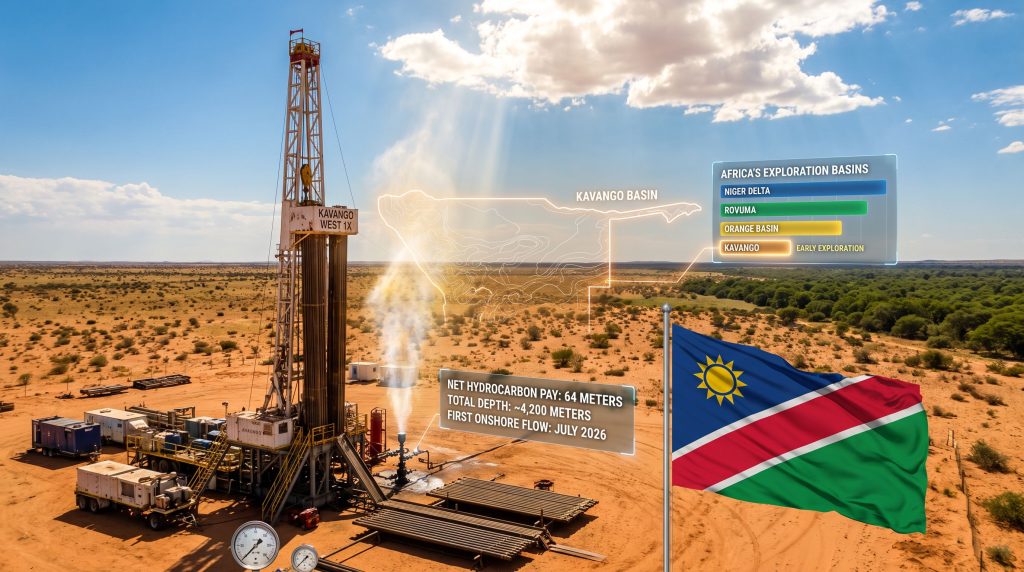
To contextualise what ReconAfrica is attempting, it is worth benchmarking the Kavango against Africa's established and emerging basins.
| Basin | Country | Exploration Maturity | Notable Status |
|---|---|---|---|
| Niger Delta | Nigeria | Highly Mature | Producing over 1.4 million bpd |
| Rovuma Basin | Mozambique | Advanced Appraisal | Major LNG development underway |
| Orange Basin | Namibia (Offshore) | Active Development | TotalEnergies and Shell major finds confirmed |
| Kavango Basin | Namibia (Onshore) | Early Exploration | First surface flow confirmed 2026 |
| Karoo Basin | South Africa | Pre-Development | Geological risks under active reassessment |
The Kavango's early-stage positioning relative to these peers underscores both the opportunity and the risk. First-mover advantage in a genuine frontier basin can be transformative if commercial scale is confirmed. However, the absence of comparable analogues in the same sedimentary system means each result carries outsized interpretive weight.
The Geological Case for Kavango: Sedimentary Depth, Formation Thickness, and Hydrocarbon Indicators
The Kavango Basin is a large intracratonic sedimentary basin containing substantial Karoo-age stratigraphy. Intracratonic basins of this type, formed within stable continental interiors, can accumulate significant sedimentary sequences over geological time, creating conditions where organic material is buried to sufficient depth and temperature to generate hydrocarbons. The presence of multiple stacked formations, including the deeper Elandshoek and shallower Hüttenberg, suggests the potential for multiple independent reservoir targets.
Key Geological Marker: The Kavango West 1X well penetrated to a total depth of approximately 4,200 meters (roughly 13,800 feet), encountering net hydrocarbon pay of 64 meters across a gross interval of approximately 400 meters. This intersection of pay within a thick gross interval is a meaningful indicator of a charged petroleum system, though it does not constitute confirmation of a commercially viable accumulation.
One technically important but underappreciated aspect of the Kavango geology is the distinction between a petroleum system being present and a commercial trap being confirmed. The flow result at Kavango West 1X confirms that hydrocarbons have been generated, migrated, and accumulated within the Elandshoek formation. What remains unquantified is whether the trap geometry, reservoir permeability, and connected volume are sufficient to sustain commercial production rates over an economically meaningful timeframe.
When big ASX news breaks, our subscribers know first
What Did the Kavango West 1X Well Actually Prove?
Breaking Down the Flow Test Results: What the Data Confirms and What It Does Not
The Kavango West 1X testing program, conducted in July 2026, produced results that are simultaneously encouraging and incomplete. The key technical parameters established during the program were as follows:
- Three separate flow tests were conducted across the upper Elandshoek formation
- The combined tested interval had a gross thickness of 163 meters across the three zones
- Natural gas flowed to the surface during all three tests, with a combined testing duration of approximately 24 hours
- Hydrocarbon liquids were also recovered alongside the gas phase
- Samples were collected and dispatched to laboratories in the United States for detailed compositional analysis
- Hydrocarbons that could not be collected as samples were flared at the wellsite
- Equipment constraints at the wellsite prevented accurate measurement of volumetric flow rates
Critical Distinction: The confirmation that hydrocarbons flow naturally to the surface is a geological milestone of real significance, particularly given onshore Namibia's exploration history. However, it is categorically not equivalent to declaring a commercially viable discovery. Flow rate, reservoir pressure, permeability, skin damage, and sustained production capacity must all be quantified before any commercial assessment is possible.
The inability to measure flow rates accurately due to equipment limitations is not a minor footnote. In exploration finance, the distinction between a well that flowed hydrocarbons and a well that produced hydrocarbons at a measurable rate is fundamental. The former confirms a charged system; the latter begins to define its commercial potential.
The Elandshoek Formation vs. the Hüttenberg Formation: Two Distinct Targets
The Kavango West 1X well encountered two separate formation targets with distinct characteristics, which is a significant structural feature of the overall programme.
| Formation | Depth Profile | Net Hydrocarbon Interval | Testing Status |
|---|---|---|---|
| Elandshoek | Deeper | Approximately 163 meters tested across 3 zones | Surface flow confirmed; rates not measured |
| Hüttenberg | Shallower | 76 meters of net pay identified via well-log analysis | Testing underway; approximately 10 days per zone |
The Hüttenberg formation's shallower depth profile has implications for eventual development economics if commercial scale is confirmed. Shallower reservoirs generally require less drilling capital per well and may be associated with lower wellbore pressures, affecting completion design. However, shallower formations in intracratonic basins can also present different permeability and cementation characteristics that affect flow behaviour.
What "First Onshore Hydrocarbon Production in Namibia" Means in a Regional Context
Namibia's hydrocarbon history has been dominated almost entirely by offshore exploration. The confirmation of surface flow from an onshore well in July 2026 represents a genuine first in the country's geological record. For the broader Southern African exploration community, it validates the hypothesis that Karoo-age onshore basins in the subcontinent can host charged petroleum systems — a conclusion that has direct implications for analogous frontier basins across the region.
ReconAfrica's Exploration Strategy and PEL 73 License Structure
Ownership, Partners, and Regulatory Standing
The PEL 73 license governing the Kavango exploration programme has a three-party ownership structure that reflects both the project's risk profile and the involvement of Namibia's national energy interests.
- ReconAfrica: 70% working interest, acting as operator and primary risk carrier
- BW Energy: 20% working interest, joining the project as a partner following ReconAfrica's 2023 financing constraints
- NAMCOR (Namibia National Petroleum Corporation): 10% carried working interest, representing the state's participation
BW Energy's entry into the project in 2023 was a structurally important development. The Norwegian-listed company, which operates producing assets in Gabon and Namibia's offshore, brings operational credibility and financial capacity to the programme. Its participation signals institutional recognition that the Kavango geological thesis warrants continued investment, though it does not reduce the exploration-stage risks inherent to any frontier programme.
A Timeline of Exploration Milestones in the Kavango Basin
| Year | Milestone |
|---|---|
| 2021 | Exploration drilling commences under PEL 73; hydrocarbon shows encountered in multiple wells |
| 2021 | Unrisked prospective resource estimate of approximately 100 billion barrels publicised |
| 2022 | Environmental legal challenge filed; Namibia's High Court dismisses the case |
| 2023 | Operations suspended due to financing constraints |
| 2023 | BW Energy joins as partner; Environmental Clearance Certificate issued for 12 additional wells |
| 2026 (June) | Kavango West 1X flow testing commences |
| 2026 (July) | First onshore hydrocarbon surface flow confirmed in Namibian history |
What Is Prospect I, and Why Does It Represent the Programme's Highest-Stakes Target?
Prospect I at a Glance: This drilling target is estimated to hold approximately 140 billion cubic feet of risked natural gas and around 32 million barrels of risked oil. It represents the largest single-well target in ReconAfrica's current Kavango exploration campaign, and its results will carry significant weight in determining the programme's commercial trajectory.
The distinction between risked and unrisked resource estimates is critical for investors and analysts evaluating the Kavango programme. Risked estimates apply geological chance-of-success factors to the gross resource potential, incorporating probabilities for trap integrity, reservoir presence, and charge adequacy. Unrisked estimates represent the hypothetical resource if all geological conditions are satisfied simultaneously. The 2021 figure of approximately 100 billion barrels that drew widespread attention was an unrisked prospective resource estimate — a speculative ceiling rather than a probable outcome.
Is the Kavango Basin Commercially Viable? A Scenario-Based Assessment
Scenario 1: Exploration Success Converts to Commercial Discovery
In this pathway, Hüttenberg formation testing yields measurable, sustained flow rates above minimum commercial thresholds, Prospect I drilling confirms adequate reservoir and trap geometry, and compositional analysis from U.S. laboratories identifies a marketable gas specification. This scenario would require subsequent appraisal wells to define areal extent and connected volume before a formal commercial discovery declaration could be made. Infrastructure planning, including pipeline routing and processing facilities in a remote desert environment, would then dominate the development timeline.
Scenario 2: Appraisal Confirms Gas But Scale Falls Short of Commercial Thresholds
It is entirely plausible that the petroleum system is real but the individual accumulations are sub-commercial in scale. This is a common outcome in frontier exploration where geological charge is confirmed but trap volumes or reservoir quality are insufficient to support economic development at prevailing gas prices and infrastructure costs. In this scenario, the programme's data would still represent a significant contribution to regional geological understanding without generating shareholder returns at the exploration stage.
Scenario 3: Environmental and Regulatory Constraints Delay or Halt Development
Strategic Risk Flag: The Kavango Basin's proximity to the Kavango-Zambezi Transfrontier Conservation Area and its position within the broader Okavango watershed system creates an environmental risk category with no direct parallel in Namibia's offshore developments. Consequently, the absence of comparable precedent makes regulatory timeline modelling particularly uncertain.
Even if commercial scale is confirmed geologically, the development pathway could be substantially extended or complicated by environmental permitting requirements, community consultation obligations, and the sustained scrutiny of international conservation organisations. The 2022 legal challenge, while dismissed by Namibia's High Court on procedural grounds rather than on the underlying environmental merits, illustrated the depth of organised opposition the project faces. In addition, considerations around natural capital in mining operations are increasingly shaping how regulators assess resource extraction in ecologically sensitive areas.
Comparing Risk Profiles: Onshore Kalahari vs. Offshore Namibia
| Risk Category | Kavango Basin (Onshore) | Orange Basin (Offshore) |
|---|---|---|
| Environmental Sensitivity | High (borders major conservation ecosystem) | Moderate (marine environment, established frameworks) |
| Infrastructure Availability | Low (remote desert, no existing pipeline network) | Moderate (requires FPSO and subsea infrastructure) |
| Community Opposition | Active (legal challenges filed 2022, ongoing scrutiny) | Limited |
| Exploration Maturity | Early stage, first surface flow 2026 | Advanced appraisal and development confirmed |
| Commercial Discovery Status | Not yet declared | Confirmed by TotalEnergies and Shell |
The Environmental Fault Line: Conservation vs. Resource Extraction
Why the Kavango-Zambezi Transfrontier Conservation Area Complicates the Development Narrative
The KAZA Transfrontier Conservation Area spans approximately 520,000 square kilometres across five southern African nations, making it one of the largest terrestrial conservation areas on earth. Its boundaries are not purely a formal designation: the region supports critical wildlife corridors, significant elephant populations, and ecological systems that underpin regional tourism economies worth billions of dollars annually. Any hydrocarbon development in the adjacent Kavango Basin would require exceptionally robust environmental management frameworks to avoid impacting these systems.
The Okavango Watershed: Understanding the Downstream Hydrological Stakes
The Okavango River system feeds the Okavango Delta in Botswana, a UNESCO World Heritage Site and one of Africa's most ecologically significant inland water systems. The Kavango Basin's position within the upper catchment of this system means that groundwater contamination risks — whether from drilling fluid infiltration, produced water disposal, or surface spills — carry potential consequences extending hundreds of kilometres downstream into internationally protected territory. This hydrological connectivity is a structural constraint on the programme that no amount of technical drilling competence can fully eliminate.
Oil discoveries in the Kalahari have drawn sustained scrutiny from global conservation bodies precisely because of these downstream watershed risks, reinforcing the complexity facing any development effort in this region.
Legal Precedents: What the 2022 High Court Ruling Did and Did Not Resolve
Ongoing Debate: Namibia's High Court dismissed the 2022 challenge on grounds of procedural standing rather than on a definitive assessment of all underlying environmental compliance questions. Community groups and environmental organisations continue to monitor the project's regulatory compliance, and the Environmental Clearance Certificate issued in 2023 for 12 additional exploration wells does not pre-empt further legal scrutiny as the programme advances toward potential commercial development phases.
The distinction between an exploration-phase clearance and a production-phase development consent is particularly important. Exploration drilling permits are typically narrower in scope than the comprehensive environmental impact assessments that production development would require. This means the current certificate does not resolve the full spectrum of regulatory questions that would arise if a commercial discovery were declared. Furthermore, risk management in mining operations in environmentally sensitive zones has become an increasingly central consideration for operators, regulators, and investors alike.
What This Means for Namibia's National Energy Ambitions
Namibia's Dual Energy Story: Offshore Momentum Meets Onshore Uncertainty
Namibia is navigating a pivotal energy transition of its own — not away from fossil fuels, but toward domestic energy self-sufficiency from a position of historical import dependence. The country currently relies on electricity imports from neighbouring countries to meet a significant portion of its national demand. A commercially viable domestic gas resource, whether offshore or onshore, would fundamentally alter this calculus.
Energy Context: Namibia's electricity import dependency has been a structural vulnerability in its energy system. A confirmed domestic gas reserve large enough to support power generation would provide energy security benefits extending beyond the economics of gas exports, potentially reshaping Namibia's position within Southern African Development Community (SADC) regional power integration frameworks.
How Does the Geopolitical Landscape Shape Kavango's Prospects?
The broader geopolitical mining landscape across Southern Africa adds another dimension to the Kavango story. Resource nationalism, cross-border environmental treaty obligations, and shifting multilateral energy partnerships all have the potential to influence how Namibia and its neighbours approach frontier hydrocarbon development. For instance, Botswana's position as a downstream stakeholder in the Okavango watershed gives it a legitimate interest in the programme's regulatory outcomes, regardless of where the legal jurisdiction for drilling decisions sits.
Comparing Namibia's Onshore Gas Potential Against Regional Peers
| Country | Onshore Gas Status | Key Basin | Development Stage |
|---|---|---|---|
| Namibia | First flow confirmed 2026 | Kavango | Early exploration |
| South Africa | Pre-development review | Karoo | Geological reassessment underway |
| Mozambique | Advanced production | Rovuma | LNG exports commenced |
| Tanzania | Appraisal and development | Ruvuma and Mnazi Bay | Domestic supply plus LNG planning |
Namibia's trajectory toward becoming an energy producer has been primarily driven by its offshore Orange Basin, where TotalEnergies' Graff and Shell's discoveries have established genuine commercial potential. The Kavango programme, if successful, would add an onshore dimension to this story. However, the development timeline and infrastructure requirements are fundamentally different from those of deepwater offshore projects.
ReconAfrica's environmental clearance to drill in Namibia marked a pivotal regulatory milestone that helped unlock the current phase of exploration activity, though it continues to attract close scrutiny from environmental stakeholders. Consequently, government intervention in mining and energy sectors across the region is likely to become more pronounced as frontier discoveries progress toward potential commercialisation.
The next major ASX story will hit our subscribers first
Frequently Asked Questions: ReconAfrica Gas Discovery in Namibia's Kalahari Desert
Has ReconAfrica Declared a Commercial Gas Discovery?
As of July 2026, no commercial discovery has been declared. The Kavango West 1X well confirmed that natural gas and associated liquids flow to the surface from the Elandshoek formation, establishing a technical first for onshore Namibia. However, equipment limitations at the wellsite prevented accurate measurement of flow rates, and no sustained production capacity assessment has been completed. Additional appraisal drilling, including the Prospect I well, is required before any commercial viability determination can be made.
Does ReconAfrica Hold Commercial Production or Hydraulic Fracturing Permits?
No. As of 2026, ReconAfrica holds exploration and appraisal permits only under the PEL 73 license. No commercial production licences have been granted, and no hydraulic fracturing permits are in place. The Environmental Clearance Certificate issued in 2023 specifically authorises the drilling of up to 12 additional exploration wells through the appraisal phase and does not extend to commercial production activities.
What Are the Next Milestones for the Kavango Exploration Programme?
The immediate programme priorities, in approximate sequence, are as follows:
- Completion of Hüttenberg formation testing at Kavango West 1X, with results anticipated by late August 2026
- Receipt and analysis of hydrocarbon compositional data from U.S. laboratories
- Integration of well results into updated geological models for the Kavango Basin
- Planning and commencement of Prospect I drilling, the programme's largest single target
- Assessment of whether aggregate results justify a formal resource upgrade or commercial discovery declaration
Key Takeaways: Framing the Kavango Discovery Within Africa's Evolving Energy Landscape
The ReconAfrica gas discovery in Namibia's Kalahari Desert is best understood as a geological proof-of-concept rather than a commercial announcement. Its significance lies in what it validates about the Kavango Basin's petroleum system, not in what it has yet to prove about economic viability. Several structural observations are worth retaining:
- The Kavango West 1X result confirms a charged petroleum system in an onshore Namibian formation that had never previously produced hydrocarbons at surface
- The Hüttenberg formation testing and Prospect I drilling will be decisive data points for the programme's commercial trajectory over the second half of 2026
- Environmental constraints tied to the Okavango watershed represent a structural risk dimension that will accompany the programme through any future development phase
- BW Energy's participation adds operational credibility and financial resilience but does not eliminate the exploration-stage uncertainties inherent to all frontier programmes
- Namibia's broader energy ambitions, anchored by confirmed Orange Basin offshore potential, give the country strategic optionality that is independent of the Kavango programme's ultimate commercial outcome
- Africa's frontier onshore basins remain among the world's least-drilled hydrocarbon systems, and technical milestones like the Kavango West 1X result carry genuine regional significance for exploration strategy
This article contains forward-looking statements, scenario analyses, and references to exploration-stage results that are inherently uncertain. Nothing in this article constitutes financial advice or an endorsement of any investment position. Readers should conduct independent research and consult qualified financial advisers before making any investment decisions related to resource exploration companies.
Want to Track the Next Major Resource Discovery Before the Market Reacts?
Discovery Alert's proprietary Discovery IQ model scans ASX announcements in real time, instantly alerting subscribers to significant mineral discoveries across more than 30 commodities — turning complex geological data into clear, actionable investment insights. Explore historic examples of how major discoveries have generated substantial returns and start your 14-day free trial today to position yourself ahead of the broader market.