
June 22, 2026
The global reconfiguration of supply chains has accelerated beyond traditional trade relationships into fundamental questions of economic resilience. As European policymakers grapple with unprecedented vulnerabilities exposed by geopolitical crises, Central Asia has emerged from the periphery to become a critical component of continental security architecture. This transformation reflects deeper structural forces reshaping how major economies conceptualise strategic autonomy, with the Kazakhstan–EU Gateway playing an increasingly pivotal role in facilitating this energy transition security.
Kazakhstan's position within this recalibration extends far beyond opportunistic commodity trading. The nation has systematically positioned itself as the primary conduit through which European economic interests can access Central Asian markets, energy resources, and critical materials without dependencies that compromise strategic flexibility. This positioning represents a carefully calibrated response to Europe's accelerated diversification imperatives following the 2022 energy crisis.
Europe's Critical Dependencies Drive Strategic Recalculation
The European Union's vulnerability assessment reveals systematic dependencies that extend beyond energy into the foundation of modern industrial capacity. According to the European Commission's Critical Raw Materials Act adopted in March 2024, the EU maintains 100% import dependence for 17 critical raw materials essential for green energy transition and defence technologies. This dependency structure creates cascading risks across sectors from renewable energy infrastructure to advanced manufacturing.
Kazakhstan holds proven reserves across multiple critical material categories, including the world's largest uranium production capacity at approximately 40% of global output, substantial chromium deposits, and significant vanadium reserves. These materials align directly with EU strategic priorities outlined in the REPowerEU plan, which allocated €1 billion specifically to accelerate alternative supply routes from Central Asia following the May 2022 adoption. Furthermore, the establishment of a critical raw materials facility demonstrates Europe's commitment to diversifying its supply chains.
The International Energy Agency documents Europe's dramatic supply source transformation, with natural gas imports from Russia declining from 40% of total imports in 2021 to approximately 8% by 2024. This rapid reconfiguration created opportunities for alternative suppliers, particularly Central Asian producers who could provide energy security without triggering new dependencies on unstable regions.
Kazakhstan–EU Gateway: Bridging Information Asymmetries
The emergence of platforms designed to coordinate policy implementation reflects recognition that strategic partnerships require sustained institutional support beyond high-level agreements. The Kazakhstan–EU Gateway, established as a Brussels-based non-governmental platform in 2023, addresses implementation bottlenecks through systematic information flow between European regulatory frameworks and Central Asian stakeholders.
This coordination mechanism produces regular intelligence synthesis through its Kazakhstan–EU Weekly Briefing, which tracks legislative developments including the Critical Raw Materials Act implementation and Carbon Border Adjustment Mechanism (CBAM) implications for Kazakh exporters. The briefing system enables proactive alignment between EU regulatory timelines and Kazakhstan's export sector preparation.
In addition, the platform's approach differs from traditional development cooperation by emphasising real-time policy translation rather than project funding. This model addresses a critical gap where broad political agreements struggle to translate into operational cooperation due to regulatory complexity and information asymmetries between Brussels decision-making processes and Central Asian business environments.
When big ASX news breaks, our subscribers know first
Geographic and Infrastructure Foundations of Gateway Strategy
Kazakhstan's effectiveness as a regional gateway stems from geographic advantages that competing routes cannot replicate. The nation occupies 2.725 million square kilometres spanning from the Eastern European Plain to the Altai Mountains, providing overland connectivity to eight neighbouring nations including direct access to Chinese, Russian, and Central Asian markets through established infrastructure networks.
Transport Corridor Performance Metrics
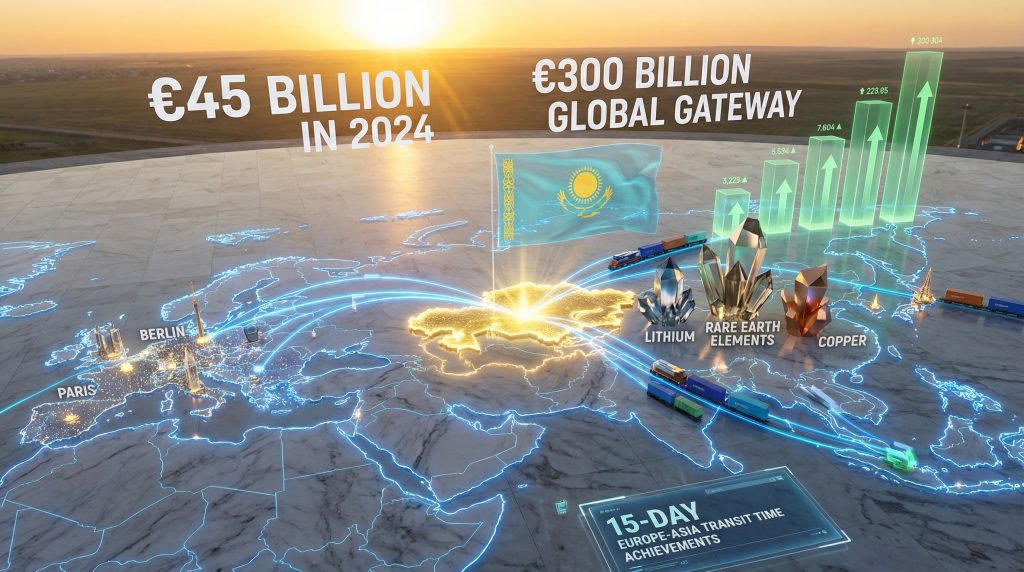
The Trans-Caspian International Transport Route (TITR), operating through Kazakhstan's Aktau Port, demonstrates measurable efficiency gains over alternative routing options. Container transit times from Asia to Europe via the Middle Corridor average 14-16 days compared to 35-40 days via Suez Canal routing, representing a 60% time reduction for high-value goods.
| Infrastructure Component | Current Capacity | 2027 Targets |
|---|---|---|
| Aktau Port Container Handling | 350,000 TEUs | 500,000+ TEUs |
| Middle Corridor Annual Capacity | 5-7 million TEUs | 10+ million TEUs |
| Baku Port Expansion | 500,000 TEUs | 1.25 million TEUs |
| Cross-Caspian Transit Time | 1-2 days average | <24 hours target |
The Baku Port expansion in Azerbaijan, serving as the western terminus for Kazakhstan-routed cargo, increased container capacity from 100,000 TEUs in 2015 to 500,000 TEUs by 2024. Phase 3 expansion targets 1.25 million TEUs by 2030, indicating sustained commitment to corridor development beyond initial pilot phases.
Regulatory Harmonisation Progress
Kazakhstan's adoption of EU technical standards has accelerated under the Enhanced Partnership and Cooperation Agreement (EPCA) framework. As of 2024, Kazakhstan has implemented 187 EU technical standards across energy, chemicals, and machinery sectors, representing approximately 45% alignment with EU regulatory requirements in trade-relevant areas.
The World Bank's Doing Business indicators show Kazakhstan's trade facilitation ranking improved from 103rd position in 2020 to 76th in 2024, driven primarily by border processing reforms aligned with EU customs standards. This improvement reflects systematic regulatory convergence rather than isolated policy changes.
However, Kazakhstan's membership in the Eurasian Economic Union (EAEU) creates a dual standards environment requiring coordination with Russia and Belarus on tariffs and regulations while simultaneously pursuing EU trade agreement alignment. This generates compliance costs but provides negotiating leverage, as Kazakhstan cannot achieve full EU harmonisation without triggering EAEU trade disputes.
Global Gateway Investment Architecture and Implementation
The European Union's Global Gateway initiative, launched in December 2021 with €300 billion committed across 2021-2027, allocated approximately €21.9 billion specifically to Central Asia and South Caucasus regions. This allocation represents a departure from traditional development aid models toward strategic infrastructure investment designed to create long-term partnership frameworks.
Sectoral Investment Distribution
Within the Central Asia allocation, transport corridors received €8.4 billion; water and energy infrastructure €6.2 billion; digital connectivity €3.1 billion; and critical materials infrastructure €4.2 billion. This distribution reflects prioritisation of physical connectivity as the foundation for subsequent economic integration.
The European Investment Bank (EIB) and Kazakhstan's Development Bank established a €200 million joint financing framework targeting transport, energy, and green technology infrastructure projects across 2023-2026. As of Q3 2024, €87 million had been deployed across 12 projects with loan terms averaging 12-15 years at 4.2% interest rates, below standard commercial financing costs.
Infrastructure Project Pipeline
The Trans-European Transport Networks (TEN-T) framework identified three priority Middle Corridor projects requiring substantial investment:
• Khorgos-Aktau rail corridor: €2.1 billion total investment with 38% EU co-financing
• Aktau Port expansion: €680 million total cost with 22% EU co-financing
• Caspian ferry terminal infrastructure: €420 million investment with 35% EU co-financing
The Khorgos-Gateway rail terminal exemplifies successful infrastructure coordination, with container volumes growing from 47,000 TEUs in 2016 to 892,000 TEUs in 2024 following EU-supported expansion completion in 2022. This 1,700% increase demonstrates direct correlation between infrastructure investment and corridor utilisation.
Digital Connectivity Framework
The €55 million Team Europe Initiative for Central Asia rural connectivity targets fibre optic backbone deployment across 8,500 kilometres of underserved territory in Kazakhstan, Kyrgyzstan, and Tajikistan. While Kazakhstan achieved 90% internet penetration in urban areas by 2024, rural connectivity remained at 35%, constraining digital trade facilitation.
Satellite internet deployment through Eutelsat and OneWeb partnerships aims to provide 10 Mbps minimum speeds to 95% of Central Asian territory by 2025. This approach addresses geographic constraints that make terrestrial infrastructure economically challenging across Kazakhstan's vast rural territories.
Critical Raw Materials Partnership Implementation
The November 2022 Memorandum of Understanding between the EU and Kazakhstan on sustainable raw materials established joint exploration ventures and technology transfer agreements beyond traditional commodity trading relationships. This framework reflects European recognition that supply chain security requires upstream investment rather than market-based procurement alone. Moreover, these developments align with broader critical minerals strategy initiatives across the region.
Mining Sector Expansion Indicators
Kazakhstan's mining sector demonstrates accelerated development aligned with EU critical materials requirements. Over 700 new exploration licenses have been issued since 2022, indicating systematic expansion beyond existing production capacity. The Eurasian Resources Group has announced increased investment in processing facilities designed to serve European manufacturing requirements.
Kazakhstan's uranium production capacity, representing approximately 40% of global output, positions the nation as a critical supplier for European nuclear power programmes essential to carbon neutrality objectives. Unlike alternative suppliers in politically unstable regions, Kazakhstan's production capacity operates under established regulatory frameworks compatible with EU environmental and social governance requirements. Furthermore, current uranium market trends indicate strong demand growth that supports these strategic partnerships.
Processing and Value Addition Strategy
Rather than limiting cooperation to raw material extraction, the EU-Kazakhstan framework emphasises downstream processing capabilities within Kazakhstan. This approach reduces European manufacturing vulnerability while creating value-added opportunities for Kazakhstan's economy beyond commodity export dependence.
Renewable hydrogen production potential represents a significant opportunity for joint development, with Kazakhstan's renewable energy capacity expansion enabling clean hydrogen production for European industrial applications. Battery materials supply chain positioning also offers opportunities for integrated production networks serving European electric vehicle manufacturing.
Carbon Border Adjustment Mechanism Implications
The European Union's Carbon Border Adjustment Mechanism implementation affects multiple Kazakh export sectors, requiring systematic compliance preparation for continued market access. CBAM affects steel, cement, fertilisers, and aluminium production, representing significant portions of Kazakhstan's export portfolio to European markets.
Compliance timeline requirements create both challenges and opportunities for Kazakh exporters. Companies demonstrating carbon intensity reductions gain competitive advantages over higher-emission alternatives from other regions. This creates incentives for technological modernisation aligned with European climate policy objectives.
Green Transition Alignment Opportunities
Kazakhstan's renewable energy development potential enables alignment with EU green taxonomy requirements for sustainable investment classification. Solar and wind resource availability across Kazakhstan's territory supports large-scale renewable energy development that could serve both domestic industrial needs and export opportunities.
Clean technology transfer through joint ventures offers pathways for Kazakhstan to modernise industrial processes while European companies gain access to lower-cost production platforms. This mutual benefit structure supports sustained cooperation beyond initial political agreements.
Implementation Challenges and Coordination Requirements
Despite strategic alignment, implementation faces systematic challenges requiring sustained coordination mechanisms. Policy literacy gaps between Brussels regulatory processes and Astana decision-making structures create timing misalignments and resource allocation inefficiencies.
Real-time legislative tracking systems become essential as EU regulatory frameworks evolve rapidly in response to geopolitical developments. Consequently, the Kazakhstan–EU Gateway's weekly briefing system addresses this need but requires expansion to cover sector-specific regulatory developments affecting different industries. Additionally, these developments reflect broader mining evolution trends shaping the global extractive industries.
Performance Measurement Framework
| Success Metric | 2024 Baseline | 2027 Targets |
|---|---|---|
| EU-Kazakhstan Trade Volume | €45 billion | €60+ billion |
| Transit Time (Asia-Europe) | 15 days average | <12 days |
| FDI Sector Diversification | 50% energy/mining | 30% green/digital |
| Regulatory Standards Alignment | 45% EPCA compliance | 70% harmonisation |
Public-private sector engagement frameworks require systematic development to ensure that policy coordination translates into commercial opportunities. Investment prioritisation mechanisms must balance political objectives with economic viability to sustain private sector participation essential for long-term success.
The next major ASX story will hit our subscribers first
Regional Comparative Analysis and Strategic Positioning
Kazakhstan's gateway effectiveness requires comparison with alternative routing options to understand competitive advantages and vulnerabilities. Turkey's Bosphorus routes offer established infrastructure but face geopolitical constraints and capacity limitations during periods of regional tension.
India's Chabahar Port initiative provides alternative access to Central Asian markets but requires transit through Iran, creating sanctions compliance challenges for European companies. Southeast Asian alternatives offer established port infrastructure but lack overland connectivity to Central Asian energy and mineral resources.
Corridor Resilience Factors
The Middle Corridor's dependence on Caspian ferry capacity represents a critical vulnerability requiring systematic risk management. Current ferry operations create 1-2 day delays during peak seasons, with expansion projects targeting 24-hour processing capabilities by 2025.
Georgian rail stability and Azerbaijani border processing efficiency affect overall corridor reliability, demonstrating that Kazakhstan's gateway function depends on multilateral coordination beyond bilateral EU-Kazakhstan agreements. These interdependencies require regional cooperation frameworks addressing single points of failure.
Future Scenarios and Strategic Implications
Accelerated Integration Scenario
Under optimal conditions, full transport corridor optimisation by 2028 could enable significant EU manufacturing nearshoring to Kazakhstan, particularly in energy-intensive industries benefiting from renewable energy availability and proximity to critical materials sources. Regional hub status for Central Asian market access would create sustained competitive advantages beyond initial infrastructure investment periods.
Moderate Progress Scenario
Gradual trade diversification and volume growth represents a more conservative projection, with selective critical materials partnership development proceeding alongside limited but stable connectivity improvements. This scenario maintains strategic benefits while managing implementation complexity and geopolitical uncertainties.
Implementation Constraints Scenario
Bureaucratic bottlenecks and coordination difficulties could limit realised benefits despite political commitment. Geopolitical tensions affecting corridor reliability or slower-than-expected regulatory harmonisation would reduce commercial viability and private sector participation.
Investment and Policy Recommendations
Stakeholders should prioritise investment frameworks emphasising maximum return on infrastructure spending through multimodal connectivity rather than single-corridor dependence. Risk management approaches for corridor-dependent businesses must include contingency planning for geopolitical disruptions and alternative routing capabilities.
Policy advocacy strategies should emphasise enhanced cooperation frameworks addressing regulatory harmonisation timelines, customs processing standardisation, and mutual recognition agreements reducing transaction costs for businesses operating across multiple jurisdictions.
The Kazakhstan–EU Gateway represents an evolving model for strategic partnership implementation that balances political objectives with commercial viability. As noted by industry analysts at the Minex Forum, these initiatives are opening new chapters for strategic cooperation between Europe and Central Asia. Success depends on sustained institutional support for coordination mechanisms that translate broad agreements into operational cooperation serving mutual long-term interests.
Disclaimer: This analysis is based on publicly available information and should not be considered investment advice. Geopolitical developments and policy changes may affect the accuracy of projections and assessments contained herein. Readers should conduct independent research and consult relevant experts before making investment or business decisions related to Central Asian markets or EU policy frameworks.
Looking to Capitalise on Critical Materials Opportunities?
Discovery Alert's proprietary Discovery IQ model delivers real-time notifications on significant ASX mineral discoveries, particularly in critical materials sectors essential for Europe's strategic supply chain diversification. Explore why major mineral discoveries can generate exceptional returns and begin your 30-day free trial today to position yourself ahead of the market.