June 15, 2026
The Geopolitics of Staying Put: Why Kazakhstan's OPEC+ Decision Is More Constrained Than It Appears
Kazakhstan to stick with OPEC+ after UAE exit is a story that reveals far more about infrastructure dependency and geopolitical constraint than it does about genuine alliance loyalty. In the world of oil cartel politics, departures attract headlines. What stays hidden is the more revealing story: why certain producers, despite powerful economic incentives to leave, choose to remain. When a state sits atop enormous hydrocarbon reserves yet routinely violates its own production commitments without consequence, the question of alliance loyalty becomes something altogether more complicated than ideology or solidarity.
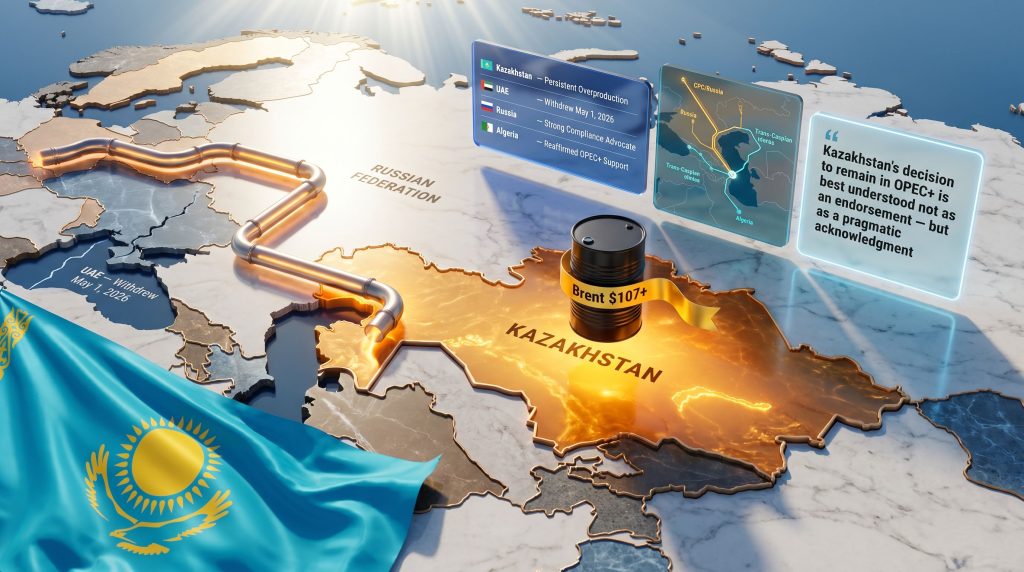
Kazakhstan's decision to stick with OPEC+ after the UAE's departure on 1 May 2026 is one such case. On the surface, it reads as geopolitical caution. Underneath, it reflects a web of infrastructure dependencies, contractual entanglements with Western energy majors, and the quiet gravitational pull of Russian strategic preferences. Understanding the crude oil price geopolitics at play here is essential to decoding Astana's position.
When big ASX news breaks, our subscribers know first
What Kazakhstan's Reaffirmation Actually Said — and What It Didn't
On 29 April 2026, Kazakhstan's Energy Ministry confirmed that changing the format of the country's participation in the OPEC+ alliance was not under consideration. The phrasing was notably precise: it did not express commitment to production discipline, nor did it reaffirm enthusiasm for quota compliance. It simply stated that a format change was not on the agenda.
That distinction matters. Kazakhstan participates in OPEC+ not as a full OPEC member, but as an affiliated non-member producer within the broader coordination framework. The legal and contractual implications of this status differ meaningfully from those facing core OPEC states. There are no formal financial penalties for exceeding production quotas and no binding enforcement mechanism. Kazakhstan's participation is, at its structural core, voluntary and consequence-free in a formal sense.
The announcement came within hours of the UAE's effective exit from both OPEC and the wider OPEC+ framework, and was echoed shortly after by Russia and Algeria. This suggests a degree of coordinated messaging designed to stabilise confidence in the alliance's continuity. Kazakhstan reaffirmed its OPEC+ membership almost immediately, further reinforcing this coordinated signal.
The narrowness of Kazakhstan's language is itself informative. A government that wished to signal genuine commitment would have spoken about quota compliance. Instead, Astana only confirmed that it was not leaving, which preserves maximum flexibility without offering any substantive pledge.
How the UAE's Exit Reshapes the Alliance's Supply Arithmetic
The UAE's departure introduced a structural variable that OPEC+ cannot easily absorb: a historically disciplined producer with meaningful spare capacity operating entirely outside the quota framework. Barclays analysts have indicated that UAE oil supply growth could accelerate following the exit, while JP Morgan has noted the potential for increased US investment in UAE upstream assets. The departure removes production constraints that Western capital markets may have viewed unfavourably.
The implications for OPEC's market influence and price management capacity are real, even if the alliance's institutional survival is not immediately in doubt.
| Factor | Impact on OPEC+ Post-UAE Exit |
|---|---|
| UAE spare capacity (est. ~1 mbpd+) | Potential unmanaged supply additions outside quota framework |
| Historical UAE compliance | Loss of a disciplined producer from the coordinated system |
| Alliance price-signalling authority | Reduced collective capacity to defend price floors |
| Investor confidence in remaining members | Depends on Saudi Arabia and Russia maintaining cohesion |
Furthermore, OilPrice.com reporting confirms the broader market consensus: OPEC+ will survive the departure structurally, but faces a genuine medium-term supply discipline challenge. The risk is not institutional collapse but incremental erosion of the cartel's ability to manage global crude balances with the same precision it achieved when the UAE was inside the tent.
Adding complexity is the broader macro environment. Brent crude was trading above $107 per barrel at the time of the UAE's exit, with prices touching $114 during periods of peak tension, while WTI hovered near $101 per barrel. These elevated levels are driven substantially by ongoing conflict disruption in the Persian Gulf, and they provide a price cushion that temporarily masks the supply management tensions the UAE's departure creates.
Iran's warnings of oil reaching $140 per barrel if the Strait of Hormuz situation escalates further adds another layer of uncertainty to an already volatile market structure. The current crude oil market reflects this tension clearly.
The Caspian Pipeline Consortium: Kazakhstan's Invisible Constraint
Why Geography Shapes Policy
To understand why Kazakhstan is structurally unlikely to follow the UAE's path, one must first understand the geography of its oil exports. Kazakhstan is landlocked. The overwhelming majority of its crude exits the country via the Caspian Pipeline Consortium route, which transits Russian territory before reaching the Black Sea terminal at Novorossiysk.
This is not a preference or a historical habit. It is the highest-capacity, lowest-cost export corridor available to Kazakhstani producers, and no credible alternative currently exists at comparable scale:
- The Trans-Caspian Pipeline remains a proposal rather than an operational reality, constrained by environmental opposition and unresolved legal frameworks
- The Baku-Tbilisi-Ceyhan pipeline has limited spare capacity for additional Kazakhstani volumes
- Chinese pipeline routes are operationally feasible but carry lower throughput and introduce a different form of strategic dependency
Ukraine's documented attacks on CPC infrastructure in early 2026 have already demonstrated how fragile this corridor can be. The episodes served as a stark reminder to Astana that provoking geopolitical friction with Moscow carries tangible export risks, not merely diplomatic ones.
Russia's Position and Its Implicit Leverage
Russia's position on OPEC+ continuity was made explicit by Kremlin spokesman Dmitry Peskov on 29 April 2026. Speaking to journalists in Moscow, he described the OPEC+ format as "a mechanism that substantially minimises fluctuations in energy markets." The language was measured but the signal was unmistakable: Moscow values the alliance's price-stabilising function and expects its partners to remain within it.
Russia has particular fiscal motivation for this position. With Persian Gulf supply disruptions driving Brent above $107 per barrel, Moscow is currently receiving windfall revenues that support its budget and geopolitical capacity. A price war triggered by unconstrained production increases from departing OPEC+ members would directly undermine those revenues. Kazakhstan's export dependence on Russian infrastructure gives Moscow an informal but effective veto over Astana's most consequential energy policy decisions.
The Foreign Operator Problem: Why Kazakhstan Cannot Simply Comply
Perhaps the most underappreciated structural tension in Kazakhstan's OPEC+ position involves the role of Western energy majors, particularly Chevron, which holds contractually controlling interests in Kazakhstan's largest producing oil fields.
Under the production-sharing agreements and joint venture arrangements that govern these assets, the operator holds significant discretion over production rates. These companies are commercially structured to maximise output and return on invested capital. Their fiduciary obligations run to shareholders, not to sovereign production quota agreements that their host government has signed with an international cartel.
Kazakh officials have publicly acknowledged this constraint, noting that Western energy companies with controlling interests at major fields prioritise profits over production quota adherence. Consequently, the Kazakh government cannot unilaterally instruct foreign-operated assets to curtail output without risking contractual disputes, potential investor-state arbitration, and reputational damage with major international investors.
This creates a structural compliance paradox: Kazakhstan is a member of a production-limiting framework but lacks the operational authority to actually limit production at its most significant fields. The result is chronic overproduction relative to quota commitments, without any formal penalty mechanism to correct it.
This is a governance gap that exists quietly inside a number of resource-rich developing economies: the state signs international agreements on behalf of resources that foreign capital effectively controls. The sovereignty is nominal; the operational reality is contractual.
The Compensation Framework and Its Limits
Has the Framework Actually Worked?
In recognition of Kazakhstan's persistent overproduction, OPEC+ introduced a specific compensation mechanism in 2025. This framework was designed to allow Kazakhstan to offset its historical quota breaches through additional future production restraint. In practice, however, the arrangement has not functioned as intended.
Reporting by Interfax confirms that Kazakhstan has struggled to meet its obligations under the compensation framework. The same structural constraints that prevented quota compliance in the first place — specifically the foreign operator problem and CPC export dynamics — continue to impede the compensation schedule. According to MarketWatch analysis, Kazakhstan remains among the members most likely to eventually drift from the alliance's orbit.
This reality has prompted some domestic voices to question the logic of remaining in OPEC+ at all. Analyst Abzal Narymbetov argued publicly that because Kazakhstan is not a full OPEC member and faces no formal penalties for overproduction, the net benefit of continued participation is questionable. His position reflects a straightforward economic calculation: if there are no enforcement consequences and the quota framework constrains revenue without binding compliance, the cost-benefit ratio of membership tilts negative.
The Kazakh government's rejection of this logic, at least for now, reflects constraints that operate above the level of domestic economic calculation.
| OPEC+ Member | Compliance Status | Primary Structural Constraint |
|---|---|---|
| Kazakhstan | Persistent overproduction; compensation shortfalls | Foreign-operated fields, CPC dependency |
| UAE | Withdrew May 1, 2026 | Prioritised unconstrained production growth |
| Russia | Strong compliance advocate | Fiscal reliance on price stability |
| Algeria | Reaffirmed OPEC+ membership | Limited spare capacity, price-sensitive budget |
The next major ASX story will hit our subscribers first
The Persian Gulf Disruption and What It Changes
Kazakhstan's OPEC+ decision is also shaped by the extraordinary macro environment in which it was made. The ongoing conflict in the Persian Gulf has generated supply disruptions that have pushed crude prices to multi-year highs, with Brent breaking $113 on some trading sessions and touching $114 at peak tension. Net crude supply loss from the conflict zone has been estimated at approximately 9 million barrels per day despite surging Atlantic Basin exports, according to Vortex analysis reported by OilPrice.com.
The downstream consequences of this disruption are visible across import-dependent economies. Pakistan's prime minister reported that oil import costs had risen by 167% since the Iran war began, illustrating the cascading economic impact of sustained supply disruption. California's gasoline prices exceeded $6 per gallon as Strait of Hormuz fears intensified. Japan was weighing $3 billion in power subsidies to manage the consequences of the LNG supply crunch.
For Kazakhstan, an oil exporter, these elevated prices represent a fiscal windfall. However, they also illustrate a critical point: OPEC+ membership provides implicit price support that Kazakhstan would forfeit by exiting. The broader geopolitical resource landscape reinforces just how interconnected these pressures are across commodity markets.
The EU's warning that the energy crisis from the Iran war could last years adds further weight to the argument that Kazakhstan's fiscal interests are currently well served by the high-price environment that OPEC+ membership helps sustain.
Four Scenarios That Could Shift Kazakhstan's Calculus
While Kazakhstan to stick with OPEC+ after UAE exit reflects the current balance of pressures, several medium-term developments could alter this assessment:
-
CPC route diversification reduces Russian leverage. If Kazakhstan successfully develops viable alternative export corridors — such as expanded BTC capacity or a functional Trans-Caspian route — its infrastructure dependency on Russia diminishes. Reduced leverage could make OPEC+ exit more strategically viable within a three to five year horizon, though no credible timeline currently exists.
-
Production-sharing agreements are renegotiated. Incorporating OPEC+ quota compliance obligations into PSA terms would resolve the foreign operator compliance gap. This is politically complex and carries investment deterrence risks, but has precedent in other resource-sovereign contexts.
-
OPEC+ restructures its quota framework for non-member affiliates. A revised allocation methodology that explicitly accounts for foreign-operated production constraints could reduce Kazakhstan's compliance burden without requiring exit. This represents the path of least resistance for all parties and may be the most likely medium-term development.
-
Sustained price decline triggered by UAE production growth. If unconstrained UAE output additions suppress global crude prices significantly, Kazakhstan's fiscal calculation shifts. At lower price levels, the revenue cost of quota compliance rises relative to the benefits of collective price management, potentially making exit more compelling.
What This Reveals About Central Asian Energy Sovereignty
Kazakhstan's situation encapsulates a tension that appears repeatedly in resource-rich developing economies: the gap between formal sovereignty over natural resources and the practical authority to govern them. Furthermore, this tension is not unique to Kazakhstan. Astana nominally controls its hydrocarbon sector, but in practice that control is mediated by Chevron's contractual rights, constrained by the CPC infrastructure corridor, and shaped by Moscow's strategic preferences.
The decision for Kazakhstan to stick with OPEC+ after the UAE's exit is best understood not as an expression of alliance loyalty, but as a pragmatic acknowledgment that the combined weight of infrastructure dependency, fiscal exposure, and geopolitical alignment currently makes exit more costly than the compliance burden of staying. The trade war oil prices dynamic adds yet another layer of complexity to the global environment in which Astana must navigate these decisions.
The OPEC+ model itself may need to evolve in response to what Kazakhstan's experience reveals. Affiliate members who lack enforcement mechanisms and whose production is substantially controlled by foreign commercial operators are structurally unreliable compliance partners. The alliance's ability to maintain credible supply discipline in a world where more production is governed by PSAs and international capital rather than sovereign decree depends on whether it can develop frameworks that account for this reality.
Kazakhstan's position inside OPEC+ is stable for now. But stability built on dependency rather than strategic alignment is inherently provisional. The structural pressures that make exit difficult today have not disappeared. They have simply not yet reached the threshold at which the cost of staying exceeds the cost of leaving.
This article is intended for informational and educational purposes only and does not constitute financial, investment, or legal advice. Forward-looking scenarios and projections discussed herein involve uncertainty and should not be relied upon as predictions of future outcomes. Readers should conduct independent research before making any investment or commercial decisions related to the energy sector.
Want to Stay Ahead of the Commodity Shifts Shaping Investment Opportunities?
While Kazakhstan's constrained position within OPEC+ illustrates how deeply geopolitics and infrastructure dependency shape global energy markets, Discovery Alert's proprietary Discovery IQ model translates these complex commodity dynamics into real-time ASX mineral discovery alerts — giving investors actionable opportunities the moment they emerge. Explore how historic mineral discoveries have generated substantial returns and begin your 14-day free trial today to position yourself ahead of the broader market.