July 11, 2026
When Domestic Energy Security Overrides Regional Trade Commitments
Central Asia's fuel supply architecture has long operated on an implicit assumption: that Russia, as the region's dominant refinery hub, would function as a reliable upstream provider of petroleum products to smaller neighbouring economies. That assumption is now under severe stress. Ukrainian drone campaigns targeting Russian refinery infrastructure have exposed a cascading vulnerability that stretches far beyond the immediate theatre of conflict, pushing Kazakhstan's domestic fuel market to the edge of a supply deficit and forcing Astana into an increasingly assertive posture toward its own energy reserves.
The Kazakhstan petroleum export ban, now extended through to May 22, 2027, is the most visible expression of this shift. What began as an emergency response to domestic supply pressures has evolved into something more structurally significant: a deliberate assertion of energy sovereignty at a time when multiple simultaneous shocks are converging on Central Asian fuel markets. Furthermore, the broader geopolitical risk landscape is amplifying the urgency of these domestic energy decisions.
When big ASX news breaks, our subscribers know first
Why Kazakhstan Is Restricting Its Own Petroleum Exports
At first glance, it may seem counterintuitive for a major oil-producing nation to restrict the outflow of petroleum products. Kazakhstan sits atop some of the world's largest hydrocarbon reserves, with the Tengiz, Kashagan, and Karachaganak fields collectively placing the country among the top twenty crude producers globally. However, crude production capacity and domestic refined product availability are fundamentally different things.
Kazakhstan's refinery network, which processes crude into usable fuels, operates with finite throughput, and its three main refineries in Atyrau, Pavlodar, and Shymkent are periodically taken offline for scheduled maintenance.
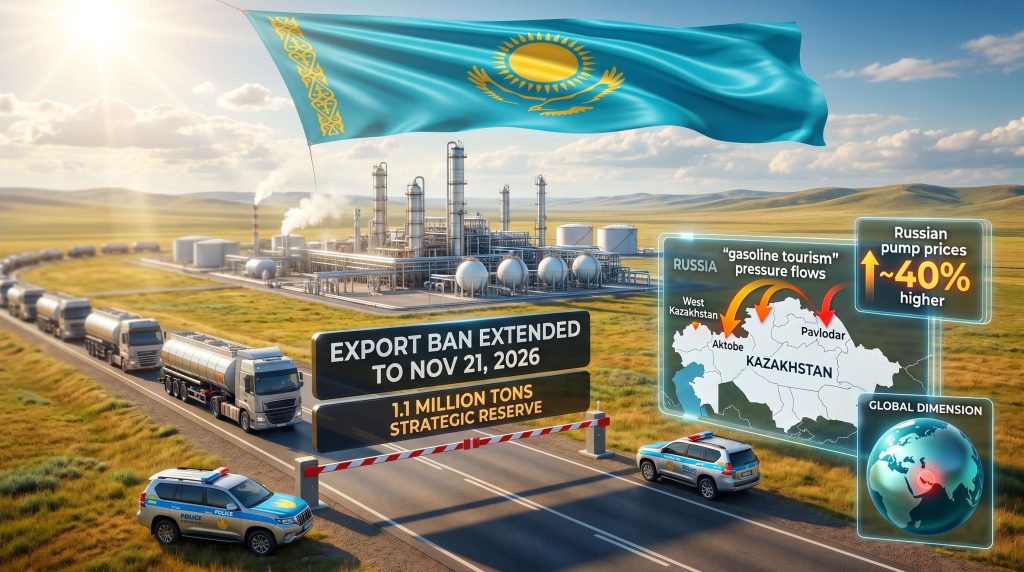
The maintenance window running from June 26 to July 15, 2026 created a predictable but significant dip in domestic refining capacity. With the country's strategic gasoline reserves benchmarked against a 1.1 million tonne baseline considered necessary for supply adequacy, the government moved to ensure that output from operational refineries fed domestic demand rather than export markets.
The ban covers a broad range of petroleum products:
- Gasoline (AI-92 octane and above)
- Diesel and gasoil
- Aviation kerosene
- Light distillates
- Liquefied petroleum gas (LPG), under a separately extended ban from October 2025
- Toluene, xylene, and bitumen
Exempt categories are narrow and deliberately defined, including lubricating oils, fuel in factory-sealed vehicle tanks, jet fuel designated for research and testing, and shipments classified as humanitarian aid under formal government approval.
The Russian Refinery Crisis and the Price Arbitrage Driving "Gasoline Tourism"
The domestic supply calculus in Kazakhstan cannot be fully understood without examining what is happening across its northern border. Ukrainian drone strikes have inflicted meaningful damage on Russian energy infrastructure throughout 2025 and 2026. According to reporting by the International Energy Agency, these attacks have disrupted Russian oil production forecasts and degraded refinery output across multiple facilities. The IEA formally cut its forecast for Russian oil production in response to the cumulative impact of these strikes (IEA, July 2026).
The practical consequence for Kazakhstan has been severe. With Russian refinery capacity curtailed and domestic Russian fuel prices climbing, a stark price differential has opened up between the two countries. The price of a litre of high-octane gasoline in Russia is currently running approximately 40 percent higher than the equivalent price in Kazakhstan, according to Tengri News Agency reporting in early July 2026. In addition, Russian oil trading sanctions have further complicated Russia's ability to stabilise its domestic fuel supply.
This gap has given rise to what is now widely described as gasoline tourism: Russian motorists and commercial operators crossing the border into Kazakhstan to fill up at significantly cheaper pumps, and in some cases transporting illicit quantities back into Russia using vehicles fitted with concealed auxiliary fuel tanks. The effect has been direct and immediate, with queues forming at petrol stations in northern Kazakh border oblasts including West Kazakhstan, Aktobe, and Pavlodar.
Gasoline tourism is more than a nuisance. It is a reliable market signal that price controls or domestic subsidies on one side of a border are being systematically arbitraged by neighbouring market participants, draining the subsidising country's supply reserves in the process.
Kazakh enforcement authorities have responded by deploying police checkpoints across approximately 60 border roads along the Russia-Kazakhstan frontier, with a one-crossing-per-day limit imposed on both passenger vehicles and trucks. On July 4, 2026, officials announced the dismantling of dozens of smuggling operations, with a total of three tonnes of intercepted fuel seized in a single coordinated enforcement action.
How the Export Ban Has Escalated Over Time
The current restrictions did not emerge overnight. Understanding the progression reveals that Kazakhstan's policymakers have been responding reactively to worsening conditions rather than executing a pre-planned energy sovereignty strategy.
| Milestone | Date | Action |
|---|---|---|
| Initial petroleum export ban introduced | November 2025 | Response to early supply tightening |
| LPG ban separately extended | October 2025 | Reflects broader fuel security posture |
| First six-month extension enacted | May 2026 | Covers refinery maintenance and continued demand pressures |
| Refinery maintenance window | June 26 to July 15, 2026 | Reduced domestic supply capacity |
| Enforcement crackdown on smuggling | July 4, 2026 | Dozens of operations dismantled, three tonnes seized |
| Latest extension announced | July 7, 2026 | Ban extended to May 22, 2027 |
Each successive extension reflects a domestic fuel balance that has not stabilised. The lengthening time horizon of the ban is analytically significant: short-term emergency measures are typically lifted once the triggering condition resolves. Multi-stage extensions signal that the underlying pressure is structural rather than episodic. Kazakhstan's extension of the ban has been closely tracked by regional energy analysts monitoring Central Asian supply dynamics.
The EAEU Paradox: Free Trade on Paper, Energy Nationalism in Practice
One of the most analytically interesting dimensions of the Kazakhstan petroleum export ban is its application to fellow Eurasian Economic Union (EAEU) members. The EAEU, which groups Russia, Kazakhstan, Kyrgyzstan, Belarus, and Armenia under a common trade architecture, was designed to guarantee the free movement of goods across member borders. In practice, the bloc has consistently struggled to enforce these provisions uniformly, and energy products have historically been among the most contested categories.
Kyrgyzstan, which is almost entirely dependent on Russian petroleum imports for its domestic fuel supply, has been directly exposed to the dual impact of Ukrainian drone damage to Russian refinery capacity and Kazakhstan's export restrictions. Bishkek has formally requested that Astana grant it an exemption from the ban, and Kazakhstan's Deputy Energy Minister Kayirkhan Tutkyshbayev confirmed that the government was reviewing the appeal as of the reporting period. No exemption had been granted.
The situation illustrates a structural tension at the heart of the EAEU model:
- Regional solidarity assumes surplus capacity will flow freely to deficit members
- National energy security imperatives create powerful incentives to retain that surplus domestically
- Enforcement mechanisms within the EAEU are insufficient to compel member states to export against their domestic interest
Kazakhstan has also incorporated a diplomatic escape valve by reserving the right to approve case-by-case exemptions for humanitarian aid and government-sanctioned supply agreements, preserving some flexibility without opening the floodgates to general export flows.
Russia's Reported Fuel Request: Diplomacy or Distraction?
Reports circulated in late June 2026 that Russia had approached Kazakhstan seeking to import up to 50,000 tonnes of AI-92 gasoline to offset its own domestic shortages. Deputy Minister Tutkyshbayev subsequently stated that no formal request had been received from Moscow, effectively closing the door on the narrative without confirming or denying back-channel discussions.
The scenario, even as speculation, carries significant analytical weight. Russia has historically been the dominant energy supplier within the post-Soviet space, and the prospect of it becoming a recipient of petroleum products from a neighbouring state represents a meaningful inversion of the traditional regional energy hierarchy. If Russian refinery damage continues to deepen, the economic logic for such a request would strengthen, regardless of the diplomatic optics.
| Scenario | Domestic Impact for Kazakhstan | Geopolitical Implication |
|---|---|---|
| Full exemption granted to Russia | Domestic shortages worsen; enforcement costs rise | Kazakhstan perceived as subordinate to Moscow's needs |
| Partial, volume-capped exemption | Manageable if reserves hold at the 1.1M tonne baseline | Diplomatic compromise; sets a precedent |
| No exemption granted | Domestic supply stabilised | Kazakhstan asserts energy sovereignty; some friction with Moscow |
The next major ASX story will hit our subscribers first
The Strait of Hormuz Crisis Adds a Second Layer of Uncertainty
Kazakhstan's fuel supply challenges are now intersecting with a global energy shock of an entirely different origin. The collapse of the US-Iran peace framework and the resumption of military activity in the Persian Gulf have reignited fears of sustained disruption to tanker traffic through the Strait of Hormuz. Approximately 20 percent of global oil supply transits this chokepoint, and any prolonged blockage sends immediate shockwaves through global crude and refined product pricing.
For Kazakhstan, the Hormuz crisis creates a secondary effect that reinforces the export ban logic. Elevated global oil prices increase the domestic value of Kazakhstan's petroleum reserves, strengthening the economic case for retention over export. The Goldman Sachs research desk flagged the renewed Hormuz disruption risk as a fresh threat to global oil supplies in early July 2026. The IEA separately warned that a sustained US-Iran escalation could upend its existing oil surplus forecast, consequences that echo concerns already seen with crude oil geopolitical tensions shaping energy markets throughout 2025.
The smaller economies of Central Asia face the sharpest exposure:
- Kyrgyzstan and Tajikistan have limited domestic refining capacity and rely heavily on imported refined products
- Higher global pricing floors make emergency procurement significantly more expensive
- Regional supply restrictions from Kazakhstan and disrupted Russian exports create a pincer effect on these markets
- Insurance premium increases on tankers transiting or near Hormuz add cost throughout the global supply chain, feeding through to Asian and Central Asian import prices
Key Risk Indicators for Central Asian Energy Markets
Analysts and market participants tracking this situation should monitor the following variables:
- Ukrainian drone campaign intensity targeting Russian energy infrastructure and its cumulative effect on Russian refinery utilisation rates
- Kazakhstan's domestic refinery throughput following the June-July maintenance window, and whether production recovers to levels sufficient to rebuild strategic reserves
- Kyrgyzstan's fuel inventory position and any emergency procurement actions taken by Bishkek
- EAEU-level diplomatic discussions on energy product exemptions, particularly any formal arbitration mechanisms invoked by Kyrgyzstan
- Strait of Hormuz tanker traffic volumes and the trajectory of war risk insurance premiums as a proxy for market confidence in passage security
- Russian domestic gasoline price trends, which will directly determine whether the cross-border price arbitrage driving gasoline tourism narrows or widens
Consequently, supply chain disruptions stemming from multiple simultaneous pressures are making it increasingly difficult for Central Asian markets to source reliable alternative supply channels.
What the Extended Ban Signals About Kazakhstan's Long-Term Energy Strategy
The extension of the Kazakhstan petroleum export ban to May 2027 is not simply a rolling emergency measure. It reflects a broader recalibration of how Astana views the relationship between its hydrocarbon wealth and domestic welfare. Kazakhstan is a major crude exporter, with the bulk of its production destined for European markets via the Caspian Pipeline Consortium. However, crude export revenues and domestic fuel affordability operate on entirely separate tracks. The government's priority has clearly shifted toward ensuring that refinery output serves Kazakh consumers before any surplus reaches external buyers.
This posture is likely to persist as long as three conditions remain in place: continued Ukrainian pressure on Russian refining capacity, a price differential that makes cross-border arbitrage economically attractive, and global energy market uncertainty stemming from the Hormuz situation. Moreover, the global oil price shock reverberating through international markets is reinforcing the domestic case for retaining refined product supply rather than releasing it to export channels.
If any of these conditions resolves materially, the pressure on Kazakh border enforcement would ease and the economic argument for maintaining the ban would weaken. Furthermore, KazMunayGas's petroleum sales framework provides some insight into how the national energy company balances domestic supply obligations against commercial export considerations during periods of constraint.
Disclaimer: This article is intended for informational purposes only and does not constitute financial, investment, or energy trading advice. Forecasts, scenarios, and projections discussed herein involve significant uncertainty. Readers should consult qualified professional advisers before making any decisions based on the information provided.
Want to Stay Ahead of the Next Major Resource Discovery Shaping Global Energy Markets?
While Central Asian fuel supply chains buckle under geopolitical pressure, Discovery Alert's proprietary Discovery IQ model scans ASX announcements in real time, delivering instant alerts on significant mineral discoveries — from energy commodities to critical minerals — so subscribers can identify actionable opportunities ahead of the broader market. Explore how historic discoveries have generated substantial returns and begin your 14-day free trial today to position yourself at the forefront of the next major find.