July 11, 2026
The Geopolitics of Metal Storage: How Sanctions Are Redrawing the LME's Inventory Map
When geopolitical fault lines shift, commodity markets rarely respond with clean, linear adjustments. Instead, they fracture in ways that are deeply counterintuitive, producing statistical anomalies that mask the true structural pressures building beneath the surface. The London Metal Exchange's aluminum warehouse data across the first half of 2026 is a masterclass in exactly this phenomenon.
The numbers appear straightforward on first reading: Russian-origin aluminum has come to occupy a commanding share of available LME stocks — the Russian aluminum share of available LME stocks. However, the story behind those numbers, why they move, what drives the swings, and what the concentration actually signals for global supply chains, is far more complex and carries significant implications for industrial buyers, traders, and risk managers worldwide.
When big ASX news breaks, our subscribers know first
Understanding LME On-Warrant Aluminum Stocks
The Critical Distinction Between Total and Available Inventory
Not all metal sitting in an LME-approved warehouse is created equal. The exchange distinguishes between total reported inventories and on-warrant stocks, which represent metal that has been formally registered and is actively available for delivery against an LME contract. Metal held off-warrant may still physically occupy warehouse space but is not tradable through LME mechanisms until it is re-warranted.
This distinction matters enormously when interpreting inventory data. A warehouse can hold hundreds of thousands of tonnes of aluminum while the on-warrant, or available, figure tells a completely different story about what is actually accessible to the market. Warrant status determines whether metal can be used to settle exchange contracts, making the on-warrant figure the true barometer of tradable supply.
What Country-of-Origin Reporting Reveals
The LME publishes monthly country-of-origin breakdowns for on-warrant stocks across its key metals. This transparency mechanism, intended to improve market visibility, has become one of the most closely watched data sets in the base metals world precisely because it exposes the geopolitical stratification now embedded within exchange-held inventory.
The origin data does not tell us where metal will ultimately be consumed. It tells us which countries' smelters are supplying metal into the formal LME warehousing system, which in turn reveals which geopolitical blocs are effectively underwriting the liquidity of the global aluminum benchmark.
The Structural Shift: Russian Aluminum's Grip on LME Warehouses
A Timeline of Dominance and Volatility in 2026
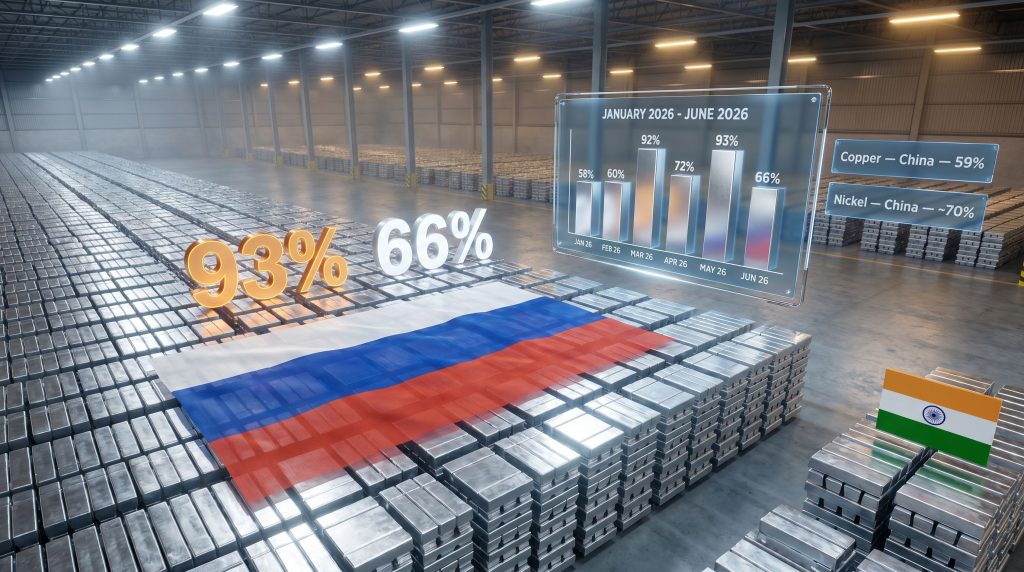
The trajectory of the Russian aluminum share of available LME stocks across the first half of 2026 tells a story of escalating concentration punctuated by sharp percentage swings driven not primarily by Russian volume changes, but by the movement of the only meaningful alternative: Indian aluminum.
| Month | Russian Aluminum Share | Approximate Total Available Stock | Key Driver |
|---|---|---|---|
| January 2026 | ~58% | Baseline period | Relatively balanced origin mix |
| February 2026 | ~60% | Modest increase | Policy-driven storage shifts |
| March 2026 | ~92% | Sharp contraction in non-Russian | Indian metal moved off-warrant |
| April 2026 | ~72% | Partial rebalancing | Indian metal returned to warrant |
| May 2026 | 93% | Further tightening | Accelerated Indian outflows |
| June 2026 | ~95% | Lowest total since April 2025 | Indian stocks fell faster than Russian |
According to LME exchange data reported by Kitco in July 2026, total available aluminum inventories fell 3% in June to approximately 246,600 metric tonnes, the lowest level recorded since April 2025. Available Russian aluminum stocks declined by 3,150 tonnes to 234,025 tonnes during the same period. However, because Indian stocks dropped by a steeper 4,875 tonnes, the Russian share of the available pool actually rose.
This is a critical and frequently misunderstood dynamic. Russian volumes were not surging into LME warehouses; they were simply falling more slowly than everything else.
Why Percentage Share and Absolute Volume Tell Different Stories
One of the most important analytical pitfalls in reading LME origin data is conflating percentage share with absolute volume trends. A rising Russian share does not necessarily indicate that more Russian aluminum is entering the system. It can, and frequently does, indicate that non-Russian alternatives are exiting faster.
Furthermore, the LME nickel crisis of 2022 demonstrated how quickly exchange-held inventory dynamics can spiral beyond expectations when geopolitical and commercial pressures converge simultaneously.
Percentage concentration metrics measure relative disappearance as much as they measure absolute accumulation. When Indian aluminum is withdrawn from warrant status, it effectively cedes its share of the available pool to whatever metal remains, regardless of whether Russian volumes have changed at all.
This mathematical reality is not merely an academic footnote. It has direct implications for how market participants interpret supply tightness, pricing pressure, and the commercial viability of the exchange's aluminum benchmark.
What Does Near-Total Russian Dominance Actually Signal?
The Gap Between Legal Eligibility and Commercial Reality
Understanding the Russian aluminum situation requires separating two distinct realities that operate in parallel. The first is the formal regulatory framework established by Western sanctions. On April 13, 2024, the United States and United Kingdom imposed sanctions that barred Russian-produced aluminum from entering LME warehousing systems if produced after that date. Metal smelted before this cutoff date retained full LME eligibility.
The second reality is commercial behaviour. A substantial portion of the trading community has voluntarily disengaged from handling Russian aluminum regardless of its technical eligibility. This informal market-driven embargo reflects:
- Reputational risk concerns among Western financial institutions and industrial buyers
- Counterparty compliance requirements imposed by banks and insurers
- Supply chain transparency obligations demanded by end-users in regulated industries
- The complexity of verifying production dates for metal already in circulation
The result is a paradox: a warehouse system increasingly filled with metal that is technically tradable but commercially shunned by a meaningful share of potential buyers. In addition, broader commodity market volatility has amplified these pressures, as explored in discussions around commodity market volatility and hedging strategies for 2025 and beyond.
The Indian Aluminum Factor: A Fragile and Finite Counterweight
By the end of June 2026, only 12,575 tonnes of Indian aluminum remained available in LME warehouses, with zero on-warrant stocks from any other country. This left Indian metal as the sole non-Russian alternative accessible through the exchange system.
India's aluminum sector, anchored by producers such as Hindalco and Vedanta's BALCO, has expanded output significantly over the past decade. However, Indian production is not configured to serve as a structural replacement for the volumes that Russian and Western metal suppliers historically provided to the LME system. Indian smelters prioritise domestic demand and export relationships outside the LME's warrant mechanism, meaning that their participation in LME warehousing is opportunistic rather than systematic.
When Indian producers find more attractive premiums in physical over-the-counter markets, they withdraw metal from LME warrant status, and the statistical dominance of Russian metal spikes accordingly. This is precisely what the data showed occurring through early 2026.
Cross-Metal Contamination: Origin Concentration Is Not Unique to Aluminum
Chinese Copper and Nickel Follow the Same Pattern
The origin concentration dynamic visible in aluminum is not an isolated phenomenon. It is replicating across multiple LME base metal markets, creating a systemic pattern of geopolitical stratification in exchange-held inventories. Consequently, the trade war impacts on global markets have compounded the fragmentation already under way within these warehousing systems.
| Metal | Dominant Origin | June 2026 Share | May 2026 Share | Volume Change (June) |
|---|---|---|---|---|
| Aluminum | Russia | ~95% | 93% | Russian stocks fell 3,150t |
| Copper | China | 59% | 53% | Chinese copper fell ~22,375t |
| Nickel | China | ~70% | 75% | Marginal rebalancing in mix |
The copper data is particularly instructive. Despite Chinese copper volumes in LME warehouses falling by approximately 22,375 tonnes to 118,650 tonnes in June, the Chinese share of available copper stocks rose from 53% to 59%. This occurred because stocks from Australia, Chile, Peru, and South Korea declined at an even faster rate, with total available copper inventories dropping by 65,175 tonnes to 201,700 tonnes, the lowest level since February 2026.
This mirrors the aluminum dynamic almost exactly. The dominant origin's share rises not because it is flooding the market, but because alternatives are retreating faster. The growing copper supply pressures driven by US tariffs have further complicated this picture, reducing the commercial flexibility of non-Chinese copper flows into the LME system.
The simultaneous concentration of Russian aluminum, Chinese copper, and Chinese nickel within LME warehouses points to a structural realignment of the global commodity storage system, not a series of unrelated coincidences.
Reading Inventory Drawdowns as Forward Signals
What Falling Total Stocks Indicate for Aluminum Pricing
The decline of total available LME aluminum inventories to their lowest point since April 2025 carries forward-looking implications beyond the origin concentration debate. Physical inventory drawdowns typically reflect one or more of the following conditions:
- Demand is absorbing metal faster than new supply is entering the warranting system
- Producers or traders are choosing to hold metal off-market in anticipation of higher prices
- Supply chain disruptions, including regional conflicts, are preventing new metal from reaching LME-approved facilities
- The commercial stigma attached to available metal is reducing participation in the warrant system
The source material specifically identifies the ongoing conflict in the Middle East as a factor tightening global aluminum supply, contributing to the inventory reduction observed through June 2026. Aluminum smelting is an energy-intensive industry, and regional energy market disruptions carry upstream consequences for smelter economics across the Middle East and beyond, constraining the flow of new metal into global warehouse networks.
The Price Premium Mechanism for Non-Sanctioned Supply
When the commercially acceptable pool of LME aluminum shrinks, physical market premiums for non-sanctioned, non-Russian origin metal respond accordingly. Buyers in Western Europe, North America, and Japan who cannot or will not accept Russian origin material must source from a thinning roster of alternatives, typically paying elevated premiums above the LME cash price.
These premiums are not always fully captured in benchmark price data, making the physical premium markets a more accurate real-time signal of supply stress for origin-conscious buyers than the headline LME price itself. For instance, concerns around European raw material supply have intensified as the pool of commercially acceptable aluminum alternatives contracts.
The next major ASX story will hit our subscribers first
How Procurement and Trading Teams Are Navigating the Landscape
The Commercial Calculus of Russian Metal Acceptance
For buyers operating under strict environmental, social, and governance (ESG) frameworks or subject to financial institution compliance requirements, accepting pre-sanction Russian aluminum — despite its technical eligibility — introduces a complex set of risks:
- Counterparty risk: Banks providing trade finance may decline to fund transactions involving Russian-origin material
- Reputational exposure: End-customers in sectors such as automotive and aerospace are increasingly auditing their supply chains for origin compliance
- Resale limitations: Metal purchased as Russian-origin may face restricted resale options in future markets if sanctions frameworks evolve
- Verification complexity: Establishing with certainty that a given lot of aluminum was produced before April 13, 2024 requires documentation chains that are not always robust
For procurement teams, the practical consequence is that even technically eligible Russian metal often carries a commercial discount that reflects these risk factors, while simultaneously the on-warrant volume of this metal accumulates because fewer buyers are willing to lift it from warehouses.
Frequently Asked Questions: Russian Aluminum and LME Stock Dynamics
What percentage of LME aluminum stocks are Russian in 2026?
The Russian aluminum share of available LME stocks represented approximately 95% of available on-warrant aluminum in June 2026, rising from 93% in May, according to LME exchange data. The figure fluctuated significantly throughout the year, reaching as low as approximately 58% in January before spiking sharply in March.
Why do traders avoid Russian aluminum even when it is technically LME-eligible?
Pre-April 2024 Russian aluminum retains formal LME eligibility, but commercial avoidance stems from bank compliance constraints, ESG supply chain requirements, reputational considerations, and difficulty verifying production dates. This informal withdrawal amplifies Russian metal's statistical dominance within the available pool.
What caused the sharp spike to 92-93% in March and May 2026?
Both spikes coincided with periods when Indian aluminum was moved off LME warrant status in significant volumes, sharply reducing the non-Russian share of the available pool. Russian volumes themselves did not surge during these periods.
How does origin concentration in LME warehouses affect commodity pricing?
High origin concentration reduces the commercially acceptable supply available for settlement, pushing physical premiums for non-sanctioned material higher. It can also distort benchmark pricing signals if a large share of on-warrant stocks is effectively off-limits to significant portions of the buyer base.
The Bigger Picture: Is the LME Becoming a Repository for Geopolitically Stranded Metal?
The concentration patterns visible across aluminum, copper, and nickel in mid-2026 raise a question that the exchange and its regulators will eventually need to confront directly: whether the LME's warehousing and warrant system is gradually evolving into a repository for metal that lacks sufficient commercial acceptance in bilateral physical markets.
If metal accumulates within the LME system precisely because it cannot find willing buyers outside it, the exchange's price discovery function becomes progressively less representative of the true cost of procuring commercially acceptable supply. This gap between the benchmark price and the all-in cost for origin-compliant metal is already measurable in physical premiums and is likely to widen if the geopolitical stratification of warehouse inventories deepens further.
For Western industrial supply chains, the practical imperative is clear: building origin diversification into long-term procurement strategies before the available pool of non-Russian, non-sanctioned-adjacent aluminum tightens further is no longer a risk management nicety. Given the trajectory of the Russian aluminum share of available LME stocks through the first half of 2026, it is becoming a commercial necessity.
This article contains forward-looking analysis and market interpretations based on publicly available LME data and commodity market reporting. Readers should not treat any content herein as financial or investment advice. Commodity markets are subject to rapid change, and past inventory trends do not guarantee future price or supply outcomes.
Want to Stay Ahead of Commodity Market Shifts Driven by Major Mineral Discoveries?
Discovery Alert's proprietary Discovery IQ model delivers real-time alerts on significant ASX mineral discoveries, transforming complex commodity data into clear, actionable insights for traders and investors at every level — explore historic examples of exceptional discovery returns or visit Discovery Alert to begin your 14-day free trial and secure a market-leading edge before the next major opportunity emerges.