
August 1, 2026
The Invisible Architecture of American Monetary Power
Most public debates about the Federal Reserve focus on a narrow question: will rates go up or down by a quarter point? That framing, while understandable, misses something far more consequential. Beneath the surface of routine policy announcements sits a deeper set of assumptions about how money works, what inflation really is, and who the central bank ultimately serves. Those foundational assumptions are now, for the first time in decades, being seriously questioned — and the concept of Kevin Warsh Federal Reserve regime change sits at the centre of that debate.
Understanding what a genuine shift in the Federal Reserve's intellectual framework would mean requires stepping back from short-term rate speculation and examining the structural forces that have been building for over fifteen years.
When big ASX news breaks, our subscribers know first
Why the Existing Monetary Framework Is Under Strain
The Debt Arithmetic That Changes Everything
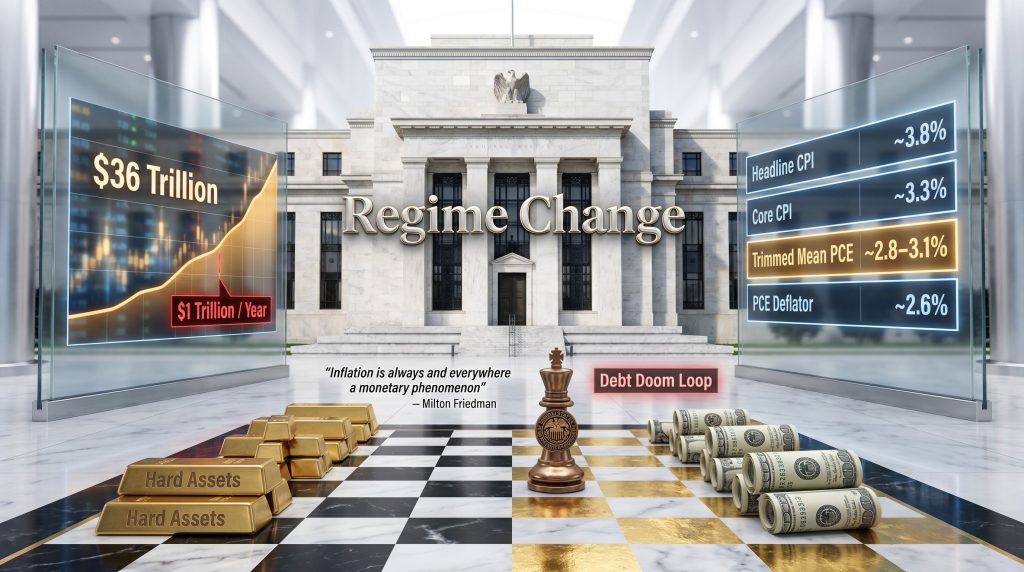
The scale of U.S. federal debt has moved beyond a political talking point and into the realm of binding financial constraint. With the national debt now exceeding $36 trillion, the mechanics of debt service have fundamentally altered the fiscal landscape. Every percentage point increase in average borrowing costs translates into approximately $360 billion in additional annual interest expense. Interest payments have already surpassed $1 trillion per year, a figure that now rivals and in some categories exceeds major spending programmes including defence.
This creates a self-reinforcing pressure on monetary policy that no single Fed chair can easily escape. The government's need to refinance existing obligations at prevailing market rates means that interest rate decisions carry fiscal consequences that dwarf their effects in previous decades. Treasury auctions, which must absorb an enormous and growing volume of debt issuance, have at times shown softening demand, and when institutional buyers become hesitant, yields rise to attract new capital, compounding the interest burden further.
The Federal Reserve audit debate adds another layer to these pressures, as calls for greater institutional transparency intensify against this backdrop of expanding fiscal constraints.
The structural reality is this: U.S. monetary policy is no longer made in isolation from the government's balance sheet. The two are entangled in ways that constrain the range of genuinely independent options available to any Fed leadership.
The Post-2008 Feedback Loop That Became Permanent
The 2008 financial crisis represented a fork in the road for Western monetary policy. Prior to that moment, even amid significant central bank intervention, there remained a broad institutional belief that market mechanisms would ultimately clear excess leverage and that economic contractions, while painful, served a necessary corrective function.
The policy response chosen in 2008 departed from that tradition. Rather than allowing the debt cycle to complete, policymakers flooded the financial system with liquidity on an unprecedented scale. What began as emergency stabilisation became the foundation of a new operating model. Quantitative easing, originally framed as a temporary tool, was deployed across multiple successive cycles, expanding the Federal Reserve's balance sheet into the trillions of dollars and remaining at historically elevated levels even after periods of so-called quantitative tightening.
The consequence of this path was a financial ecosystem that began pricing in permanent central bank support. Risk assets, credit markets, and even sovereign debt valuations became calibrated against the assumption that the Fed would intervene whenever conditions deteriorated sufficiently. This distorted the price signals that markets rely on for capital allocation, and it created a dependency that makes normalisation politically and economically costly.
Kevin Warsh and the Monetarist Revival
Who Warsh Is and Why His Intellectual Background Matters
Kevin Warsh served as a Federal Reserve Governor from 2006 to 2011, placing him at the centre of the institution during the most acute phase of the 2008 crisis. He was among the youngest individuals ever appointed to the Fed Board, giving him both direct institutional knowledge of crisis-era decision-making and a long subsequent period to observe and critique the trajectory those decisions set in motion.
What distinguishes Warsh from recent Fed leadership is not merely his stated policy preferences but the intellectual tradition he draws from. He has publicly and repeatedly aligned himself with the economic framework of Milton Friedman, the Nobel Prize-winning economist whose foundational claim was that sustained inflation is always and everywhere a monetary phenomenon driven by excessive money creation relative to economic output.
Friedman's framework stands in direct opposition to the view that inflation is primarily a supply-chain disruption, a corporate pricing behaviour, or a temporary anomaly correctable through patience. Under the Friedman framework, those factors can generate short-term price spikes, but persistent, embedded inflation requires monetary fuel — specifically an expansion of money supply and credit that outpaces productive economic growth.
Friedman also described inflation as a form of taxation without legislation, meaning that the erosion of purchasing power through money creation is a transfer of real wealth from holders of currency to the entities that benefit from new money entering the system first. This framing has significant implications for who bears the cost of monetary policy decisions, a point returned to later in this analysis.
Jerome Powell, Warsh's predecessor, took a position starkly different from this tradition. Powell argued publicly that monetarism — the intellectual framework linking money supply growth to inflation outcomes — not only lacked important implications for the economic outlook but was something that needed to be actively unlearned within the institution. Warsh has been openly critical of this view, suggesting that rejecting the money-inflation relationship requires a level of institutional insularity disconnected from historical evidence. Kevin Warsh calls for regime change at the Fed, arguing that this intellectual reset is long overdue and essential to restoring central bank credibility.
What "Regime Change" Actually Means in Practice
The term regime change, in a monetary policy context, does not refer to personnel changes alone. It describes a fundamental reorientation of the philosophical assumptions that govern how the central bank interprets data, constructs its communication strategy, and defines its core mandate. In essence, Kevin Warsh Federal Reserve regime change represents a structural intellectual reset rather than a simple change in leadership.
| Dimension | Recent Framework | Warsh's Proposed Direction |
|---|---|---|
| Inflation Measurement | Headline CPI (~3.8%) as primary reference | Trimmed mean inflation as policy anchor |
| Balance Sheet | Elevated from successive QE cycles | Structural reduction as philosophical priority |
| Forward Guidance | Detailed, market-sensitive signalling | Restrained, less prescriptive communication |
| Mandate Emphasis | Dual mandate with employment flexibility | Stronger emphasis on price stability |
| Institutional Culture | Continuity-oriented incrementalism | Structural intellectual reset |
The Three Pillars of the Proposed Monetary Reset
Pillar One: Changing How Inflation Is Measured
One of the most consequential and least publicly discussed elements of any Warsh-led policy shift involves the choice of inflation metric used as a policy anchor. Warsh has expressed preference for trimmed mean inflation over the conventional Consumer Price Index.
The methodological difference is significant. CPI measures price changes across a broad basket of goods and services, including highly volatile components like energy. Trimmed mean inflation removes the largest statistical outliers from the price distribution in both directions, producing a smoother underlying trend signal that filters out commodity price shocks driven by geopolitical events or supply disruptions.
| Metric | What It Captures | Approximate Current Reading | Policy Sensitivity |
|---|---|---|---|
| Headline CPI | All goods and services | ~3.8% | High, includes volatile components |
| Core CPI | Excludes food and energy | ~3.3% | Moderate |
| Trimmed Mean PCE | Strips statistical outliers | ~2.8 to 3.1% | Lower, favours earlier rate adjustment |
| PCE Deflator | Fed's traditional preferred gauge | ~2.6% | Baseline for current policy |
The practical consequence is that if the Fed anchors policy to a metric that reads materially lower than what households experience in grocery stores, fuel stations, and housing costs, it creates conditions where official data could justify rate cuts even while consumer purchasing power continues to erode. This is not necessarily evidence of bad faith, but it is a structural risk embedded in the measurement choice that demands transparency.
Choosing which inflation metric governs monetary decisions is not a technical footnote. It is a political act with distributional consequences that fall most heavily on those with the least ability to hedge against purchasing power erosion.
Pillar Two: Balance Sheet Normalisation as a Philosophical Statement
Reducing the Fed's balance sheet is technically described as quantitative tightening, but under a Warsh-influenced framework it carries a deeper significance. The argument is that the Fed's continued dominance as a buyer of government securities has created a form of market dependency in which sovereign debt is priced partly on the assumption of central bank support rather than purely on fiscal fundamentals.
Unwinding that dependency is operationally complex in an environment where Treasury issuance is simultaneously expanding to cover fiscal deficits. Reducing the Fed's footprint as a buyer while private market demand must absorb more supply puts upward pressure on yields, which then feeds back into the debt service cost problem described earlier. This is one of the central tensions that any genuine balance sheet normalisation programme must navigate.
Furthermore, the broader debate around gold in the monetary system has gained renewed relevance as investors reassess what genuine monetary discipline might look like in a post-QE framework.
Pillar Three: Reforming the Fed's Communication Architecture
Current Fed communication practice, developed and refined over several decades, involves detailed forward guidance about the anticipated path of rates. This practice was originally intended to reduce market uncertainty and improve the transmission of monetary policy. However, the unintended consequence has been the creation of what might be described as a co-dependency between the central bank and financial markets.
Investors increasingly position not on underlying economic fundamentals but on interpretations of Fed language. When communication becomes the primary driver of asset prices, the market loses its function as a genuine price discovery mechanism and becomes a referendum on central bank credibility. A shift toward more restrained, less prescriptive communication would force markets to operate more independently, likely introducing short-term volatility while potentially improving the long-run information content of market prices.
The AI Productivity Argument and Its Bond Market Contradiction
Why the Disinflationary AI Thesis Faces a Timing Problem
Warsh has argued that the artificial intelligence productivity revolution will be structurally disinflationary over time, as efficiency gains reduce costs across broad sectors of the economy. This is a coherent long-run thesis, but it faces a significant near-term complication rooted in capital market dynamics.
Technology companies are collectively projected to spend close to $1 trillion on capital investment in AI infrastructure in 2025 alone. That capital must come from somewhere. A substantial portion is being raised through corporate bond issuance, which creates an enormous new supply of fixed-income securities competing with U.S. Treasuries for investor capital. When AI-related corporate bonds flood the market, investors require higher yields to absorb the supply, and that yield pressure does not stay contained within the corporate bond market. It migrates into the Treasury complex as investors compare relative value across the fixed-income landscape.
The disinflationary benefits of AI, if they materialise, are a multi-decade phenomenon. The capital market pressures from AI infrastructure financing are immediate and observable today. This asymmetry between the long-run thesis and the near-term market mechanics represents one of the more underappreciated tensions in the current policy environment. Consequently, the interplay between gold and bond volatility during this transition period warrants close attention from investors seeking to navigate these crosscurrents.
The Bond Market as the Ultimate Arbiter
Why No Policy Framework Succeeds Without Investor Confidence
Central banks set short-term policy rates. Bond markets determine long-term borrowing costs. This distinction is more than semantic. Mortgage rates, corporate investment financing, and the government's own debt service costs are all tied to long-term Treasury yields, which are set by the collective judgement of investors globally rather than by Fed announcements.
If bond investors conclude that the U.S. fiscal trajectory is unsustainable, or that inflation is being statistically managed downward rather than genuinely controlled, they will demand higher yields as compensation for perceived real return risk. This dynamic operates independently of whatever narrative the Fed constructs. In addition, declining trust in the US dollar among global reserve managers adds another dimension of pressure that no domestic monetary framework can fully insulate against.
Three Scenarios for the Warsh Framework
Scenario A: Credibility Is Established
- Bond investors accept the new measurement framework and believe the institutional commitment to price stability is genuine
- Long-term yields stabilise or decline, reducing refinancing costs and creating fiscal breathing room
- The AI disinflationary narrative gains traction over a multi-year horizon, providing narrative support for policy normalisation
Scenario B: Bond Markets Reject the Framework
- Investors interpret trimmed mean metrics as a mechanism to justify premature easing
- Yields continue rising despite official data showing inflation "under control"
- Rising yields increase debt service costs, which increase deficit financing needs, which increase Treasury supply, which pushes yields higher still, creating a self-reinforcing debt doom loop
Scenario C: Political Pressure Undermines Independence
- Monetary policy becomes visibly aligned with executive branch fiscal priorities
- Global reserve managers reduce Treasury allocations as perceived independence deteriorates
- Dollar purchasing power erosion accelerates as the credibility premium embedded in reserve currency status erodes
The Federal Reserve can construct and communicate a policy narrative. It cannot compel markets to believe that narrative. The entire reform agenda rests on rebuilding credibility that has been degrading for over a decade.
The next major ASX story will hit our subscribers first
Who Pays When the Debt Is Inflated Away
The Distributional Reality of Financial Repression
Historical precedent is instructive on how heavily indebted nations ultimately reduce their real debt burdens. Fiscal surpluses sufficient to retire the debt have been vanishingly rare among reserve currency issuers. Formal default is politically unthinkable for the world's largest economy. The mechanism that has repeatedly done the work is inflation-driven erosion of real debt value, sometimes combined with artificially low interest rates relative to nominal growth — a combination known as financial repression.
If this is the path that unfolds, intentionally or otherwise, the costs and benefits are distributed in a deeply asymmetric way.
| Stakeholder Group | Inflation Scenario Impact | Rate Cut Scenario Impact |
|---|---|---|
| U.S. Treasury / Government | Positive, real debt burden declines | Positive, lower refinancing costs |
| Fixed-income retirees | Negative, purchasing power erosion | Neutral to slightly positive |
| Equity investors | Mixed, depends on earnings relative to inflation | Generally positive |
| Dollar savers | Negative, real returns decline | Negative, lower deposit rates |
| Hard asset holders | Positive, real asset values rise | Positive, lower opportunity cost |
| Nominal bond investors | Negative, real returns compressed | Positive, capital appreciation |
The groups most structurally exposed to purchasing power erosion include retirees on fixed income streams, holders of dollar-denominated savings, annuity recipients whose payments are not indexed to inflation, and long-duration nominal bond investors. However, groups with structural protection include holders of real assets such as property and commodities, equity investors in companies with genuine pricing power, fixed-rate borrowers whose real obligation shrinks as prices rise, and holders of inflation-linked instruments.
Furthermore, central bank gold demand has surged precisely as these distributional concerns have become more widely recognised, reflecting institutional efforts to hedge against the scenarios described above.
The Institutional Origin Problem
Why the Fed Was Never Designed to Protect Purchasing Power
The Federal Reserve was established in 1913 through the Federal Reserve Act with a mandate centred on providing an elastic currency and functioning as a lender of last resort to the banking system. Its foundational design was oriented toward the stability of the financial system and the interests of the banking sector — not toward preserving the purchasing power of ordinary wage earners or savers.
Murray Rothbard's analysis in The Case Against the Fed describes this structural orientation in stark terms, characterising the central bank as an institution whose operations systematically transfer wealth from the general public to the financial sector through the mechanism of money creation. Whether one accepts that framing in full or partially, the historical record suggests that the institution's governance structure, legal mandate, and deeply embedded operational culture create significant resistance to the kind of philosophical reset that a genuinely reform-minded chair would need to execute.
Previous Fed chairs who entered office with strong reform intentions have consistently found that managing a multi-trillion-dollar debt economy limits how aggressively policy can deviate from market expectations without triggering the kind of yield spike that would defeat the reform's own objectives. The Fox News analysis of what Warsh must do underscores the urgency of this challenge, arguing that swift action is needed to undo decades of compounding policy errors before market forces narrow the window of opportunity further.
Key Indicators to Monitor as the Framework Evolves
What the Data Will Tell You Before the Headlines Do
Investors and analysts tracking whether a genuine monetary regime shift is underway — or whether the rhetoric outpaces the reality — should focus on the following real-time and periodic data series:
| Indicator | What It Signals | Frequency |
|---|---|---|
| 10-year Treasury yield | Bond market confidence in U.S. fiscal credibility | Daily |
| Trimmed mean vs. headline CPI spread | Gap between official and household-experienced inflation | Monthly |
| Fed balance sheet total assets | Pace of quantitative tightening progress | Weekly |
| Dollar index (DXY) | Global confidence in USD purchasing power | Daily |
| TIPS breakeven rates | Market-implied inflation expectations over 5 and 10 years | Daily |
| Foreign Treasury holdings | Reserve manager confidence in U.S. debt sustainability | Quarterly |
| AI-sector corporate bond issuance | Leading indicator of Treasury market crowding pressure | Monthly |
Frequently Asked Questions
What is the monetarist view of inflation that Warsh draws from?
Monetarism, most closely associated with Milton Friedman, holds that persistent inflation is fundamentally driven by excessive growth in the money supply and credit relative to productive economic output. Supply chain disruptions and external price shocks can generate temporary price increases, but for inflation to become embedded and sustained, monetary conditions must provide the enabling fuel. This view was the dominant framework in central banking through the 1980s before gradually losing institutional favour in subsequent decades.
How does trimmed mean inflation differ from CPI in practical terms?
CPI captures price changes across a comprehensive basket of consumer goods and services including highly volatile categories. Trimmed mean inflation removes the statistical outliers from the price distribution — both the largest upward movers and the largest downward movers — to produce a smoother underlying trend signal. During periods of energy price spikes, geopolitical commodity shocks, or other temporary distortions, trimmed mean readings will be materially lower than headline CPI, which can influence whether official data justifies policy easing even while households continue to experience meaningful cost pressures.
What is a debt doom loop and why does it matter?
A debt doom loop describes a self-reinforcing cycle in which rising interest rates increase government debt service costs, requiring additional borrowing to fund those costs, which increases total debt outstanding, which puts further upward pressure on yields as the market demands higher compensation for perceived fiscal risk. Each iteration of the cycle worsens the conditions for the next iteration. The mechanism has historical precedents in multiple sovereign debt crises, though the U.S. dollar's reserve currency status provides buffers that most other nations do not have.
Why can bond markets override Federal Reserve decisions?
The Fed controls the overnight federal funds rate, which anchors very short-term borrowing costs. Long-term Treasury yields — which govern mortgage rates, corporate investment financing, and the government's own debt service costs on multi-year obligations — are determined by the collective decisions of global bond investors. When those investors lose confidence in the fiscal trajectory or inflation outlook, they sell bonds or demand higher yields to purchase new issuance, and no Fed statement can reverse that pricing pressure if the underlying concerns are not addressed. The Kevin Warsh Federal Reserve regime change agenda ultimately lives or dies on whether bond markets extend the credibility required for the transition to succeed.
Disclaimer: This article contains forward-looking analysis, macroeconomic projections, and scenario-based assessments that involve significant uncertainty. Nothing in this article constitutes investment advice. Readers should consult qualified financial professionals before making investment decisions. Economic scenarios described represent analytical frameworks, not predictions of specific outcomes.
Want to Stay Ahead of Major Commodity and Resource Discoveries Driven by Shifting Monetary Landscapes?
As debates around Federal Reserve regime change and inflation reshape capital flows into hard assets, Discovery Alert's proprietary Discovery IQ model delivers real-time alerts on significant ASX mineral discoveries — turning complex market signals into actionable investment opportunities for both short-term traders and long-term investors. Explore how historic discoveries have generated substantial returns by visiting Discovery Alert's dedicated discoveries page, and begin your 14-day free trial today to position yourself ahead of the market.