May 14, 2026
Copper's Structural Shift and What One Miner's Numbers Reveal
The global copper market does not move in straight lines. It lurches forward in cycles shaped by decades-long supply decisions, geopolitical friction, and the slow-burning demand created by electrification infrastructure. Understanding where we are in that cycle matters enormously for interpreting any single earnings result, especially when KGHM Q1 core profit beats forecasts and prompts a deeper look at what is really driving the outperformance.
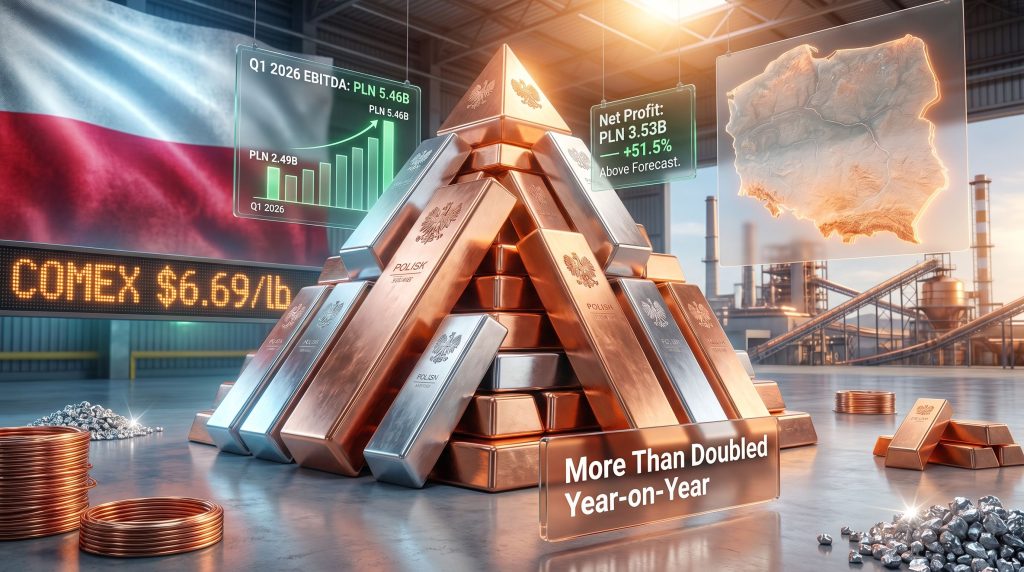
That convergence is precisely what KGHM Q1 core profit beats forecasts data signals when examined against the broader commodity landscape visible in May 2026. On the same day the Polish miner published its results, Comex copper futures had surged to a record $6.69 per pound, silver futures were up 7.47% to $75.495 per ounce, and gold futures had climbed to $4,713.3 per ounce, gaining 3.84%.
Furthermore, Brent crude fell 4.21% to $104.4 per barrel, suggesting a partial easing of the energy cost burden that often compresses smelting margins. This simultaneous rally across base and precious metals created an especially favourable backdrop for an integrated producer with meaningful exposure to all three.
This commodity backdrop is not incidental context. Rather, it is the operating environment, and understanding why KGHM was positioned to benefit more acutely than many peers requires looking beyond a single quarter's headline numbers.
Breaking Down the Q1 2026 Financial Performance
What the Numbers Actually Show
The headline figures from KGHM's Q1 2026 result are striking in both scale and consistency.
| Financial Metric | Q1 2026 Result | Prior Year Comparison | Consensus Forecast | Variance |
|---|---|---|---|---|
| Adjusted Core Profit (EBITDA) | PLN 5.46 billion (~$1.51B USD) | More than doubled YoY | Below actual | Beat |
| Net Profit (Jan–Mar) | PLN 3.53 billion | Approximately 10x increase YoY | PLN 2.33 billion | +51.5% above forecast |
| Polish Domestic Unit EBITDA | More than tripled YoY | — | — | Significant outperformance |
| USD/PLN Exchange Rate Applied | 3.6274 | — | — | Reference conversion |
The gap between reported profit and analyst expectations is particularly notable. A 51.5% positive variance is not the sort of result explained by minor modelling errors. Instead, it points to a material disconnect between how the market priced KGHM's earnings power and what its integrated operating model delivered.
To place that in a broader context, the EBITDA trajectory over recent periods is equally revealing:
| Period | Adjusted Core Profit (EBITDA) | Key Driver |
|---|---|---|
| Q1 2024 (estimated) | ~PLN 1.56 billion | Base period |
| Q1 2025 | PLN 2.49 billion | +60% YoY, copper price recovery |
| Q1 2026 | PLN 5.46 billion | +119% YoY, price surge and domestic strength |
Over two years, adjusted EBITDA expanded by roughly 250%. Consequently, the result looks less like a short-term bounce and more like sustained earnings expansion supported by embedded operating leverage.
Three Drivers Behind the Profit Surge
A beat of this magnitude rarely comes from one factor alone. In KGHM's case, three dynamics appear to have converged.
- Commodity price leverage: As a vertically integrated producer, KGHM captures value from mining through refining. Therefore, when prices rise, benefits flow across multiple stages rather than just one.
- Domestic unit outperformance: The Polish operations delivered the strongest uplift, with adjusted EBITDA growth exceeding 200% year-on-year.
- Currency hedging discipline: Although a weaker US dollar can dilute zloty-denominated revenue, KGHM's FX hedging softened that impact.
In addition, the company's diversified exposure to copper, silver, gold and molybdenum created a broader earnings base. That mattered because silver's 7.47% jump added meaningful support alongside the copper rally.
As KGHM's own results centre indicates, adjusted EBITDA remains a key measure for evaluating heavy industrial miners because it better isolates underlying cash-generative performance from depreciation and financing noise.
How KGHM Compares With Global Copper Producers
The Integrated Producer Advantage
The copper sector includes business models ranging from explorers to concentrate sellers and smelter-only operators. KGHM holds a distinctive position as one of the relatively few large-scale European groups with full mine-to-refinery integration.
| Dimension | KGHM | Typical Concentrate Seller | Smelter-Only Operator |
|---|---|---|---|
| Integration Level | Full (mine to refinery) | Mine and concentrator only | Processing only |
| Revenue Capture | Full metal value chain | Concentrate price minus TC/RC | Treatment and refining charges |
| Commodity Exposure | Copper, silver, gold, molybdenum | Primarily copper | Copper output only |
| Geographic Base | Poland (EU-based) | Predominantly LatAm, DRC | Varies |
| Pricing Leverage | Maximum during bull markets | Moderate | Minimal |
| Hedging Capacity | Active FX and commodity | Variable | Variable |
This distinction is critical. During rising markets, integrated producers capture more of the upside. However, during weaker periods, they can also absorb costs more effectively through downstream processing revenues.
The Supply Gap Narrative
KGHM's beat comes at a time when global copper supply reliability is under serious scrutiny. For instance, concerns around major producer transparency and output have sharpened attention on established supply. That broader market tension aligns with growing concern over the coming copper supply crunch.
Meanwhile, questions around the Codelco production outlook reinforce how important dependable existing producers have become. Even where large resources are identified elsewhere, the path from discovery to production is often measured in years.
As a result, KGHM's established Polish operations carry scarcity value. They are already connected to mature smelting and refining infrastructure, which is difficult to replicate quickly or cheaply.
KGHM's Strategic Growth Agenda: Beyond Q1
Securing Ore Closer to Home
In April 2026, KGHM disclosed plans to invest in mining assets across Europe and Morocco. The appeal is straightforward: shorter ore transport distances lower logistics costs and streamline flows into Polish smelting assets.
Furthermore, European sourcing offers an additional benefit in the form of regulatory and trade familiarity. Morocco, meanwhile, presents geological potential that could complement KGHM's processing base.
This strategy also reflects a broader effort to tighten the supply chain. By bringing ore sources closer to core infrastructure, KGHM may improve unit economics and reduce exposure to shipping disruption.
Renewable Energy as a Cost Strategy
KGHM has also shown interest in energy-related acquisitions. For an energy-intensive smelter, that is less about branding and more about margins. Lower-cost power can materially improve profitability per tonne.
That is why trends in renewable energy in mining matter here. In the same vein, the rise in energy transition demand continues to support copper's strategic importance while also encouraging miners to rethink energy sourcing.
Shareholder Returns and Capital Allocation
KGHM's share price more than doubled in the twelve months through March 2026, reflecting a substantial re-rating. Additionally, with quarterly EBITDA at PLN 5.46 billion and net profit at PLN 3.53 billion, the company has greater flexibility around dividends, acquisitions and balance sheet management.
According to a Reuters report on the quarter, the result materially exceeded market forecasts. That naturally raises expectations over how management allocates capital from here.
The Copper Market's Structural Trajectory
Reading Earnings as a Market Signal
When KGHM Q1 core profit beats forecasts by such a wide margin, the result works as more than a company update. It also offers a real-time signal about market tightness and realised pricing power across the quarter.
Realised prices matter because they reflect what producers actually captured over months of production and delivery, rather than a single spot-market snapshot. Therefore, the quarter suggests strength that was sustained, not merely episodic.
The Electrification Demand Thesis
Copper's role in electrification is already well established. Electric vehicles, expanded power grids, renewable installations and data centres all require substantial copper volumes. In parallel, many of the same themes are captured in current analysis of copper price growth drivers.
That longer-term demand profile helps explain why KGHM Q1 core profit beats forecasts should be viewed in structural rather than purely cyclical terms. The result shows how supportive pricing translates directly into operating earnings.
Macro and Currency Risks
Even so, there are meaningful risks that could affect future quarters:
- Persistent USD weakness: this could reduce zloty-equivalent revenues despite hedging.
- Energy cost reacceleration: European power and gas remain volatile.
- Copper price mean reversion: record prices can correct sharply.
- Execution risk: acquisitions in Europe or Morocco may prove more complex than expected.
- Domestic cost inflation: labour and energy costs in Poland could erode margins.
Disclaimer: The analysis above includes forward-looking assessments that are inherently uncertain. Past performance and commodity price trends do not guarantee future outcomes.
Frequently Asked Questions: KGHM Q1 2026 Earnings
What is KGHM's core business?
KGHM Polska Miedź S.A. is Poland's largest integrated copper and silver producer. It operates mines, smelters and refineries in Poland, alongside international interests including Sierra Gorda in Chile and assets in North America.
Why did profits beat forecasts so strongly?
The beat was driven by record copper prices, strong silver prices, exceptional domestic operating performance and disciplined currency hedging. Together, these factors created unusually powerful earnings leverage.
How large was the gap to expectations?
Net profit reached PLN 3.53 billion versus a consensus estimate of PLN 2.33 billion. That represents outperformance of about 51.5%.
What should investors watch next?
The most important indicators include:
- Comex copper prices
- Silver price momentum
- FX hedging disclosures
- Acquisition announcements
- Sierra Gorda output
- Polish cost trends
Key Indicators to Watch in the Months Ahead
KGHM's Q1 2026 result validates the company's integrated business model under favourable commodity conditions. More importantly, it highlights the growing value of established European processing capacity in a market where supply reliability is increasingly scarce.
Ultimately, KGHM Q1 core profit beats forecasts is more than a strong quarter. It reflects decades of infrastructure investment, operational depth and financial discipline converging at a moment when the copper market is rewarding exactly those qualities.
Want To Catch the Next Major Copper Discovery Before the Market Does?
Discovery Alert's proprietary Discovery IQ model scans ASX announcements in real time, instantly identifying significant mineral discoveries — including copper — and delivering actionable alerts to subscribers ahead of the broader market. Explore historic discoveries and the returns they generated, then begin your 14-day free trial to ensure you're positioned when the next major discovery hits the exchange.