May 13, 2026
The Silent Vulnerability Inside Every Processing Circuit
Reliability in mineral processing is rarely lost in dramatic fashion. It erodes quietly, one sensor failure at a time, one unplanned shutdown cascading into the next, until operational confidence deteriorates across an entire circuit. In high-throughput copper and cobalt operations, VEGA level switches in copper and cobalt processing represent a critical line of defence, where processing chains run continuously across multiple interconnected stages and the weakest link is often not the equipment itself but the instrumentation tasked with monitoring it.
This dynamic is particularly acute in the Congolese Copperbelt, where some of the world's most chemically aggressive processing environments are combined with some of its highest-value ore deposits. In that context, the question of which level measurement technology can withstand decades of corrosive, steam-laden, alkaline process conditions is not an academic one. It is a question with direct consequences for metal supply chains that underpin global electrification.
When big ASX news breaks, our subscribers know first
Why Copper and Cobalt Processing Creates Extreme Instrumentation Demands
The Copperbelt's Unique Geological and Geochemical Profile
The Congolese Copperbelt occupies a geological position unlike almost anywhere else on Earth. Copper ore grades at operations within this region can exceed 5% copper, a figure that stands far above the global commercial mining average of roughly 0.5% to 1%. That concentration disparity shapes everything downstream, from metallurgical circuit design to the sheer intensity of chemical processing required to achieve refined metal outputs.
The co-occurrence of copper and cobalt in the same ore body is a defining characteristic of Copperbelt mineralogy. Rather than a simple single-metal extraction process, producers in this region must navigate multi-stage separation circuits designed to recover both metals efficiently without cross-contamination. The DRC mineral resources profile also positions the country as holding one of the world's largest shares of cobalt, a fact that has elevated the Copperbelt's strategic importance considerably as lithium-ion battery demand continues to accelerate across the electric vehicle and grid storage sectors.
Adding further complexity is the presence of uranium as a trace mineral in Copperbelt ores. While concentrations remain at trace levels, this introduces material selection constraints for instrumentation components that make wetted contact with the ore stream, as well as implications for regulatory compliance frameworks governing radioactive material handling.
The Chemistry of Corrosion: What Process Environments Actually Look Like
Understanding why standard instrumentation fails in copper-cobalt processing requires a clear picture of the chemical conditions involved. The following table summarises the key stress conditions across major processing stages:
| Process Stage | Primary Chemical Stress | Secondary Stress | Instrumentation Risk |
|---|---|---|---|
| Froth Flotation | Reagent-laden slurries, surfactants | Foam, variable pulp density | False readings, sensor fouling |
| Acid Leaching | Acidic to strongly acidic solutions | Elevated temperature | Corrosion of wetted materials |
| Alkaline Scrubbing Columns | pH 11 alkaline wash water | Steam exposure | Combined corrosion and condensation |
| Solvent Extraction | Organic solvents, emulsified phases | Interface instability | Dielectric property variation |
| Electrowinning Cells | Electrolyte solutions, acidic pH | Electrical interference | Signal noise, material attack |
One application that illustrates the combined stress challenge particularly well is the scrubbing column circuit, where wash water operating at pH 11 creates a strongly alkaline environment. This is simultaneously exposed to steam in the column headspace, creating a dual-stress scenario that is especially destructive to instrumentation not specifically engineered for it. Critically, pH 11 is an alkaline condition, not acidic — a distinction that matters considerably when specifying wetted materials for sensor components.
From Rock Face to Refined Metal: The Processing Chain in Detail
Copper: Mechanical Liberation Through to Cathode Production
Copper extraction at large Copperbelt operations begins with opencast mining, where ore is extracted and crushed to liberate copper-bearing minerals from surrounding host rock. The crushed ore then enters froth flotation circuits, where chemical reagents render copper mineral surfaces hydrophobic. When air is injected into the flotation cell, hydrophobic copper particles attach to rising bubbles and accumulate at the surface as a mineral-rich froth concentrate.
That concentrate undergoes smelting to produce blister copper, which is then cast into anodes. Electrolytic refining completes the process: copper anodes are dissolved electrochemically in an acidic copper sulphate electrolyte, with pure copper plating selectively onto cathode substrates. The result is a copper cathode product typically achieving 99.99% Cu purity, meeting the specifications required for electrical conductor applications in grid infrastructure, transformers, and EV motors. For context on how copper market trends are evolving globally, demand pressures from electrification continue to intensify the need for reliable processing output.
Cobalt: Hydrometallurgical Recovery and Electrowinning
Cobalt recovery diverges from copper processing after the smelting stage. Smelting residues, which retain significant cobalt concentrations, are treated hydrometallurgically: acids dissolve the cobalt into aqueous solution, after which a sequence of solvent extraction and chemical separation stages isolates cobalt from impurity elements including iron, manganese, and zinc.
The purified cobalt solution then enters electrowinning cells, where direct electrical current drives the selective plating of cobalt metal onto cathode substrates. The cobalt cathode product that emerges is of sufficient purity for battery precursor chemistry applications, serving cathode active material manufacturers supplying the lithium-ion battery supply chain. Furthermore, shifts in Congo cobalt export impacts have reinforced how sensitive downstream battery supply chains are to upstream processing continuity.
Where Level Measurement Intersects the Processing Chain
Reliable level detection is not a single-point requirement in copper-cobalt processing. It is distributed across the entire circuit:
- Flotation columns: Froth-pulp interface stability requires continuous level monitoring to optimise air-to-pulp ratio and recovery efficiency
- Leach tanks: High and low setpoints protect against overflow and prevent pump dry-run damage in both acid leach and alkaline circuits
- Scrubbing columns: Continuous level monitoring in alkaline wash water circuits under steam exposure
- Electrowinning cells: Electrolyte level management protects cathode geometry and current efficiency
- Thickener underflows: Density and level monitoring to optimise pulp discharge and water recovery
How VEGA Level Switches Work and Why the Physics Matter
The Vibrating Fork Principle Explained
The core operating mechanism of a vibrating fork level switch is elegant in its simplicity. A two-pronged tuning fork structure, mounted on the process connection, is driven to oscillate continuously at its natural mechanical resonant frequency by a piezoelectric excitation element. This self-sustaining oscillation occurs in air or vapour without any external process contact.
When rising liquid makes contact with the fork prongs, the mechanical load on the vibrating structure increases. This damping effect causes a measurable shift in the resonant oscillation frequency. The electronics module continuously monitors this frequency and, upon detecting the characteristic shift associated with liquid immersion, converts the change into a binary switching output — a clean, unambiguous wet or dry signal that feeds directly into pump control logic, alarm systems, or safety interlock circuits.
This frequency-shift detection principle means the sensor output is entirely independent of the electrical conductivity, colour, opacity, or optical properties of the liquid. It functions equally in clear water, dark slurries, alkaline wash solutions, and chemically aggressive leachates, provided the wetted materials are appropriately specified for the chemical environment.
VEGASWING 63: Technical Capability in Mining-Grade Applications
The VEGASWING 63 is specifically designed for demanding point-level applications in liquid media. Its tube extension design allows side-wall tank mounting with the fork element projecting into the process medium, enabling installation without requiring top-entry access to the tank. Key technical parameters relevant to mining applications are summarised below:
| Specification | Parameter |
|---|---|
| Detection Principle | Vibrating tuning fork, resonant frequency shift |
| Mounting | Side-wall with tube extension (selectable lengths) |
| Liquid Density Range | 0.5 to 2.5 g/cm³ |
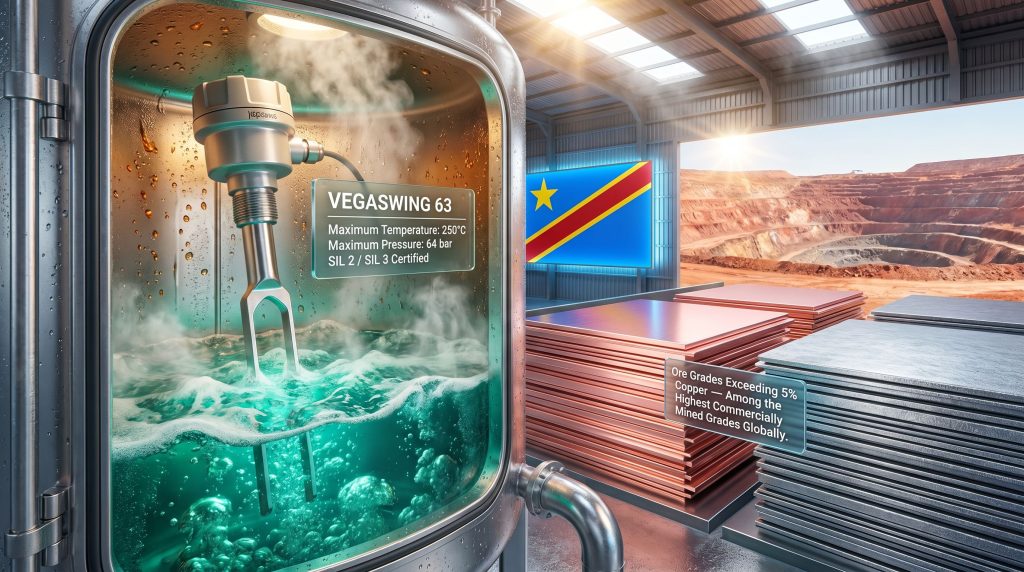
| Maximum Process Temperature | Up to 250°C |
| Maximum Process Pressure | Up to 64 bar |
| Safety Integrity Level | SIL 2 / SIL 3 capable |
| Hazardous Area Approval | ATEX certified |
| Output Signal | Binary switch (relay or transistor) |
| Control System Integration | PLC and DCS compatible; HART and IO-Link support |
The SIL 2 and SIL 3 capability deserves specific attention. Safety Integrity Level certification, defined under IEC 61508 and IEC 61511, quantifies the probability of dangerous failure on demand for a safety instrumented function. A SIL 2 rating requires a probability of dangerous failure on demand (PFD) of between 1×10⁻³ and 1×10⁻², meaning the function fails dangerously in no more than one in every thousand demands. For overfill prevention at mining operations where failure consequences include environmental contamination, equipment destruction, or personnel injury, SIL-rated instrumentation is frequently mandated by site safety management systems.
Dual Setpoint Protection: How the Logic Chain Operates
The VEGASWING 63 at KCC operates on a dual-setpoint protection architecture that addresses both overflow and dry-run failure modes:
High-Level Protection Sequence:
- Process liquid rises toward the pre-configured high-level setpoint within the scrubbing column
- The vibrating fork becomes immersed, and the electronics detect the resonant frequency shift
- A switch output signal is transmitted to the site's PLC-based control system
- The control system activates the high-level alarm and commands inlet pumps or fill valves to stop
- The alarm state is held until liquid level retreats below the setpoint threshold
Low-Level Protection Sequence:
- Liquid level drops to the pre-configured low-level setpoint
- The fork returns to free-air oscillation as it emerges from the liquid
- The resulting frequency change triggers the dry-detection switch output
- The control system initiates a refill sequence or shuts down downstream pump circuits
- Centrifugal and peristaltic pumps are protected from dry-run damage, preventing seal failure and impeller wear
The Case for VEGA in Corrosive Mining Environments: Performance vs. Alternatives
Comparative Technology Assessment
Not all level detection technologies perform equally when exposed to the combined stresses of alkaline chemistry, steam, and high-temperature conditions. The following comparison illustrates the relative capability of competing technologies across parameters relevant to copper-cobalt processing:
| Technology | Corrosive Media Tolerance | Foam and Froth Immunity | Moving Parts Failure Risk | SIL Certification Availability | Estimated Mining Lifespan |
|---|---|---|---|---|---|
| Vibrating Fork (VEGA) | High | High | None | SIL 2/3 | 10 to 15+ years |
| Float Switch | Limited | Low | Present | Rarely certified | 3 to 7 years |
| Capacitive Probe | Moderate | Moderate | None | Some models | 5 to 10 years |
| Conductive Probe | Low | Low | None | Rarely | 2 to 5 years |
| Ultrasonic | Moderate | Poor | None | Some models | 5 to 8 years |
The absence of moving parts is a critical design advantage in corrosive slurry environments. Float switches, which rely on a mechanical float element rising and falling with liquid level, are vulnerable to float corrosion, fouling with mineral scale, and jamming in a fixed position due to chemical attack on the pivot mechanism. A jammed float switch that fails to indicate a rising level presents precisely the overfill scenario that level measurement is intended to prevent. Industry reporting on corrosion management in mining further underscores how material selection and sensor design directly influence long-term reliability in these environments.
The Economics of Reliability: Total Cost of Ownership in Context
Instrumentation procurement in mining operations is frequently evaluated on upfront unit cost, a framework that systematically undervalues operational reliability. A more rigorous evaluation uses total cost of ownership (TCO) analysis:
- Replacement frequency: A sensor requiring replacement every three to five years versus one operating reliably for fifteen or more years represents a direct consumable cost differential that dwarfs the initial price premium
- Maintenance labour: Field technician time for recalibration, troubleshooting, and replacement carries significant cost in remote African mining locations where specialist labour is expensive and logistically complex to deploy
- Unplanned downtime: A single instrumentation-driven process interruption affecting a continuous hydrometallurgical circuit can suspend production across multiple downstream stages simultaneously
- False trip costs: An unreliable sensor generating nuisance trip signals creates pressure to bypass safety interlocks, progressively undermining the protection framework the instrumentation was installed to provide
The operational evidence from KCC's deployment of VEGASWING 63 units across more than two decades of continuous service in pH 11 alkaline, steam-exposed scrubbing column applications speaks directly to this TCO argument. Sustained performance across that timeframe, without the maintenance burden associated with alternative technologies, represents the practical validation of the engineering specification.
The Broader VEGA Technology Portfolio for Mining Applications
Matching Sensor Technology to Process Application
Beyond vibrating fork point-level detection, copper-cobalt processing operations deploy a range of measurement technologies across their circuits. The following matrix matches VEGA sensor series to specific mining applications:
| Application | Recommended Technology | Primary Selection Rationale |
|---|---|---|
| Scrubbing column level control | VEGASWING 63 (vibrating fork) | Corrosion resistance, dual setpoint, no moving parts |
| Flotation cell continuous level | VEGAPULS radar (non-contact) | Foam tolerance, non-contact, high accuracy |
| Leach tank interface detection | VEGAFLEX guided wave radar | Liquid-liquid interface capability |
| Pump inlet protection | VEGASWING 61 (direct mount) | Compact design, fast response |
| Thickener underflow density | VEGASOURCE radiometric | Non-invasive, no fouling contact |
| Process pressure monitoring | VEGABAR pressure transmitter | Hydrostatic level, pump protection |
The radiometric measurement option within the VEGASOURCE series deserves particular mention for high-fouling applications. By using a sealed gamma radiation source mounted externally to the vessel, the technology achieves non-invasive measurement with zero wetted components, eliminating fouling, corrosion, and abrasion as failure mechanisms entirely. In applications such as thickener underflow density monitoring where slurry compositions are extremely aggressive, this approach can eliminate instrumentation as a maintenance category altogether.
The next major ASX story will hit our subscribers first
Instrumentation as a Strategic Variable in Critical Mineral Supply Chains
The Underappreciated Link Between Sensors and Metal Production Continuity
Process instrumentation typically represents well under 1% of total capital expenditure at a large-scale mining operation. Yet its influence on production continuity, and by extension annual metal output and revenue, is disproportionately large. A processing circuit that operates at 95% availability versus 97% availability due to instrumentation-related interruptions represents a meaningful difference in annual copper cathode and cobalt metal production at operations processing thousands of tonnes of ore daily.
This relationship becomes strategically significant when considered alongside broader critical minerals demand trajectories, as the Copperbelt hosts capacity expansions that will shape global supply availability for both metals through the 2030s. At operations of this scale and strategic importance, instrumentation reliability is not merely an operational consideration — it is a variable in global critical mineral supply chain resilience.
Instrumentation Reliability and ESG Performance
The connection between sensor performance and environmental, social, and governance (ESG) outcomes is increasingly recognised by mining operators and their investors. Overfill incidents caused by level measurement failures can result in:
- Process liquid spills with potential to contaminate surrounding soils and water courses
- Regulatory non-compliance events triggering operational suspensions or penalties
- Community relations damage in areas where mining's environmental footprint is under close scrutiny
- Elevated insurance risk ratings affecting operating costs
Reliable level measurement directly reduces the probability of these outcomes, contributing measurably to spill prevention and environmental compliance performance. In regions such as the DRC, where environmental licensing and community social licence are both active operational considerations, this contribution carries practical value beyond the purely operational. Broader reporting on sustainable African mining further reinforces how instrumentation choices feed into wider ESG commitments across the continent.
The Value of Multi-Decade Instrumentation Partnerships
KCC's relationship with VEGA Controls spanning more than twenty years of continuous deployment illustrates a dynamic that is frequently undervalued in mining procurement strategy. Long-term instrumentation partnerships accumulate institutional knowledge of site-specific process conditions, chemical variations, and operational history that is genuinely difficult to replicate through periodic competitive tender cycles.
An instrumentation supplier with twenty years of deployment data from a specific operation understands the seasonal variations in ore chemistry, the specific failure modes that have been encountered and resolved, and the configuration parameters that have been optimised for local conditions. That accumulated knowledge is not visible in a unit price comparison but represents real operational value.
Consequently, as global cobalt production scales up to meet energy transition demand, the instrumentation partnerships built on that foundation of experience will play a quiet but consequential role in determining whether those capacity increases translate reliably into sustained metal output. VEGA level switches in copper and cobalt processing environments are, in this sense, far more than a line item in a capital expenditure budget — they are an embedded variable in the reliability of critical mineral supply chains that underpin the global energy transition.
Disclaimer: This article is intended for informational purposes only and does not constitute investment advice, financial recommendations, or endorsement of any specific company or product. Readers should conduct independent due diligence before making any investment or procurement decisions. Forward-looking statements and production forecasts referenced herein are subject to material risks and uncertainties.
Want to Track the Next Major Copper or Cobalt Discovery Before the Market Catches On?
Discovery Alert's proprietary Discovery IQ model delivers real-time alerts on significant ASX mineral discoveries — instantly translating complex data across 30+ commodities into clear, actionable insights for both traders and long-term investors. Explore how historic mineral discoveries have generated substantial returns and begin your 14-day free trial today to position yourself ahead of the market.