June 4, 2026
The Underground Equipment Economy: How a US$70M Fleet Order Reveals the True Cost of Building a World-Class Copper Mine
Underground mining economics are rarely discussed in terms of equipment alone, yet the procurement decisions made years before a tonne of ore reaches a processing plant often determine whether a mine achieves its production ceiling or stalls in a costly development loop. The capital required to properly equip a mid-tier underground copper operation is staggering by most industrial standards, and the lead times involved mean that every procurement decision is simultaneously a bet on future commodity demand, contractor capability, and technological reliability.
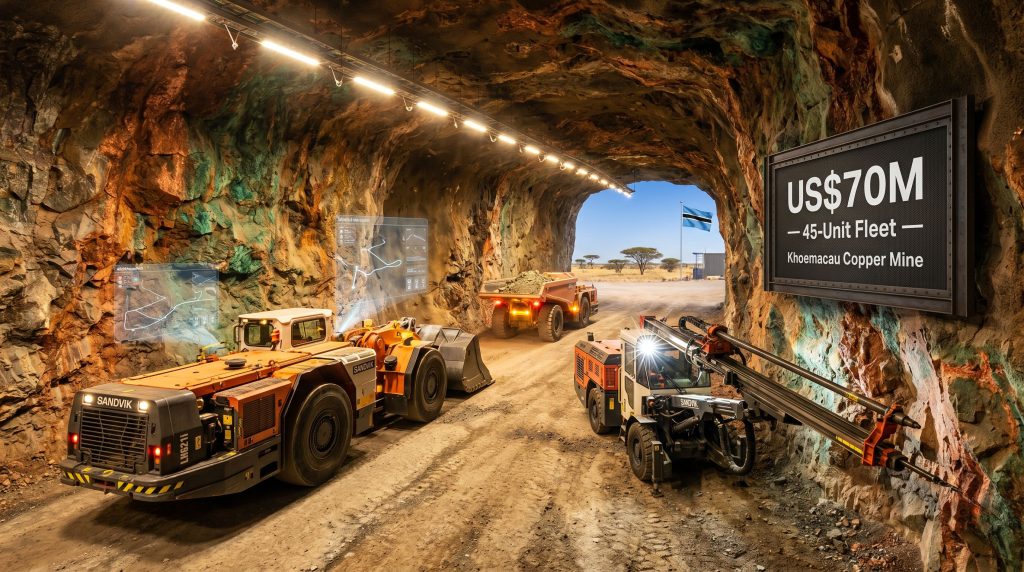
The Sandvik JCHX order for Khoemacau copper mine in Botswana, placed in Q2 2026 and valued at approximately US$70 million, offers a rare window into the full machinery of underground mine development at scale. It also raises questions that go well beyond a single equipment contract: Why is the Kalahari Copper Belt attracting this level of capital attention now? What does automation actually deliver in a remote African underground copper mining environment? And what does the progression from a 32-unit fleet to a 45-unit fleet tell us about MMG's long-term production ambitions at Khoemacau?
When big ASX news breaks, our subscribers know first
The Kalahari Copper Belt: An Underappreciated Geological Frontier
Copper's geological story in Africa is typically told through the lens of the Central African Copperbelt, the high-grade, high-volume corridor spanning Zambia and the Democratic Republic of Congo that has dominated global copper supply narratives for decades. However, a second, structurally distinct copper-bearing system runs through northwest Botswana and into Namibia, and it has spent most of its commercial life in relative obscurity.
The Kalahari Copper Belt is a sediment-hosted stratiform copper district, a geological classification that distinguishes it meaningfully from the Central African Copperbelt's different structural setting. Sediment-hosted stratiform deposits tend to follow predictable bedding planes, which can be advantageous for underground mine planning, but they also require systematic deep drilling programmes to confirm continuity at depth, a process that is capital-intensive and time-consuming.
What makes this corridor particularly compelling from an exploration standpoint is how little systematic deep drilling has been completed relative to its strike length. Unlike Zambia's mature copper districts, where surface and near-surface resources have been extensively characterised over many decades, the Kalahari Belt retains genuine resource expansion optionality at depth. For operators like MMG, this means the infrastructure investment being made today at Khoemacau is not merely sustaining known resources but positioning the operation to capture upside that has not yet been fully delineated.
MMG's Zone 5 underground mine and Boseto processing plant represent the most technically developed expression of this geological potential currently in production, and the infrastructure commitments being made through the Sandvik JCHX equipment programme reflect confidence in the belt's long-term productivity. Furthermore, the copper market trends shaping global demand make this timing particularly significant for new production capacity coming online.
Dissecting the US$70M Contract: What 45 Units Actually Represent
The headline figure of US$70 million for 45 units works out to an average unit cost of roughly US$1.56 million per machine, a number that underscores just how capital-intensive underground hard-rock mining equipment has become. In practice, the fleet is not uniform, and individual machine values vary considerably depending on complexity and size.
According to reporting by Mining.com, the contract covers the following equipment categories:
- Toro underground trucks for ore and waste haulage within the mine's underground network
- Toro loaders (load-haul-dump machines) for mucking operations following blasting cycles
- Development drill rigs to advance underground tunnels and access drives
- Long-hole production drills for stope drilling, enabling bulk ore extraction from developed ore zones
- Raise-boring equipment for developing vertical and inclined connections between levels
- Utility support vehicles providing ancillary underground services
The inclusion of raise-boring equipment is particularly instructive. Raise borers are used to develop ore passes, ventilation raises, and shaft connections between levels, infrastructure that becomes necessary only when a mine is pushing its underground footprint deeper or wider than its existing level configuration supports. Their presence in the 2026 order, absent from the composition description of the 2025 order, suggests that Khoemacau's underground development is entering a phase focused on vertical or lateral extension rather than simply sustaining current production zones.
| Contract Parameter | Detail |
|---|---|
| Contract Value | Approximately US$70 million |
| Order Placement | Q2 2026 |
| Number of Units | 45 |
| Delivery Start | August 2026 |
| Delivery Completion | April 2030 |
| Automation Platform | AutoMine (loaders and long-hole drills) |
| Contracting Party | JCHX Mining Management |
| Mine Operator | MMG |
| Location | Kalahari Copper Belt, Northwest Botswana |
JCHX Mining Management: Understanding the Contract Miner Business Model
To fully appreciate the strategic significance of this order, it is worth understanding what JCHX Mining Management actually does and why equipment procurement decisions carry such weight for contract mining companies specifically.
JCHX is a China-headquartered mining services contractor operating across multiple African jurisdictions and beyond. Unlike a mine owner who generates revenue from selling ore or concentrate, a contract miner generates revenue by executing underground development and production activities on behalf of mine owners. The contractor typically supplies its own equipment, workforce, and technical management, billing the mine owner on a per-metre, per-tonne, or fixed-contract basis.
This model creates a fundamental asymmetry: the contractor absorbs the capital cost and operational risk of the equipment fleet, while the mine owner benefits from variable cost structures rather than fixed capital commitments. For JCHX, the US$70 million Sandvik order represents a substantial balance sheet commitment made against the contractual revenues expected from its agreement with MMG at Khoemacau.
What makes this dynamic particularly relevant to understanding the deal's significance is that JCHX's profitability is directly tied to machine availability and utilisation rates. A fleet that sits idle due to mechanical failure, parts shortages, or maintenance backlogs directly erodes contract margins. This is precisely why the choice of equipment supplier, and the after-sales support infrastructure that supplier provides, matters as much as the purchase price.
Since 2025, cumulative orders placed by JCHX with Sandvik have exceeded US$100 million, according to Canadian Mining Journal. This level of commercial concentration with a single OEM reflects a deliberate preferred-supplier strategy rather than competitive tendering on each individual order.
The depth of the JCHX-Sandvik commercial relationship, spanning more than US$100 million in consecutive orders across a single project, points to a procurement philosophy where service reliability and relationship continuity are weighted more heavily than unit price alone.
Comparing the 2025 and 2026 Fleet Orders: Reading the Development Signal
The Khoemacau project has now been the subject of two distinct Sandvik equipment orders from JCHX, and comparing them reveals a clear directional signal about how the underground operation is evolving.
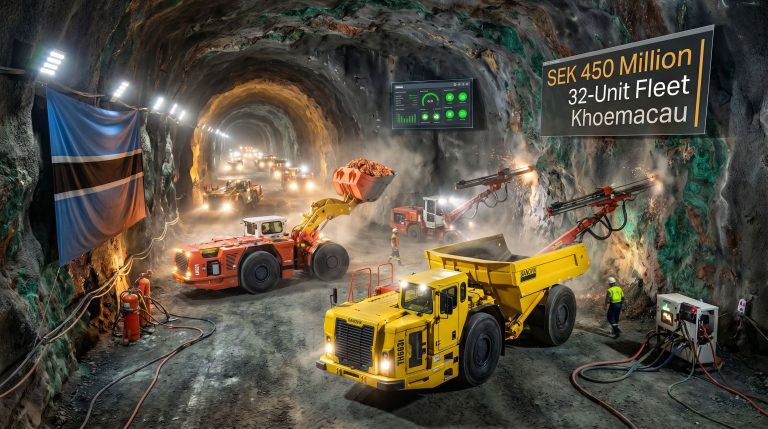
| Parameter | 2025 Order | 2026 Order |
|---|---|---|
| Fleet Size | 32 units | 45 units |
| Approximate Value | ~US$70 million | |
| Automation Level | Remote Monitoring Service | AutoMine platform + Remote Monitoring |
| Key Equipment | TH663i trucks, LH621i loaders, DD422i drills, DL432i drill, Rhino 100 raise borer | Toro trucks, loaders, drill rigs, long-hole production drills, raise borers, utility units |
| Delivery Window | Q3 2025 to Q2 2026 | August 2026 to April 2030 |
Several observations emerge from this comparison. First, the step-up in fleet size from 32 to 45 units represents a 40% increase in equipment complement. Second, the 2026 order introduces AutoMine automation across the loader and long-hole drill categories, a capability upgrade that was not present in the initial fleet deployment.
Third, the delivery window for the 2026 order is considerably longer, spanning almost four years compared to roughly twelve months for the 2025 order. This extended delivery schedule is not a logistical limitation; it reflects a phased development programme where different equipment types are needed at different stages of the underground expansion.
Combined, both orders represent a total Sandvik fleet investment at Khoemacau exceeding US$110 million, making this one of the largest single-site underground equipment commitments recorded for an African copper operation in recent years.
AutoMine in a Remote African Underground: What Automation Actually Delivers
Sandvik's AutoMine platform is frequently discussed in the context of technology showcase projects in Scandinavia or Australia. Its deployment at a mid-tier copper mine in northwest Botswana, through a Chinese contractor operating on behalf of a global mining company, represents a more commercially grounded test of whether automation genuinely shifts the economics of underground mining in frontier jurisdictions.
The platform's core functions relevant to the Khoemacau deployment include:
- Remote loader operation allowing surface-based operators to control underground LHD machines, removing personnel from the immediate post-blast environment during mucking cycles
- Autonomous tramming along pre-mapped underground routes, enabling machines to move between loading and dumping points without continuous operator input
- Real-time telemetry integration feeding machine health data into Sandvik's Remote Monitoring Service for predictive maintenance scheduling
- Operational analytics capturing cycle times, payload data, and utilisation metrics to identify productivity bottlenecks
For JCHX specifically, the case for AutoMine is not primarily philosophical. It is financial. In a contract mining environment where margins are tightly linked to machine productivity, consistent automation-driven cycle times reduce the variance that erodes profitability. The ability to operate loaders remotely also reduces the dependence on a deep pool of certified underground equipment operators, a genuine labour market constraint in parts of sub-Saharan Africa.
Furthermore, these data-driven mining operations approaches remove personnel from active blast zones and high-traffic underground intersections, reducing incident exposure in ways that carry both humanitarian and contractual significance for a services company operating under performance agreements.
The next major ASX story will hit our subscribers first
Khoemacau's Production Profile and What the Fleet Expansion Implies
MMG's Khoemacau operation currently produces between 43,000 and 53,000 tonnes of copper concentrate per annum through the Zone 5 underground mine and the Boseto processing plant, with a stated production potential of up to 60,000 tonnes per year, according to MMG data cited in Canadian Mining Journal.
| Production Metric | Current Range | Stated Upside |
|---|---|---|
| Annual Copper Concentrate Output | 43,000 to 53,000 tonnes | Up to 60,000 tonnes |
| Mining Method | Underground, Zone 5 | Lateral and depth expansion |
| Processing Facility | Boseto Plant | Existing infrastructure |
| Geological Setting | Kalahari Copper Belt | Material exploration upside at depth |
The gap between the current production ceiling and the stated upside potential of 60,000 tonnes is meaningful context for interpreting the fleet order. A simple fleet replacement programme would not require raise-boring equipment or long-lead deliveries extending to April 2030. These characteristics are more consistent with a programme designed to access new ore zones below or adjacent to the currently developed underground workings.
The phased delivery schedule supports this interpretation:
- 2026 to 2027: Initial deliveries support ongoing Zone 5 production while development drilling begins expanding the underground footprint
- 2028 to 2029: Raise-boring and long-hole production drill deliveries indicate deeper level development and expanded stope inventory preparation
- 2030: Final fleet deliveries likely coincide with the ramp-up of production from newly developed underground zones
This delivery architecture is not accidental. It reflects careful sequencing by both MMG and JCHX to ensure the right machines arrive at the right stage of underground development, minimising idle capital while maintaining development momentum.
What This Deal Signals for Sandvik's African Market Strategy
Securing back-to-back major orders from a single contractor client at a single project, totalling more than US$100 million since 2025, reveals something instructive about how Sandvik is competing in African mining markets where Chinese domestic equipment manufacturers have steadily expanded their presence on price competitiveness grounds.
The Sandvik approach at JCHX appears to rest on three pillars:
- Multi-tiered service infrastructure spanning local, regional, and global support levels, reducing operational risk for contractors working in geographically remote locations where parts availability and technical support can be critical bottlenecks
- Relationship-led commercial development prioritising account continuity and adaptability to evolving client needs over transactional price competition
- Technology differentiation through platforms like AutoMine that create genuine operational value and introduce switching costs that favour repeat procurement across successive project phases
David Wang, JCHX Global Account Manager at Sandvik, noted that the company's local, regional, and global support model had been recognised by JCHX alongside its capacity to adapt to the project's evolving requirements, as reported by Global Mining Review. Wang Xiancheng, Chair of JCHX, confirmed that the relationship is grounded in trust built through consistent delivery on commitments over time, also per Canadian Mining Journal.
These statements, while commercially framed, point to a broader competitive dynamic: in a market where Chinese contractors are increasingly the dominant force in African underground mine development, Western OEMs that can demonstrate service reliability and technology depth retain a defensible position even against lower-cost domestic alternatives. In addition, the largest copper mines globally continue to demonstrate that equipment quality directly correlates with sustained production performance over the long term.
Frequently Asked Questions
What is the total value of the Sandvik order for Khoemacau copper mine?
The 2026 JCHX order is valued at approximately US$70 million, covering 45 units of underground mining equipment. Combined with a preceding order placed in 2025, the cumulative value of Sandvik equipment orders from JCHX for the Khoemacau project has surpassed US$100 million since 2025, per Canadian Mining Journal.
When will deliveries begin and end?
Deliveries are scheduled to commence in August 2026, with the complete 45-unit fleet to be delivered progressively through to April 2030.
What equipment types are included in the 2026 order?
The fleet covers Toro underground trucks and loaders, development drill rigs, long-hole production drills, raise-boring machines, and utility support vehicles. Loaders and long-hole drill rigs will be equipped with Sandvik's AutoMine platform alongside productivity and remote monitoring services.
Who operates the Khoemacau copper mine?
MMG operates the Khoemacau copper mine in northwest Botswana. JCHX Mining Management serves as the underground mining contractor, responsible for underground development and production activities.
What is Khoemacau's current and potential production capacity?
The Zone 5 underground mine and Boseto processing plant currently produce between 43,000 and 53,000 tonnes of copper concentrate per year, with a stated potential to reach 60,000 tonnes annually, according to MMG data referenced in Canadian Mining Journal.
What does AutoMine actually do underground?
AutoMine enables remote and autonomous operation of underground loaders and drill rigs, integrating with Sandvik's fleet monitoring services to deliver real-time machine health data, predictive maintenance scheduling, autonomous tramming capability, and operational analytics for productivity optimisation. Understanding these copper investment strategies helps contextualise why technology adoption at this scale is increasingly viewed as a value driver rather than a cost centre.
Key Takeaways
- The Sandvik JCHX order for Khoemacau copper mine in Botswana, valued at approximately US$70 million for a 45-unit fleet, is one of the most substantial single underground equipment contracts placed for an African copper operation in recent years
- Combined orders from JCHX to Sandvik since 2025 now exceed US$100 million, reflecting a preferred-supplier relationship built on service reliability and technology capability rather than price alone
- The inclusion of raise-boring equipment and the extended delivery window through April 2030 signal a multi-year underground expansion programme at Khoemacau, not a routine fleet replacement cycle
- AutoMine integration across the loader and long-hole drill fleet represents a meaningful automation step-up from the 2025 order, with direct implications for JCHX's contractor margins and safety performance
- MMG's stated production upside of 60,000 tonnes per annum at Khoemacau provides a credible rationale for the scale of equipment commitment, suggesting the incoming fleet is partly oriented toward unlocking capacity above the current production ceiling of 53,000 tonnes
- The Kalahari Copper Belt's underexplored depth profile means infrastructure investments made today carry exploration optionality value that extends well beyond the current Zone 5 mine plan
This article is intended for informational purposes only and does not constitute financial or investment advice. Forward-looking statements regarding production targets, delivery timelines, and project outcomes involve inherent uncertainty and should not be relied upon as guarantees of future performance. Readers should conduct independent due diligence before making any investment decisions.
Want to Track the Next Major Copper Discovery Before the Market Does?
Discovery Alert's proprietary Discovery IQ model delivers real-time alerts the moment significant ASX mineral discoveries are announced, transforming complex geological data into actionable investment insights — explore the historic returns major discoveries have generated and begin your 14-day free trial to position yourself ahead of the broader market.