June 4, 2026
When Underground Mining Equipment Becomes a Strategic Statement
The global copper supply chain is undergoing a structural shift. As electrification accelerates across transportation, grid infrastructure, and industrial systems, the pressure on copper producers to scale output efficiently has intensified to a degree not seen in previous commodity cycles. This pressure is most acutely felt underground, where the productivity ceiling of any operation is ultimately determined not by ore grade alone, but by the capability and configuration of the equipment moving rock from face to surface.
It is within this context that a procurement decision involving JCHX Mining Management and Swedish original equipment manufacturer Sandvik carries significance well beyond a routine fleet refresh. JCHX buys 45 Sandvik vehicles for Botswana copper mine, consolidating its underground equipment strategy around a single OEM at the Khoemacau copper-silver mine. This represents a deliberate architectural choice about how modern underground copper mines are built, managed, and scaled.
Understanding why this decision was made, what it means operationally, and what it signals for the broader underground copper mining technology market requires examining the technical, commercial, and strategic layers beneath the headline figures.
When big ASX news breaks, our subscribers know first
Botswana and the Khoemacau Copper-Silver Operation
Botswana's global mining identity has been shaped almost entirely by diamonds, with the Jwaneng and Orapa mines cementing the country's position as a cornerstone of the global rough diamond supply. Yet the geology of Botswana extends well beyond kimberlite pipes. The northwest of the country sits within the southern extension of the Central African Copperbelt, a geological province that stretches across Zambia and the Democratic Republic of Congo and contains some of the world's highest-grade copper deposits.
Khoemacau occupies a significant position within this geological setting. Operated by MMG Limited, a global base metals company with a portfolio that includes large-scale copper and zinc operations across multiple continents, Khoemacau is an underground copper-silver mine producing two commercially distinct revenue streams from a single ore body. This co-production model provides a degree of revenue diversification that pure copper operations lack, with silver credits partially hedging against copper price volatility.
The mine's underground configuration drives the logic behind fleet selection. Ore body geometry, depth characteristics, and the spatial constraints of underground development corridors all influence decisions about truck payload class, loader bucket size, and the ratio of development drilling capacity to production drilling capacity. In an underground operation of Khoemacau's scale, these decisions compound over a mine life measured in decades, making initial fleet specification a decision with long-duration financial consequences.
JCHX Mining Management: China's Most Globally Active Underground Contractor
JCHX Mining Management has built a substantial international footprint as one of China's most active underground mining contractors, operating across Africa, Southeast Asia, and other emerging mining jurisdictions. The company's core competencies span the full spectrum of underground mining activity: lateral development, production drilling, load-haul-dump operations, and the management of complex multi-stage underground production systems.
Why Contract Mining Shapes Equipment Procurement Differently
Understanding JCHX's procurement approach requires understanding how contract mining economics differ from owner-operator models. A contract miner's profitability is directly tied to equipment uptime, maintenance cost control, and technician deployment efficiency. Unlike a mining company that may treat its fleet as a long-term fixed asset, a contractor must extract maximum productive value from each unit while minimising the operational overhead of managing that fleet across potentially multiple concurrent contracts.
This commercial reality makes OEM selection a strategic rather than purely technical decision. Key considerations include:
- Total cost of ownership across the full contract term, not just capital acquisition price
- Parts availability and lead times in remote or logistically challenging locations like landlocked Botswana
- Technician training investment and the efficiency gains from certifying personnel on a single platform
- OEM service infrastructure in the operating jurisdiction and adjacent regions
- Warranty and service contract terms that transfer risk back to the manufacturer
JCHX's decision to standardise on Sandvik across the Khoemacau fleet reflects this calculus. Fleet homogeneity reduces spare parts inventory complexity, accelerates the technician certification pipeline, and creates a single point of accountability for equipment performance across the operation.
The 45-Unit Fleet: Technical Architecture and Equipment Roles
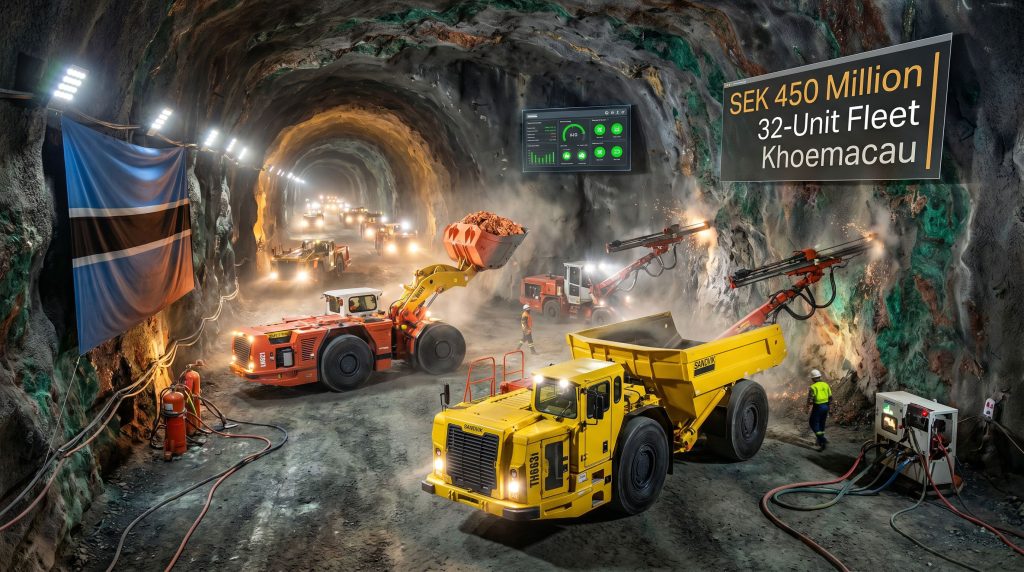
The Khoemacau fleet order, valued at approximately SEK 450 million and booked in Q3 2025, encompasses 45 units of underground mining equipment spanning haulage, loading, development drilling, production drilling, and raise boring functions. This breadth of coverage is notable; the order is not a supplementary fleet addition but a comprehensive equipment solution covering the entire underground mining cycle.
Fleet Composition Overview
| Equipment Category | Units | Primary Operational Function |
|---|---|---|
| Sandvik Toro TH663i Haul Trucks | 12 | Ore and waste haulage from production and development areas |
| Sandvik Toro LH621i LHD Loaders | 10 | Load-haul-dump operations at draw points and muck piles |
| Development Drill Rigs | 8 | Lateral development: drives, cross-cuts, and access tunnels |
| Longhole Production Drill | 1 | Production stope drilling for blasting patterns |
| Raise Borer | 1 | Ventilation raises and ore pass construction |
| Total Fleet | 32 primary units | Full-cycle underground mining capability |
Note: The total fleet referenced in industry reporting as 45 Sandvik vehicles encompasses the full equipment complement including ancillary and support units beyond the primary production equipment listed above.
The Toro TH663i: Why 63 Tonnes Matters Underground
The Sandvik Toro TH663i represents the upper tier of Sandvik's underground truck range, a 63-tonne payload class vehicle designed for high-volume underground haulage in large-format operations. The i-series designation signals the truck's integration with Sandvik's intelligent systems architecture, encompassing automation-readiness, onboard telematics, and compatibility with the AutoMine and OptiMine digital platforms.
For an underground copper operation like Khoemacau, the 63-tonne payload class is significant. Larger payload trucks reduce the number of cycles required to move a given volume of ore, which in turn reduces traffic density in underground access drives, lowers fuel consumption per tonne hauled, and decreases wear on underground infrastructure. The relationship between truck payload and tramming distance is a fundamental productivity equation: at longer haul distances, larger payload trucks deliver disproportionate efficiency gains relative to smaller class vehicles.
The i-series platform also positions the fleet for future automation in mining integration. Furthermore, while fully autonomous underground truck operations remain operationally complex, the architecture embedded in i-series equipment allows operators to incrementally introduce automation features — including remote operation capability and autonomous tramming on defined underground routes — without requiring fleet replacement.
The Toro LH621i: Matching Loader and Truck in the Loading Cycle
The Sandvik Toro LH621i is a 21-tonne payload class underground loader designed to complement the TH663i's loading cycle requirements. The relationship between loader payload and truck payload is not arbitrary; it reflects a loading cycle optimisation where the loader fills the truck in a defined number of passes, minimising truck wait time at the draw point while maximising loader utilisation.
A 21-tonne loader paired with a 63-tonne truck creates a three-pass loading cycle, a configuration widely regarded in underground mining engineering as optimal for balancing cycle efficiency against loading precision. Deviations from this ratio either increase truck wait time (if the loader is underpowered) or reduce loader utilisation (if the loader overshoots the optimal pass count).
The LH621i's i-series designation also enables remote operation capability, a feature of growing importance in underground environments where ore body geometry or blast fume management may create conditions where human operation at the machine is undesirable or unsafe.
Development Drills: The Rate-Governing Asset Class
Among all equipment categories in an underground mine, development drills are arguably the most consequential for long-term mine performance. The rate at which lateral development advances determines how quickly new ore blocks become accessible to production equipment. An operation that falls behind on development metres will eventually face a production shortfall, regardless of how capable its loaders and trucks are.
The eight development drill units in the JCHX fleet at Khoemacau represent a significant commitment to maintaining development advance rates ahead of production requirements. This is not a passive buffer; it is an active investment in the mine's future production optionality, ensuring that ore reserve access expands faster than current production depletes existing stopes.
Longhole Drill and Raise Borer: Specialised Productivity Infrastructure
The single longhole production drill and single raise borer in the fleet are low unit-count but high-criticality assets. The longhole drill performs production stope drilling, creating the blast hole patterns that fragment ore within the stope for subsequent loading. Its productivity directly governs the rate at which stopes are prepared for blasting and hence the frequency with which fresh ore becomes available to the loader and truck fleet.
The raise borer serves a different but equally critical function: constructing vertical or sub-vertical excavations used for ventilation shafts, ore passes, and access raises. In a deep underground operation, adequate ventilation is a hard constraint on the number of diesel-powered machines that can operate simultaneously underground. Raise borer productivity therefore indirectly caps the maximum fleet utilisation achievable at any given mine depth.
Financial Scale: What SEK 450 Million Means in Context
The SEK 450 million order value, equivalent to approximately USD 42-44 million at mid-2025 exchange rates, places the per-unit average for the 32 primary units at approximately SEK 14 million per machine, or roughly USD 1.3-1.4 million per unit. This per-unit figure is consistent with premium intelligent underground equipment pricing in the 20-63 tonne class, where i-series technology commands a meaningful premium over conventional mechanised equivalents.
More significantly, this order is not an isolated transaction. JCHX has committed in excess of USD $100 million in equipment orders with Sandvik since July 2025, reflecting a procurement relationship that has moved well beyond opportunistic purchasing into the territory of a structured strategic partnership between contractor and OEM.
For Sandvik, a fleet of 45 intelligent underground machines represents not just revenue recognition in Q3 2025, but a long-duration aftermarket revenue stream. Underground mining equipment of this class typically operates on 8-12 year replacement cycles, during which the OEM generates ongoing revenue from parts supply, service contracts, software updates, and technology upgrades. The lifetime aftermarket revenue from a 32-45 unit intelligent underground fleet can substantially exceed the original equipment sale value.
According to Sandvik's official announcement, the order underscores the company's growing strategic relationship with JCHX across multiple geographies, signalling that this bilateral commitment extends well beyond a single project.
Delivery Timeline and Phased Deployment Logic
Deliveries are scheduled across a four-quarter window from Q3 2025 through Q2 2026, a phasing that reflects the practical realities of deploying heavy underground equipment into an active mine.
Why Phased Delivery Is Operationally Necessary
Sequential deployment is not simply a logistics convenience; it is a mine development requirement. Underground infrastructure must be ready to support each equipment category before it arrives on site:
- Workshop and maintenance facilities must be commissioned before truck and loader fleets arrive, as underground equipment of this scale requires dedicated maintenance bays, overhead lifting capacity, and specialised tooling
- Ventilation capacity must be adequate to support the cumulative diesel engine emissions of the deployed fleet at any given phase of development
- Access drives and ramps must have sufficient clearance and gradient specifications to accommodate the physical dimensions and traction requirements of 63-tonne trucks
- Operator and technician workforce must be recruited, trained, and safety-inducted before equipment deployment, a process that typically requires several months per cohort
The sequencing logic suggests development drills likely enter service in the earliest delivery phase, advancing the lateral development necessary to create the underground real estate into which loaders, trucks, and production drilling equipment subsequently deploy.
The next major ASX story will hit our subscribers first
Remote Monitoring Service: The Intelligence Layer Beneath the Iron
Embedded within the Sandvik fleet procurement is the inclusion of Sandvik's Remote Monitoring Service, a telematics and diagnostics platform that transmits real-time machine health data from underground equipment to surface monitoring centres. This capability transforms fleet management from a reactive maintenance discipline into a predictive one, and it sits at the heart of broader data-driven mining operations strategies now emerging across the industry.
The Operational Value of Predictive Maintenance in Remote Mining Contexts
In conventional time-based maintenance regimes, equipment is serviced according to fixed intervals regardless of its actual condition. Components that could safely operate longer are replaced prematurely, while components that have degraded faster than average may fail before their scheduled service. Remote monitoring disrupts this inefficiency by providing continuous condition data that enables maintenance scheduling based on actual equipment state rather than elapsed hours.
The business case is compelling. In underground copper mining operations of Khoemacau's scale, unplanned equipment downtime can impose costs in the range of USD $50,000 to $150,000 per shift depending on the equipment class and the throughput impact of the stoppage. A remote monitoring service that prevents even a small number of unplanned failures annually can generate returns that are multiples of the service contract cost.
For a landlocked operation in Botswana, where the logistics of sourcing replacement components or mobilising specialist technicians involves extended lead times, the value of failure prediction is amplified. Detecting a developing fault weeks in advance allows parts to be pre-positioned and technician travel coordinated, converting what would have been an emergency breakdown into a planned intervention.
The Competitive Landscape: Sandvik vs. Epiroc in African Underground Markets
The Khoemacau fleet award positions Sandvik advantageously in what is becoming an increasingly contested market for intelligent underground equipment in Africa. Epiroc, Sandvik's primary competitor in this segment following its 2018 spin-off from Atlas Copco, offers comparable equipment across the same payload classes with its own digital ecosystem.
| Competitive Dimension | Sandvik | Epiroc |
|---|---|---|
| 63t-class underground truck | Toro TH663i | MT65 |
| 21t-class LHD loader | Toro LH621i | ST18 |
| Automation platform | AutoMine / OptiMine | Mobilaris / RCS |
| Remote monitoring | Integrated OEM service | My Epiroc platform |
| Africa underground presence | Expanding aggressively | Established network |
Large fleet deals like the Khoemacau order validate Sandvik's service infrastructure investment across the African continent, demonstrating to prospective customers in comparable projects that the OEM can support fleet deployments of this scale in geographically demanding locations. Each major fleet win creates a reference installation that supports future tender competitiveness.
Why Single-OEM Fleet Strategies Are Reshaping Contractor Procurement
The JCHX approach at Khoemacau reflects a broader trend among large underground mining contractors toward single-OEM fleet standardisation. This strategy, once considered operationally conservative, is increasingly recognised as a sophisticated approach to managing total cost of ownership across long-duration contracts.
The advantages compound over time:
- Parts inventory simplification: A single OEM fleet requires stocking one set of critical spare parts rather than multiple parallel inventories for different equipment platforms, reducing working capital tied up in parts and reducing the risk of holding the wrong parts when a breakdown occurs
- Technician certification efficiency: Training mechanics and operators on a single equipment platform reduces training time and creates deeper expertise faster than cross-platform training programmes
- Service contract leverage: Procuring 45 units from a single OEM creates substantial commercial leverage in negotiating aftermarket service terms, warranty extensions, and performance guarantees
- Data comparability: Fleet performance data from homogeneous equipment is directly comparable across units, enabling more precise benchmarking and more reliable predictive maintenance modelling
- Resale and fleet rotation: Standardised fleets command stronger secondary market interest and support more straightforward fleet rotation strategies as equipment ages
The shift toward single-OEM strategies also creates a structural dynamic in which large contract miners become increasingly important commercial partners for equipment manufacturers, capable of delivering substantial order volumes and multi-year aftermarket revenue streams. This dynamic gives contractors like JCHX real leverage in OEM negotiations that would not exist if procurement were fragmented across multiple suppliers.
Production Implications for MMG's Khoemacau Targets
Translating fleet specifications into production capacity requires understanding how equipment units interact within the mine's operational architecture. Twelve haul trucks and ten LHD loaders, operating in a well-configured underground environment, represent substantial haulage and loading throughput capacity. However, the productive utilisation of this fleet is governed not by equipment capability alone but by the rate at which development drilling creates accessible ore.
The eight development drill units are the rate-governing assets in this context. Their combined monthly advance rate potential determines how quickly the underground footprint expands, how many active draw points are available to loaders, and ultimately how closely the truck and loader fleet can approach its theoretical throughput ceiling. An undersized development drilling capacity is the most common source of production underperformance in underground mines that are otherwise well-equipped.
By committing eight dedicated development drills, JCHX has signalled a clear operational philosophy: maintain development advance well ahead of production requirements to ensure the loader and truck fleet always has sufficient active working areas to sustain target throughput. This approach accepts higher near-term development costs in exchange for production schedule certainty over the medium term. In the context of a tightening copper supply crunch, this philosophy is increasingly shared among operators of the largest copper mines globally.
As mining-technology.com reports, the JCHX and Sandvik partnership reflects a growing recognition that equipment strategy and mine planning must be integrated from the outset, rather than treated as separate disciplines.
Frequently Asked Questions
How many vehicles did JCHX order from Sandvik for the Khoemacau mine?
Industry reporting references 45 Sandvik vehicles in total for the Khoemacau operation. The primary production and development equipment within this fleet comprises 32 units, including 12 haul trucks, 10 LHD loaders, eight development drills, one longhole production drill, and one raise borer, with ancillary and support equipment making up the balance.
What is the total value of the JCHX Sandvik order for Khoemacau?
The order was valued at approximately SEK 450 million, booked in Q3 2025, with deliveries scheduled across a four-quarter window from Q3 2025 through Q2 2026.
What Sandvik models form the core of the Khoemacau fleet?
The haulage and loading fleet is centred on the Sandvik Toro TH663i underground truck and the Sandvik Toro LH621i loader, both part of Sandvik's i-series intelligent underground equipment range incorporating automation readiness and real-time telematics.
Who operates the Khoemacau copper-silver mine?
Khoemacau is operated by MMG Limited, with JCHX Mining Management serving as the primary underground mining contractor responsible for development and production operations.
What is Sandvik's Remote Monitoring Service?
Remote Monitoring Service is an OEM-provided telematics and predictive diagnostics platform that transmits continuous machine health data from underground equipment, enabling condition-based maintenance scheduling and early fault detection to reduce unplanned downtime across the deployed fleet.
How much has JCHX committed to Sandvik since July 2025?
JCHX has committed in excess of USD $100 million in equipment orders with Sandvik since July 2025, establishing a commercially significant bilateral procurement relationship between the two organisations.
Key Takeaways
JCHX buys 45 Sandvik vehicles for Botswana copper mine in a transaction that is simultaneously a procurement event, an operational architecture decision, and a signal about the direction of underground mining equipment strategy in Africa and beyond. Several structural conclusions emerge:
- Fleet homogeneity is becoming a competitive advantage, not just an operational convenience, as contract miners recognise the compounding total cost of ownership benefits of single-OEM standardisation across multi-year contracts
- Intelligent i-series equipment is the new baseline, with automation readiness and embedded telematics transitioning from premium options to default specifications in large fleet procurements
- Remote monitoring services are becoming contractual expectations in major fleet deals, reflecting a market-wide shift toward predictive maintenance as the primary operational risk management tool for remote underground operations
- Africa's underground copper pipeline is generating material OEM order flow, validating equipment manufacturer investment in continental service infrastructure and creating competitive dynamics that will intensify as additional underground projects advance toward production
- Development drilling fleet sizing is the most strategically consequential decision in underground mine equipment configuration, as it governs the rate at which future production capacity is unlocked regardless of loader and truck capability
- Single large-contractor relationships are reshaping OEM commercial strategies, with USD $100 million-plus bilateral commitments creating partnership dynamics that differ fundamentally from transactional equipment sales
Disclaimer: This article contains forward-looking observations and industry analysis based on publicly available procurement information and general mining engineering principles. It does not constitute financial or investment advice. Production estimates, cost projections, and market comparisons involve inherent uncertainty. Readers should conduct independent due diligence before making any investment or commercial decisions based on information contained herein.
Want to Capitalise on the Next Major Copper Discovery Before the Market Does?
As copper demand surges on the back of global electrification, Discovery Alert's proprietary Discovery IQ model delivers real-time alerts on significant ASX copper and base metals discoveries, translating complex geological announcements into actionable investment insights the moment they hit the exchange — explore historic discovery returns on Discovery Alert's discoveries page to see what's possible, and begin your 14-day free trial at Discovery Alert to position yourself ahead of the broader market.