May 21, 2026
The Shifting Architecture of Southeast Asia's Commodity Corridors
The global bauxite trade has never operated in isolation from geography. Across Southeast Asia, the physical layout of coastlines, straits, and waterways has historically determined which regions succeed as export hubs and which remain structurally disadvantaged by port infrastructure that cannot handle the scale modern commodity markets demand. West Kalimantan represents a compelling case study in how purpose-built deep-sea infrastructure can fundamentally reshape a region's position within the global aluminium supply chain, and Kijing Terminal bauxite trade in West Kalimantan sits at the centre of that transformation.
When big ASX news breaks, our subscribers know first
Why Location Defines Kijing Terminal's Strategic Value
The Strait of Malacca remains one of the world's most critical maritime chokepoints, with approximately 94,000 vessels transiting annually according to data compiled by the International Maritime Organization, representing an estimated 25 to 30 percent of global seaborne trade in oil and liquefied natural gas. For bulk commodity exporters, proximity to this corridor is not merely convenient — it is commercially decisive.
Kijing Terminal's position in Mempawah Regency places it within approximately 350 nautical miles of Port Klang, Malaysia, one of the region's major hub ports, and within established vessel routing corridors that service both East Asian and South Asian aluminium manufacturing centres. This positioning reduces vessel deviation costs significantly compared to secondary port alternatives, typically saving exporters several transit days per shipment on key trade lanes.
Before Kijing Terminal's development, West Kalimantan's commodity exporters depended on Pontianak Port, a facility not engineered for the draft requirements of large bulk carriers. The construction of a dedicated deep-sea multipurpose facility fundamentally changed the logistics calculus — enabling vessels of up to 100,000 Dead Weight Tonnes (DWT) to call directly at the region, bypassing the costly feeder vessel arrangements that had previously added both time and expense to export operations. The Pontianak branch has since optimised Kijing terminal activities to further boost trade volumes across key commodity segments.
Regional maritime trade volumes through Southeast Asian straits have grown at approximately 4.2 percent annually over the past decade, according to UNCTAD's Review of Maritime Transport 2024, with dry bulk and container segments leading the expansion. Kijing Terminal's development trajectory mirrors and benefits from this macro trend.
West Kalimantan's Bauxite Endowment: Scale, Quality, and Trade Context
The resource foundation underpinning Kijing Terminal's commercial rationale is West Kalimantan's bauxite reserve base. Indonesia's total identified bauxite reserves are documented at approximately 812 to 850 million tonnes across resource and reserve classifications, according to the Indonesian Ministry of Energy and Mineral Resources and the USGS Mineral Commodity Summaries. West Kalimantan accounts for an estimated 60 to 70 percent of this national total, representing one of the largest concentrated bauxite endowments in the Asia-Pacific region.
Furthermore, the mineralogical profile of West Kalimantan bauxite is worth understanding from an industry standpoint. These deposits are primarily lateritic bauxite, formed through tropical weathering of aluminium-bearing rocks over geological timescales. Among the bauxite production leaders, Indonesia stands out for the quality profile of its West Kalimantan deposits. Typical specifications from the Mempawah Regency area include:
- Alumina content: 45 to 52 percent
- Silica content: 3 to 8 percent
- Iron oxide content: 8 to 15 percent
- Reactive silica: 1 to 3 percent
Reactive silica is a particularly important quality metric for downstream processors. In the Bayer process — the dominant industrial method for refining bauxite into alumina — high reactive silica content increases caustic soda consumption, raises operating costs, and reduces alumina recovery efficiency. West Kalimantan bauxite's relatively low reactive silica levels make it well-suited for smelter-grade alumina production, which is the primary feedstock for primary aluminium smelting.
It is important to note that Indonesia's November 2023 raw bauxite export ban, which took effect from early 2024, substantially altered the trade flow context for Kijing Terminal bauxite trade in West Kalimantan. Prior to this regulatory shift, national raw bauxite exports had reached approximately 2.8 million tonnes in 2022 before declining sharply. The export ban redirects bauxite toward domestic alumina refineries rather than international markets in raw form, reshaping the terminal's cargo composition toward alumina and processed mineral products rather than unprocessed ore.
From Presidential Decree to Operational Reality: The Infrastructure Story
The Kijing Terminal project was formally designated as a National Strategic Project under Presidential Decree No. 43 of 2017, placing it within the same infrastructure priority tier as major national development initiatives under President Joko Widodo's administration. Construction had commenced in 2016 following site preparation and feasibility studies beginning in 2015. President Jokowi noted that the terminal was integral to building the competitiveness of West Kalimantan's leading export products.
Total project investment reached approximately 2.9 trillion Indonesian Rupiah, equivalent to roughly USD 190 to 215 million at historical 2016 to 2017 exchange rates. The facility was formally inaugurated by President Widodo on August 9, 2022, at which point it replaced Pontianak Port as West Kalimantan's primary non-containerised cargo facility. Operations have been managed through the Pontianak Branch of PT Pelabuhan Tanjung Priok (PTP Nonpetikemas), a state-owned enterprise operating under the Indonesian Ministry of Transportation.
Infrastructure Specifications at a Glance
| Feature | Specification |
|---|---|
| Maximum vessel size | Up to 100,000 DWT |
| Berthing capacity | More than 15 vessels |
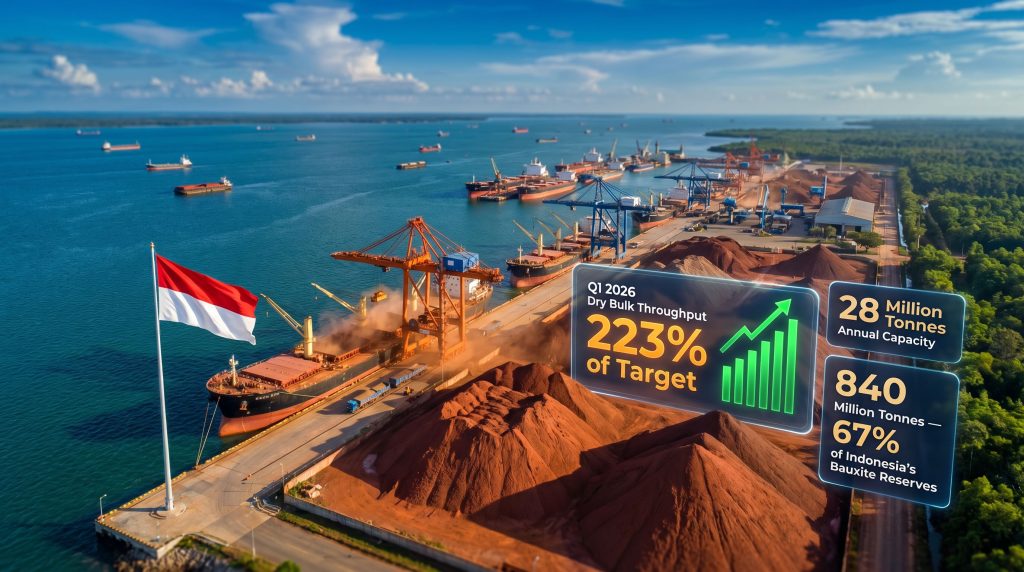
| Annual cargo capacity | 28 million tonnes |
| Cargo types handled | Bauxite, coal, alumina, CPO, liquid bulk |
| Terminal classification | Kalimantan's largest deep-sea multipurpose terminal |
| Commercial operations commenced | August 2022 |
The designed annual handling capacity of 28 million tonnes represents theoretical maximum throughput across all berths under optimal operating conditions. At current utilisation levels, the terminal retains substantial headroom for volume growth — a structural feature that aligns with Indonesia's longer-term industrial ambitions.
Throughput Performance: Q1 2026 as a Defining Benchmark
Since commencing operations in August 2022, Kijing Terminal has demonstrated consistent year-on-year throughput improvement, reflecting deepening integration with Indonesia's commodity export economy. The first quarter of 2026 produced particularly significant results, establishing a new performance benchmark across multiple cargo segments.
| Cargo Segment | Q1 2026 Volume | Target Achievement |
|---|---|---|
| Total throughput | ~1.5 million tonnes | Above target |
| Dry bulk (bauxite, coal, alumina) | ~845,000 tonnes | 223% of target |
| Liquid bulk | ~662,000 tonnes | 168% of target |
| Bag cargo | Not disclosed | 93% of target |
Dry bulk cargo — the segment encompassing bauxite, coal, and alumina — exceeded its quarterly target by more than double, registering 223 percent of planned volume. This level of outperformance is not simply a reflection of favourable market conditions; it signals improved operational execution, better vessel scheduling coordination, and strengthening demand from downstream aluminium processors requiring consistent raw material throughput.
When a port consistently and significantly exceeds operational targets, it typically signals one of three things: conservative target-setting, genuine demand expansion, or infrastructure efficiency improvements compounding over time. At Kijing Terminal, all three factors appear to be contributing simultaneously.
April 2026: A Snapshot of Day-to-Day Operations
A concrete illustration of the terminal's operational role emerged in April 2026, when dry bulk bauxite handling activities resumed. The barge BG Bahari 30073 discharged approximately 6,530 tonnes of bauxite across a three-day window from April 19 to April 21, 2026. While this represents a single operational event rather than a systemic data point, it demonstrates the terminal's function as an active intermediary between upstream mining extraction and downstream refinery-stage processing.
Kijing Terminal's Role Within Indonesia's Aluminium Value Chain
Understanding Kijing Terminal's strategic importance requires appreciating where it sits within Indonesia's broader aluminium industrialisation architecture. The country's long-term industrial policy has been oriented toward moving up the value chain — from exporting raw bauxite toward producing alumina and eventually primary aluminium domestically. This transition has created an intensive logistics requirement that facilities like Kijing Terminal are structurally positioned to service.
Several interconnected projects illustrate this dynamic. The role of major aluminium mining companies in shaping downstream demand is also worth noting, as their refinery expansion plans directly influence throughput requirements at terminals like Kijing:
- The Smelter Grade Alumina Refinery (SGAR) project requires consistent inbound bauxite supply and outbound alumina shipment logistics, both of which run through Kijing Terminal's operational network.
- PT Indonesia Asahan Aluminium (Inalum), the state aluminium enterprise, maintains barge transfer operations connecting West Kalimantan bauxite extraction to its refining and smelting facilities.
- Proposed alumina refinery projects with projected capacities of up to 1 million tonnes per year would substantially increase the terminal's throughput requirements if brought to full operation.
Beyond aluminium, the terminal's multi-commodity handling capability positions it to absorb growth in crude palm oil exports, with projections suggesting CPO shipment volumes could approach 7 million tonnes by 2030. This diversification consequently reduces the terminal's concentration risk across any single commodity cycle.
The Industrial Zone Proposition
Integrated industrial zone proposals covering 2,000 to 3,000 hectares adjacent to the terminal corridor represent the logical next step in the area's industrial evolution. The co-location of processing facilities alongside deep-sea export infrastructure is a well-established development model in resource-rich regions globally — reducing transportation costs between processing and export, improving supply chain responsiveness, and creating upstream-downstream employment linkages.
If realised, such a zone would shift Kijing Terminal's role from a cargo-handling facility into the logistical core of a manufacturing and processing precinct — a transformation that would substantially increase its throughput requirements and economic multiplier effects for West Kalimantan. Effective mine-to-port logistics planning will be essential to unlocking the full value of this integrated corridor.
The next major ASX story will hit our subscribers first
Technology as an Operational Multiplier
The rollout of the Pelindo Terminal Operating System Multipurpose (PTOS-M) platform represents a meaningful step in the terminal's operational modernisation. This digital infrastructure layer delivers:
- Real-time cargo monitoring across all active berths
- Integrated vessel scheduling and cargo sequencing tools
- Transparent operational reporting for trade compliance and logistics auditing
- Reduced manual coordination requirements between vessel operators, cargo handlers, and terminal management
The practical impact of PTOS-M extends beyond operational efficiency metrics. Transparent digital systems reduce information asymmetries between terminal operators, shipping lines, and commodity traders — lowering transaction costs and improving planning reliability for all parties in the supply chain. This is particularly valuable in bauxite and alumina logistics, where just-in-time supply arrangements are increasingly common among refinery operators managing tight production schedules.
Equipment upgrades, including progressive crane modernisation and cargo-handling tool improvements, have complemented the digital layer by reducing vessel turnaround times and improving asset utilisation rates. The combination of hardware and software improvements is widely credited within port operations literature as the most effective pathway to sustained throughput efficiency gains — and Kijing's Q1 2026 dry bulk overperformance of 223 percent reflects this compounding effect.
Management Philosophy and Community Integration
The operational mandate articulated by PTP Nonpetikemas leadership extends beyond cargo volume metrics. Branch management has consistently emphasised a dual commitment: optimising loading and unloading service quality while reinforcing West Kalimantan's position as a competitive export corridor within the national logistics network.
Branch Manager Suwanda has described the terminal as the economic lifeblood of West Kalimantan, noting that its role encompasses not only facilitating the movement of goods but also strengthening the national logistics ecosystem — a framing that positions the terminal as infrastructure serving broad economic development rather than purely commercial throughput objectives.
This philosophy extends to the Social and Environmental Responsibility (TJSL) programme, which operates alongside commercial logistics activities. Programme focus areas include:
- Workforce training and professional certification for local community members
- Safety standards development and job readiness improvement aligned with terminal expansion requirements
- Human resource empowerment initiatives designed to build long-term local employment capacity
Embedding community development within port operations management is increasingly recognised in infrastructure development literature as a prerequisite for long-term social licence to operate — particularly in resource-adjacent regions where local communities may experience both the benefits and disruptions of large-scale industrial activity.
Economic Multiplier Effects and Indonesia's Aluminium Sovereignty Ambitions
The broader economic significance of Kijing Terminal bauxite trade in West Kalimantan extends well beyond its own throughput statistics. Terminal expansion generates downstream employment across logistics coordination, mining support services, vessel maintenance, and commodity processing sectors. Export competitiveness improvements benefit West Kalimantan's wider commodity economy, reducing supply chain costs for producers across bauxite, coal, palm oil, and industrial minerals.
At the national level, Kijing Terminal functions as a critical enabling node within Indonesia's aluminium sovereignty agenda — the strategic objective of building a complete, domestically controlled aluminium value chain from bauxite extraction through to refined metal production. The terminal's 28-million-tonne annual capacity and deep-sea berthing capability provide the physical infrastructure headroom needed to scale alongside this industrial ambition.
Furthermore, when considering how China commodity demand continues to shape global aluminium supply chains, Indonesia's strategic positioning through infrastructure like Kijing Terminal becomes even more significant. The global bauxite mines landscape is shifting, and however that evolution unfolds, West Kalimantan's port infrastructure places it competitively within the emerging supply order.
Indonesia's trajectory toward domestic alumina refining and primary aluminium production, accelerated by the 2023 to 2024 raw bauxite export restrictions, creates a structural requirement for ports capable of handling both inbound raw material logistics and outbound processed product shipments. Kijing Terminal's multi-cargo architecture positions it precisely at this intersection.
Disclaimer: This article is intended for informational and educational purposes only. Throughput figures, reserve estimates, and financial data referenced reflect publicly available sources and should not be relied upon for investment decision-making. Forward-looking statements regarding industrial development, export projections, and infrastructure capacity represent potential scenarios rather than confirmed outcomes. Readers should conduct independent research and consult qualified advisers before drawing investment-related conclusions.
Frequently Asked Questions: Kijing Terminal and Bauxite Trade in West Kalimantan
When did Kijing Terminal begin operations?
Kijing Terminal commenced commercial operations in August 2022 following its inauguration by President Joko Widodo as part of Indonesia's National Strategic Project framework.
What types of cargo does Kijing Terminal handle?
The terminal handles non-containerised cargo including dry bulk bauxite, coal, alumina, crude palm oil, and liquid bulk commodities across its deep-sea berth network.
What is the significance of West Kalimantan's bauxite reserves?
West Kalimantan holds an estimated 60 to 70 percent of Indonesia's national bauxite reserve base, with typical alumina content of 45 to 52 percent making regional ore well-suited for smelter-grade alumina refining applications.
How has Indonesia's 2023 raw bauxite export ban affected Kijing Terminal's operations?
The export restriction has shifted the terminal's cargo focus away from raw bauxite exports toward supporting domestic alumina refining logistics, aligning with Indonesia's broader industrial policy of retaining more value from its mineral resources domestically.
What digital systems does Kijing Terminal use?
The terminal operates the Pelindo Terminal Operating System Multipurpose (PTOS-M), providing real-time cargo monitoring, integrated vessel scheduling, and transparent operational reporting capabilities.
What is the terminal's maximum annual cargo capacity?
Kijing Terminal has a designed handling capacity of 28 million tonnes per year across all cargo types under full operational utilisation.
Want To Catch the Next Major Mineral Discovery Before the Market Does?
Discovery Alert's proprietary Discovery IQ model delivers real-time alerts on significant ASX mineral discoveries — translating complex commodity data into actionable investment insights across bauxite, aluminium, and more than 30 other commodities. Explore Discovery Alert's dedicated discoveries page to understand how historic mineral discoveries have generated substantial returns, and begin your 14-day free trial today to position yourself ahead of the broader market.