May 18, 2026
What Makes the Kingking Copper-Gold Project a Game-Changer for Philippine Mining?
Modern copper-gold deposits face unprecedented scrutiny regarding their economic viability as global metal demand shifts toward critical minerals demand for energy transition technologies. Processing techniques that maximise resource recovery while minimising environmental impact have become the defining characteristic separating viable projects from marginal developments. The technical specifications underlying large-scale mineral operations now determine whether billion-dollar investments can deliver sustainable returns across multi-decade mine lives.
Strategic Location Advantages in Mindanao's Mineral Belt
The Kingking Copper-Gold Project in the Philippines occupies a strategic position within Mindanao's established mineral corridor, situated in the Municipality of Pantukan, Davao de Oro Province. This location provides access to existing transportation infrastructure while positioning the project near established mining support services throughout the region.
Regional Infrastructure Benefits:
• Proximity to established port facilities for concentrate export
• Access to skilled mining workforce with regional experience
• Connection to existing power grid infrastructure
• Established regulatory framework for large-scale mining operations
The project's positioning within an active mining district reduces development risks typically associated with greenfield operations in remote locations. Transportation corridors already serve regional mining activities, creating cost efficiencies for equipment mobilisation and ongoing supply chain logistics.
Scale and Significance: 960 Million Tonnes of Proven Reserves
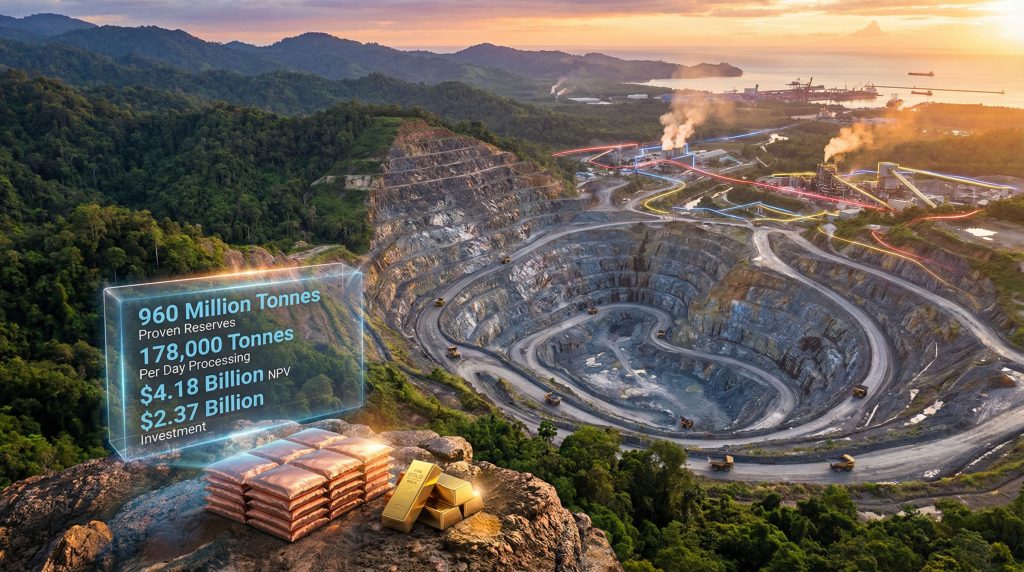
The Kingking project encompasses 960 million tonnes of mineral reserves, establishing it among the world's largest undeveloped copper-gold deposits. This reserve base supports a projected 38-year mine life at planned processing rates, providing operational certainty that extends well beyond typical mining investment horizons.
Reserve magnitude creates several operational advantages:
• Economies of Scale: Large tonnages justify substantial capital investment in processing infrastructure
• Operational Flexibility: Extended mine life allows for equipment amortisation and operational optimisation
• Market Positioning: Significant production volumes enable long-term offtake agreements
• Resource Security: Extensive reserves provide buffer against geological uncertainties
The scale positions Kingking within the tier of major copper-gold operations globally, comparable to established porphyry systems that anchor regional mining economies across similar geological terranes.
Infrastructure Connectivity to Global Markets
Stantec's engagement to deliver integrated pit-to-port solutions reflects the comprehensive infrastructure requirements for connecting mine operations to international commodity markets. This approach encompasses transportation networks, processing facilities, and export infrastructure necessary for efficient product delivery.
The pit-to-port framework addresses:
• Mine-to-mill transportation optimisation
• Concentrate handling and storage systems
• Port facility access and shipping logistics
• Supply chain integration for operational materials
This integrated approach reduces operational bottlenecks while ensuring consistent product flow to international buyers, critical for projects of Kingking's anticipated production scale.
When big ASX news breaks, our subscribers know first
How Does Kingking's Resource Profile Compare to World-Class Deposits?
Copper-Gold Grade Analysis and Metallurgical Characteristics
The Kingking deposit exhibits characteristics typical of porphyry copper-gold systems, with moderate grades compensated by substantial tonnages and favourable metallurgical properties. Average copper grades of 0.25% combined with 0.32 g/t gold provide economic viability through scale and by-product credits.
Porphyry systems typically demonstrate:
• Consistent Mineralisation: Uniform grade distribution enabling predictable mining
• Favourable Metallurgy: Copper sulfide minerals responsive to flotation processing
• Gold Recovery: Associated gold mineralisation providing revenue enhancement
• Large Tonnages: Bulk mining methods applicable to extensive ore bodies
The grade profile supports both conventional milling for higher-grade zones and heap leaching for lower-grade materials, maximising resource utilisation across the deposit.
Reserve Categories: Milling vs. Heap Leaching Potential
| Resource Type | Tonnage (Mt) | Copper Grade (%) | Gold Grade (g/t) | Processing Method |
|---|---|---|---|---|
| Proven/Probable Milling | 849 | 0.26 | 0.36 | Conventional Mill |
| Leaching Reserves | 111 | 0.23 | – | Heap Leach |
| Total Reserves | 960 | 0.25 | 0.32 | Integrated |
This dual processing approach optimises economic recovery by directing ore streams to appropriate treatment methods. Milling reserves of 849 million tonnes justify substantial processing infrastructure investment, while 111 million tonnes designated for heap leaching provide cost-effective processing for lower-grade material.
The integration strategy offers several advantages:
• Capital Efficiency: Heap leaching requires lower initial investment than equivalent milling capacity
• Operational Flexibility: Multiple processing paths accommodate varying ore characteristics
• Resource Maximisation: Treatment of otherwise sub-economic material
• Cash Flow Optimisation: Different processing costs enable margin management
Geological Formation and Porphyry System Advantages
Porphyry copper-gold deposits represent the most significant source of copper production globally, characterised by large tonnage, moderate grade, and predictable geological continuity. These systems form through magmatic-hydrothermal processes that create extensive zones of copper-gold mineralisation suitable for bulk mining methods.
Key Geological Features:
• Alteration Zonation: Predictable mineral distribution patterns
• Structural Control: Fracture networks enhancing ore accessibility
• Mineral Assemblages: Copper sulfides amenable to conventional processing
• Geometric Continuity: Regular ore body shapes suitable for open-pit mining
The geological model supports long-term mine planning with confidence intervals appropriate for large-scale investment decisions. Porphyry systems typically exhibit less geological risk than vein-type deposits, providing operational predictability essential for projects of Kingking's magnitude.
What Are the Technical Specifications for Kingking's Production Framework?
Processing Capacity: 178,000 Tonnes Per Day Operations
The Kingking project targets 178,000 tonnes per day processing capacity, equivalent to approximately 65 million tonnes annually. This throughput rate positions the operation among significant copper-gold processing facilities globally, requiring substantial infrastructure investment and operational coordination.
Processing scale implications include:
• Equipment Sizing: Large-scale crushers, mills, and flotation circuits
• Power Requirements: Substantial electrical infrastructure for processing operations
• Water Management: Significant process water circulation and treatment systems
• Waste Handling: Tailings management for high-volume processing
The daily throughput rate supports projected production targets while maintaining operational efficiency across the extended mine life. Processing capacity sizing reflects optimisation studies balancing capital investment against operational performance.
Dual Processing Strategy: Milling and Heap Leaching Integration
The integrated processing approach combines conventional flotation milling with heap leaching operations, maximising resource recovery across different ore types and grades. This strategy optimises economic returns by applying appropriate technology to specific material categories.
Conventional Milling Operations:
• Primary Crushing: Reduces ore to manageable sizing for further processing
• Grinding Circuits: Ball mills achieve liberation size for mineral separation
• Flotation Processing: Separates copper and gold minerals into marketable concentrates
• Concentrate Handling: Dewatering and storage for shipment to smelters
Heap Leaching Operations:
• Secondary Crushing: Prepares oxide ore for heap construction
• Pad Construction: Engineered heap design for solution percolation
• Acid Leaching: Chemical extraction of copper from oxide minerals
• Solution Processing: Copper recovery through solvent extraction and electrowinning
This dual approach ensures comprehensive resource utilisation while optimising processing costs across varying ore characteristics throughout the deposit. Furthermore, this comprehensive gold-copper exploration approach demonstrates the project's technical sophistication.
Mining Methodology: Open Pit with Contract Mining Approach
The project employs open-pit mining methodology using contract mining services, a strategy that reduces initial capital requirements while accessing specialised mining expertise. The 0.81 strip ratio indicates favourable geometry requiring limited waste removal per tonne of ore extracted.
Contract Mining Advantages:
• Capital Reduction: Eliminates need for mining equipment ownership
• Operational Expertise: Access to specialised mining contractors
• Flexibility: Ability to adjust mining capacity based on operational requirements
• Risk Transfer: Contractor assumes equipment maintenance and replacement responsibilities
The low strip ratio reflects accessible ore body geometry, minimising overburden removal costs while enabling efficient pit sequencing throughout the mine life.
The Kingking project targets annual production of 284 million pounds of copper and 333,000 ounces of gold during the first five years, positioning it among the Philippines' most significant mineral developments.
How Do the Economics Stack Up for This $2.37 Billion Investment?
Capital Expenditure Breakdown and Financing Structure
The $2.37 billion initial capital expenditure represents substantial investment in mining infrastructure, processing facilities, and supporting systems necessary for large-scale operations. This capital requirement positions Kingking among major greenfield mining developments requiring sophisticated project financing structures.
Capital Investment Components:
• Mine Development: Open-pit preparation, access roads, and mining infrastructure
• Processing Facilities: Mill construction, heap leach pads, and concentrate handling
• Infrastructure: Power supply, water systems, and transportation networks
• Ancillary Facilities: Maintenance shops, laboratories, and administrative buildings
• Contingency Allowances: Risk management provisions for cost variations
The scale of investment requires comprehensive project financing combining debt and equity sources, potentially including development banks, commercial lending, and strategic partnerships.
Revenue Projections: 38-Year Mine Life Analysis
| Metric | Value |
|---|---|
| After-tax NPV (7%) | $4.18 billion |
| Internal Rate of Return | 34.20% |
| Payback Period | 1.9 years |
| Initial CAPEX | $2.37 billion |
| Sustaining CAPEX | $798 million |
| Strip Ratio | 0.81 |
The economic analysis demonstrates robust project returns with 34.20% internal rate of return and 1.9-year payback period. These metrics significantly exceed typical mining project benchmarks, indicating strong economic fundamentals underlying the development decision.
Revenue Drivers:
• Copper Production: Primary revenue source from concentrate sales
• Gold By-Product: Additional revenue enhancement from precious metal recovery
• Long Mine Life: Extended cash flow generation across 38-year operational period
• Scale Benefits: Cost efficiencies from large-scale operations
Return Metrics: NPV, IRR, and Payback Period Assessment
The $4.18 billion after-tax net present value at 7% discount rate demonstrates substantial value creation potential for project stakeholders. The NPV calculation incorporates copper and gold price assumptions, operating cost projections, and capital expenditure requirements across the full mine life.
Financial Performance Indicators:
• High IRR (34.20%): Indicates superior returns compared to alternative investments
• Short Payback (1.9 years): Rapid capital recovery reduces investment risk
• Positive NPV: Value creation exceeds cost of capital requirements
• Sustaining CAPEX ($798M): Ongoing investment for maintaining production
These metrics reflect conservative commodity price assumptions and detailed cost engineering, providing confidence in project viability across various market scenarios. In addition, current gold market performance trends support favourable pricing assumptions for the precious metal component.
What Role Does Stantec Play in Advancing the Definitive Feasibility Study?
Integrated Engineering Approach: Pit-to-Port Solutions
Stantec's selection to lead the Definitive Feasibility Study reflects the project's requirement for comprehensive engineering expertise spanning multiple technical disciplines. The integrated approach addresses all aspects of mine development from ore extraction through product delivery to international markets.
Engineering Scope:
• Mining Engineering: Pit design, production scheduling, and equipment selection
• Process Engineering: Mill design, metallurgical optimisation, and plant layout
• Infrastructure Engineering: Power systems, water management, and transportation
• Environmental Engineering: Waste management, water treatment, and closure planning
The pit-to-port framework ensures seamless integration across all operational components, minimising interfaces while optimising system performance throughout the mining value chain.
Risk Assessment and Stakeholder Engagement Protocols
The Definitive Feasibility Study incorporates comprehensive risk assessment methodologies addressing technical, environmental, social, and financial uncertainties inherent in large-scale mining developments. Stakeholder engagement protocols ensure community input throughout the planning process.
Risk Management Components:
• Technical Risk: Geological uncertainty, metallurgical variability, and operational challenges
• Environmental Risk: Water management, waste disposal, and ecosystem protection
• Social Risk: Community relations, employment, and cultural considerations
• Regulatory Risk: Permitting requirements, compliance obligations, and policy changes
Stakeholder engagement encompasses government agencies, local communities, environmental organisations, and traditional landowners, ensuring comprehensive consultation throughout project development.
NI 43-101 Compliance and Financial Modelling Standards
The Definitive Feasibility Study adheres to National Instrument 43-101 standards, ensuring international best practices for mineral resource disclosure and technical reporting. This compliance provides investor confidence while meeting regulatory requirements for public companies.
NI 43-101 Requirements:
• Qualified Person Oversight: Independent professional validation of technical assessments
• Resource Classification: Measured, indicated, and inferred resource categories
• Reserve Estimation: Proven and probable reserve calculations
• Technical Report Standards: Comprehensive documentation of study methodology
Financial modelling incorporates detailed cost estimation, production scheduling, and sensitivity analysis, providing robust economic evaluation suitable for investment decision-making.
How Does Kingking Support Global Critical Metals Supply Chains?
Copper Demand Drivers: Clean Energy Transition Requirements
Global copper demand continues expanding driven by electrification trends, renewable energy infrastructure, and electric vehicle adoption. The International Energy Agency projects copper requirements increasing substantially through 2030 as energy transition accelerates worldwide.
Copper Applications in Energy Transition:
• Wind Turbines: Each megawatt of wind capacity requires approximately 3-5 tonnes of copper
• Solar Infrastructure: Photovoltaic systems utilise copper for wiring and electrical components
• Electric Vehicles: Battery electric vehicles contain 3-4 times more copper than conventional vehicles
• Grid Infrastructure: Transmission and distribution networks require substantial copper input
The Kingking project's projected 284 million pounds annual copper production contributes meaningfully to global copper supply during critical infrastructure development periods. Moreover, understanding copper price drivers becomes essential for project economics.
Gold Production Context in Southeast Asian Markets
Gold production from the Kingking project provides portfolio diversification while supporting regional precious metals markets. 333,000 ounces annually represents significant production within Southeast Asian context, contributing to regional supply chains.
Gold Market Functions:
• Store of Value: Portfolio diversification during economic uncertainty
• Industrial Applications: Electronics, medical devices, and aerospace components
• Central Bank Reserves: Monetary policy and currency stabilisation
• Investment Demand: Exchange-traded funds and direct ownership
Gold by-product revenue enhances project economics while providing hedge against copper price volatility throughout commodity cycles.
Strategic Positioning for Low-Carbon Technology Supply
The project aligns with global priorities for securing critical mineral supplies necessary for clean energy technologies. Copper represents an essential component in virtually all renewable energy systems, positioning Kingking as a strategic resource for energy transition requirements.
As Carl Kopke from Stantec emphasised, the project represents an important step toward supporting the world's shift to low-carbon technologies and evolving energy infrastructure, reflecting alignment with sustainable development commitments and responsible resource delivery practices.
Supply Chain Contributions:
• Renewable Energy: Direct input to wind, solar, and hydroelectric systems
• Transportation Electrification: Support for electric vehicle manufacturing
• Grid Modernisation: Smart grid and energy storage infrastructure
• Industrial Decarbonisation: Process electrification across manufacturing sectors
The next major ASX story will hit our subscribers first
What Are the Key Development Milestones and Timeline Expectations?
DFS Completion Pathway and Regulatory Approvals
The Definitive Feasibility Study represents a critical milestone advancing the project toward development decision. Stantec's comprehensive study scope addresses all technical, environmental, and economic aspects necessary for final investment approval.
DFS Deliverables Include:
• Comprehensive Data Review: Integration of existing geological, metallurgical, and environmental data
• Risk Assessment: Identification and mitigation of project development risks
• Trade-off Studies: Optimisation of design parameters and processing alternatives
• Capital Cost Estimation: Definitive-level budgeting for construction planning
• Operating Cost Analysis: Detailed operational expense projections
• Financial Modelling: Economic evaluation across multiple scenarios
Regulatory approvals encompass environmental permits, mining licences, and social compliance requirements necessary for construction commencement.
Construction Phase Planning and Equipment Procurement
Following DFS completion and regulatory approval, construction planning addresses equipment procurement, contractor selection, and project execution scheduling. The $2.37 billion capital programme requires sophisticated project management coordinating multiple work streams.
Construction Components:
• Site Preparation: Access roads, utilities, and temporary facilities
• Process Plant Construction: Mill building, flotation circuits, and concentrate handling
• Infrastructure Development: Power supply, water systems, and waste management
• Equipment Installation: Processing machinery, mining equipment, and support systems
Long-lead equipment items require early procurement to maintain construction schedules, particularly large mills, flotation cells, and electrical infrastructure components.
Production Ramp-Up Schedule and Market Entry Strategy
Production ramp-up typically spans 12-18 months following construction completion, gradually increasing throughput to nameplate capacity while optimising operational parameters. The 178,000 tonnes per day target requires systematic commissioning and performance optimisation.
Ramp-Up Phases:
- Mechanical Completion: Equipment installation and pre-commissioning testing
- Cold Commissioning: System integration and process verification
- Hot Commissioning: Ore processing trials and parameter optimisation
- Production Ramp: Gradual throughput increase to design capacity
Market entry strategy encompasses offtake agreements, concentrate specifications, and shipping logistics ensuring efficient product delivery to international customers.
Who Are the Key Stakeholders and Ownership Structure?
St. Augustine Gold & Copper Ltd. Leadership Role
St. Augustine Gold & Copper Ltd. serves as the project development entity responsible for advancing Kingking through feasibility studies, regulatory approvals, and construction phases. The company's selection of Stantec reflects commitment to international engineering standards and technical excellence.
According to Andy Russel, Kingking Project Director, Stantec was selected based on their multidimensional project capability and experience, which the Kingking project requires, with confidence in delivering the project on schedule and within budget parameters.
Development Responsibilities:
• Technical Studies: Feasibility analysis, engineering design, and regulatory compliance
• Stakeholder Relations: Community engagement, government liaison, and partnership management
• Project Financing: Capital raising, debt arrangement, and investor relations
• Construction Management: Contractor oversight, schedule coordination, and quality control
Joint Venture Partners: NADECOR and Villar Group Participation
The project operates through joint venture arrangements incorporating local Philippine partners, ensuring compliance with mining regulations while accessing regional expertise and relationships. Partnership structures typically address equity participation, operational responsibilities, and profit distribution.
Partnership Benefits:
• Local Knowledge: Understanding of regulatory environment and business practices
• Government Relations: Established relationships with relevant agencies
• Community Connections: Local stakeholder engagement and cultural awareness
• Operational Support: Regional supply chains and service providers
Joint venture arrangements provide risk mitigation while ensuring project alignment with Philippine mining development objectives.
Government Relations and MPSA Framework Compliance
The project operates under the Mineral Production Sharing Agreement (MPSA) framework established by Philippine mining regulations. MPSA agreements provide long-term security for mining investments while ensuring government participation in project benefits.
MPSA Framework Components:
• Tenure Security: 25-year renewable mining rights
• Government Share: Revenue participation through taxes and royalties
• Environmental Obligations: Compliance with environmental protection standards
• Social Commitments: Community development and employment requirements
Government relations encompass national agencies, provincial authorities, and local government units, ensuring comprehensive regulatory compliance throughout project development.
What Challenges and Opportunities Define Kingking's Development Path?
Infrastructure Development Requirements
Large-scale mining operations require substantial infrastructure investment extending beyond processing facilities to encompass transportation, power supply, water management, and community services. The remote location necessitates comprehensive infrastructure planning.
Infrastructure Challenges:
• Power Supply: Reliable electrical infrastructure for processing operations
• Transportation: Road upgrades and maintenance for equipment and personnel
• Water Management: Process water supply and environmental protection
• Communication Systems: Reliable connectivity for operational coordination
Infrastructure development creates opportunities for regional economic development while supporting long-term operational requirements.
Environmental and Social Impact Considerations
Mining operations require comprehensive environmental management addressing water quality, waste disposal, biodiversity protection, and air quality. Social impact management encompasses employment, community development, and cultural preservation.
Environmental Management:
• Water Treatment: Mine drainage management and processing water recycling
• Waste Management: Tailings storage and long-term stability
• Biodiversity Conservation: Ecosystem protection and rehabilitation programmes
• Air Quality Control: Dust suppression and emissions monitoring
Social Development:
• Employment Creation: Direct and indirect job opportunities
• Skills Development: Training programmes for local workforce
• Community Infrastructure: Healthcare, education, and transportation improvements
• Cultural Preservation: Protection of traditional practices and heritage sites
Market Positioning in Global Copper-Gold Production Rankings
The Kingking project's projected production positions it within the tier of significant global copper-gold operations, contributing meaningfully to international metal supply during periods of increasing demand for critical minerals.
Competitive Advantages:
• Scale Benefits: Large production volumes supporting cost competitiveness
• Product Quality: High-grade concentrates meeting smelter specifications
• Operational Longevity: Extended mine life providing supply security
• Geographic Positioning: Strategic location for Asian market access
The project's development occurs during a period of heightened focus on critical mineral security, creating favourable conditions for new supply sources meeting international standards for responsible mining practices.
What Does the Future Hold for Kingking?
Following completion of the Definitive Feasibility Study and regulatory approvals, construction is anticipated to span 3-4 years, with first production targeted for the early 2030s. With 960 million tonnes of reserves and a 38-year mine life, Kingking ranks among the region's largest undeveloped copper-gold deposits, comparable to established operations in Indonesia and Papua New Guinea.
The combination of conventional milling for higher-grade ore and heap leaching for lower-grade material maximises resource recovery while optimising operational costs across different ore types. This technical sophistication, combined with the project's substantial scale and favourable economics, positions the Kingking Copper-Gold Project in the Philippines as a transformative development opportunity.
The project represents a significant contributor to global copper-gold supply during the critical energy transition period. Comprehensive feasibility analysis currently underway will refine development parameters while addressing environmental and social considerations essential for sustainable mining operations.
Looking to Capitalise on Major Copper-Gold Developments?
Discovery Alert's proprietary Discovery IQ model delivers real-time notifications on significant copper-gold discoveries across the ASX, enabling investors to identify actionable opportunities ahead of the broader market. Understand why historic discoveries can generate substantial returns by exploring our dedicated discoveries page, then begin your 14-day free trial today to position yourself ahead of the market.