July 28, 2026
The Geology of Urgency: Why the Race for Deep Copper Has Never Been More Consequential
Underground mining at extreme depths is one of the most demanding engineering challenges the resources sector has ever confronted. Rock temperatures climb, geotechnical pressures intensify, ventilation requirements multiply, and the logistics of moving workers, equipment, and ore across vertical distances approaching two kilometres demand purpose-built solutions that shallow or open-cut operations never require. When a deposit of genuine global significance sits at those depths, the calculus changes entirely: the challenge is enormous, but so is the prize.
This is the context in which the KoBold Metals Mingomba mine in Zambia must be understood. Not simply as a large infrastructure project or a corporate milestone, but as a convergence of geological timing, technological ambition, and macro-level supply pressure that rarely aligns so precisely. The decisions being made at Mingomba today — about engineering methodology, workforce development, processing infrastructure, and development pace — will carry consequences for global copper markets for decades.
When big ASX news breaks, our subscribers know first
What Makes the Mingomba Copper Deposit Geologically Significant
Location, Depth, and the Copperbelt Advantage
Zambia's Copperbelt province sits within one of the most mineralised geological corridors on the planet. Stretching across the border into the Democratic Republic of Congo, this arc of ancient sedimentary rocks has hosted some of the most productive copper mining operations in history. The Mingomba deposit, also referred to locally as the Konkola West project due to its geographic proximity to the established Konkola mining complex, is embedded in this proven corridor.
What distinguishes Mingomba from other Copperbelt deposits is not merely its scale but its grade. Independent assessments have characterised it as one of the highest-grade copper discoveries made anywhere in the world in recent decades — a descriptor that carries significant weight in an era when declining ore grades at established operations have become a defining structural challenge for the industry. High-grade deposits reduce processing costs per tonne of contained metal and improve the economic resilience of a project across different commodity price environments.
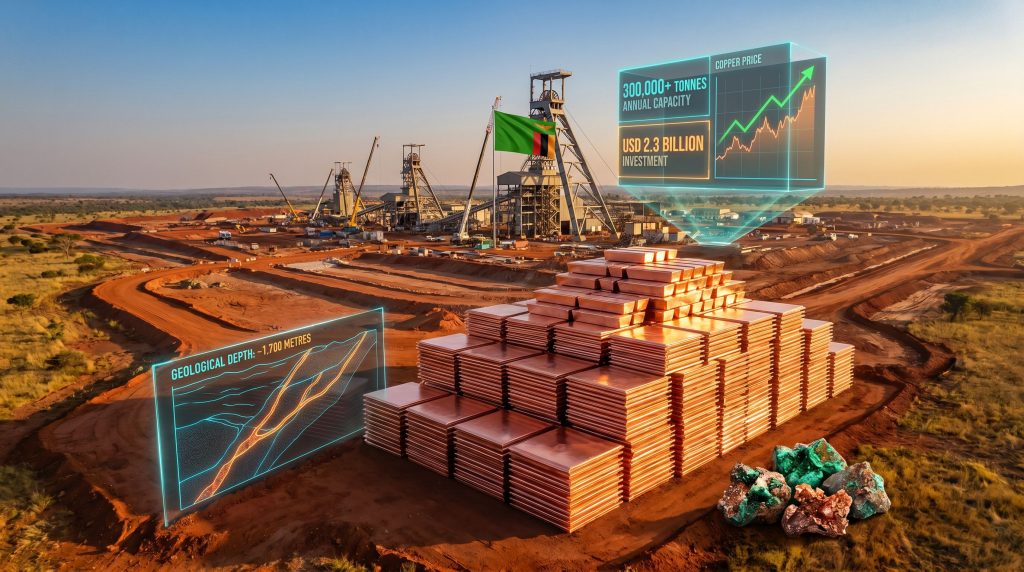
The orebody itself is situated approximately 1,700 metres below the surface, placing Mingomba among the deepest planned underground copper mines globally. To contextualise this depth: most conventional underground copper mines operate at depths between 400 and 900 metres. At 1,700 metres, the engineering domain shifts fundamentally. Rock stress, heat management, shaft logistics, and ventilation requirements all escalate in ways that demand highly specialised engineering design rather than adaptations of standard practice.
The Groundwater Problem Beneath the Copperbelt
Zambia's Copperbelt carries a geological characteristic that has shaped mining operations in the region for over a century: exceptionally high underground water inflows. Neighbouring operations in the same geological formation are classified among the wettest underground mines in the world, requiring continuous large-scale pumping to maintain safe and productive conditions. The Konkola mine, for example, has historically required pumping systems operating at volumes that rank among the largest of any underground mine globally.
At 1,700 metres, Mingomba's water management challenge will be orders of magnitude more complex than shallower regional peers. The hydrostatic pressure at that depth, combined with the known aquifer systems of the Copperbelt, means dewatering infrastructure must be engineered as a primary constraint from the project's inception, not treated as a secondary operational consideration. This is a detail that does not feature prominently in high-level project announcements but represents one of the most technically consequential decisions KoBold Metals will make during its engineering study phase.
How AI-Driven Exploration Compressed a 15-Year Timeline
From Acquisition to Groundbreaking in Under Four Years
KoBold Metals acquired the Mingomba asset in December 2022. Fewer than four years later, in May 2026, the company broke ground on full construction. The conventional mining industry benchmark for moving from initial discovery to construction commencement exceeds 15 years — a timeline shaped by sequential feasibility studies, environmental assessments, permitting processes, infrastructure development, and financing arrangements.
The compression KoBold achieved — roughly four to five times faster than the industry norm — is attributable in large part to the company's proprietary AI in mineral exploration platform. Rather than executing exploration campaigns sequentially, KoBold's technology enables a fundamentally different sequence:
- Data aggregation of historical geological surveys, satellite imagery, geophysical datasets, and legacy drill core records into a unified analytical environment
- Pattern recognition through machine learning models trained to identify mineralisation signatures and structural anomalies correlated with high-grade copper concentrations
- Targeted physical drilling directed at AI-generated priority zones, significantly reducing the number of unproductive drill holes and the capital required per unit of geological knowledge gained
- Iterative resource model refinement as each new drill result feeds back into the model, accelerating the transition from inferred to indicated and ultimately measured resource confidence
- Parallel development decision-making, with construction commencing ahead of the completion of full engineering studies, compressing phases that traditionally follow sequentially
Mining industry analyst Rebecca Moore of ResourceTech Insights has described KoBold's approach as an attempt to apply Silicon Valley's iterative development philosophy to the geological domain, emphasising that the ultimate test of this methodology will be whether the physical complexity of deep, water-bearing rock cooperates with algorithmic predictions.
What AI-Accelerated Exploration Cannot Eliminate
It is worth being precise about what the AI methodology achieves and what it does not. The technology improves the probability and efficiency of discovery and compresses the time required to build geological confidence. It does not eliminate geological risk, engineering uncertainty, or the physical reality of constructing infrastructure at extreme depth. The decision to commence construction before finalising engineering studies reflects genuine investor confidence and strategic urgency, but it also means that the final capital cost estimate of USD 2.3 billion remains unconfirmed until engineering studies are completed in early 2027.
This is a meaningful distinction for investors and industry observers. The USD 2.3 billion figure is a current estimate, not a fixed commitment, and deep, water-intensive underground projects have historically demonstrated a tendency toward cost escalation as engineering complexity is fully resolved during detailed design phases.
The Scale and Strategic Architecture of the Mingomba Project
Project Parameters and Ownership Structure
The Mingomba project is structured as a joint venture between KoBold Metals, holding an 80% controlling interest, and Zambia Consolidated Copper Mines Investment Holdings (ZCCM-IH), retaining a 20% sovereign stake. ZCCM-IH functions as the Zambian government's primary vehicle for equity participation in the country's mining sector, providing the state with ongoing economic exposure to major operations without requiring direct operational management responsibilities.
At full capacity, Mingomba is projected to produce in excess of 300,000 tonnes of copper per year, positioning it alongside the most productive underground copper operations in the world. For reference, the global copper mining industry's largest individual operations produce between 200,000 and 600,000 tonnes annually, meaning a fully operational Mingomba would rank among the top tier of copper producers globally.
The total capital investment is estimated at USD 2.3 billion, making it one of the largest single mining capital commitments in Zambian and broader African mining history. More than USD 150 million was deployed in exploration alone before the first tonne of construction material was moved. Furthermore, KoBold has reported that over USD 200 million in total contributions to the Zambian economy had already been made prior to formal construction commencement, through direct investment, local procurement, and community programmes.
Zambia's National Production Ambitions
The Mingomba development sits within a national policy context defined by President Hakainde Hichilema's publicly stated ambition to more than triple Zambia's copper output to approximately 3 million metric tonnes annually by 2030. The Zambia copper growth forecast underpins much of the strategic urgency around projects of this scale. At the May 2026 groundbreaking ceremony, the President described the project as evidence of Zambia's openness to international mining investment, characterising the transition from undeveloped ground to active shaft construction as a demonstration of the country's industrial trajectory.
Mingomba is not the only element of this national strategy. Barrick Mining and First Quantum Minerals are both expanding their footprint in the Zambian Copperbelt, creating a broader investment wave that reinforces the region's position as a priority destination for global mining capital.
Technical Risk Profile: A Structured Assessment
The Mingomba project carries a risk profile that is substantially more complex than comparably sized open-cut or shallow underground copper developments. Understanding this risk profile is essential for evaluating the project with appropriate analytical rigour.
| Risk Category | Nature of the Challenge | Current Mitigation Status |
|---|---|---|
| Depth and geotechnics | Rock stress, heat, logistics at 1,700m | Engineering studies ongoing to early 2027 |
| Groundwater inflows | Among highest in global underground mining history | Pumping infrastructure design in progress |
| Capital cost certainty | Final CAPEX estimate not confirmed until 2027 | USD 2.3bn is a current estimate subject to revision |
| Processing route | Smelting and refining decision unresolved | Options under active evaluation |
| Operator transition | First mine KoBold has constructed and will operate | Talent acquisition and operational capability building critical |
| Construction sequencing | Construction proceeding ahead of full engineering studies | Iterative engineering model accepted by investors |
The Processing Infrastructure Decision
One of the least-discussed but most consequential unresolved questions surrounding Mingomba is the processing route. KoBold Metals has not yet confirmed whether it will develop dedicated smelting and refining capacity at or near the mine site, or route copper concentrate through existing regional infrastructure. This decision carries implications far beyond capital cost. Indeed, advanced copper ore sorting technologies may also inform how ore is handled prior to processing, adding another layer of technical decision-making to an already complex picture.
- Local smelting capacity would generate downstream employment, contribute to Zambia's industrial development objectives, and potentially capture greater value from the ore
- Reliance on regional infrastructure reduces upfront capital requirements but limits Zambia's ability to capture value-added processing revenue within its borders
- The Zambian government's broader industrial strategy explicitly prioritises downstream beneficiation, meaning this decision will be scrutinised for its alignment with national economic development goals
From Explorer to Operator: The Capability Challenge KoBold Must Solve
Why Discovery Expertise and Operational Excellence Are Different Disciplines
KoBold Metals has built a compelling track record as a technology-enabled exploration company capable of identifying significant mineral deposits in compressed timeframes. Mingomba is, however, the company's first attempt to construct and operate a producing mine at scale — representing an organisational and technical step-change that the mining industry's history treats with considerable caution.
Mining consultant Peter van der Merwe articulated the nature of this transition clearly, noting that exploration success and operational success draw on fundamentally different capabilities, and that building and running a deep, complex underground mine requires disciplines entirely distinct from geological discovery. Van der Merwe further observed that execution quality — not capital availability or technological sophistication — will ultimately determine whether Mingomba becomes a landmark achievement or a cautionary study in the limits of accelerated development.
Workforce Architecture and Zambian Leadership
KoBold Metals has made a deliberate organisational choice in structuring the project's leadership. Mfikeyi Makayi, serving as KoBold Metals Africa CEO, leads operations with a Zambian-first workforce model. At the groundbreaking ceremony, Makayi emphasised the project's commitment to pace without compromising standards, framing urgency and operational integrity as complementary rather than competing imperatives.
More than 200 Zambian nationals are currently employed across the project as employees and contractors, with this number expected to scale significantly as construction activity intensifies. The project's workforce model is designed to develop indigenous technical capacity in underground mining disciplines that can contribute to Zambia's long-term human capital base beyond the mine's operational life.
KoBold President Josh Goldman acknowledged the genuine engineering complexity of the project at depth, stating that water management, infrastructure requirements, and geotechnical conditions all add layers of difficulty, while expressing confidence that appropriate engineering solutions can be identified and deployed.
The next major ASX story will hit our subscribers first
How Mingomba Compares to Africa's Major Copper Operations
Competitive Positioning Within the African Copper Investment Landscape
| Project | Country | Operator | Current Stage | Distinguishing Characteristic |
|---|---|---|---|---|
| Mingomba (Konkola West) | Zambia | KoBold Metals / ZCCM-IH | Construction commenced May 2026 | AI-accelerated discovery; 1,700m depth |
| Kamoa-Kakula | DRC | Ivanhoe Mines / Zijin Mining | Producing | World's highest-grade large copper mine |
| Kansanshi Expansion | Zambia | First Quantum Minerals | Active expansion | Established Copperbelt producer |
| Lumwana Super Pit | Zambia | Barrick Mining | Expansion underway | Major open-cut scale-up |
| Kipushi | DRC | Ivanhoe Mines | Producing | High-grade polymetallic zinc-copper |
Mingomba's depth and groundwater characteristics place it in a technically more demanding category than most comparable African copper developments. This simultaneously elevates execution risk and creates competitive barriers: the engineering expertise and capital required to operate successfully at 1,700 metres in a high-inflow environment is not easily replicated, providing a degree of long-term protection against competitive imitation that simpler deposits do not enjoy.
Unlike producing operations, Mingomba carries the full weight of construction and ramp-up risk. It also carries the potential to bring significant new supply to market precisely when copper pricing may reflect peak supply tightness — a timing dynamic that metals strategist James Rutledge of Green Transition Capital has described as a double-edged variable: delivery on schedule could capture exceptional price realisation, while delays could mean entering a market where additional supply from other sources has partially relieved the deficit. The global copper supply crunch makes this timing consideration especially consequential for both operators and investors alike.
The Investor Calculus: Technology, Sovereignty, and Speed
What Capital Allocation Signals About Industry Expectations
KoBold Metals has attracted capital from a high-profile cohort of technology-oriented investors, including Bill Gates and Sam Altman, reflecting the company's positioning at the intersection of advanced data analytics and resource development. The decision to proceed with construction activity ahead of completing full engineering studies signals that these investors are comfortable accepting a degree of cost uncertainty in exchange for timeline compression.
Laura Chen, a partner at Frontier Resources Advisory, has noted that capital is returning to the mining sector with qualitatively different expectations than in previous cycles. Investors are seeking projects that combine technological differentiation, accelerated development timelines, and measurable ESG performance alongside traditional resource quality. Projects like Mingomba are being studied as potential proof-of-concept demonstrations for an entirely different model of mineral discovery and development.
Key Milestones That Will Define the Project's Trajectory
The following milestones represent the most important near-term indicators of Mingomba's progress and should be monitored closely by industry observers and investors:
- Early 2027: Completion of detailed engineering studies and publication of a confirmed capital cost estimate, which may revise the current USD 2.3 billion figure upward or downward
- 2027 onward: Shaft sinking progress and underground development advance rates, serving as leading indicators of whether the project is tracking its construction schedule
- Processing route announcement: The decision on smelting and refining capacity will signal both capital commitment levels and alignment with Zambia's downstream industrial ambitions
- Workforce scale-up metrics: Growth in Zambian national employment numbers as a practical measure of local content commitments being honoured during the construction phase
- Water management systems commissioning: Early evidence of how dewatering infrastructure is performing relative to design parameters will provide important technical validation before deep ore access is required
Economic Significance for Zambia: Beyond the Mine Boundary
The economic footprint of the Mingomba project extends considerably beyond direct mining activity. The infrastructure commitments associated with the project include upgraded electrical power supply serving both mine operations and surrounding communities, improved road networks connecting the broader Copperbelt region, and expanded education and healthcare facilities in adjacent areas.
Royalty flows, corporate tax contributions, and ZCCM-IH dividend streams from a fully producing Mingomba operation would represent a material addition to Zambia's national fiscal position. At 300,000 tonnes of annual copper output, and depending on the prevailing copper price environment, the mine's gross revenue generation would run into billions of dollars annually, with a meaningful proportion flowing to the Zambian state through various fiscal instruments.
The project also carries broader signal value for African mining investment more generally. Mining industry commentators have observed that Mingomba is being watched internationally as an indicator of whether Zambia's policy reform trajectory is translating into genuine investor confidence and tangible capital deployment, rather than remaining aspirational. For context, Bloomberg's reporting on the project captured the scale of international attention this development has attracted.
If the KoBold Metals Mingomba mine in Zambia delivers on its development schedule and production targets, the implications will extend far beyond the Copperbelt. It would represent validation of AI-driven mineral exploration as a commercially viable methodology, a template for compressed development timelines, and evidence that deep, technically complex deposits can attract and retain the capital and talent required for successful development in frontier jurisdictions.
The mining industry does not lack for ambitious projects that ultimately fell short of their founding promise. What distinguishes Mingomba is the convergence of exceptional geological quality, a genuinely novel technological approach to discovery, a committed and politically engaged sovereign partner, and a macro demand environment that rewards successful execution with historically elevated copper pricing. Consequently, those evaluating copper investment strategies in the current environment would be well served by monitoring how Mingomba's engineering and operational milestones unfold. Whether those converging forces prove sufficient to overcome the formidable engineering realities of 1,700 metres of depth, high-inflow groundwater, and an organisation making its first transition from explorer to operator, remains the defining question that the next five years will answer.
Disclaimer: This article contains forward-looking statements, projections, and analysis based on publicly available information as of May 2026. All financial figures, production targets, and development timelines referenced are estimates subject to material change. Capital cost estimates for the Mingomba project are unconfirmed pending the completion of engineering studies expected in early 2027. This article does not constitute financial or investment advice. Readers should conduct independent due diligence before making investment decisions related to any companies or projects mentioned herein.
Want to Track the Next Major Copper Discovery Before the Broader Market Does?
Discovery Alert's proprietary Discovery IQ model delivers real-time alerts the moment significant mineral discoveries are announced on the ASX, transforming complex geological data into actionable investment insights — explore historic discoveries and their extraordinary returns to understand the opportunity, then begin your 14-day free trial at Discovery Alert to position yourself ahead of the market.