
July 17, 2026
When the Ground Opens: Why the KoBold Zambia Copper Mine Mingomba Signals a New Chapter in Critical Mineral Supply
Copper has always been a metal that rewards patience. Decades pass between discovery and production, and the economics of any given project can shift dramatically across that timeline. Yet something different is happening across Zambia's Copperbelt in 2026 — a convergence of technology-driven discovery, surging downstream demand, and concentrated capital that is collapsing traditional timelines and rewriting expectations for how major deposits are found and developed.
At the centre of this shift is a project that, until recently, existed only as unexplored potential beneath one of the world's most mineralised corridors. The KoBold Zambia copper mine Mingomba, officially entering its shaft-sinking phase in April 2026, is now the most consequential new copper development on the African continent — and arguably one of the most closely watched greenfield mining investments anywhere in the world.
When big ASX news breaks, our subscribers know first
The Supply Mathematics That Make Mingomba Matter
Copper demand is not a future projection anymore — it is an accelerating present reality. Electric vehicles require roughly three to four times more copper per unit than conventional internal combustion vehicles. Grid infrastructure upgrades needed to support renewable energy transitions are copper-intensive at every stage. Furthermore, AI-driven data centre buildouts, which require dense copper wiring for power distribution and cooling systems, are adding a demand vector that was not modelled in most supply forecasts written before 2022.
The result is a structural supply picture that industry analysts and multilateral institutions have been flagging with increasing urgency. Bloomberg reported in April 2026 that there is growing consensus around a significant supply shortfall arriving precisely during the window in which Mingomba is expected to begin production. Understanding the copper supply crunch is, consequently, essential context for evaluating why this project has attracted such concentrated global attention.
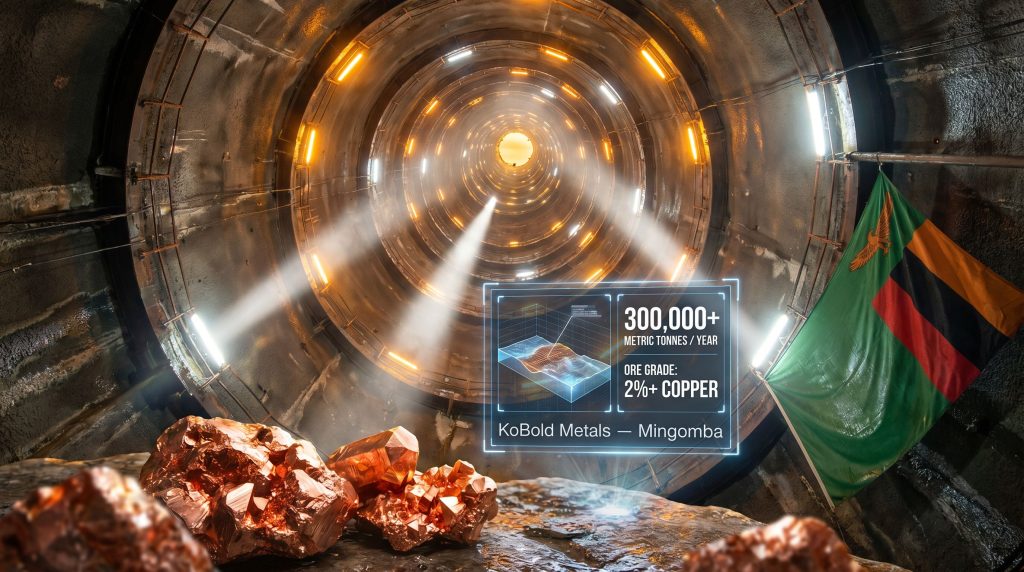
At more than 300,000 metric tonnes of copper per year at full capacity, Mingomba would represent a meaningful single-asset contribution to closing that gap. At current global mine supply levels of approximately 22 million tonnes annually, a project of that scale accounts for roughly 1.3% of total output from one greenfield development — a rare achievement in a sector where most new projects target far more modest production rates.
What the KoBold Zambia Copper Mine Mingomba Actually Is
Mingomba is located in Zambia's Copperbelt Province, positioned near the border with the Democratic Republic of Congo in a mineralised corridor that hosts some of the world's most significant sediment-hosted stratiform copper deposits. These geological formations, associated with the Roan Group, are characterised by laterally continuous, high-grade mineralisation that has historically proven amenable to bulk underground extraction.
KoBold Metals acquired the project in December 2022. Within approximately three and a half years, the company had advanced from acquisition through AI-assisted resource delineation to a formal groundbreaking ceremony and the commencement of shaft-sinking activities — a compressed timeline by any standard in the mining industry.
The headline project metrics position Mingomba as a top-tier development globally:
| Metric | Detail |
|---|---|
| Estimated Capital Cost | $2.3 billion to $2.5 billion |
| Target Annual Production | More than 300,000 metric tonnes of copper |
| Mine Depth | Approximately 1,700 metres below surface |
| KoBold Ownership Stake | 80% |
| ZCCM-IH Ownership Stake | 20% |
| Shaft Sinking Commencement | April 2026 groundbreaking |
| Engineering Study Completion | Targeted for early 2027 |
| Target First Production | Early 2030s |
The capital requirement alone makes this one of the largest single investment projects in Zambia's history. A definitive feasibility study cost figure will not be confirmed until KoBold completes a formal engineering study, with KoBold president Josh Goldman confirming that this process is expected to conclude by early 2027. The current $2.3 to $2.5 billion range reflects pre-feasibility level accuracy, with refinement expected as detailed engineering progresses.
How Artificial Intelligence Unlocked a Previously Hidden Resource
Perhaps the most technically significant aspect of the KoBold Zambia copper mine Mingomba story is how the orebody was identified in the first place. KoBold Metals, headquartered in Silicon Valley and backed by prominent technology sector investors including Bill Gates and Sam Altman, deployed proprietary machine learning and AI-driven geological modelling tools across the Mingomba subsurface dataset after acquiring the project.
The outcome was the identification of a highly concentrated copper resource at depth that prior conventional exploration had not surfaced. This is a distinction worth dwelling on. Conventional geological exploration relies on drill-hole interpolation, surface mapping, and geophysical surveys interpreted through human expertise. However, AI in mineral exploration integrates all of these data streams simultaneously, identifying anomaly patterns across far larger and more complex datasets than a human team can process in comparable timeframes.
What makes this methodologically significant is not just that the tool worked at Mingomba — it is the implication for the broader exploration pipeline. If AI-driven subsurface analysis can identify high-grade resources that decades of conventional exploration missed, the global inventory of undiscovered copper may be materially larger than current resource databases reflect. That is a speculative but increasingly credible hypothesis that a number of geologists and mineral economists are beginning to engage with seriously.
Industry thinking is evolving around the idea that the discovery gap in mature mining belts may be less a function of geological scarcity and more a function of analytical limitations in historical exploration methodologies.
For KoBold, the Mingomba discovery validates the company's core thesis — that the intersection of data science and hard rock geology can deliver exploration outcomes superior to traditional methods, particularly at depth and in geologically complex environments.
The Engineering Challenge Beneath the Surface
Building a mine at approximately 1,700 metres below the surface places Mingomba in a category occupied by very few copper operations globally. Ultra-deep mining introduces compounding technical challenges that surface and shallow underground mines simply do not encounter.
Rock mechanics become non-linear at depth. The overburden pressure at 1,700 metres generates stress conditions that require specialised shaft lining designs, reinforced excavation techniques, and continuous geotechnical monitoring. Rock bursting — the sudden, explosive failure of highly stressed rock — is a documented risk in ultra-deep mining environments and demands specific engineering controls.
Ventilation requirements scale with depth. Moving sufficient air volume to maintain safe working temperatures and dilute diesel exhaust and blast fumes at extreme depths requires primary ventilation infrastructure that itself represents a significant capital and operational cost line. In deep mines, ventilation is frequently cited as one of the largest single energy consumers.
The hydrogeological environment adds another layer of complexity. The Copperbelt region near the Zambia-DRC border hosts what Bloomberg has described as some of the wettest underground mines in the world, requiring massive pump installations to manage groundwater inflows and prevent flooding. At Mingomba's proposed depth, the hydraulic head pressure driving groundwater into excavations will be substantial, and dewatering infrastructure will need to be engineered for continuous operation across the full mine life.
Ore hoisting over 1,700 metres is a logistical and mechanical challenge in its own right. Shaft rope tensions, skip capacities, winder specifications, and shaft conveyance cycle times all constrain throughput and must be carefully optimised to support the production volumes KoBold is targeting.
Collectively, these factors explain why the project's definitive capital estimate cannot be confirmed until a rigorous engineering study is complete. Each of these technical variables carries cost sensitivity that can shift the final number materially.
Zambia's National Copper Ambition and Where Mingomba Sits Within It
Zambia's government has publicly targeted annual copper production of 3 million metric tonnes by 2031 — a figure that would represent roughly triple the country's current output. President Hakainde Hichilema, speaking at Mingomba's groundbreaking ceremony in April 2026, framed the project as proof of Zambia's investment climate evolution, noting that what was once undeveloped land is now the site of a major shaft-sinking operation.
Mingomba sits at the centre of this national strategy. It is the single largest greenfield copper investment in Zambia's history and, alongside concurrent expansions by First Quantum Minerals at Kansanshi and Barrick Mining Corp at Lumwana, forms part of a broader production uplift across the Copperbelt. The Zambia copper growth forecast reflects just how central projects like Mingomba are to the country's economic ambitions.
The state-linked investment vehicle ZCCM-IH holds a 20% equity stake in the Mingomba joint venture. This ownership structure ensures direct national participation in project economics while maintaining an ownership configuration that preserves the operational control and capital responsibility that KoBold, as the majority partner, requires to execute the development.
This joint venture model reflects a broader shift in African mining governance — away from outright resource nationalism that deters capital and toward structured co-ownership frameworks that capture national value without undermining investment feasibility.
The next major ASX story will hit our subscribers first
Competitive Context: How Mingomba Compares to Other Copperbelt Developments
Mingomba does not exist in a vacuum. Zambia's Copperbelt is attracting multiple large capital commitments simultaneously, creating both a positive narrative for the jurisdiction and practical competition for resources.
| Project / Operator | Status | Approximate Annual Capacity | Key Feature |
|---|---|---|---|
| Mingomba (KoBold Metals) | Under Development | 300,000+ t/y | Highest-grade undeveloped deposit |
| Kansanshi (First Quantum Minerals) | Active Expansion | ~250,000 t/y | Largest copper mine in Africa |
| Lumwana (Barrick Mining Corp) | Active Expansion | ~130,000–170,000 t/y | Super pit development underway |
| Konkola Copper Mines (Vedanta) | Operational / Restructuring | Variable | Historically significant asset |
The simultaneous advancement of these projects creates important infrastructure considerations. Roads, power transmission, water supply, and logistics corridors serving multiple large operations offer potential co-investment efficiencies. However, skilled labour availability, specialised mining equipment procurement, and construction contractor capacity may all face pressure if project timelines converge.
For Mingomba specifically, the depth and hydrogeological complexity of the operation means it draws on a narrower pool of specialist expertise than shallower operations. Deep shaft-sinking crews, dewatering engineers, and ultra-deep winder specialists are not abundant in the global mining services market.
The First-Time Mine Builder Question
One of the more candid risk factors associated with the KoBold Zambia copper mine Mingomba is one that KoBold itself does not obscure: the company has not built a mine before. Bloomberg's April 2026 reporting noted directly that KoBold is yet to build a mine anywhere, let alone one of this complexity, given that its expertise has so far been concentrated in discovery and exploration activities.
This is not an unusual position for a technology-driven exploration company to find itself in. The mining value chain is long, and the skills required to discover a deposit are genuinely different from those required to design, construct, and operate a producing mine. The transition from exploration to development is where many well-resourced companies have encountered their most significant setbacks.
For Mingomba, the mitigants to this risk lie in the quality of engineering partners engaged, the rigour of the ongoing feasibility study, and the depth of operational expertise that KoBold assembles around the project. A $2.3+ billion ultra-deep mine in a challenging hydrological environment will demand best-in-class execution partners — and the identification and retention of those partners is itself a material project variable.
Key Risk Factors for Analysts and Long-Term Observers to Track
Projects of this scale and complexity carry a layered risk profile that evolves at each development stage. The following risk categories warrant structured monitoring:
Technical and Operational Risks:
- Dewatering system performance and groundwater management cost variability at 1,700 metres depth
- Shaft sinking schedule adherence, given that this is an inherently long-lead activity sensitive to geological surprises
- Execution risk associated with a first-time mine builder navigating a technically demanding development environment
- Rock mechanics and ground support requirements at extreme depth that may diverge from modelled assumptions
Financial and Market Risks:
- The definitive capital cost will not be known until early 2027, leaving a window of financial uncertainty for potential lenders and co-investors
- Copper price volatility across a five-to-seven-year development horizon could affect project economics meaningfully, given the high absolute capital commitment
- Resource grade continuity at depth remains a critical variable, and any deviation from modelled grades would affect projected revenue and operating cost ratios
Geopolitical and Regulatory Risks:
- Zambia's investment climate has improved materially under the Hichilema administration, but regulatory continuity across a multi-decade mine life carries inherent uncertainty
- Proximity to the DRC border introduces regional stability considerations relevant to logistics and security
- Future changes to royalty structures, taxation frameworks, or local content requirements could affect long-term project returns
Furthermore, those evaluating copper investment strategies in the context of African development projects should consider all of the above risk categories as part of any structured due diligence process.
This article contains forward-looking information based on publicly available statements and industry analysis. It does not constitute financial advice. All project timelines, capital estimates, and production figures are subject to change and should be verified against official company disclosures.
Frequently Asked Questions: KoBold Metals Mingomba Copper Mine
What is the Mingomba copper mine?
Mingomba is a large-scale copper development project in Zambia's Copperbelt Province, being developed by Silicon Valley-based KoBold Metals, which holds an 80% stake, alongside Zambia's state investment vehicle ZCCM-IH at 20%. It is considered the world's highest-grade undeveloped copper deposit and will be one of the deepest copper mines on the African continent.
How much will Mingomba cost to build?
Current pre-feasibility estimates place total capital expenditure between $2.3 billion and $2.5 billion, making it one of the largest investment projects in Zambia's history. A definitive figure will be established following completion of an engineering study expected in early 2027.
When will Mingomba produce first copper?
First production is targeted for the early 2030s. Shaft sinking commenced with the April 2026 groundbreaking and will require several years of construction and commissioning before first copper output.
How much copper will Mingomba produce?
At full capacity, Mingomba is expected to produce more than 300,000 metric tonnes of copper per year, placing it among the highest-output copper operations on the African continent.
What role does AI play in the Mingomba project?
KoBold Metals used proprietary AI and machine learning tools to analyse subsurface geological data, identifying a highly concentrated copper resource at depth that conventional exploration methods had not previously detected.
Who owns the Mingomba copper mine?
KoBold Metals holds an 80% interest and Zambia's ZCCM-IH holds the remaining 20% in the Mingomba joint venture.
The Longer Arc: What Mingomba Means for Global Copper Supply
The significance of the KoBold Zambia copper mine Mingomba extends beyond its own production numbers. It represents a proof of concept for technology-driven mineral discovery at scale — and if that model is replicable across other underexplored geological terranes, the implications for the global copper supply picture could be substantial.
Zambia's Copperbelt has been mined for nearly a century, yet Mingomba's AI-assisted discovery suggests meaningful resource potential remains at depth in a belt long assumed to be thoroughly explored. That finding should attract attention from exploration companies and development finance institutions alike, not just for what it means for Mingomba but for what it implies about discovery potential across comparable geological settings elsewhere on the continent.
At the national level, Mingomba's development — alongside the concurrent Kansanshi and Lumwana expansions — positions Zambia as a copper jurisdiction capable of competing for major capital on terms that were not available a decade ago. The combination of a sovereign-friendly joint venture structure, a government that has actively courted foreign investment, and an emerging track record of large project development is creating a self-reinforcing cycle of institutional confidence.
Whether Mingomba delivers on its ambitious targets depends on execution decisions that have not yet been made, technical challenges that have not yet been fully quantified, and market conditions that cannot be predicted with precision across a decade-long development horizon. What is already clear is that its groundbreaking marks a structural inflection point for African copper development — one that will be studied closely regardless of how the project ultimately unfolds.
Want to Track the Next Major Mineral Discovery Before the Broader Market Does?
Discovery Alert's proprietary Discovery IQ model delivers real-time alerts on significant ASX mineral discoveries, transforming complex geological and commodity data into actionable investment insights — explore Discovery Alert's dedicated discoveries page to understand how historic finds have generated substantial returns, and begin your 14-day free trial to position yourself ahead of the market.