July 27, 2026
The Economics of Frontier Lithium: Why West Africa Is Rewriting the Battery Supply Chain Playbook
The global race to secure lithium supply for electric vehicle batteries has historically centred on the global lithium market dynamics of South America's lithium triangle and the hard-rock pegmatite fields of Western Australia. Yet a quieter, arguably more structurally significant shift has been unfolding across the Birimian geological terrain of West Africa, where a combination of Chinese capital deployment, host government resource nationalism, and operationally resilient junior miners is producing a new template for critical minerals development. Understanding this model requires looking closely at how projects actually get built, financed, and operated in frontier jurisdictions, rather than relying on assumptions drawn from more established mining geographies.
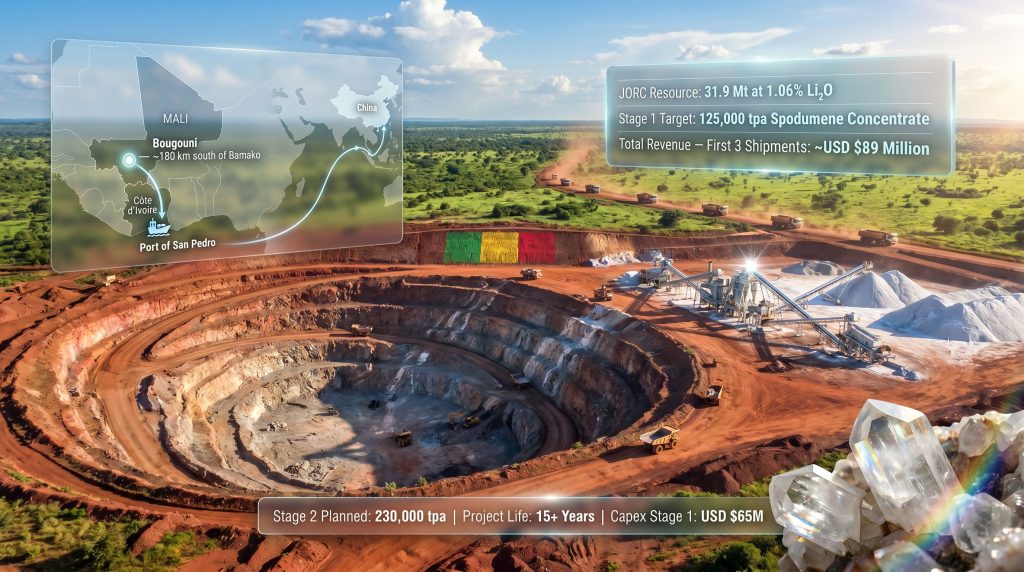
The Kodal Bougouni lithium project in Mali represents one of the clearest working examples of this emerging model. Situated approximately 180 km south of Bamako within a 350 km² project area, Bougouni is not a development-stage concept or a resource estimate waiting for capital. It is an operational open-pit lithium mine that has already generated over USD $89 million in revenue from its first three spodumene concentrate shipments, and it is ramping toward a Stage 1 annual output target of 125,000 tonnes of spodumene concentrate.
When big ASX news breaks, our subscribers know first
Mali's Emergence as a Dual-Pillar Lithium Producer
Mali's arrival as a lithium-producing nation has been rapid and largely underappreciated outside specialist mining circles. The country's second operational lithium mine, the Kodal Bougouni lithium project in Mali, reached first production in February 2025, following Goulamina's commissioning in December 2024. Together, these two assets position Mali as one of the continent's most consequential new sources of spodumene concentrate supply.
The Birimian geological terrain, which underlies much of West Africa's gold and lithium prospectivity, hosts lithium-bearing pegmatites that exhibit characteristics well-suited to efficient processing. The Bougouni project's primary pit at Ngoualana sits within this terrain, with a run-of-mine stockpile exceeding 350,000 tonnes at 1.17% Li₂O, a grade consistent enough to support predictable Dense Media Separation throughput without requiring the metallurgical complexity of flotation at the initial stage.
Spodumene extraction, the process behind Bougouni's exports, functions as the upstream precursor for lithium chemicals used across the EV battery manufacturing chain. Typically processed to a 5-6% Li₂O equivalent grade, the concentrate is shipped from Port of San Pedro in Côte d'Ivoire directly to Hainan, China, where it enters downstream lithium conversion facilities. This integrated supply corridor from pit to port to processor reflects a deliberate supply chain architecture rather than an opportunistic arrangement.
Project Fundamentals: What the Bougouni Asset Actually Looks Like
The Kodal Bougouni lithium project in Mali operates through a legal entity called Les Mines de Lithium de Bougouni SA, or LMLB, which holds the mining licence and conducts all on-site operations. Below is a consolidated view of the project's core parameters.
| Parameter | Detail |
|---|---|
| Location | Southern Mali, ~180 km south of Bamako |
| Project Area | 350 km² within Birimian terrain |
| Operating Entity | Les Mines de Lithium de Bougouni SA (LMLB) |
| Stage 1 Target Output | 125,000 tpa spodumene concentrate |
| Stage 2 Planned Output | 230,000 tpa (flotation plant, ~2028) |
| JORC Resource (2023) | 31.9 Mt at 1.06% Li₂O |
| Resource Uplift | 40% increase from 2019 estimate |
| Primary Pit ROM Stockpile | Exceeds 350,000 t at 1.17% Li₂O |
| Project Life | 15+ years (10+ years from Stage 2) |
| Stage 1 Capex | USD $65 million, fully financed by Hainan Group |
| Processing Method | Dense Media Separation (DMS) |
| DMS Throughput Target | 10,000 tonnes per month |
The Geological Foundation and Why It Matters
The 2023 JORC Mineral Resource update of 31.9 Mt at 1.06% Li₂O represented a 40% uplift from the 2019 estimate, a meaningful increase that signals improved geological confidence through additional drilling and more sophisticated deposit modelling. In West African lithium geology, this kind of resource growth trajectory from initial discovery to updated estimate is particularly significant because Birimian-hosted pegmatites can display considerable structural complexity, making early resource definitions inherently conservative.
The Ngoualana deposit, which serves as the primary mining pit, carries ROM ore at 1.17% Li₂O, marginally above the overall resource average. This grade consistency at the active mining face is operationally important because DMS processing efficiency is sensitive to feed grade variability. A stable, predictable feed grade supports consistent concentrate output and reduces the risk of off-spec product deliveries that could trigger price adjustments at final settlement.
The Birimian terrain is not unique to Mali. Ghana, Guinea, and Burkina Faso host portions of the same geological sequence, which means the regional prospectivity context for lithium-bearing pegmatites extends well beyond Bougouni's licence boundary. However, what distinguishes Bougouni is the combination of resource size, accessible location, and an already-functioning export logistics corridor that most prospective West African lithium assets do not yet possess.
Understanding the Three-Party Ownership Architecture
The ownership structure underpinning the Kodal Bougouni lithium project in Mali is layered in a way that reflects both Chinese capital efficiency and West African resource nationalism. It is worth mapping this carefully because the revenue exposure of each party is not immediately obvious from surface-level reporting.
The Bougouni project operates under a tiered joint venture framework in which Chinese capital, British-listed equity, and Malian sovereign interests converge within a single operational entity, a governance model that is becoming increasingly common across the continent's critical minerals sector.
The ownership cascade functions as follows:
- Hainan Mining (China) holds 51% of Kodal Mining UK (KMUK) and carries ultimate operational and financial control, having fully financed Stage 1 construction at a cost of USD $65 million
- Kodal Minerals (AIM-listed) holds 49% of KMUK, retaining strategic oversight and management control responsibilities at the LMLB level despite not holding a majority position
- KMUK in turn holds 65% of LMLB, the direct project licence holder and on-ground operator
- The Malian Government holds the remaining 35% of LMLB as a free-carried interest under the 2023 Mali Mining Code, entitling it to revenue distributions without any capital contribution requirement
The mining licence transfer to the 2023 Mining Code framework was completed in November 2024, formalising the government's 35% stake ahead of the project's official inauguration. That inauguration, conducted by Mali's President General Assimi Goïta on November 3, 2025, marked a politically significant milestone, reflecting the highest level of national recognition for the project's contribution to Mali's resource economy.
What Kodal Minerals' 49% KMUK Stake Means in Practice
For investors in Kodal Minerals, the 49% KMUK position requires careful interpretation. The company does not hold a direct operational majority at the LMLB level. However, KMUK, in which Kodal holds its stake, is contractually responsible for providing management oversight and operational control of mining activities at the project, according to reporting by Mining Weekly (May 5, 2026). This means Kodal's involvement is not merely passive equity participation; it carries governance responsibilities that differentiate it from a purely financial interest.
Revenue flows from LMLB's concentrate sales, with distributions allocated across the KMUK/government ownership split, and then further divided between Hainan Mining and Kodal Minerals within KMUK's 65% share. The free-carry mechanics for the Malian government mean that 35 cents of every dollar generated at LMLB level flows to state coffers before KMUK distributions are calculated, a material consideration for understanding effective revenue exposure.
From Exploration to Export: The Development Timeline
The speed with which the Kodal Bougouni lithium project in Mali moved from updated resource to operational production is notable, particularly for a frontier jurisdiction with elevated logistical complexity. Furthermore, understanding how lithium mining works across different geologies helps contextualise why Bougouni's DMS-first approach was strategically astute.
- 2019: Initial JORC Mineral Resource established, providing the first formal geological framework for the project
- 2023: Updated JORC Resource confirmed at 31.9 Mt at 1.06% Li₂O, representing a 40% increase and significantly strengthening project economics
- Mid-2024: DMS plant construction commenced, with Hainan Group providing the entire USD $65 million capital envelope
- November 2024: Mining licence formally transferred to the 2023 Mining Code framework, completing the legal architecture required for full commercial operation
- February 2025: Stage 1 DMS plant commissioned ahead of schedule, with first spodumene concentrate production achieved
- November 3, 2025: Official project inauguration conducted by President General Assimi Goïta
- Late 2025: First commercial spodumene shipments dispatched via Port of San Pedro, Côte d'Ivoire
- April 12, 2026: Third shipment of approximately 20,480 dmt departed Port of San Pedro, bound for Hainan
- May 2026: Total revenue from first three shipments surpasses approximately USD $89 million; operations continuing without interruption
DMS is a gravity-based concentration method that operates efficiently on coarser-grained mineralisation without requiring the chemical reagents, finer grinding circuits, or flotation cells that Stage 2 will introduce. This lower-complexity process enabled on-schedule delivery within a compressed capital envelope in a region where construction logistics present genuine challenges.
Shipment Performance and Revenue Mechanics
The commercial performance of the Kodal Bougouni lithium project in Mali has been demonstrably strong across its first three shipments, with each cargo providing data points on both pricing dynamics and operational execution.
| Shipment | Volume (dmt) | Revenue Received | Equivalent Price | Status |
|---|---|---|---|---|
| Shipment 1 | Not individually disclosed | Included in $89M total | Not separately reported | Complete |
| Shipment 2 | ~19,738 dmt | $27.6M (final payment) | $1,681.3/t SC6% equivalent | Final settled |
| Shipment 3 | ~20,480 dmt | $34.4M (95% interim) | Pending final settlement | In transit (July 2026 arrival) |
The Provisional Payment Structure: A Mechanism Worth Understanding
The payment structure for spodumene concentrate shipments operates on a provisional and final settlement basis that is common across bulk mineral commodity trading but not widely understood outside the sector. When a cargo departs, the buyer — in this case Hainan Mining — makes an interim payment representing 95% of the estimated cargo value, adjusted for grade and freight and insurance costs. The remaining 5% is settled only after independent verification of grade, dry metric tonnage, and moisture content has been completed at the receiving port.
This mechanism protects both parties: the seller receives substantial early cash flow, while the buyer retains a settlement buffer pending physical confirmation of the cargo's commercial specifications. For the third shipment of ~20,480 dmt, LMLB received an interim payment of $34.4 million upon shipment in April 2026, with the final payment triggered following the cargo's expected arrival in Hainan in July 2026.
The receipt of final payment for the second shipment and the interim payment for the third shipment points to a strengthening spodumene concentrate price environment and growing demand from the broader lithium market, according to Kodal Minerals CEO Bernard Aylward, as reported by Mining Weekly on May 5, 2026.
The second shipment's $1,681.3/t SC6% equivalent average price provides a useful market benchmark. SC6% refers to spodumene concentrate standardised to a 6% Li₂O grade, the industry pricing reference point that allows comparison across different concentrate grades from different producers. Prices at this level reflect meaningful recovery from the lithium price trough of 2023-2024, though they remain well below the peak pricing environment of 2022.
The next major ASX story will hit our subscribers first
Navigating the Security Environment: Operational Continuity as a Competitive Variable
Mali's broader security environment has attracted significant international attention, particularly regarding instability in the country's northern and central zones. For an operational lithium asset, the question of how security conditions translate into production risk is not abstract — it directly affects investor confidence, insurance costs, offtake contract terms, and ultimately valuation.
As of May 2026, the Bougouni township and project site have remained unaffected by the security incidents reported elsewhere in Mali, with site operations continuing normally, including fuel deliveries, spare parts logistics, and concentrate exports to Port of San Pedro, according to CEO Bernard Aylward as reported by Mining Weekly on May 5, 2026.
Several structural factors contribute to Bougouni's relatively favourable security profile compared to other Malian resource operations:
- Southern location: Bougouni sits approximately 180 km south of Bamako, geographically distant from the higher-risk northern and central regions where most instability has been concentrated
- Proximity to an established township: Operating adjacent to the Bougouni regional centre provides logistical depth, a local workforce base, and access to civil infrastructure that remote operations lack
- Multi-layered security framework: The project maintains support from private security contractors, coordination with local government officials, and community engagement programmes that reduce vulnerability to localised disruption
- Ministerial engagement: Visits from Mali's Mines Minister Amadou Keita reflect sustained governmental interest in the project's operational continuity
- Export route through Côte d'Ivoire: The logistics corridor through Port of San Pedro transits a politically stable neighbouring country, reducing the project's dependence on Malian internal transport infrastructure alone
This combination of geographic positioning, governance relationships, and logistics diversification creates a risk profile that differs materially from what the headline Sahel security narrative might suggest. That said, investors should note that security conditions in the broader region remain dynamic and subject to change, and no mining operation in the Sahel is entirely insulated from geopolitical risk.
Stage 2 Expansion: The Flotation Pathway and Long-Term Production Potential
The Stage 2 expansion plan targets a doubling of production capacity through the addition of a flotation processing plant, with a planned output of 230,000 tpa of spodumene concentrate and a target commissioning timeline of approximately 2028. In addition, innovations in direct lithium extraction technology are reshaping how producers think about downstream processing efficiency, though Bougouni's Stage 2 pathway remains anchored in proven flotation methodology.
| Stage | Technology | Target Output | Timeline | Notes |
|---|---|---|---|---|
| Stage 1 | Dense Media Separation | 125,000 tpa | Operational (2025 onwards) | Coarse-grained ore; lower capex complexity |
| Stage 2 | Flotation Plant | 230,000 tpa | Planned ~2028 | Captures finer-grained lithium mineralisation |
The technical rationale for adding flotation is straightforward but often misunderstood. DMS processing is highly efficient for coarse-grained spodumene crystals but cannot economically recover the finer lithium mineralisation that constitutes a significant portion of many pegmatite ore bodies. Flotation uses reagent chemistry to selectively attach fine spodumene particles to air bubbles, allowing them to be separated from gangue minerals in a froth layer. By deploying both technologies in sequence, the Bougouni operation would capture a substantially larger proportion of the lithium content in each tonne of ore processed.
This has direct implications for resource life. The 31.9 Mt JORC resource at 1.06% Li₂O supports a 10+ year mine life at Stage 2 production rates, with total project life exceeding 15 years when both stages are considered together. That longevity positions Bougouni as a long-duration supply asset rather than a short-cycle producer, which has different implications for offtake contract structures, project financing terms, and sovereign royalty revenues for Mali.
Benchmarking Bougouni Against African Lithium Peers
Contextualising the Kodal Bougouni lithium project in Mali within the African lithium development landscape reveals both its current position and its potential trajectory. For instance, comparing it against the scale of the Manono lithium project in the DRC highlights how different development stages and geological endowments shape each project's strategic significance.
| Project | Country | Status | Annual Output Target | Primary Owner |
|---|---|---|---|---|
| Bougouni | Mali | Operational (Stage 1) | 125,000 tpa SC | Hainan Mining / Kodal Minerals |
| Goulamina | Mali | Operational | ~500,000 tpa SC | Ganfeng Lithium |
| Arcadia | Zimbabwe | Operational | ~240,000 tpa SC | Huayou Cobalt |
| Manono | DRC | Development (disputed) | 700,000+ tpa LCE (long-term) | AVZ Minerals |
Bougouni's Stage 1 output is modest relative to Goulamina's scale, but the two projects together are positioning Mali as the continent's most consequential lithium-producing nation in the near term. A critical distinction worth noting is Bougouni's capital structure: with Stage 1 fully financed by Hainan Group at USD $65 million and no debt exposure on Kodal Minerals' balance sheet, the project carries a fundamentally different financial risk profile from assets still seeking construction capital.
Three structural advantages differentiate Bougouni as an investment-grade producing asset:
- No debt burden on Kodal Minerals: The full Hainan Group financing eliminates balance sheet risk for the AIM-listed entity, providing revenue exposure without corresponding liability
- Secured offtake with immediate revenue certainty: The Hainan Mining offtake agreement underpins cash flow from day one of commercial production, removing the demand uncertainty that affects non-integrated producers
- Established and functioning export corridor: The Port of San Pedro route through Côte d'Ivoire has already been operationally validated across three shipments, removing logistics risk that remains hypothetical for many competing African lithium projects
Frequently Asked Questions: Kodal Bougouni Lithium Project in Mali
What is the Kodal Bougouni lithium project?
The Kodal Bougouni lithium project in Mali is an operational open-pit lithium mine located approximately 180 km south of Bamako in southern Mali. It produces spodumene concentrate through a Dense Media Separation plant and exports the product to China via Port of San Pedro in Côte d'Ivoire. The project is operated through LMLB, a joint venture entity owned by Kodal Mining UK (65%) and the Malian government (35%).
Who owns the Bougouni lithium mine?
Ownership operates through two tiers. At the KMUK level, Hainan Mining of China holds 51% and Kodal Minerals (AIM-listed) holds 49%. At the LMLB (project) level, KMUK holds 65% and the Malian government holds 35% as a free-carried interest under the 2023 Mali Mining Code.
When did the Bougouni project start production?
The Stage 1 DMS plant was commissioned in February 2025, achieving first spodumene concentrate production ahead of schedule. The project's official inauguration took place on November 3, 2025, with first commercial shipments dispatched in late 2025.
How much revenue has Bougouni generated from shipments?
As of May 2026, the operation had received total revenue of approximately USD $89 million from its first three shipments, including final payment of $27.6 million for the second shipment and an interim payment of $34.4 million for the third shipment, as reported by Mining Weekly on May 5, 2026.
Is the Bougouni project affected by Mali's security situation?
As of May 2026, the Bougouni township and project site had remained unaffected by security incidents reported in other parts of Mali. Operations including fuel and spare parts deliveries and concentrate exports to Port of San Pedro were continuing without disruption.
What is spodumene concentrate and why does it matter?
Spodumene is a lithium-bearing pyroxene mineral found within pegmatite rock formations. When mined and processed, it is upgraded to a concentrate — typically 5-6% Li₂O grade (referred to as SC5 or SC6) — which serves as the primary feedstock for conversion into lithium hydroxide or lithium carbonate for use in EV battery cathodes. SC6 pricing is the industry standard reference benchmark for spodumene concentrate transactions globally.
What is the long-term production plan?
Stage 1 DMS operations are targeting 125,000 tpa of spodumene concentrate. Stage 2, which involves the addition of a flotation plant, is planned for approximately 2028 and targets 230,000 tpa. Total project life exceeds 15 years based on the 31.9 Mt JORC resource at 1.06% Li₂O.
Key Metrics Summary
| Metric | Value |
|---|---|
| Total revenue (first 3 shipments) | ~USD $89 million |
| Second shipment volume | ~19,738 dmt |
| Second shipment SC6% equivalent price | $1,681.3/t |
| Second shipment final payment | $27.6 million |
| Third shipment volume | ~20,480 dmt |
| Third shipment interim payment (95%) | $34.4 million |
| JORC Resource | 31.9 Mt at 1.06% Li₂O |
| Stage 1 annual output target | 125,000 tpa spodumene concentrate |
| Stage 2 planned annual output | 230,000 tpa |
| Project life | 15+ years |
| Stage 1 capex | USD $65 million |
| DMS throughput target | 10,000 tpm |
What the Kodal Bougouni lithium project in Mali ultimately demonstrates is that the frontier lithium development model — anchored by Chinese capital, governed through layered joint venture structures, and validated by functioning export logistics — is capable of generating meaningful revenue while navigating genuinely complex operating environments. Whether that model scales efficiently through Stage 2 flotation expansion will determine Bougouni's longer-term contribution to both Mali's resource economy and the global spodumene supply chain.
This article contains forward-looking statements and financial projections based on publicly available information as of May 2026. Readers should conduct their own due diligence before making investment decisions. Mining operations in frontier jurisdictions carry inherent geopolitical, operational, and commodity price risks that may differ materially from projections.
Want to Catch the Next Major Mineral Discovery Before the Market Does?
Discovery Alert's proprietary Discovery IQ model scans ASX announcements in real time, instantly identifying high-potential mineral discoveries across lithium and more than 30 other commodities — converting complex geological data into clear, actionable opportunities for both short-term traders and long-term investors. Explore how historic discoveries have delivered extraordinary returns on Discovery Alert's dedicated discoveries page, then begin your 14-day free trial to position yourself ahead of the market.