July 18, 2026
West African Lithium Finance Is Maturing Faster Than Most Investors Realise
Hard-rock lithium projects in frontier jurisdictions have long been viewed through a lens of geological promise tempered by execution risk. The conventional narrative positions West Africa as a region of abundant mineral endowment but fragile infrastructure, complex regulatory environments, and uncertain capital recovery timelines. What the Bougouni lithium project in southern Mali is demonstrating in 2026 challenges that narrative in a meaningful way. Within roughly 18 months of first production, the operation has generated sufficient export revenue to begin returning capital through its joint venture structure, a milestone that reshapes how project finance models for Sino-African mining ventures should be evaluated.
The Kodal Minerals Bougouni repayment of US$13 million from Les Mines de Lithium de Bougouni (LMLB) to Kodal Mining UK (KMUK) is not simply a cash transfer between entities. It is evidence that a specific financing architecture, built on intercompany loans rather than syndicated debt, can cycle capital back to partners faster than external project finance structures typically allow.
When big ASX news breaks, our subscribers know first
The Three-Tier Capital Structure That Made This Possible
Understanding why the Kodal Minerals Bougouni repayment is structurally significant requires unpacking the layered ownership arrangement that governs the project. LMLB functions as the on-the-ground operating entity responsible for mine development, concentrate production, and export logistics. KMUK sits above it as an intermediate holding company, through which Kodal Minerals holds a 49% economic interest. Hainan Mining, the Chinese majority partner, controls the remaining stake and has served as the principal source of project capital through a loan facility extended to KMUK.
This three-tier arrangement is increasingly common in Chinese-African mineral development partnerships. Rather than seeking project finance from multilateral lenders or commercial banks, which typically require extensive feasibility documentation and security packages, capital flows through intercompany structures where the majority partner provides funding on negotiated terms. The benefit is speed to production. The trade-off, particularly for minority partners like Kodal, is that cash distributions downstream are contingent on sufficient loan repayment upstream. Understanding the broader junior mining investment landscape helps contextualise why these structures have become so prevalent.
The US$13 million repaid by LMLB to KMUK has been applied to reduce the outstanding Hainan Mining loan facility, a step that is prerequisite to any cash reaching Kodal's balance sheet. For minority partners in this type of structure, the critical variable is not just revenue generation at the operating level but the rate at which the senior facility is amortised.
The $15 Million Government Payment and Its Financial Consequences
Embedded within this capital structure is a cost that has become the subject of legal dispute between the JV partners. Securing the mining licence transfer and the export permits essential to commence commercial shipments required a negotiated payment of $15 million to the Malian government, structured as two tranches. The first instalment was made at the time of the MoU signing in November 2024, with the second $7.5 million tranche settled on 30 April 2025.
To fund this obligation, KMUK drew on a 10-month loan at 15% annual interest from Hong Kong Xinmao Investment, a subsidiary of Hainan Mining. Kodal's position is that this payment constitutes an indemnifiable cost under the terms of the existing funding agreement, making it an obligation that Hainan Mining should bear. Hainan Mining's counter-position has not been publicly detailed, but the dispute has advanced to formal arbitration. Furthermore, the complexity of lithium project financing in frontier markets means such disputes are not uncommon.
This is a distinction that matters enormously in JV accounting: the $15 million Malian government payment was not a royalty, a tax obligation, or a community levy. It was a negotiated commercial commitment to obtain export rights, and its classification as either a shared capital cost or a partner-specific liability changes the economic balance of the entire venture.
The arbitration outcome could materially alter the net capital recovery position for Kodal. If the $15 million qualifies for indemnification, the effective cost of Kodal's participation in the project reduces accordingly.
Production Economics: How Bougouni's Output Supports Debt Repayment
The revenue foundation underpinning the Kodal Minerals Bougouni repayment has been built through a rapidly scaling shipment programme. Three commercial export cargoes have now been completed, with a fourth underway.
| Shipment | Volume (DMT) | Pricing Basis | Interim Payment Received |
|---|---|---|---|
| Shipment 1 | Undisclosed | Not specified | US$21.3 million |
| Shipment 2 | Undisclosed | Not specified | US$27.6 million (final settlement) |
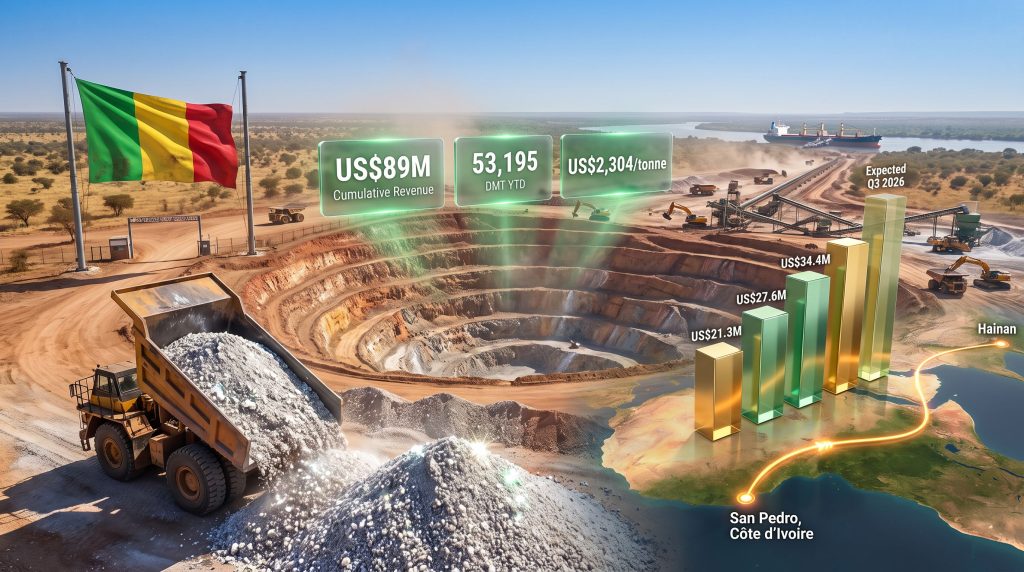
| Shipment 3 | ~20,400 | US$2,304/t (6% Li₂O CIF) | US$34.4 million |
| Shipment 4 | ~24,200 | TBC | Expected Q3 2026 |
Cumulative revenue across the first three shipments has exceeded US$89 million, a figure that demonstrates the cash generative capacity of even a modestly sized spodumene operation when pricing conditions are supportive. The third shipment pricing of US$2,304 per tonne was referenced against the Shanghai Metal Market CIF indices for 6% lithium oxide concentrate, the most widely used benchmark for physical spodumene trade between West Africa and Chinese processing facilities.
What Spodumene Grade and Quality Mean for Bougouni's Pricing Position
Spodumene concentrate basics centre on lithium oxide (Li₂O) content as the primary grading metric. The 6% Li₂O threshold is the industry standard reference for pricing, and contracts are typically adjusted up or down based on actual delivered grade. Bougouni's Q2 2026 production of 26,174 DMT at 5.34% Li₂O sits modestly below the 6% benchmark, which means the effective realised price per tonne of contained lithium is slightly diluted relative to benchmark quotes.
This grade consideration is not trivial. In a price-sensitive market, the difference between 5.34% and 6.0% Li₂O affects the per-tonne economics at the offtake level. However, Bougouni's shipment volumes and the structured interim payment mechanism suggest that even at sub-benchmark grades, the operation generates sufficient margin to service intercompany debt obligations.
Year-to-date production to 30 June 2026 reached 53,195 DMT of spodumene concentrate, placing the project on a trajectory that reflects genuine operational scale for a West African hard-rock lithium producer.
The Crushing Circuit Failure: What Single-Infrastructure Risk Looks Like in Practice
May 2026 illustrated a risk that is easy to underestimate in frontier mining operations. A breakdown in the crushing circuit reduced feed throughput to the processing plant, causing below-budget production for the quarter. The incident is a textbook example of single-point-of-failure risk in processing infrastructure: when a project relies on one crushing circuit, any mechanical failure cascades directly into production volume.
Maintenance was completed and throughput returned to normal levels in June, but the episode quantifies the operational buffer required to absorb similar events without breaching annual production budgets. The mobilisation of additional mining equipment to the Ngoualana open pit, which has improved mining rates and feed consistency, provides some upstream resilience, but processing infrastructure redundancy remains a longer-term consideration for project planners.
The Export Logistics Chain: Mali's Landlocked Challenge and the Côte d'Ivoire Solution
One of the less-discussed structural features of the Bougouni project is its dependence on Côte d'Ivoire's San Pedro port for export. Mali is a landlocked nation, which means all mineral exports require transit through neighbouring coastal states. The selection of San Pedro, rather than the closer but politically complex routes through other neighbours, reflects a pragmatic assessment of port capacity, customs efficiency, and transit reliability.
The shipping timeline from San Pedro to Hainan port in China spans approximately six to eight weeks, a transit duration with direct implications for working capital management. Revenue under the interim payment structure is partially recognised at shipment departure, with final settlement occurring after price confirmation against CIF benchmarks upon arrival. The fourth shipment of ~24,200 DMT departed San Pedro on 11 July 2026 and is expected to arrive at Hainan port in late August, with revenue recognition falling within Q3 2026.
This six-to-eight week cycle, combined with the regular shipment cadence of one cargo every six to eight weeks, creates a reasonably predictable revenue visibility window. However, it also means that working capital is effectively tied up in transit inventory for extended periods, a consideration that becomes more significant as shipment volumes scale upward.
Mali's Evolving Mining Governance Context
Operating in Mali under current governance conditions requires navigating a regulatory environment that has become demonstrably more assertive toward foreign mining operators. In December 2025, the Malian authorities recovered US$1.2 billion in mining arrears from operators across the sector, a signal that the state intends to capture a larger share of mineral revenues generated on its territory.
This context reframes the $15 million MoU payment made to secure Bougouni's export rights. In the current Malian environment, this type of negotiated commercial commitment to government authorities is increasingly the cost of doing business rather than an anomalous impost. For investors assessing frontier lithium jurisdictions, the Bougouni experience suggests that government payment obligations can represent short-term leverage risk but, once settled, can provide long-term operational certainty by locking in licence and export permit security.
Arbitration between JV partners does not necessarily signal operational breakdown. In many Sino-African mining structures, legal disputes over cost classification proceed in parallel with continued cooperation at the operational level. The production and export trajectory at Bougouni suggests the working relationship between LMLB's operational team and Hainan Mining's capital structure remains functional despite the ongoing legal process.
Revenue Cadence and What It Means for Minority Partner Cash Flow
For investors holding exposure to Kodal Minerals, the most important financial question is not the gross revenue generated by LMLB but the rate at which cash flows through the JV waterfall to reach the 49% partner level. The cash flow sequence follows a clear hierarchy:
- Export revenue is received by LMLB upon shipment departure (interim payment) and price confirmation (final balance)
- LMLB meets operating costs, including mining, processing, logistics, and in-country obligations
- Surplus cash is applied to repay intercompany loans owed to KMUK (the $13 million repayment represents the first cycle of this step)
- KMUK applies repayments received from LMLB to reduce the outstanding Hainan Mining loan facility
- Once the Hainan Mining facility is sufficiently reduced, KMUK becomes eligible to distribute cash to its shareholders, including Kodal at its 49% interest level
The US$13 million Kodal Minerals Bougouni repayment marks the activation of step three in this sequence. It does not yet represent cash in Kodal's hands, but it confirms that the waterfall mechanism is functioning and that LMLB is generating surplus above operating costs at current spodumene prices.
The next major ASX story will hit our subscribers first
Wet Season Preparation and H2 2026 Production Continuity
West African open-pit mining operations face a recurring seasonal constraint during the rainy months spanning roughly July through September. Precipitation in the Sahel region can affect haul road conditions, pit drainage, and overall mining rates, making wet season preparation protocols a genuine determinant of annual production budget adherence.
Management has indicated that preparatory steps have been taken at Bougouni to maintain production continuity through Q3 2026. The return of the crushing circuit to full throughput in June, combined with the additional equipment at Ngoualana, positions the project to manage seasonal disruption more effectively than it might have in its first operational year. Nonetheless, the wet season remains a material variable in H2 2026 production forecasting. In addition, understanding how lithium mining works in varying climatic conditions helps illustrate why these seasonal factors are taken so seriously by project managers.
Frequently Asked Questions: Kodal Minerals Bougouni Repayment
What exactly was repaid in the US$13 million Kodal Minerals Bougouni repayment?
The payment represents LMLB repaying capital expenditure loans that KMUK had previously extended to fund mine development. It is entirely separate from the $15 million paid to the Malian government to secure the mining licence transfer and export permits.
How does Kodal's 49% stake translate into cash distributions?
Kodal holds 49% of KMUK. Cash distributions to Kodal depend on KMUK first reducing its own outstanding loan facility with Hainan Mining using repayments received from LMLB. The $13 million repayment contributes to this facility reduction.
What is the 6% Li₂O CIF benchmark and why does it matter?
Spodumene concentrate quality is measured by lithium oxide percentage. The 6% Li₂O grade is the global trade benchmark against which pricing is set. Bougouni's Q2 2026 production averaged 5.34% Li₂O, meaning realised pricing is adjusted relative to the benchmark. The Shanghai Metal Market CIF indices for both Chinese and African origin 6% concentrate are the primary pricing references used in Bougouni's export contracts. Consequently, the various lithium extraction methods employed globally also influence how concentrate grades are assessed across different supply chains.
When is Kodal's fourth shipment revenue expected?
The fourth shipment of approximately 24,200 DMT departed San Pedro on 11 July 2026. Given the six-to-eight week transit to Hainan port, arrival is anticipated in late August 2026, with revenue recognition falling within Q3 2026 reporting.
What is the arbitration claim about?
Kodal is pursuing arbitration against Hainan Mining over whether the $15 million Malian government MoU payment qualifies for indemnification under the terms of the existing JV funding agreement. The outcome could materially affect the economic cost allocation between partners.
Key Takeaways for Investors and Project Finance Analysts
- Intercompany loan structures in Sino-African JVs can cycle capital faster than external project finance, but minority partners must understand that distributions are downstream of majority partner facility repayment
- Spodumene pricing at US$2,304/tonne for 6% Li₂O CIF is sufficient to generate operating surplus capable of servicing intercompany debt at Bougouni's current production scale
- Single-circuit processing infrastructure creates material production risk, as demonstrated by the May 2026 crushing breakdown, and investors should factor operational buffer requirements into production forecasting
- Mali's regulatory environment requires upfront government payment commitments to secure operational certainty, a cost structure that is becoming standard rather than exceptional for foreign miners in the jurisdiction
- The San Pedro to Hainan shipping route adds six to eight weeks of working capital lock-up per cargo, a factor that grows in significance as shipment volumes increase toward full operational capacity
- The arbitration outcome between Kodal and Hainan Mining over the $15 million government payment classification represents a binary event that could alter the net economics of Kodal's participation in KMUK
This article contains forward-looking analysis and scenario modelling based on publicly available information. It does not constitute financial advice. Investors should conduct independent due diligence and consider their own risk tolerance before making investment decisions related to any securities mentioned.
Want To Catch the Next Major Mineral Discovery Before the Market Does?
Discovery Alert's proprietary Discovery IQ model scans ASX announcements in real time, instantly identifying high-potential mineral discoveries across more than 30 commodities and turning complex geological data into clear, actionable insights for both short-term traders and long-term investors. Explore how historic discoveries have generated exceptional returns on Discovery Alert's dedicated discoveries page, then begin your 14-day free trial to position yourself ahead of the broader market.