June 16, 2026
Mining operations across the globe are witnessing unprecedented transformation through autonomous technology integration, with the Komatsu autonomous haul truck milestone representing a pivotal achievement in industrial automation. This technological evolution demonstrates how artificial intelligence, electric drive systems, and sophisticated navigation technologies converge to create revolutionary mining capabilities. The progression from human-operated fleets to fully automated systems marks one of the most significant shifts in heavy industry operations.
Furthermore, the integration of autonomous systems with electric drive technology has established new operational paradigms that extend beyond traditional automation concepts. These advances enable mining companies to achieve exceptional productivity levels whilst simultaneously addressing environmental sustainability goals and workforce safety concerns.
The Engineering Foundation Behind Revolutionary Mining Automation
Modern autonomous haul truck technology relies on sophisticated integration of multiple advanced systems working in perfect coordination. The Komatsu autonomous haul truck milestone of 1,000 commissioned vehicles demonstrates the maturation of technologies that began with commercial introduction in 2008. This nearly two-decade evolution has produced systems capable of moving 11.5 billion metric tons of material across diverse global mining environments.
The technological foundation combines precision GPS navigation with machine learning algorithms that continuously adapt to changing operational conditions. Real-time positioning accuracy enables trucks to navigate complex pit environments whilst maintaining optimal spacing and route efficiency. These systems process thousands of sensor inputs per second, creating detailed environmental maps that update dynamically as mining operations progress.
Advanced Navigation and Safety Systems Integration
Collision avoidance systems represent critical safety infrastructure that enables autonomous vehicles to operate safely alongside traditional equipment and personnel. The FrontRunner autonomous haulage system incorporates redundant safety-boosting operations mechanisms designed to prevent accidents through predictive analysis rather than reactive responses.
Key technological components include:
• Multi-spectrum sensor arrays providing 360-degree environmental awareness
• Predictive path analysis preventing potential collision scenarios
• Emergency stop capabilities with sub-second response times
• Integration protocols for mixed fleet operations
The transition from reactive to predictive safety systems has fundamentally altered mining operations. Traditional approaches relied on human operators to identify and respond to hazards, whilst autonomous systems continuously analyse potential risks and adjust behaviour proactively.
Machine Learning Optimisation in Mining Operations
Route optimisation algorithms learn from operational data to improve efficiency continuously. These systems analyse factors including haul road conditions, traffic patterns, equipment maintenance schedules, and weather impacts to determine optimal routing strategies. The machine learning approach enables adaptation to site-specific conditions whilst maintaining fleet-wide optimisation objectives.
Performance metrics demonstrate measurable improvements in operational predictability. Mining executives emphasise that autonomous systems enable more consistent operations by eliminating variability associated with human factors such as fatigue, skill differences, and safety concerns.
When big ASX news breaks, our subscribers know first
Ultra-Class Electric Drive Technology and Productivity Enhancement
The 930E-5AT ultra-class electric drive truck with its 290-metric-ton payload capacity represents the current standard for autonomous mining operations. With more than 500 autonomous 930E trucks deployed across customer sites globally, this vehicle class has become the foundation for large-scale autonomous fleet implementations.
Additionally, electric drive systems provide distinct advantages over traditional diesel powertrains in autonomous applications. The precise torque control enables smoother acceleration and deceleration profiles, reducing mechanical stress and improving ride quality. Electric systems also support advanced energy management strategies that optimise power consumption based on route characteristics and operational requirements.
Operational Performance Comparison Analysis
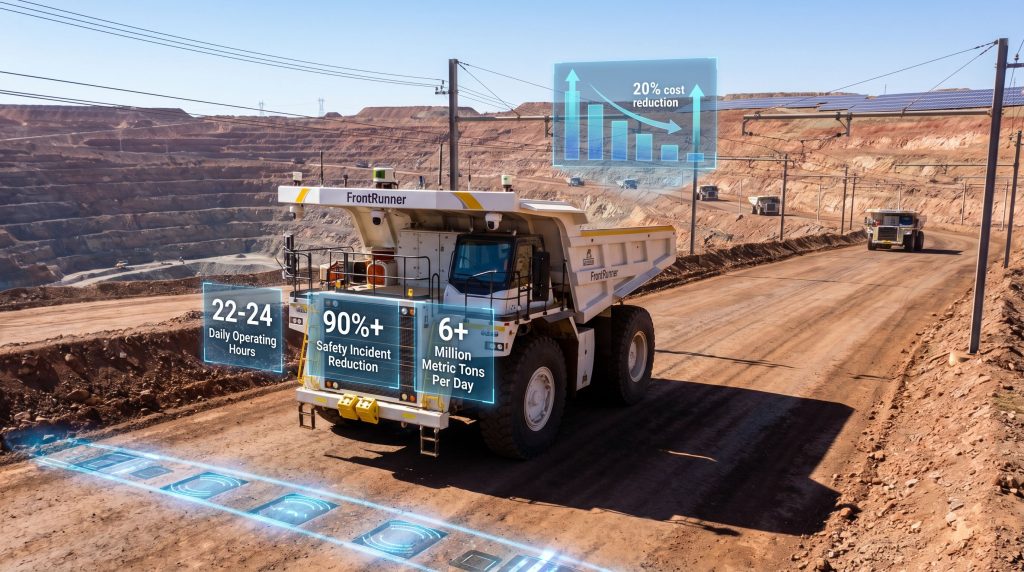
| Performance Metric | Autonomous Electric Fleet | Traditional Diesel Fleet | Improvement Factor |
|---|---|---|---|
| Daily Operating Hours | 22-24 hours | 16-18 hours | 35% increase |
| Maintenance Predictability | AI-scheduled intervals | Reactive maintenance | 30% cost reduction |
| Energy Efficiency | Route-optimised consumption | Variable operator performance | 20% improvement |
| Safety Performance | Near-zero incident rates | Industry baseline | 90%+ reduction |
The extended operating hours capability of autonomous fleets creates significant productivity multipliers. Traditional operations are constrained by shift schedules, operator breaks, and fatigue management protocols. However, autonomous systems operate continuously with only planned maintenance interruptions, effectively extending productive hours by 25-35% daily.
Fleet Scalability and Geographic Deployment
Successful deployment across North America, South America, Australia, and Europe demonstrates the technology's adaptability to diverse climate conditions and operational environments. Each geographic region presents unique challenges including temperature extremes, altitude variations, and seasonal weather patterns that autonomous systems must accommodate.
For instance, the expansion from pilot programmes to full-scale operations required extensive validation across different commodity types and mine configurations. Gold mining operations at Barrick's Nevada Gold Mines represent strategic expansion beyond traditional iron ore and copper applications, validating the technology's versatility across mining sectors.
Critical Performance Indicators for Autonomous Mining Success
Autonomous mining success depends on quantifiable performance metrics that demonstrate operational value across safety, productivity, and cost dimensions. The cumulative achievement of 11.5 billion metric tons of material moved since 2008 provides substantial real-world validation of system reliability and effectiveness.
Material Movement and Throughput Metrics
Fleet performance analysis reveals significant improvements in asset utilisation rates compared to traditional operations. Autonomous trucks achieve higher utilisation through:
• Elimination of shift change downtime
• Reduced break and meal period interruptions
• Optimised routing reducing empty travel time
• Predictive maintenance minimising unplanned downtime
The transition to autonomous operations typically results in 25-35% increases in material throughput per vehicle, with additional benefits from improved route optimisation and reduced congestion in loading and dumping areas.
Safety Performance and Risk Reduction
Safety improvements represent one of the most significant benefits of autonomous mining operations. The elimination of human operators from haul truck cabins removes personnel from high-risk environments whilst enabling safer, more skilled roles in system monitoring and maintenance.
Mining executives report that autonomous systems reduce manual equipment interactions, which historically account for significant portions of mining accidents. Water truck automation, in addition to haul truck automation, further reduces personnel exposure to heavy equipment operations.
Autonomous operations transition operators away from haulage activities and enable more predictable operations, supporting safer, more skilled roles whilst improving energy efficiency and reducing environmental footprints.
Advanced Electrification Integration and Energy Management
The industry evolution trends demonstrate that autonomous haul truck technology has achieved a breakthrough with the first power agnostic electric drive truck operating autonomously whilst connected to a dynamic trolley line. This technology enables continuous power delivery during uphill transport whilst maintaining autonomous operation capabilities.
Dynamic Trolley Line Technology Innovation
Trolley-assist technology combines overhead catenary lines with battery-electric propulsion systems, creating hybrid power delivery mechanisms that optimise energy consumption across variable terrain. The system maintains autonomous decision-making capabilities even during overhead power connection, ensuring safety and operational efficiency.
This integration addresses one of electric mining's primary challenges: energy consumption during uphill hauls with maximum payload. Traditional battery systems experience significant drain during steep grade operations, whilst trolley-assist provides continuous power supply for the most energy-intensive portions of haul routes.
Sustainability and Decarbonisation Benefits
Electric autonomous systems support mining companies' decarbonisation objectives through multiple mechanisms:
• Direct emissions reduction through elimination of diesel engines
• Energy efficiency optimisation via AI-driven route planning
• Renewable energy integration through grid-connected charging infrastructure
• Predictive maintenance reducing waste and extending equipment lifecycles
The $2.4 billion in social impact generated globally in 2024 reflects comprehensive benefits including environmental improvements, workforce safety enhancements, and community economic contributions. This valuation employs impact accounting methodologies that quantify previously intangible benefits of autonomous mining operations.
Economic Impact Analysis and Return on Investment
The economic benefits of autonomous mining operations extend far beyond direct productivity improvements to encompass workforce transformation, operational cost reductions, and long-term asset optimisation. Consequently, mining companies report significant returns on investment through multiple value streams that compound over equipment lifecycles.
Financial Performance and Cost Structure Changes
Capital expenditure for autonomous systems typically generates returns through operational savings in labour costs, fuel consumption, and maintenance requirements. The extended operational hours capability creates immediate productivity multipliers that justify initial technology investments.
Primary cost reduction categories include:
• Labour cost optimisation through workforce redeployment to higher-value roles
• Fuel and energy efficiency improvements through route optimisation
• Maintenance cost reduction via predictive maintenance strategies
• Insurance and safety cost decreases due to improved safety performance
Furthermore, the transition from reactive to predictive maintenance creates substantial cost savings through optimised parts inventory, reduced emergency repairs, and extended equipment lifecycles. AI in mining automation enables mining operations to plan maintenance activities during optimal timing rather than responding to equipment failures.
Workforce Transformation and Skills Development
Autonomous mining creates opportunities for workforce advancement by transitioning personnel from operating roles to technical supervision, maintenance, and system optimisation positions. These roles typically offer higher compensation and improved working conditions compared to traditional haul truck operation.
Training programmes for autonomous systems require 40-80 hours of specialised education covering system monitoring, emergency procedures, and technical troubleshooting. The investment in workforce development creates long-term benefits through improved retention and enhanced technical capabilities within mining operations.
Industry Leadership and Future Technology Development
The strategic partnership between Komatsu and Barrick for Nevada Gold Mines deployment demonstrates successful technology transfer into new commodity sectors. This partnership model enables technology validation in gold mining operations whilst expanding beyond traditional copper and iron ore applications.
Software-Defined Vehicle Platforms
The advancement toward software-defined vehicle strategies represents the next evolution in autonomous mining technology. This approach enables continuous capability improvements through software updates rather than requiring hardware replacements, extending equipment lifecycles whilst enhancing functionality.
Key architectural components include:
• Standardised sensor packages compatible across vehicle types
• Modular software architecture enabling rapid capability deployment
• Over-the-air update capabilities for continuous system improvement
• Site-specific adaptation algorithms optimising performance for local conditions
Integration with Digital Mine Ecosystems
Advanced autonomous systems integrate with comprehensive digital mine platforms that coordinate activities across all operational systems. This integration enables optimisation of autonomous vehicle operations within broader mine planning and execution frameworks.
In addition, data-driven mining operations represent the future of mining technology, where real-time operational monitoring, predictive maintenance scheduling, and energy management optimisation work together to balance power consumption with operational needs.
The next major ASX story will hit our subscribers first
Operational Challenges and Implementation Considerations
Despite significant advantages, autonomous mining technology faces ongoing challenges that require continuous attention and development. Weather conditions, mixed fleet operations, and cybersecurity concerns represent primary areas requiring ongoing innovation and management attention.
Environmental and Operational Adaptability
Extreme weather conditions pose ongoing challenges for autonomous systems, particularly regarding sensor performance and navigation accuracy. Arctic conditions can affect battery performance and sensor functionality, whilst dust and high temperatures in desert mining operations require specialised equipment protection and cooling systems.
Site-specific adaptations address local environmental conditions whilst maintaining safety and performance standards. These adaptations typically require customisation of sensor packages, software parameters, and maintenance protocols to optimise performance for specific operational environments.
Mixed Fleet Integration and Cybersecurity
Most mining operations require gradual transition from traditional to autonomous fleets, creating complex mixed-fleet operational scenarios. Autonomous systems must safely interact with human-operated equipment whilst maintaining optimal performance and safety standards.
However, cybersecurity considerations become increasingly critical as mining operations depend more heavily on digital systems. Network security protocols, system access controls, and data protection measures are essential components of autonomous mining implementations.
The green electrification sustainability initiatives in mining demonstrate how autonomous systems contribute to environmental goals whilst maintaining operational efficiency. The achievement of 1,000 commissioned autonomous haul trucks by Komatsu represents a major milestone in mining automation technology.
Technical Support and Infrastructure Requirements
Autonomous systems require specialised technical support capabilities that extend beyond traditional heavy equipment maintenance. Personnel must develop expertise in software systems, sensor technologies, and advanced troubleshooting procedures to maintain optimal system performance.
Training programmes for maintenance personnel typically require 80-120 hours of specialised education covering autonomous system components, diagnostic procedures, and safety protocols. This investment in technical capability development creates long-term operational benefits through improved system reliability and reduced downtime.
The development of comprehensive technical support capabilities represents a critical success factor for autonomous mining implementations. For instance, Australia's implementation of 500 autonomous trucks showcases the scalability and reliability of these advanced systems across diverse mining operations.
Disclaimer: This analysis contains forward-looking statements and projections based on current industry trends and available data. Autonomous mining technology continues evolving rapidly, and actual performance outcomes may vary based on specific operational conditions, implementation approaches, and technological developments. Investment and operational decisions should incorporate comprehensive due diligence and risk assessment appropriate to individual circumstances and organisational requirements.
Interested in the Next Big Mining Discovery?
Discovery Alert's proprietary Discovery IQ model provides instant alerts on significant ASX mineral discoveries, enabling subscribers to identify opportunities in emerging mining technologies and automation leaders ahead of the broader market. Begin your 14-day free trial today and position yourself to capitalise on the next breakthrough in mining innovation.