May 17, 2026
The mining industry's technological evolution continues to accelerate as autonomous systems redefine operational standards across global extraction sites. While traditional mining operations have relied on human-operated equipment for decades, the emergence of sophisticated autonomous haulage systems represents a fundamental shift in how materials move from extraction points to processing facilities. Furthermore, Komatsu autonomous haul trucks have established themselves as the industry standard, demonstrating remarkable achievements in safety, efficiency, and operational scale across diverse mining environments. This transformation extends beyond simple automation, encompassing integrated systems that optimise productivity, safety, and environmental performance through advanced technological architectures.
What Makes Komatsu's Autonomous Mining Fleet the Industry Standard?
Komatsu's FrontRunner Autonomous Haulage System has established market leadership through consistent technological advancement and proven operational deployment across diverse mining environments. Since achieving its first commercial deployment in 2008, the system has accumulated over 11.5 billion tonnes of material movement across customer operations worldwide. This extensive operational history provides a substantial data foundation for continuous system refinement and performance optimisation.
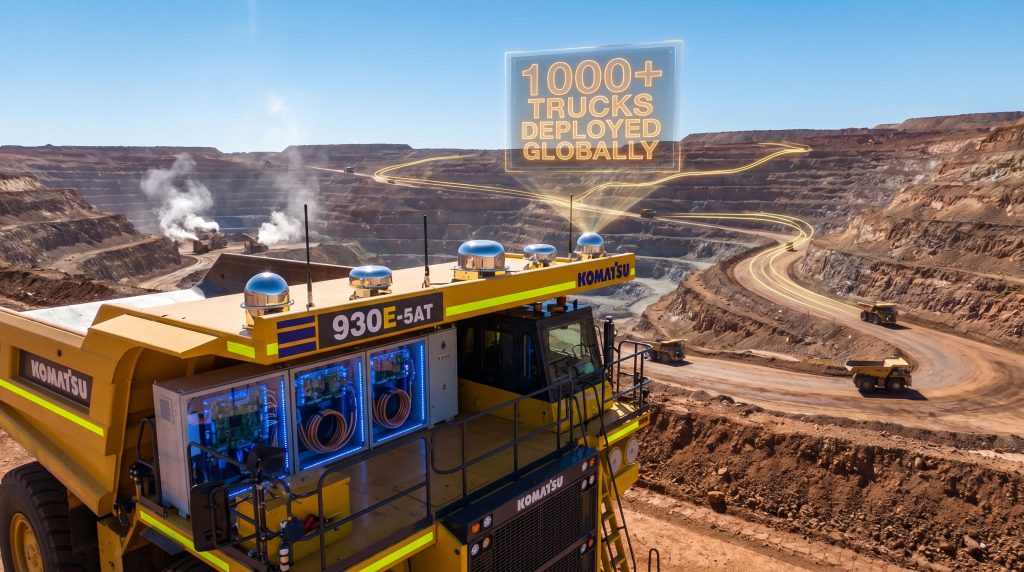
The 1000th autonomous haul truck milestone, achieved in April 2026 with deployment at Nevada Gold Mines, demonstrates the scalability of autonomous haulage technology across different commodity sectors. This achievement represents the culmination of nearly two decades of technological development and customer collaboration, establishing Komatsu as the first original equipment manufacturer to reach this deployment threshold.
Additionally, this milestone aligns with broader industry evolution trends that emphasise technological advancement and operational efficiency across mining operations.
The Technical Architecture Behind FrontRunner AHS
The FrontRunner system integrates multiple technological components to achieve autonomous operation in complex mining environments:
- High-precision GPS positioning systems that provide centimetre-level accuracy for navigation and route optimisation
- Obstacle detection algorithms utilising multiple sensor arrays for real-time environmental monitoring
- Wireless communication networks enabling fleet coordination and dispatch integration
- Real-time routing optimisation that adjusts vehicle paths based on operational conditions and traffic patterns
Operational Performance Metrics That Define Success
The system's operational track record includes several key performance indicators that differentiate autonomous operations from traditional mining haulage:
Asset Utilisation Improvements:
- Continuous 24/7 operation capability without shift changes or operator breaks
- Consistent operating speeds and acceleration profiles that optimise fuel consumption
- Predictable maintenance scheduling based on actual equipment usage patterns
Safety Statistics:
- Zero system-related injuries across global deployments, according to Komatsu operational data
- Elimination of operator exposure to high-risk mining environments
- Standardised safety protocols integrated into automated systems
Equipment Longevity Data:
- Extended component lifecycles through optimised operating parameters
- Reduced wear patterns from consistent, programmed vehicle operation
- Predictive maintenance algorithms that prevent equipment failures
When big ASX news breaks, our subscribers know first
How Do Ultra-Class Autonomous Haul Trucks Transform Mine Site Operations?
The integration of ultra-class autonomous haul trucks fundamentally alters traditional mining workflows by introducing predictable, optimised material movement patterns. These systems operate within sophisticated control frameworks that coordinate multiple vehicles simultaneously, creating efficient traffic management across mining sites while maintaining safety protocols.
Electric Drive Technology Integration
The Komatsu 930E-5AT electric drive truck represents advanced integration of autonomous systems with electrification technology. This ultra-class vehicle features a 290-tonne payload capacity while incorporating electric drive systems that provide several operational advantages over conventional diesel equipment.
Moreover, this development supports the broader adoption of electric vehicles in mining operations, demonstrating the industry's commitment to sustainable transportation solutions.
Electric Drive Truck (EDT) Advantages:
| Feature | Electric Drive | Conventional Diesel |
|---|---|---|
| Power Delivery | Instant torque availability | Gradual power buildup |
| Maintenance Requirements | Fewer moving parts | Complex engine systems |
| Energy Source Flexibility | Grid, battery, or trolley line | Diesel fuel dependency |
| Emissions Profile | Zero direct emissions | Direct exhaust emissions |
Power-Agnostic Operation Capabilities:
The 930E-5AT demonstrates industry-first capability to operate autonomously while connected to dynamic trolley line systems. This advancement enables mines to reduce diesel consumption while maintaining autonomous operation, supporting both productivity and environmental objectives.
Fleet Scale and Geographic Distribution
Autonomous haul truck deployments span multiple continents, with operations adapted to diverse geological conditions and commodity requirements. The global distribution reflects the technology's versatility across different mining environments and regulatory frameworks.
Reported Global Deployment Distribution:
| Region | Operational Context | Primary Commodities |
|---|---|---|
| Australia | Large-scale open-pit operations | Iron ore, coal, gold |
| North America | Mixed geological conditions | Gold, copper, coal |
| South America | High-altitude mining environments | Copper, lithium, gold |
| Europe | Stringent environmental regulations | Various minerals |
What Economic Impact Do Autonomous Haul Trucks Deliver to Mining Operations?
The economic implications of autonomous haulage technology extend beyond simple operational cost reductions, encompassing broader impacts on workforce development, community investment, and long-term asset optimisation. Komatsu reports approximately US$2.4 billion in social impact globally during 2024, calculated using methodologies developed by Capitals Coalition and Value Balancing Alliance.
Cost-Benefit Analysis Framework
Capital Investment Considerations:
- Initial autonomous system acquisition costs typically exceed conventional equipment by 15-25%
- Infrastructure requirements include GPS base stations, communication networks, and control centre facilities
- Training investments for technical workforce development and systems management
Operational Savings Categories:
-
Equipment Lifecycle Extension:
- Optimised operating parameters reduce component wear rates
- Predictable maintenance schedules improve parts inventory management
- Extended asset useful life through consistent operational patterns
-
Energy Efficiency Improvements:
- Route optimisation reduces unnecessary fuel consumption
- Consistent speed profiles maximise fuel economy
- Electric drive integration enables renewable energy utilisation
-
Labour Cost Evolution:
- Transition from equipment operators to technical systems roles
- Reduced overtime costs through continuous autonomous operation
- Enhanced safety reduces insurance and liability expenses
Return on Investment Calculations
The ROI framework for autonomous haulage systems involves multiple variables that differ significantly across mining operations:
Productivity Improvements:
- Continuous operation capability potentially triples daily equipment utilisation
- Consistent performance regardless of weather conditions or shift changes
- Optimised loading and dumping cycles through integrated fleet management
Risk Mitigation Value:
- Safety incident cost avoidance through operator removal from high-risk areas
- Equipment damage reduction through standardised operating procedures
- Regulatory compliance improvements in safety-sensitive jurisdictions
Long-Term Asset Value:
- Preserved equipment condition through optimal operating parameters
- Enhanced resale value due to documented maintenance history
- Technology upgrade pathways that extend asset economic life
How Does Autonomous Technology Address Modern Mining Challenges?
Contemporary mining operations face multiple interconnected challenges that autonomous technology directly addresses through systematic operational improvements. These challenges include workforce safety, environmental compliance, operational predictability, and resource optimisation in increasingly complex mining environments.
Furthermore, Komatsu autonomous haul trucks demonstrate how advanced technology can simultaneously address multiple operational challenges while supporting decarbonisation benefits across mining operations.
Safety Enhancement Protocols
Autonomous haulage systems eliminate human exposure to several categories of mining hazards while introducing standardised safety protocols that operate consistently across all shifts and conditions.
Risk Elimination Strategies:
- Operator Removal: Personnel no longer operate in high-risk haul truck environments
- Predictable Equipment Behaviour: Standardised acceleration, braking, and turning profiles
- Emergency Response Integration: Automated incident detection and response protocols
- Collision Avoidance: Advanced sensor systems prevent equipment interactions
Integrated Safety Systems:
Modern autonomous trucks incorporate multiple redundant safety systems that monitor vehicle status, surrounding environment, and operational parameters simultaneously. These systems can halt operations immediately when safety parameters are exceeded, providing fail-safe protection beyond human reaction capabilities.
Environmental and Sustainability Benefits
The environmental advantages of autonomous haulage extend beyond direct emissions reductions to encompass broader sustainability improvements across mining operations.
Emissions Reduction Mechanisms:
- Optimised Routing: AI-driven path selection minimises unnecessary travel distances
- Speed Harmonisation: Consistent vehicle speeds optimise fuel consumption profiles
- Electric Drive Integration: Enables renewable energy utilisation and grid connection
- Reduced Ground Disturbance: Precise navigation minimises off-road travel and surface damage
Resource Efficiency Improvements:
- Fuel consumption optimisation through consistent operating parameters
- Reduced tyre wear through optimised acceleration and braking profiles
- Extended equipment lifecycles reducing replacement material requirements
- Integration with renewable energy systems for charging and operation
What Technical Specifications Define Ultra-Class Autonomous Capabilities?
Ultra-class autonomous haul trucks incorporate sophisticated technological systems that enable safe, efficient operation in complex mining environments. These specifications define the boundaries of autonomous capability and determine operational performance across diverse conditions.
Vehicle Control System Components
Core Autonomous Architecture:
| System Component | Function | Performance Parameters |
|---|---|---|
| Central Processing Units | Real-time decision making | Millisecond response times |
| Sensor Arrays | Environmental monitoring | 360-degree obstacle detection |
| Communication Modules | Fleet coordination | Continuous network connectivity |
| Backup Systems | Fail-safe operation | Redundant control pathways |
Navigation and Positioning Systems:
- GPS accuracy within centimetre-level precision for route following
- Inertial measurement units providing continuous position data during GPS interruptions
- Digital mapping integration with real-time updates for changing mine conditions
- Geofencing capabilities that define operational boundaries and restricted areas
Performance Parameters and Operational Limits
Operating Specifications:
- Maximum Operating Speeds: Typically limited to 60 km/h for safety optimisation
- Acceleration Profiles: Programmed for fuel efficiency and component preservation
- Payload Optimisation: Dynamic load distribution algorithms for stability
- Weather Adaptability: Operation continues in specified visibility and precipitation conditions
Terrain Navigation Capabilities:
- Grade limitations typically up to 10% depending on loaded conditions
- Curve radius requirements based on vehicle dimensions and speed
- Surface condition monitoring for traction and stability assessment
- Dynamic path adjustment for temporary obstacles or changing conditions
How Do Mining Companies Implement Autonomous Haul Truck Systems?
The implementation of autonomous haulage systems requires comprehensive planning and phased deployment strategies that minimise operational disruption while maximising technology benefits. Successful deployments integrate technical infrastructure, workforce development, and operational process modifications.
Consequently, this implementation process benefits significantly from data-driven operations that enable optimised system performance and continuous improvement.
Deployment Planning and Site Preparation
Infrastructure Requirements:
- Communication Networks: High-reliability wireless systems for continuous vehicle control
- GPS Base Stations: Precision positioning infrastructure for accurate navigation
- Control Centres: Centralised monitoring and fleet management facilities
- Charging Infrastructure: Electric vehicle support systems where applicable
Existing Equipment Integration:
Mining operations must evaluate retrofit possibilities for current fleet assets versus new equipment acquisition. This analysis includes:
- Equipment age and remaining useful life assessment
- Compatibility with autonomous system requirements
- Cost comparison between retrofit and replacement options
- Operational downtime considerations during conversion
Operational Transition Strategies
Phased Implementation Approaches:
- Pilot Program Phase: Limited deployment on specific haul routes for system validation
- Gradual Expansion: Progressive increase in autonomous vehicle count and operational areas
- Full Integration: Complete autonomous fleet operation with traditional equipment phase-out
- Continuous Optimisation: Ongoing system refinement based on operational data
Workforce Transition Management:
The shift to autonomous operations requires comprehensive workforce development programmes that transition equipment operators to technical support roles. This includes:
- Technical training for autonomous system monitoring and maintenance
- Career development pathways from operators to system technicians
- Retention strategies for experienced personnel during transition periods
- Community impact assessment and mitigation planning
The next major ASX story will hit our subscribers first
What Future Developments Will Shape Autonomous Mining Equipment?
The evolution of autonomous mining technology continues toward increasingly sophisticated systems that integrate artificial intelligence, machine learning, and predictive analytics. These developments promise enhanced operational efficiency and expanded autonomous capabilities across mining operations.
However, the integration of AI in mining technology extends beyond haulage systems to encompass comprehensive mining operations.
Software-Defined Vehicle Evolution
Future autonomous mining equipment will operate as software-defined vehicles that receive continuous updates and capability enhancements throughout their operational lifecycle. This approach transforms mining equipment from static assets to evolving technological platforms.
Continuous System Enhancement Features:
- Over-the-Air Updates: Regular software improvements and feature additions
- Machine Learning Integration: Site-specific operational optimisation through data analysis
- Predictive Maintenance: Component failure prediction and proactive maintenance scheduling
- Adaptive Performance: Real-time adjustment to changing operational conditions
Multi-Equipment Automation Integration
The expansion of autonomous technology beyond haul trucks encompasses comprehensive mine-site automation that coordinates multiple equipment types simultaneously.
Integrated Autonomous Systems:
- Autonomous Water Trucks: Road maintenance and dust suppression automation
- Cross-Platform Compatibility: Integration with diverse equipment manufacturers
- Mine-Wide Traffic Management: Coordinated movement of all autonomous equipment
- Loading and Drilling Integration: Complete material handling cycle automation
Which Commodity Sectors Benefit Most from Autonomous Haulage Technology?
Different mining sectors derive varying benefits from autonomous haulage implementation based on operational characteristics, commodity values, and production requirements. The technology's flexibility enables adaptation across diverse mining applications with sector-specific optimisations.
Gold Mining Applications and Considerations
The deployment at Nevada Gold Mines represents autonomous technology's expansion into precious metals mining, where operational precision and safety requirements are paramount.
Gold Mining Advantages:
- High-Value Commodity Protection: Reduced material loss through precise handling
- Environmental Compliance: Enhanced operational control in environmentally sensitive areas
- Production Consistency: Reliable material movement supporting processing plant feed rates
- Security Benefits: Reduced human presence in valuable material handling areas
Iron Ore and Base Metals Operations
Large-scale iron ore and base metals operations represent the primary deployment environment for autonomous haulage systems due to high-volume material movement requirements and operational scale benefits.
Bulk Commodity Optimisation:
- Scale Efficiency: Cost per tonne optimisation for high-volume operations
- Remote Location Benefits: Reduced personnel requirements in isolated mining areas
- Equipment Utilisation: Maximised asset productivity in capital-intensive operations
- Supply Chain Reliability: Consistent material delivery supporting global commodity markets
How Do Autonomous Systems Compare Across Different Mining Equipment Manufacturers?
The autonomous mining equipment market includes multiple technology providers, each offering distinct approaches to autonomous haulage implementation. Comparative analysis reveals different strategic focuses and technological capabilities across manufacturers.
Competitive Technology Analysis
Market Position Overview:
| Technology Provider | Market Entry | Deployment Scale | Strategic Focus |
|---|---|---|---|
| Komatsu FrontRunner | 2008 | 1000+ trucks | First-mover advantage, integrated systems |
| Caterpillar Command | 2013 | Growing fleet | Equipment integration, global service |
| Hitachi AHS | 2015 | Expanding deployment | Flexible implementation, partnership focus |
Performance Benchmarking Metrics
System Reliability Comparisons:
Autonomous system performance varies across manufacturers based on technological approaches, deployment experience, and customer support capabilities. Key differentiation factors include:
- Operational Uptime: System availability and maintenance requirements
- Implementation Timeline: Deployment duration and complexity management
- Customer Support: Technical assistance and system optimisation services
- Technology Evolution: Upgrade pathways and feature development
Total Cost of Ownership Analysis:
Long-term ownership costs encompass initial acquisition, ongoing maintenance, system updates, and operational support. These costs vary significantly based on:
- Equipment purchase price and financing options
- Infrastructure requirements and installation complexity
- Training and workforce development expenses
- Maintenance contracts and technical support agreements
What Investment Considerations Apply to Autonomous Mining Technology?
Investment decisions regarding autonomous mining technology require comprehensive analysis of capital requirements, operational benefits, and long-term strategic positioning. These considerations vary significantly based on mining operation characteristics and corporate strategic objectives.
Moreover, Komatsu autonomous haul trucks represent a significant capital investment that requires careful evaluation of long-term operational benefits and competitive positioning.
Capital Allocation and Financial Planning
Investment Framework Components:
- Equipment Acquisition Costs: Premium pricing for autonomous capability versus conventional equipment
- Infrastructure Development: Communication networks, control systems, and facility modifications
- Training and Development: Workforce transition and technical capability building
- System Integration: Compatibility with existing operations and equipment
Long-Term Financial Projections:
Autonomous haulage investments typically require 5-10 year analysis horizons to capture full operational benefits and technology evolution impacts.
Risk Assessment and Mitigation Strategies
Technology Risk Considerations:
- Obsolescence Risk: Technology advancement rate and upgrade pathway availability
- Operational Dependency: Backup systems and contingency planning requirements
- Regulatory Changes: Evolving safety and environmental compliance requirements
- Market Adoption: Industry standardisation and competitive positioning implications
Financial Risk Management:
Successful autonomous haulage investments require comprehensive risk mitigation strategies including:
- Phased implementation to reduce initial capital exposure
- Performance guarantees and service level agreements with technology providers
- Insurance coverage for autonomous system operations
- Contingency planning for technology failures or market changes
This analysis is based on publicly available information and industry reports. Investment decisions should incorporate current market conditions, specific operational requirements, and comprehensive due diligence. Future performance may differ from historical results and projections.
Ready to capitalise on the next breakthrough in autonomous mining technology?
Discovery Alert's proprietary Discovery IQ model delivers real-time alerts on significant ASX mineral discoveries, instantly empowering subscribers to identify actionable opportunities ahead of the broader market. Begin your 14-day free trial today and secure your market-leading advantage.