June 21, 2026
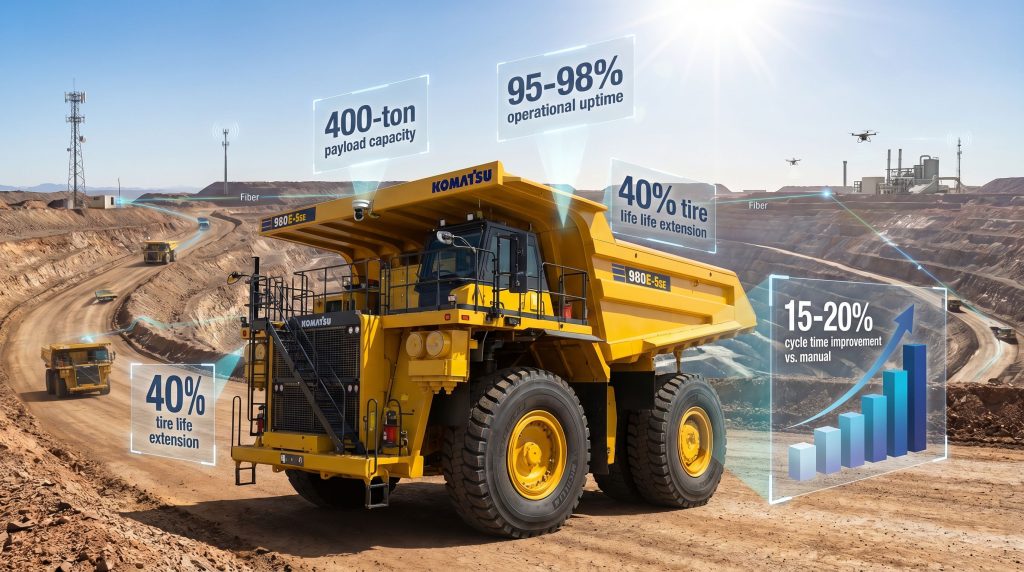
The evolution of mining equipment has fundamentally altered how extractive industries approach large-scale material movement, with autonomous systems emerging as the cornerstone of operational efficiency in the modern mining landscape. Komatsu ultra-class autonomous haul trucks represent the convergence of decades of technological advancement, sophisticated engineering, and operational necessity. These massive machines, capable of moving hundreds of metric tons without human intervention, have transformed from experimental prototypes into production-standard equipment across global mining operations. Furthermore, these developments align with broader data-driven mining operations that are reshaping the industry.
Understanding Ultra-Class Autonomous Mining Equipment
Ultra-class autonomous haul trucks are defined by their exceptional payload capacities exceeding 290 metric tons, positioning them at the apex of mining equipment hierarchy. The classification extends beyond mere size considerations to encompass integrated autonomous navigation systems, advanced electric drive technology, and sophisticated fleet coordination capabilities that enable seamless integration with existing mine infrastructure.
The 930E ultra-class electric drive truck (EDT) represents the current production standard, with over 500 autonomous trucks deployed across customer sites globally as of April 2026. These vehicles form the backbone of autonomous haulage systems, demonstrating the industry's commitment to replacing traditional manual operations with precision-controlled automated alternatives.
Key performance indicators for autonomous haulage systems include cycle time consistency, operational availability, predictive maintenance capabilities, and integration compatibility with legacy mining infrastructure. The classification threshold of 290 metric tons establishes these vehicles as purpose-built for large-scale mining operations where material movement volumes justify the substantial capital investment required for autonomous deployment.
Integration requirements with existing mine infrastructure demand comprehensive communication protocols, unified fleet management frameworks, and real-time coordination systems. These systems enable autonomous vehicles to operate alongside traditional equipment whilst maintaining operational safety and efficiency standards.
When big ASX news breaks, our subscribers know first
How Komatsu's FrontRunner Technology Transforms Mining Operations
Komatsu ultra-class autonomous haul trucks utilise FrontRunner technology, which has established an 18-year operational history since its commercial introduction in 2008. This extensive deployment timeline positions autonomous haulage as a mature technology rather than an emerging innovation, with cumulative material movement exceeding 11.5 billion metric tons across diverse mining environments.
FrontRunner's autonomous navigation systems integrate GPS-based positioning with real-time mapping capabilities, enabling precise route optimisation and obstacle avoidance. The technology employs sophisticated fleet coordination algorithms that manage traffic patterns, reduce congestion, and optimise material flow throughout mining operations. Weather adaptation protocols ensure operational continuity across varying environmental conditions, from arctic mining sites to tropical operations.
Electric drive integration represents a significant advancement in autonomous haulage capabilities. The system demonstrates power agnostic operation whilst connected to dynamic trolley lines, representing an industry first in autonomous electric vehicle technology. This integration enables energy recovery during downhill operations and reduces overall power consumption through optimised route planning and regenerative braking systems.
The 930E-5AT model deployed at Barrick's Nevada Gold Mines as the 1,000th commissioned autonomous truck exemplifies the technology's maturity and market acceptance. This deployment marks Komatsu's expansion into gold mining operations, complementing existing deployments across copper, iron ore, and coal mining sectors.
Social impact valuation of FrontRunner operations reached approximately $2.4 billion globally in 2024, based on impact accounting methodologies developed jointly by Capitals Coalition and Value Balancing Alliance. This figure demonstrates the broader economic and social benefits of autonomous mining technology beyond direct operational improvements.
Operational Performance Metrics of Ultra-Class Autonomous Trucks
Autonomous mining operations deliver measurable performance improvements across multiple operational dimensions compared to traditional manual equipment. Cycle time consistency emerges as a primary benefit, with autonomous systems maintaining standardised operation patterns that eliminate variability associated with human operators.
Material Handling Capacity Analysis:
• 930E-5AT configuration: 290-metric-ton payload capacity
• Cumulative global movement: Over 11.5 billion metric tons since 2008
• Active fleet size: More than 500 autonomous trucks across customer sites
• Geographic deployment: Operations across North America, South America, Australia, and Europe
Tyre life extension represents a significant operational improvement through consistent driving patterns and optimised route selection. Autonomous systems eliminate aggressive acceleration, harsh braking, and suboptimal routing decisions that typically reduce tyre longevity in manual operations.
Maintenance optimisation occurs through predictive analytics and consistent operational parameters. Autonomous trucks generate continuous operational data streams that enable maintenance scheduling based on actual equipment condition rather than predetermined intervals. Consequently, this approach reduces unexpected downtime and extends equipment life cycles.
Operational uptime improvements result from elimination of shift changes, breaks, and human fatigue factors. Autonomous systems can maintain continuous operation with only scheduled maintenance interruptions, significantly increasing daily material movement capacity compared to manual operations.
"The integration of electric drive systems with autonomous navigation enables real-time power optimisation based on route characteristics, load conditions, and operational requirements. This dynamic power management capability contributes to overall efficiency improvements beyond traditional diesel-powered alternatives."
What Mining Operations Benefit Most from Ultra-Class Autonomous Systems?
Gold mining operations represent a confirmed deployment sector, exemplified by the 1,000th autonomous truck deployment at Barrick's Nevada Gold Mines. Gold mining's requirement for consistent ore movement and standardised processing workflows aligns well with autonomous system capabilities.
Open-pit operations across multiple commodities benefit from autonomous deployment through predictable haulage routes and standardised pit-to-processing workflows. The technology's suitability extends to operations requiring high-volume material movement where consistency and reliability provide competitive advantages.
Optimal Deployment Characteristics:
• High-volume requirements: Operations moving millions of tons annually
• Predictable route patterns: Established haul roads with minimal variation
• Standardised workflows: Consistent loading and dumping procedures
• Large-scale infrastructure: Operations justifying substantial technology investment
Arctic operations present unique deployment considerations requiring specialised adaptations. Cold-weather operations demand enhanced heating systems, specialised lubricants resistant to low temperatures, and battery management systems capable of maintaining performance in sub-zero conditions. These adaptations enable 24/7 operational capability in environments where traditional equipment faces significant climate-related challenges.
Site-Specific Adaptation Requirements:
- Desert environments: Heat management and dust filtration systems
- High-altitude operations: Atmospheric pressure and oxygen level adaptations
- Tropical climates: Humidity resistance and corrosion protection
- Arctic conditions: Cold-weather systems and extended battery management
Integration with Mine-Wide Systems
Ultra-class autonomous trucks integrate with comprehensive mine-wide automation frameworks extending beyond individual vehicle operation. Fleet management coordination enables real-time load balancing across multiple autonomous units, optimising material flow and reducing operational bottlenecks throughout mining operations. This integration connects seamlessly with AI in mining operations to enhance overall efficiency.
DISPATCH system integration provides centralised fleet management with optimised route assignments based on real-time operational conditions. The system coordinates autonomous vehicles with processing facilities, ensuring consistent material feed rates and minimising crusher idle time through predictive scheduling algorithms.
Fleet Management Components:
• Real-time communication: Continuous data exchange between vehicles and control systems
• Route optimisation: Dynamic path planning based on traffic and operational conditions
• Load balancing: Distribution of material movement across available fleet assets
• Predictive maintenance: Condition-based scheduling integrated with operational planning
Safety protocol implementation encompasses exclusion zone management around autonomous vehicles, emergency stop systems with manual override capabilities, and personnel detection systems preventing unauthorised access to active autonomous zones. Coordination protocols enable mixed-fleet operations where autonomous and manual equipment operate within shared mining areas.
Beyond haulage vehicles, mine-wide integration includes autonomous water trucks for road maintenance, support equipment for infrastructure management, and remotely operated machinery. This comprehensive approach extends automation benefits across diverse mining functions, delivering system-level performance gains rather than isolated equipment improvements.
Furthermore, Komatsu's leadership in autonomous technology continues to drive industry standards for ultra-class deployment strategies.
Economic Implications and Return on Investment
Ultra-class autonomous deployment requires substantial initial capital investment for autonomous conversion, infrastructure development, and workforce training. However, operational cost reductions through optimised fuel consumption, reduced labour requirements, and enhanced equipment utilisation typically generate positive returns within 3-5 years of implementation.
Economic Impact Analysis:
| Cost Category | Traditional Operations | Autonomous Operations | Annual Savings |
|---|---|---|---|
| Labour Costs | Multiple operators per shift | Reduced supervision requirements | $800,000 – $1,200,000 |
| Fuel Consumption | Variable efficiency | Optimised route planning | $200,000 – $400,000 |
| Maintenance Costs | Reactive scheduling | Predictive optimisation | $150,000 – $300,000 |
| Tyre Replacement | Standard wear patterns | Extended life cycles | $100,000 – $200,000 |
Labour cost implications extend beyond operator elimination to include workforce redeployment toward higher-value technical positions. Mining operations typically retrain equipment operators for autonomous system supervision, maintenance support, and technology management roles that require enhanced technical skills but offer improved safety conditions.
Maintenance cost optimisation occurs through predictive analytics identifying potential equipment issues before they result in operational failures. This approach reduces emergency repair costs, minimises unplanned downtime, and extends overall equipment life cycles through optimised maintenance scheduling.
Return on investment calculations must consider productivity improvements beyond cost reductions. Enhanced operational consistency, increased daily material movement, and improved equipment utilisation rates contribute to revenue generation that accelerates investment recovery timelines for large-scale mining operations.
The next major ASX story will hit our subscribers first
Electrification and Environmental Considerations
Electric drive integration with autonomous systems represents a significant advancement in mining equipment technology. Power agnostic operation enables dynamic switching between diesel generation and electric grid power based on operational requirements and energy availability. This flexibility optimises energy consumption whilst maintaining operational continuity.
Power System Components:
• Electric drive motors: High-efficiency alternatives to diesel engines
• Trolley-assist capability: Energy recovery during uphill operations
• Battery management: Extended autonomous operation during power interruptions
• Grid integration: Renewable energy utilisation for sustainable operations
Environmental impact reduction extends beyond emissions to include noise pollution mitigation and energy consumption optimisation. Electric drive systems operate significantly quieter than diesel alternatives, reducing environmental impact in mining operations near residential areas or sensitive ecological zones. These developments reflect broader industry evolution trends toward sustainable practices.
Carbon footprint reduction strategies integrate route optimisation algorithms that minimise energy consumption through efficient path planning and traffic coordination. Regenerative braking systems capture energy during downhill operations, further reducing overall power requirements and environmental impact.
Energy recovery systems enable mining operations to offset power consumption through trolley-assist technology that captures kinetic energy during loaded vehicle descent. This recovered energy contributes to overall grid efficiency and reduces dependency on external power sources for mining operations.
Implementation Challenges and Technical Barriers
Infrastructure requirements for autonomous operation demand significant upfront investment in communication systems, control facilities, and supporting technology infrastructure. Remote mining locations face particular challenges establishing reliable connectivity required for autonomous fleet coordination and real-time operational monitoring.
Technical Implementation Requirements:
- Communication infrastructure: Reliable wireless networks with redundant capabilities
- Control centre facilities: Centralised monitoring and fleet management systems
- Maintenance capabilities: Specialised technical support for autonomous system components
- Training programmes: Workforce development for autonomous system operation and maintenance
Software integration complexity arises when implementing autonomous systems within existing mining operations utilising legacy equipment and management systems. Compatibility requirements between new autonomous technology and established operational protocols require comprehensive planning and phased implementation strategies.
Cybersecurity considerations become critical as autonomous systems rely on digital communication and remote monitoring capabilities. Mining operations must implement robust security protocols protecting autonomous fleet management systems from potential cyber threats that could disrupt operations or compromise safety systems.
Regulatory compliance varies significantly across different mining jurisdictions, requiring navigation of diverse safety standards, environmental regulations, and operational approval processes. International mining operations face particular complexity coordinating autonomous deployment across multiple regulatory frameworks with varying requirements and approval timelines.
How Will Future Technology Developments Shape Industry Expansion?
Artificial intelligence enhancement for predictive route optimisation represents a significant opportunity for autonomous system advancement. Machine learning algorithms analysing operational data can identify efficiency improvements and optimise fleet performance beyond current rule-based autonomous navigation systems.
Emerging Technology Integration:
• 5G connectivity: Enhanced real-time communication and reduced latency
• Advanced sensor technology: Improved environmental awareness and obstacle detection
• AI-driven optimisation: Continuous performance improvement through machine learning
• Predictive analytics: Enhanced maintenance scheduling and operational planning
Industry expansion projections indicate continued growth in autonomous mining fleet deployment across diverse commodity sectors. Technology adoption rates are accelerating as mining operations recognise competitive advantages from autonomous deployment and operational experience demonstrates consistent performance improvements. These trends were highlighted in recent innovation expo insights showcasing autonomous advancements.
Integration potential with renewable energy mining operations presents opportunities for sustainable mining practices through electrified autonomous fleets powered by solar, wind, or hydroelectric sources. This convergence of autonomous technology and renewable energy aligns with industry sustainability objectives whilst maintaining operational efficiency requirements.
Scalability considerations for smaller mining operations include development of modular autonomous systems and shared fleet management services. These innovations enable technology access without requiring full-scale infrastructure investment, potentially democratising autonomous technology benefits across diverse mining operation scales and geographic locations.
Additionally, recent developments from industry leaders demonstrate autonomous truck milestones that showcase the maturity of ultra-class deployment strategies.
Strategic Value and Competitive Advantages
Komatsu ultra-class autonomous haul trucks deliver strategic value through productivity standardisation that eliminates operational variability associated with traditional manual equipment. This consistency enables precise operational planning and reliable material movement scheduling critical for large-scale mining profitability.
Safety enhancement through reduced human exposure to operational hazards represents a fundamental benefit extending beyond regulatory compliance to workforce retention and operational reputation. Autonomous systems eliminate operator exposure to equipment-related accidents whilst maintaining operational capability during adverse weather conditions or hazardous operational environments.
Economic efficiency improvements result from optimised operational patterns, reduced variability, and enhanced equipment utilisation rates. Mining operations implementing autonomous systems typically achieve improved cost predictability and operational consistency that contributes to enhanced financial performance and competitive positioning.
Technology adoption as competitive advantage becomes increasingly important as mining operations face pressure to improve efficiency, reduce environmental impact, and maintain safety standards. Early autonomous deployment provides operational experience and optimisation opportunities that create sustainable competitive advantages in commodity markets.
In conclusion, Komatsu ultra-class autonomous haul trucks represent a transformative technology that continues to reshape mining operations globally. With over 1,000 units now in operation and proven benefits across multiple operational dimensions, autonomous haulage systems have moved from experimental technology to industry standard. The combination of operational efficiency, safety improvements, and environmental benefits positions autonomous mining as an essential component of modern extractive operations.
Disclaimer: This article contains forward-looking statements and analysis based on current industry trends and available information. Mining operations considering autonomous technology deployment should conduct comprehensive feasibility studies and consult with equipment manufacturers and technical specialists before making investment decisions. Performance metrics and return on investment calculations may vary significantly based on specific operational conditions, commodity types, and deployment scales.
Ready to Capitalise on Mining Technology Advancements?
Discovery Alert's proprietary Discovery IQ model delivers instant notifications on significant ASX mineral discoveries across innovative mining companies implementing cutting-edge technologies like autonomous operations. Explore Discovery Alert's dedicated discoveries page to understand how major mineral discoveries can generate substantial market returns, then begin your 14-day free trial today to position yourself ahead of the market with actionable investment insights.