May 23, 2026
The Engineering Problem Underground Mining Couldn't Solve Alone
For decades, the underground hard rock mining industry has wrestled with a structural inefficiency that sits quietly at the heart of every development heading: the gap between what equipment can theoretically deliver and what it actually produces over a full operating cycle. Cycle times stretch longer than planned, maintenance crews juggle overlapping spare parts inventories across machines that share little in common, and operators trained on one machine face a steep relearning curve when transferred to another. These aren't isolated problems. They compound across shift rotations, fleet deployments, and multi-year capital plans until the cumulative cost becomes impossible to ignore.
The medium-size class development drilling segment has historically carried this burden more than most. Too large to benefit from the simplicity of light-duty equipment, yet not large enough to justify the engineering investment that heavy-class development machines attract, machines in this category have often been designed as standalone assets rather than components of an integrated fleet system. The result has been exactly what operators experience on the ground: fragmented training requirements, duplicated maintenance infrastructure, and a total cost of ownership that rarely reflects the efficiency gains equipment manufacturers promise on paper.
It is against this backdrop that the Komatsu ZJ32 face drill and ZB31 bolter arrive as genuinely differentiated products rather than incremental updates to an existing line.
When big ASX news breaks, our subscribers know first
Why the Z3 Series Represents a Platform-Level Rethink
The Universal Platform Concept and What It Actually Means
When Komatsu introduced the Z3 series at MINExpo 2024 in Las Vegas, the central engineering claim was not about a single performance metric. It was about architecture. Both the ZJ32 and ZB31 are built on a shared universal platform, meaning that the driveline, hydraulic systems, and electrical infrastructure are common across the two machines. According to Komatsu's official product announcement, this is a fundamentally different design philosophy from the model-specific approach that has dominated medium-class underground equipment for years.
The practical implications of platform commonality extend across the entire operational lifecycle of a mine:
- Spare parts inventories shrink because components are interchangeable between the face drill and the bolter
- Procurement teams work from a shorter, more manageable parts list
- Maintenance technicians trained on one machine apply that knowledge directly to the other
- Warranty and service agreements consolidate under a single technical framework
- Fleet planning becomes simpler when two machines share the same foundational systems
Platform commonality is not merely a cost-reduction strategy. It represents a shift toward fleet-level thinking, where machines are designed to function as interoperable systems rather than isolated assets competing for the same maintenance budget.
Standardized Controls and the Workforce Flexibility Dividend
Beyond hardware commonality, the Z3 series introduces universal operator controls across both models. In underground mining environments where shift patterns are demanding and workforce continuity is never guaranteed, the ability to transition an operator from a face drill to a bolter without extensive retraining is operationally significant.
Traditional underground fleets often require operators to be certified and proficient on each machine type independently. Where control interfaces differ substantially between models, even experienced operators need dedicated transition periods before productivity returns to baseline. Standardized controls compress that transition window, which has meaningful implications for:
- Workforce deployment flexibility during unplanned absences or shift changes
- Reduced training programme overhead at the mine site level
- Faster onboarding for new operators entering the underground workforce
- Improved operator confidence and reduced error rates during early deployment periods
Komatsu ZJ32 Face Drill: A Technical Breakdown
Core Configuration and Face Coverage Capability
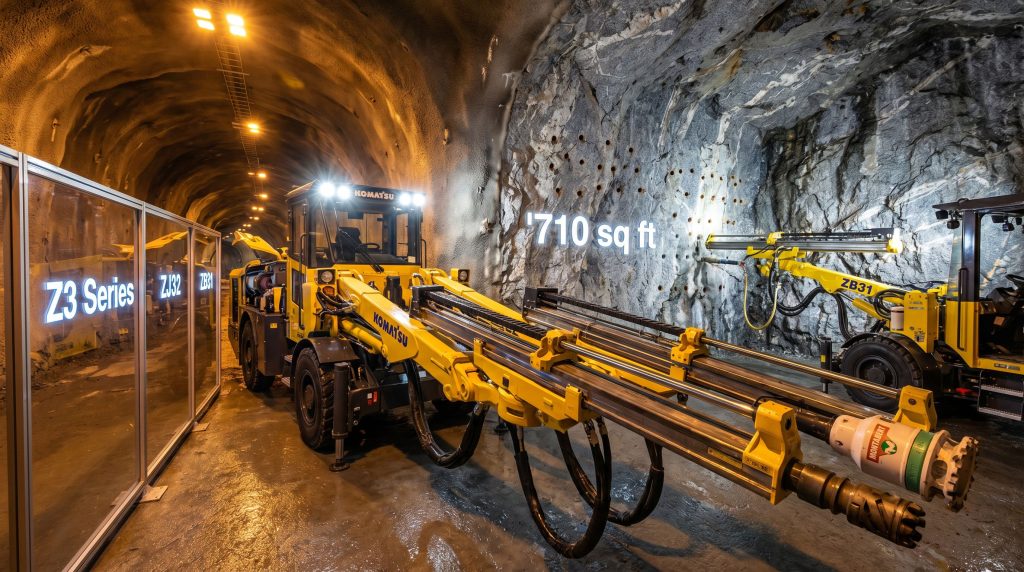
The ZJ32 is a dual-boom development jumbo configured specifically for underground hard rock face drilling. Its two booms provide a maximum face coverage area of 710 square feet (66 m²), positioning it firmly in the medium-size development class. Feed length reaches a maximum of 18 feet (5.5 m), with drill rod options spanning both 8-foot and 10-foot configurations in fixed and telescopic formats. Maximum drill depth per pass sits in the 7 to 8-foot (2.1 to 2.4 m) range, which is well suited for medium-length blast rounds in typical development tunnelling applications.
Drilling Attachment Engineering: Fewer Parts, Less Downtime
One of the most practically significant design decisions in the ZJ32 is the approach taken to its drilling attachments. Rather than pursuing maximum feature density, the engineering team prioritised mechanical simplicity, reducing the number of moving parts in the attachment system. This directly affects two measurable operational outcomes: setup time between drill holes and drifter uptime over a full operating cycle.
Fewer mechanical components mean fewer failure points. In underground environments where maintenance access is constrained and unplanned downtime translates directly into delayed blast rounds and extended heading cycle times, the reliability of drilling attachments is not a secondary consideration. It sits at the centre of productivity calculations.
Furthermore, the ZJ32 integrates Montabert drifters for percussive drilling performance, pairing the simplified attachment design with a drifter unit that carries its own established performance credentials in underground hard rock applications.
Auto-Paralleling Technology: Precision That Changes Blast Economics
The ZJ32 incorporates auto-paralleling functionality, which automatically aligns drill rods parallel to each other during face drilling operations. The maximum angular error tolerance of this system is 1 degree, a specification that carries significant consequences for blast pattern quality.
In development tunnelling, drill hole alignment directly determines:
- Blast pattern integrity: Holes that deviate from parallel disturb the designed explosive distribution across the face
- Overbreak control: Angular errors cause drill holes to exit the tunnel profile boundary, producing more rock breakage than intended and increasing mucking volumes
- Explosive efficiency: Poorly aligned patterns require blast design adjustments that typically increase powder factor and explosive cost
- Tunnel profile consistency: Overbreak in critical infrastructure tunnels creates secondary costs in ground support and concrete lining
A 1-degree maximum error tolerance represents a level of precision that meaningfully tightens all of these variables, particularly in longer development drives where cumulative alignment errors become more pronounced.
Power System and Regulatory Certification
The ZJ32 runs on a Cummins QSB4.5 engine, rated to both Tier III and Euro V emissions standards. For North American underground operations, this matters beyond environmental compliance. The machine carries certification from both MSHA (Mine Safety and Health Administration) for U.S. operations and CANMET for Canadian underground mining environments.
Dual certification is operationally important for mining companies with assets on both sides of the border, eliminating the need to manage separate equipment approval processes or maintain country-specific fleet variants.
Cabin Design and Operator Health Standards
The ZJ32 features a fully enclosed cabin certified to ROPS (Rollover Protective Structure) and FOPS (Falling Object Protective Structure) standards, reflecting the physical hazard profile of underground hard rock development environments. Engineering attention to noise and vibration reduction within the cabin also aligns with the direction that occupational health regulation is moving across major underground mining jurisdictions, where whole-body vibration and noise-induced hearing loss have become increasingly regulated health outcomes.
Komatsu ZB31 Bolter: Ground Support Engineered Into the Machine
Configuration and Bolting Versatility
Where the ZJ32 handles face drilling, the ZB31 is a single-boom bolter purpose-built for ground support installation. Its configuration allows bolting across walls, back, and face applications, providing the geometric flexibility required in variable ground conditions without requiring machine repositioning that would otherwise consume cycle time.
Compatibility with multiple bolt types and sizes is a practical necessity in hard rock mining, where ground conditions can shift significantly along a single development drive and prescribed support patterns may specify different bolt lengths or formats depending on rock mass classification outcomes.
The Jennmar J-LOK P System: Co-Developed Chemistry Meets Machine Design
The most technically distinctive feature of the ZB31 is its ground support installation system, developed in collaboration with Jennmar and centred on the J-LOK P pumpable resin. This represents an unusual departure from the conventional OEM equipment approach, where machines are designed to install bolts and a separate consumables supply chain provides the grouting materials independently.
By co-developing the machine and the resin chemistry together, Komatsu and Jennmar have integrated the chemical performance of the ground support system directly into the ZB31's operational workflow. As noted by the Canadian Mining Journal, this collaboration sets a new precedent for how underground equipment manufacturers are approaching consumables integration.
The differences between J-LOK P pumpable resin and conventional cartridge resin systems are meaningful at the productivity level:
| Performance Dimension | Traditional Cartridge Resin | ZB31 with J-LOK P System |
|---|---|---|
| Resin delivery consistency | Variable, cartridge-dependent | Metered, pumped delivery |
| Cycle time per bolt | Extended setup and insertion | Compressed through streamlined process |
| Bolt type flexibility | Often model-specific limitations | Multiple types and sizes supported |
| Manual handling intensity | Higher operator involvement | Reduced intervention required |
| Per-bolt installation cost | Higher total installation cost | Lower through process efficiency |
The co-development of a purpose-built ground support chemistry system with a specialist consumables manufacturer integrates the science of rock reinforcement directly into the machine's design logic, rather than treating the two as independent engineering problems.
In practical terms, pumpable resin systems eliminate the cartridge insertion step, deliver more consistent resin distribution within the bolt hole, and reduce the physical handling demands on operators working in confined underground spaces. For high-cycle bolting operations, these incremental time savings per bolt accumulate into material productivity gains across a full shift.
How the Z3 Series Positions Against the Competitive Field
Where the Differentiation Is Most Defensible
The underground hard rock drilling market has established players including Sandvik, Epiroc, and Atlas Copco, each with medium-class development equipment in their portfolios. The Z3 series does not compete primarily on any single specification. Instead, its differentiation is structural, resting on the combination of platform commonality, integrated ground support chemistry, and a confirmed electrification and autonomy roadmap.
| Feature Category | Z3 Series (ZJ32 / ZB31) | Typical Competitor Medium-Class |
|---|---|---|
| Platform architecture | Universal shared platform | Often model-specific design |
| Operator control standardization | Unified across ZJ32 and ZB31 | Varies by machine and model |
| Ground support system | Integrated J-LOK P co-developed resin | Bolt installation only |
| Drilling attachment design | Simplified, fewer moving parts | More complex attachment systems |
| Electrification pathway | Confirmed battery variant roadmap | Limited or unconfirmed |
| Regulatory certification | MSHA and CANMET certified | Varies by manufacturer |
Operations Where the Z3 Series Delivers Its Strongest Case
The machines are most compelling in specific operational contexts:
- Development projects running parallel headings where fleet interoperability creates scheduling and maintenance advantages
- Operations managing mixed-skill underground workforces where training programme costs are a visible line item
- Mines operating across North American jurisdictions where both MSHA and CANMET certification removes procurement friction
- Projects pursuing a phased pathway toward battery-electric or autonomous fleet deployment without requiring full capital replacement cycles
The Electrification and Autonomy Roadmap: Why Timing Matters
Battery-Electric Variants: The Ventilation Equation
Komatsu has confirmed that battery-electric variants of the Z3 series are in development and will be added to the product lineup. For underground mines, the business case for battery-electric drilling equipment extends well beyond emissions compliance.
The fundamental economics of diesel-powered underground fleets are increasingly challenged by ventilation costs. Diesel engines produce exhaust heat and particulates that require substantial airflow to dilute to safe working concentrations. In deep underground operations, ventilation infrastructure represents one of the largest single capital and operating cost categories. Battery-electric drills produce no exhaust, dramatically reducing the ventilation requirement for any development heading they operate in.
The universal platform architecture of the Z3 series simplifies the eventual engineering transition from diesel to battery power. When the driveline and electrical systems are already designed for modularity, substituting a battery power pack for a diesel engine is a substantially less complex retrofit than redesigning a machine-specific platform from scratch.
Intelligent Machine Control and the Autonomy Spectrum
The confirmed addition of intelligent machine control variants signals Komatsu's intention to position the Z3 series as a foundation for autonomous development drilling. Rather than requiring mine operators to purchase entirely new fleets when autonomous technology matures, the incremental upgrade pathway means that a diesel Z3 deployed today can evolve through semi-autonomous and eventually fully autonomous configurations as the technology and the operation are ready.
This matters for capital planning. Equipment with a defined autonomy upgrade pathway carries lower stranded asset risk than equipment that will require full replacement when automation becomes economically justified.
The next major ASX story will hit our subscribers first
Frequently Asked Questions: Komatsu ZJ32 and ZB31
What is the difference between the ZJ32 and the ZB31?
The ZJ32 is a dual-boom development jumbo face drill designed to drill blast holes into tunnel faces, offering 710 sq ft of face coverage and a maximum feed length of 18 feet. The ZB31 is a single-boom bolter focused on ground support installation across walls, backs, and faces, integrated with the Jennmar J-LOK P pumpable resin system for faster and more consistent bolt installation.
When were the ZJ32 and ZB31 officially launched?
Both machines were introduced to the market at MINExpo 2024 in Las Vegas in September 2024, with coverage published by Canadian Mining Journal on October 2, 2024.
What engine does the ZJ32 use?
The ZJ32 is powered by a Cummins QSB4.5 engine, certified to Tier III and Euro V emissions standards, with MSHA certification for U.S. underground operations and CANMET certification for Canadian mines.
Are battery-electric versions of the Z3 series confirmed?
Yes. Komatsu has confirmed that battery-electric and intelligent machine control variants will be added to the Z3 product family, though specific launch timelines and technical specifications have not yet been publicly disclosed.
What makes the J-LOK P system different from standard bolting?
J-LOK P is a pumpable resin co-developed by Komatsu and Jennmar that delivers resin through a metered pumping system rather than manual cartridge insertion. This produces more consistent resin distribution, compresses bolt installation cycle times, and reduces the manual handling burden on underground operators compared to conventional cartridge-based ground support methods.
Which regulatory certifications do the ZJ32 and ZB31 carry?
Both machines are certified to MSHA standards for United States underground mining operations and CANMET standards for Canadian underground mining environments.
Key Takeaways for Mining Equipment Decision-Makers
The Komatsu ZJ32 face drill and ZB31 bolter collectively represent a coherent argument for fleet-level thinking in underground hard rock development. The individual specifications of each machine are competitive within their respective categories, but the more durable case rests on the architecture that connects them.
- Universal platform design reduces spare parts complexity and total fleet maintenance costs across both models
- Standardized operator controls accelerate workforce flexibility and compress training programme timelines
- J-LOK P co-developed ground support delivers measurable cycle time improvements over conventional bolting methods
- Auto-paralleling precision at 1-degree maximum error improves blast pattern accuracy and reduces overbreak-related costs in development tunnelling
- Dual MSHA and CANMET certification removes procurement friction for operators with North American multi-jurisdictional portfolios
- Confirmed battery-electric and autonomy roadmap positions the Z3 series as a capital investment with a defined upgrade pathway rather than a technology endpoint
For operations evaluating medium-class underground development equipment, the Z3 series asks a different question than most of its competitors. Rather than competing on a single performance dimension, it asks whether the fleet, as a system, can be made more productive, more maintainable, and more adaptable to the technological changes that are already reshaping underground mining economics.
This article contains references to product specifications and forward-looking roadmap information sourced from Komatsu product announcements and coverage by Canadian Mining Journal (October 2, 2024). Readers evaluating purchasing decisions should verify current technical specifications directly with Komatsu Mining. Forward-looking statements regarding battery-electric and autonomous variants represent stated manufacturer intentions and should not be interpreted as confirmed delivery commitments or guaranteed performance outcomes.
Want to Know Which ASX Mining Companies Are Making the Next Big Discovery?
While the Komatsu Z3 series redefines what integrated underground fleet systems can deliver, the real opportunity for investors lies in identifying the exploration and mining companies adopting transformative technologies and uncovering significant new mineral deposits before the broader market catches on. Powered by its proprietary Discovery IQ model, Discovery Alert delivers real-time ASX mineral discovery alerts, turning complex announcement data across 30-plus commodities into immediate, actionable insights — explore the historic returns major discoveries have generated and begin your 14-day free trial today to position yourself ahead of the market.