June 16, 2026
Small modular reactors represent a fundamental shift in nuclear technology deployment, requiring specialised materials engineered to withstand extreme operational conditions. The pursuit of carbon-neutral baseload power generation has intensified focus on reactor designs that demand ultra-high purity graphite components for neutron moderation systems. Furthermore, Kookaburra graphite for small modular reactors presents a significant opportunity for Australian resource development in this emerging market.
Nuclear-Grade Graphite Specifications for HTGR Systems
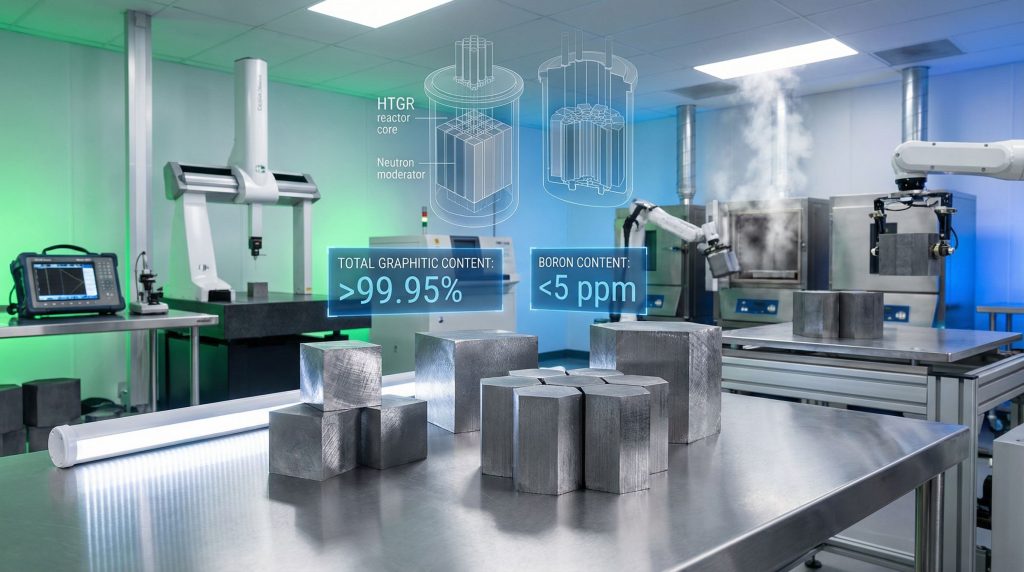
High-temperature gas-cooled reactor technology relies on precisely engineered graphite blocks to control neutron flux within reactor cores. These applications demand exceptional material purity levels exceeding 99.95% total graphitic carbon content, with stringent controls over neutron-absorbing impurities that could compromise reactor performance.
The operational environment within HTGR systems subjects graphite moderators to sustained temperatures approaching 1,000°C while maintaining structural integrity over multi-decade service lives. Moreover, material specifications must address thermal expansion characteristics, dimensional stability under irradiation, and resistance to oxidation in helium coolant environments.
Critical Material Properties for SMR Applications
| Property | Specification | Application Requirement |
|---|---|---|
| Total Graphitic Content | >99.95% | Neutron moderation efficiency |
| Boron Content | <5 ppm | Minimised neutron absorption |
| Thermal Conductivity | >100 W/m·K | Heat dissipation capability |
| Compressive Strength | >70 MPa | Structural load bearing |
| Density | 1.7-1.9 g/cm³ | Neutron physics optimisation |
Nuclear-grade graphite blocks undergo precision machining to achieve dimensional tolerances within ±0.1mm, ensuring proper assembly within reactor core geometries. Consequently, manufacturing processes incorporate isostatic pressing techniques that produce uniform density distributions essential for consistent neutron moderation properties.
These stringent specifications align closely with established nuclear waste disposal standards, reflecting the industry's commitment to safety across all nuclear applications.
When big ASX news breaks, our subscribers know first
Australian Resource Development for Nuclear Applications
South Australia's Eyre Peninsula hosts graphite deposits exhibiting favourable characteristics for nuclear-grade processing applications. The Kookaburra project, located approximately 35 km north of Port Lincoln, contains a 12.8-million-tonne resource grading 7.56% total graphitic carbon.
Near-surface mineralisation reduces extraction complexities compared to deep underground operations, while regional geology minimises contamination from sulfur-bearing phases that complicate downstream purification processes. Additionally, testwork conducted during 2024 demonstrated purification capabilities achieving greater than 99.95% total graphitic content, meeting preliminary nuclear-grade specifications.
Economic Viability Assessment
Pre-feasibility study results completed in 2024 outlined project economics including:
• 16-year mine life based on current resource definition
• $29 million upfront capital expenditure for processing facility development
• $114 million after-tax net present value at base case assumptions
• Near-term development pathway through existing infrastructure access
The collaboration between Lincoln Minerals and StarCore Nuclear establishes a 12-month assessment framework for technical suitability evaluation. However, potential feasibility studies target completion by end of calendar year 2026.
This development aligns with Australia's broader critical minerals strategy, positioning graphite as a key component in the nation's resource portfolio.
SMR Technology Market Dynamics
Small modular reactor deployment addresses critical gaps in clean energy infrastructure, providing 50-300 MW capacity units suitable for distributed power generation applications. These systems offer enhanced safety features through passive cooling mechanisms and inherent design characteristics that reduce operational risks compared to conventional large-scale nuclear facilities.
Global energy transition requirements drive demand for reliable baseload power generation that complements intermittent renewable energy sources. In addition, SMRs provide carbon-free electricity generation operating continuously, addressing grid stability challenges as solar and wind capacity deployment accelerates worldwide.
Target Market Applications
Primary deployment opportunities for SMR technology include:
• Remote mining operations requiring reliable power independent of grid infrastructure
• Northern communities in Canada and similar jurisdictions lacking transmission connectivity
• Industrial facilities demanding consistent power supply for process operations
• Island nations seeking energy security through diversified generation portfolios
According to Lincoln Minerals CEO Chris Wilcox, global investment in nuclear energy continues increasing to meet growing energy demands while reducing reliance on carbon-emitting energy sources. Furthermore, SMRs offer reliable, always-on clean energy that fills gaps when solar and wind generation falls short, helping prevent shortages and stabilise electricity prices.
The market dynamics for Kookaburra graphite for small modular reactors are influenced by evolving uranium market strategies and overall nuclear sector growth.
Advanced Processing Technologies for Nuclear-Grade Purity
Achieving nuclear-grade graphite specifications requires sophisticated processing methodologies incorporating multiple purification stages. Primary concentration through flotation separation typically achieves 93-98% total graphitic content, providing feedstock for subsequent thermal and chemical treatment processes.
Multi-Stage Purification Pathway
Stage 1: Mineral Processing
- Crushing and grinding to optimise liberation characteristics
- Flotation concentration using selective reagent chemistry
- Dewatering and preparation for thermal treatment
Stage 2: Thermal Purification
- High-temperature treatment in controlled atmosphere furnaces
- Sublimation of volatile impurity compounds
- Crystallographic structure optimisation
Stage 3: Chemical Refinement
- Acid leaching for metallic impurity dissolution
- Multi-stage washing and filtration systems
- Final product characterisation and quality verification
Production Scale Economics
| Production Scale | Annual Capacity | Capital Investment | Operating Cost Range |
|---|---|---|---|
| Pilot Operations | 1,000 tonnes | $15-20 million | $800-1,200/tonne |
| Commercial Scale | 5,000 tonnes | $40-60 million | $600-900/tonne |
| Industrial Scale | 15,000 tonnes | $100-150 million | $400-700/tonne |
These processing advances reflect broader trends in mining technology evolution, demonstrating how traditional mineral processing adapts to meet specialised nuclear applications.
Regulatory Framework and Certification Requirements
Nuclear-grade graphite suppliers must obtain comprehensive certification from national nuclear regulatory authorities, demonstrating consistent material properties across production batches. Quality management systems require compliance with ISO 19443 nuclear quality assurance standards and complete traceability protocols from raw material extraction through final product delivery.
International Standards Compliance
Key regulatory frameworks governing nuclear-grade graphite include:
• ASTM D7219 – Standard Specification for Isotropic and Near-Isotropic Nuclear Graphites
• ISO 12185 – Nuclear-grade graphite requirements and test methods
• ASME Section III – Nuclear component design and manufacturing standards
• Nuclear regulatory authority – Material qualification and supply chain verification
Certification processes require demonstration of material performance under simulated reactor conditions. Consequently, this includes thermal cycling tests, irradiation behaviour assessment, and long-term dimensional stability verification.
Supply Chain Infrastructure Development
Nuclear-grade graphite requires specialised transportation and handling protocols maintaining product purity throughout the supply chain. Packaging systems must prevent contamination while providing complete documentation for chain of custody requirements governing nuclear materials.
Logistical Considerations
Strategic supply chain development incorporates:
• Geographic diversification reducing supply concentration risks
• Inventory management supporting reactor maintenance scheduling requirements
• Supplier qualification through rigorous vendor approval processes
• Long-term contracting providing stable pricing and delivery arrangements
Individual SMR units require approximately 200-500 tonnes of nuclear-grade graphite blocks, depending on reactor design specifications and power output ratings. Moreover, commercial-scale SMR deployment programmes could demand 5,000-10,000 tonnes annually across multiple reactor installations.
The growing critical minerals demand encompasses nuclear-grade graphite as utilities worldwide adopt SMR technology for clean energy generation.
The next major ASX story will hit our subscribers first
Market Outlook and Development Timeline
Global SMR deployment trajectories suggest substantial expansion in nuclear-grade graphite demand through the next decade. Current production capacity remains concentrated amongst established suppliers, creating opportunities for new entrants capable of meeting stringent quality requirements.
The collaboration between Lincoln Minerals and StarCore Nuclear represents a pathway to commercialise Australian graphite resources for high-value nuclear applications. According to Mining Weekly, both parties will work collaboratively to identify cooperation opportunities, including potential graphite supply arrangements and technical suitability assessment through continued testwork.
However, the development of Kookaburra graphite for small modular reactors requires careful evaluation of market conditions and technical requirements. Small Caps reports that Lincoln Minerals will further investigate SMR graphite opportunities for the Kookaburra project through this strategic partnership.
What Are the Key Development Milestones?
The agreement establishes collaborative frameworks for the next 12 months, during which parties will align on project development parameters including flowsheet design, product mix and potential commercial structures. Furthermore, binding arrangements remain subject to due diligence, metallurgical testwork, feasibility studies and definitive agreement execution.
Industry Insight: StarCore Nuclear develops SMRs based on high-temperature gas-cooled reactor technology, targeting small-scale, safe and carbon-free power supply to remote communities in Canada and internationally. Additionally, high-purity graphite blocks moderate nuclear reactions, improving stability and safety during long-term reactor operation.
The technical assessment programme includes comprehensive evaluation of the Kookaburra deposit's suitability for nuclear applications. Subsequently, this involves detailed mineralogical characterisation, processing testwork, and product specification validation against SMR requirements.
Disclaimer: This analysis contains forward-looking statements regarding SMR market development, graphite demand projections, and project development timelines. Actual results may vary based on technological advancement, regulatory approvals, and market conditions. Investment decisions should consider comprehensive due diligence and professional financial advice.
Looking to Capitalise on Nuclear Energy's Growth?
Discovery Alert's proprietary Discovery IQ model delivers real-time alerts on significant mineral discoveries across critical sectors including nuclear materials, instantly empowering subscribers to identify actionable opportunities ahead of the broader market. Understand why major discoveries can lead to substantial returns by exploring Discovery Alert's dedicated discoveries page, showcasing historic examples of exceptional outcomes, and begin your 30-day free trial today to position yourself ahead of the market.